
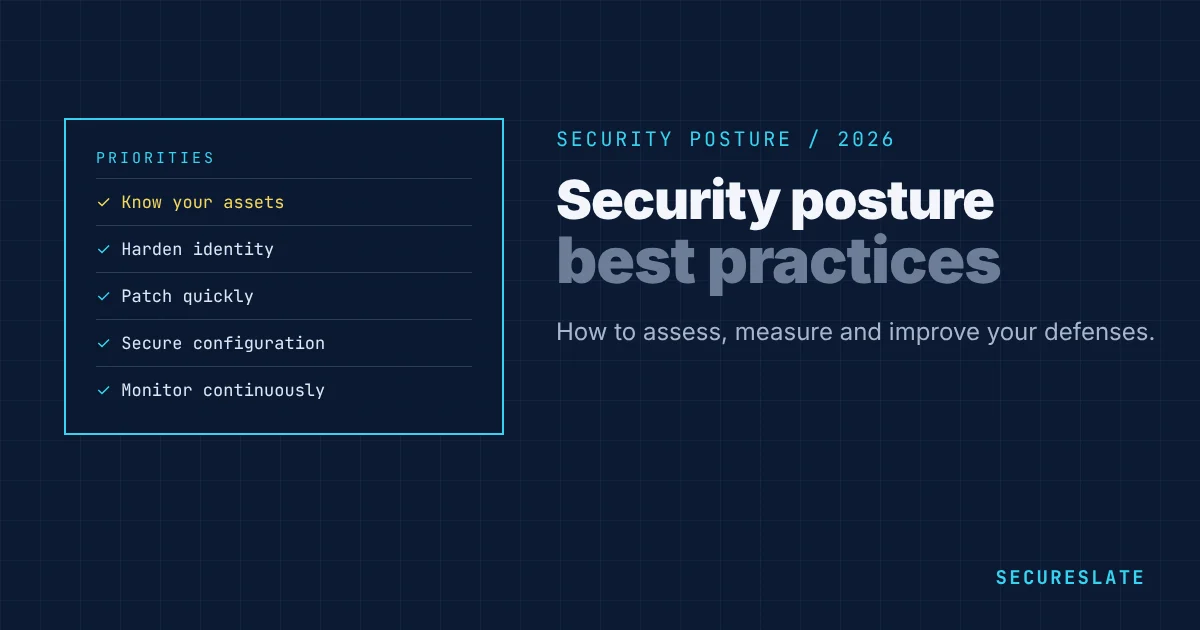
Security posture best practices help you answer a simple question leadership and customers keep asking: how secure are we right now? Security posture is the overall strength of an organization's defenses: its people, processes, technology and ability to prevent, detect and respond to threats. A strong posture is not a single product or certificate. It is visible inventory, sound configuration, controlled access, fast patching, tested response and continuous monitoring. This guide explains how to assess your posture, which metrics matter and a prioritized set of practices to improve it.
Related guides: Identity risk · Penetration testing best practices · Risk vs vulnerability scanning · Cloud security audit
Key takeaways
- Security posture covers assets, configurations, identities, vulnerabilities, vendors and response capability.
- You cannot protect what you cannot see. Inventory is the first step.
- Measure posture with a small set of clear metrics reviewed regularly.
- Prioritize identity, patching, configuration and backups, which stop most common attacks.
- Move from periodic checks to continuous posture monitoring so drift is caught quickly.
What makes up security posture
| Component | What it includes |
|---|---|
| Asset visibility | Inventory of devices, cloud resources, applications, data and vendors |
| Attack surface | Internet-facing systems, domains, APIs and exposed services |
| Identity and access | Authentication strength, privileges, account lifecycle |
| Vulnerability management | Scanning, patching speed, end-of-life software |
| Configuration | Secure baselines for cloud, endpoints and SaaS |
| Data protection | Classification, encryption, backup, retention |
| Detection and response | Logging, alerting, incident response readiness |
| Third parties | Vendor security and access |
| People | Training, awareness and security culture |
| Governance | Policies, risk management, compliance status |
How to assess your security posture
- Build an inventory of assets, users, vendors and data stores from authoritative sources such as cloud APIs, MDM and HR.
- Map the attack surface with external scanning of domains, IPs and applications.
- Benchmark configurations against CIS Benchmarks or your framework's controls.
- Scan for vulnerabilities across infrastructure, applications and dependencies.
- Review identities for MFA, admin rights and inactive accounts.
- Test response with a tabletop exercise or incident simulation.
- Review vendors handling sensitive data.
- Compare against a framework such as NIST CSF 2.0, CIS Controls v8.1 or ISO 27001 to find gaps.
- Run a penetration test to see how an attacker would chain weaknesses.
- Score and prioritize findings by risk.
Metrics that show posture
| Metric | Why it matters |
|---|---|
| Percentage of assets inventoried and managed | Unmanaged assets are blind spots |
| MFA coverage | Stops most credential attacks |
| Critical vulnerabilities past target fix time | Exposure window |
| Mean time to remediate by severity | Speed of response to known risk |
| Cloud misconfigurations open | Direct exposure in cloud environments |
| Devices with encryption and current OS | Endpoint hygiene |
| Backup restore test success | Ransomware resilience |
| Training completion and phishing click rate | Human risk |
| Critical vendors with current reviews | Supply chain risk |
| Control test pass rate | Overall compliance health |
Pick eight to ten, track them monthly and report trends to leadership.
Best practices to improve security posture
1. Know your assets
Automate inventory from cloud, identity, MDM and code systems. Assign an owner to every important asset.
2. Harden identity
Enforce MFA everywhere, adopt phishing-resistant MFA for admins, remove standing admin rights and automate offboarding.
3. Patch and update quickly
Set fix targets by severity, such as 15 days for critical and 30 days for high, and prioritize vulnerabilities known to be exploited, such as those in CISA's Known Exploited Vulnerabilities catalog. Replace end-of-life software.
4. Use secure configurations
Define baselines for cloud accounts, endpoints and SaaS tools, deploy them through code or policies, and detect drift automatically.
5. Reduce the attack surface
Remove unused services, close management ports to the internet, retire forgotten subdomains and review public storage.
6. Protect data
Classify data, encrypt it at rest and in transit, limit who can access sensitive stores and set retention rules.
7. Back up and test recovery
Keep backups separate and protected from deletion, and test restores regularly.
8. Log and monitor
Centralize logs from identity, cloud, endpoints and key applications. Alert on high-risk events and review alerts promptly.
9. Prepare for incidents
Maintain an incident response plan, define roles, and run at least one tabletop exercise per year.
10. Manage third parties
Tier vendors by risk, review critical vendors yearly and limit vendor access.
11. Train people
Run regular, short security training and phishing simulations, and make it easy to report suspicious activity.
12. Monitor continuously
Replace yearly snapshots with continuous control monitoring, so you know when posture slips.
Security posture management tools
| Tool type | Focus |
|---|---|
| CSPM and CNAPP | Cloud configuration and workload risk |
| SSPM | SaaS application settings |
| ASPM | Application security findings across the development lifecycle |
| External attack surface management | Internet-facing exposure |
| Identity security posture management | Identity configuration and privilege |
| Compliance automation platforms | Control monitoring across cloud, identity, devices and vendors, mapped to frameworks |
Small companies often get the most value from a compliance automation platform that combines many of these checks with audit-ready evidence.
Security posture and compliance
Compliance frameworks are a useful structure for posture, but passing an audit does not guarantee a strong posture. Use frameworks such as SOC 2 and ISO 27001 as a baseline, then focus on the metrics above to make sure controls actually reduce risk day to day.
Reporting posture to leadership
Leaders want a clear answer: are we getting better or worse, and what do you need? Give a one-page summary with a short overall rating, three to five metrics with trends, top risks and their status, and decisions or budget needed. Avoid raw counts without context, such as "4,000 vulnerabilities," and explain impact in business terms.
Security posture maturity levels
| Level | Description |
|---|---|
| Reactive | Security handled when something breaks; little inventory or monitoring |
| Basic | Core controls such as MFA, antivirus and backups in place; checks are manual |
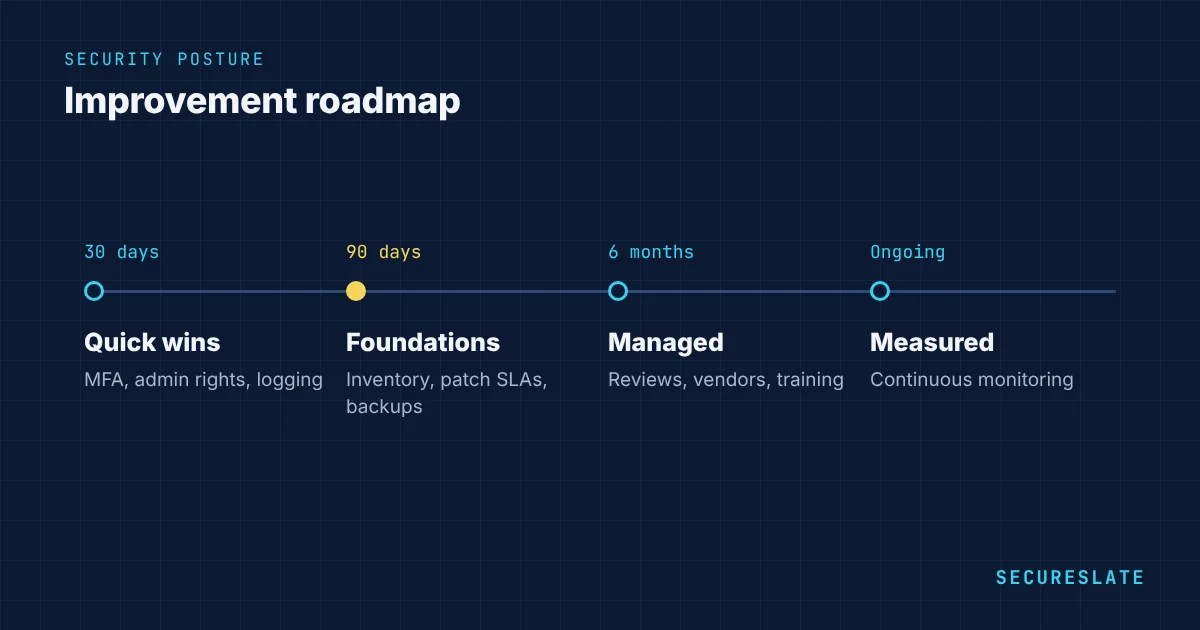
| Managed | Defined policies, regular scanning and patching targets, quarterly access reviews |
| Measured | Metrics tracked and reported; continuous monitoring of key controls |
| Optimized | Automation for detection and remediation; posture improves with each incident and audit |
Most small companies move from basic to managed within a year by focusing on identity, patching, configuration and backups, then reach measured by adding continuous monitoring and metrics.
Quick wins for the next 30 days
- Turn on MFA for every application through SSO
- Remove admin rights that are not needed every day
- Close any management ports open to the internet
- Enable audit logging in every cloud account and region
- Test restoring one critical backup
- Run an external scan of your domains and fix exposed services
How SecureSlate helps
SecureSlate gives small and mid-size teams continuous visibility of their security posture. It monitors AWS and Google Cloud configurations, identity and MFA, devices through the device agent, external attack surface, outdated and end-of-life software, code and secrets, and vendors, then maps everything to SOC 2, ISO 27001 and other frameworks with dashboards leadership can read.
FAQ
What is security posture?
The overall strength of an organization's cybersecurity, including its assets, controls, processes and ability to prevent, detect and respond to threats.
How do you assess security posture?
Inventory assets, map the attack surface, check configurations and identities, scan for vulnerabilities, test response, review vendors and compare against a framework.
What is the difference between security posture and compliance?
Compliance shows you meet a framework's requirements at audit time. Security posture is your actual, current ability to resist and respond to attacks.
How often should security posture be assessed?
Continuously for technical controls, with formal reviews at least quarterly and a broader assessment yearly.
What is security posture management?
Tools and processes that continuously monitor configurations, identities and exposures to keep security posture strong.
What is a security posture score?
A summary number or rating that combines control results, such as configuration checks, vulnerabilities and identity metrics, into one view. It is useful for trends, but always look at the underlying metrics before making decisions.
Disclaimer (legal note)
This article is for general information only and is not legal, regulatory, or professional advice. Requirements vary by framework, industry, and jurisdiction. Consult qualified advisors for your specific obligations.
Need compliance without the complexity?
SecureSlate automates ISO 27001, SOC 2, GDPR, HIPAA, and more. Built for growing teams. See it in action.
Find compliance gaps in 30 seconds