
Identity risk is the chance that a user, service or machine identity is misused to access systems or data it should not. Stolen passwords, phishing, excessive permissions, forgotten accounts and leaked API keys all create identity risk. Because most modern attacks start by logging in rather than breaking in, identity has become the main security perimeter for cloud-first companies. This guide explains the sources of identity risk, how to measure it, the controls that reduce it and how it maps to compliance frameworks such as SOC 2 and ISO 27001.
Related guides: Access control policy · Risk register · Security posture best practices · Best access control software
Key takeaways
- Identity risk covers human users, service accounts, API keys and machine identities.
- The biggest drivers are weak or missing MFA, excessive privilege, orphaned accounts and exposed credentials.
- Non-human identities often outnumber people and are less monitored.
- Reduce risk with strong authentication, least privilege, lifecycle automation, access reviews and monitoring.
- Measure identity risk with clear metrics such as MFA coverage, privileged account count and time to deprovision.
Why identity risk matters
Industry breach reports, such as the Verizon Data Breach Investigations Report, consistently find that stolen credentials and phishing are among the most common ways attackers get in. In cloud and SaaS environments, a valid login often gives direct access to data, with no network barrier in between. A single compromised admin account can expose an entire cloud account, code repository or customer database. Identity is also central to compliance: auditors test access controls more than almost any other area.
Sources of identity risk
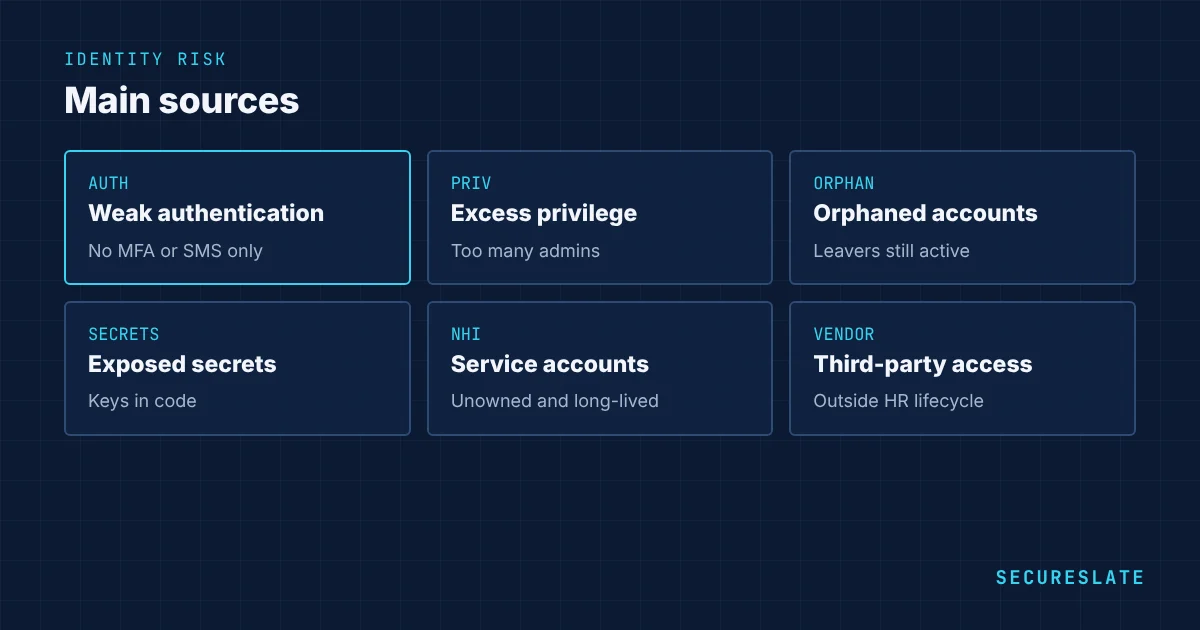
| Source | Example | Why it is risky |
|---|---|---|
| Weak authentication | Passwords only, SMS codes, MFA not enforced for all apps | Easy to phish or reuse stolen passwords |
| Excessive privilege | Everyone in engineering is a cloud admin | Bigger blast radius if one account is compromised |
| Orphaned accounts | Former employees or contractors still active | Unmonitored access paths |
| Shared accounts | One login used by a whole team | No accountability, hard to revoke |
| Exposed secrets | API keys in code or chat | Direct access without MFA |
| Unmanaged service accounts | Old integrations with broad permissions | Rarely reviewed, often long-lived |
| Third-party access | Vendors and contractors with standing access | Outside your HR lifecycle |
| Session hijacking | Stolen session tokens or cookies | Bypasses MFA after login |
| Privilege creep | Users keep access from old roles | Accumulates silently over time |
Human and non-human identities
Human identities are employees, contractors and partners. Non-human identities include service accounts, workload identities, API keys, OAuth tokens, bots, CI/CD pipelines and AI agents. Non-human identities often have broad permissions, never use MFA and are created by developers without central tracking. Managing identity risk now means inventorying both, assigning owners to non-human identities and rotating or removing credentials that are not needed.
How to measure identity risk
| Metric | Target example |
|---|---|
| MFA coverage for all users | 100% |
| Phishing-resistant MFA for admins | 100% |
| Number of users with admin rights | As small as practical; reviewed monthly |
| Accounts inactive for 90 days | Zero, or disabled |
| Time to deprovision leavers | Same day |
| Access reviews completed on time | 100% |
| Long-lived access keys older than 90 days | Zero |
| Secrets detected in code repositories | Zero open |
Controls that reduce identity risk
Strong authentication
Enforce MFA everywhere through single sign-on. Use phishing-resistant methods such as FIDO2 security keys or passkeys for administrators and high-risk users. Block legacy authentication protocols that bypass MFA.
Least privilege and role-based access
Grant access based on roles, start with the minimum and add only what is needed. Separate admin accounts from daily accounts. Use just-in-time elevation for privileged tasks instead of standing admin rights.
Lifecycle automation
Connect the HR system to the identity provider so joiners get standard access automatically, movers lose old access, and leavers are disabled immediately.
Access reviews
Have managers and system owners review who has access at least quarterly for sensitive systems. Remove access that is not needed and keep records.
Secrets management
Store credentials in a secrets manager, scan code and repositories for exposed secrets, rotate keys and prefer short-lived tokens and workload identity federation over static keys.
Monitoring and detection
Alert on risky sign-ins, impossible travel, MFA fatigue patterns, new admin grants and disabled logging. Identity threat detection and response (ITDR) tools focus specifically on these signals.
Third-party access control
Give vendors named accounts with time limits, MFA and monitoring. Review vendor access as part of vendor risk management.
Identity risk in compliance frameworks
| Framework | Relevant requirements |
|---|---|
| SOC 2 | CC6.1 to CC6.3 logical access, provisioning, removal and reviews |
| ISO 27001:2022 | Annex A 5.15 to 5.18 access control and identity management, 8.2 privileged access, 8.5 secure authentication |
| HIPAA Security Rule | Unique user identification, access control and audit controls |
| PCI DSS v4.0.1 | Requirements 7 and 8 on access and authentication, including MFA into the cardholder data environment |
| NIST CSF 2.0 | PR.AA identity management, authentication and access control |
Identity risk reduction roadmap
| Timeframe | Actions |
|---|---|
| First 30 days | Enforce MFA on all apps via SSO; remove obvious orphaned accounts; list admins |
| 30 to 90 days | Automate joiner, mover and leaver; start quarterly access reviews; scan for secrets |
| 90 to 180 days | Phishing-resistant MFA for admins; just-in-time privileged access; inventory service accounts |
| Ongoing | Monitor risky sign-ins; review metrics monthly; rotate credentials |
Common mistakes
- Enforcing MFA in the identity provider but leaving apps that bypass SSO
- Ignoring service accounts and API keys because they are not people
- Running access reviews where managers approve everything without looking
- Keeping admin rights for convenience
- Offboarding that depends on a manual checklist
Example identity risk scenarios
MFA fatigue. An attacker with a stolen password sends repeated push notifications until an employee approves one. Number matching or phishing-resistant MFA, plus alerts on repeated denied pushes, stop this.
Forgotten contractor. A contractor's account stays active six months after the project ends, and the password appears in a public breach. Automated expiry for contractor accounts and quarterly access reviews would have removed it.
Leaked cloud key. A developer commits an access key to a public repository. Automated bots find it within minutes and start mining cryptocurrency. Secrets scanning before push, short-lived credentials and alerts on unusual usage limit the damage.
Privilege creep. An engineer who moved to a sales engineering role still has production database access. Mover workflows and role-based access remove old permissions automatically.
Who owns identity risk?
Identity risk crosses teams. IT or security usually owns the identity provider and policies, HR owns the employment lifecycle that triggers changes, managers and system owners approve and review access, and engineering owns service accounts and secrets. Record these responsibilities in the access control policy and the risk register so nothing falls between teams.
How SecureSlate helps
SecureSlate reduces identity risk for small and mid-size teams. It continuously checks MFA, admin roles and inactive accounts across your identity provider and cloud accounts, runs access reviews with recorded decisions, flags exposed credentials through secrets detection, and monitors leaked employee credentials with dark web monitoring. Evidence feeds directly into SOC 2 and ISO 27001.
FAQ
What is identity risk?
The risk that a human or machine identity is compromised or misused to access systems or data it should not.
What are the biggest identity risks?
Weak or missing MFA, excessive privileges, orphaned accounts, exposed credentials and unmanaged service accounts.
How do you reduce identity risk?
Enforce strong MFA, apply least privilege, automate account lifecycle, review access regularly, manage secrets and monitor for risky sign-ins.
What are non-human identities?
Service accounts, API keys, tokens, workloads, bots and other machine identities that access systems without a person logging in.
Is identity risk part of SOC 2?
Yes. SOC 2 logical access criteria cover authentication, provisioning, removal and review of user and system access.
What is identity threat detection and response?
ITDR tools and practices focus on detecting and responding to attacks on identity systems, such as credential theft, privilege escalation and suspicious changes in the identity provider.
Disclaimer (legal note)
This article is for general information only and is not legal, regulatory, or professional advice. Requirements vary by framework, industry, and jurisdiction. Consult qualified advisors for your specific obligations.
Need compliance without the complexity?
SecureSlate automates ISO 27001, SOC 2, GDPR, HIPAA, and more. Built for growing teams. See it in action.
Find compliance gaps in 30 seconds