
Photo by Zulfugar Karimov on Unsplash: security software on screen (Unsplash License).

Related guides:
- your guide to soc 2 audits
- the ultimate iso 27001 guide
- us data privacy compliance checklist
- the best user access review tools
- a user access review template
- how to perform quarterly access reviews
Need access control evidence for an audit? SecureSlate access reviews connect to your identity provider and apps, run quarterly reviews with managers and store the evidence auditors ask for under SOC 2 and ISO 27001.
Key takeaways
- What is Access Control Software: Access control software is a digital access control solution that regulates access to physical and digital environments.
- Why Access Controls Matter in 2026: In 2026, security challenges are more complex than ever.
- What to Look for in Access Control Software: Before diving into the top 10, let’s quickly break down the key factors that organizations evaluate when choosing an access control solution.
Access control software decides who can enter which buildings, rooms and systems, and records every attempt. This guide compares the 10 best access control software options for 2026, covering physical access control (doors, badges and biometrics) and logical access control (identities, apps and data), so you can shortlist the right type for your organization.
In 2026, security is evolving faster than ever. Gone are the days when a lock and key were enough to protect a business. Today, organizations face a complex mix of cyber threats, insider risks, compliance challenges, and physical breaches. To stay ahead, businesses are turning to modern access control software and upgrading legacy access control systems into unified, software-driven security programs.
Investing in the right access control software is no longer optional. According to a 2024 Gartner survey, 73% of enterprises now integrate access control with video surveillance, alarms, and other security systems, highlighting the industry’s shift toward unified, intelligent platforms.
With the global access control market projected to surpass $20 billion by 2026, it’s clear that organizations of all sizes are prioritizing smart access management.
What is Access Control Software?
Access control software is a digital access control solution that regulates access to physical and digital environments. It ensures that authorized individuals can access the areas or systems they need, while preventing unauthorized access. In practice, this often functions as management software for access control systems, defining policies, issuing credentials, and logging access events across your security system.
Modern access control software combines multiple technologies and intelligence layers, creating a comprehensive security ecosystem.
Key features include:
- Authentication Methods: Multi-factor authentication using cards, PINs, biometrics, or mobile credentials.
- User Management: Granular permissions based on role, department, or location.
- Monitoring and Alerts: Real-time dashboards and notifications for suspicious activity.
- System Integration: Seamless connections with video surveillance, intrusion detection, and IT platforms like Active Directory.
- Deployment Options: Cloud-based solutions for flexibility or on-premises installations for regulated industries.
- Analytics and AI: Predictive algorithms that detect abnormal access patterns and enhance security planning.
Why Access Controls Matter in 2026
In 2026, security challenges are more complex than ever. Organizations are no longer just protecting physical premises. They must also safeguard sensitive data, digital assets, and hybrid work environments. This makes access control software a critical component of any modern security strategy.
- Protect Against Modern Threats: Safeguards physical spaces and digital assets from cyberattacks, insider risks, and unauthorized access.
- Ensure Compliance: Supports regulations like HIPAA, GDPR, and ISO 27001 with detailed logs and audit-ready reports.
- Unified Security Ecosystems: Integrates with video surveillance, intrusion detection, and AI analytics for centralized monitoring.
- Adapt to Hybrid Work: Enables contextual access based on location, device, or time for remote and office-based employees.
- Boost Operational Efficiency: Automates credentialing, visitor management, and mobile access to reduce administrative workload.
- Future-Ready Security: Leverages AI, biometrics, and predictive analytics to anticipate risks and respond proactively.
What to Look for in Access Control Software
Before diving into the top 10, let’s quickly break down the key factors that organizations evaluate when choosing an access control solution:
- Scalability : Can it handle hundreds, or even millions, of users?
- Integration : Does it sync with video surveillance, alarms, or IT systems like Active Directory?
- User Experience : How intuitive is the platform for admins and employees?
- Authentication Methods : Support for cards, biometrics, mobile credentials, and multi-factor authentication.
- Cloud vs. On-Premises : Cloud offers flexibility, while on-prem is preferred for highly regulated industries. If you want easier rollout across sites, look for a cloud based platform that can integrate access control across doors, apps, and devices.
- Analytics and AI : Modern solutions now predict and flag suspicious behavior.
- Cost Transparency : Pricing models vary from per-door to per-user to enterprise-wide licensing.
With these factors in mind, let’s explore the leading platforms shaping the future of secure access.
10 Best Access Control Software in 2026
1. SecureSlate: Identity & Access Governance for Compliance
SecureSlate is a strong choice for organizations that need to govern identity and access in line with compliance. It offers a streamlined approach to access policies, role-based controls, and audit-ready evidence for standards like ISO 27001, SOC 2, and HIPAA, so you can prove who has access to what and how it’s managed.
Key Highlights:
- Simplifies access control policies and compliance with ISO 27001, SOC 2, HIPAA, and more.
- Role-based access and audit trails for who accessed what and when.
- Reduces audit preparation time with continuous monitoring and evidence collection.
- Automates compliance workflows and integrates with existing tech stacks.
- Affordable plans starting at $224/month, billed annually, for growing teams.
Best For: Startups, SMBs, and mid-market companies that need identity and access governance tied to compliance, without enterprise pricing.
2. LenelS2 OnGuard: The Enterprise Titan
LenelS2’s OnGuard is a global leader trusted by airports, Fortune 500 corporations, and government institutions.

Key Highlights:
- Multi-factor authentication (biometrics + card or PIN)
- Integrated video management systems (VMS)
- Real-time monitoring and lockdown capabilities
- Enterprise-grade reporting and compliance support
Scalability is OnGuard’s strongest suit; it can manage over 1 million cardholders across multiple facilities. Its stability and granularity allow administrators to set access rights per user, per door, or even per event.
Pricing : Custom quotes; typically starting $25,000+ annually for enterprise deployments.
Best For: Airports, hospitals, global enterprises, and high-security government projects.
3. Honeywell Pro-Watch: Modular Powerhouse
Honeywell’s Pro-Watch stands out for its modular architecture, enabling organizations to scale up functionality without overhauling their system.
Key Highlights:
- Visitor management and badge issuance
- Tailgating detection with AI-powered alerts
- Integration with Honeywell building management systems
- Compliance-focused audit trails
The 2026 upgrade added AI-driven anomaly detection, which analyzes access patterns and automatically flags suspicious behavior.
Pricing : Starting at $10,000 for small installations, with flexible modular licensing.
Best For: Manufacturing plants, enterprises with phased growth plans.
4. Genetec Security Center: The Unified Platform
Genetec’s Security Center delivers a true unified security solution by combining access controls, video surveillance, license plate recognition, and intrusion detection into a single dashboard.

Key Highlights:
- Centralized command-and-control for multiple systems
- Cloud-native virtualization introduced in 2026
- AI-powered incident correlation (e.g., linking access events to camera feeds)
- Mobile dashboards for remote management
Pricing : Base license at around $12,000, with add-ons for video, ALPR, and analytics.
Best For: Universities, smart cities, multi-campus enterprises.
5. Brivo Onair: Cloud-First Simplicity
Brivo has become a go-to solution for cloud-first, mobile-friendly access controls. Known for its ease of use and transparent pricing, it’s perfect for agile companies.
Key Highlights:
- Mobile credentialing via smartphones and wearables
- Browser-based and mobile app administration
- Analytics dashboard with entry trends
- Strong integration with coworking and smart office tools
Pricing : Transparent, starting at $350/year per door.
Best For: Startups, SMBs, co-working hubs, and distributed offices.
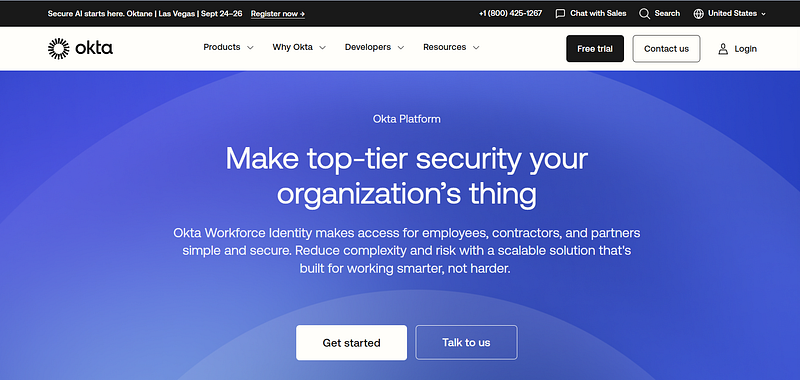
6. Okta Workforce Identity & Access Management
Traditionally an identity management giant, Okta is bridging the gap between digital and physical access. Its workforce platform enables unified management of credentials for apps, files, and doors.
Key Highlights:
- Single sign-on (SSO) plus physical door access
- Geo-fencing and contextual access
- MFA across both digital and physical environments
- Subscription-based cloud model
Pricing : From $6/user/month , with scalable enterprise packages.
Best For: Hybrid-work companies, tech firms, and digitally driven enterprises.
7. Entrust Adaptive Access: Risk-Aware Security
Entrust focuses on adaptive and risk-based access controls, making it a strong choice for highly regulated industries.
Key Highlights:
- Contextual access based on location, time, or device
- Multi-factor authentication with biometrics and cards
- Dynamic risk scoring per user activity
- Hardware integration with fingerprint scanners and secure cards
Pricing : Around $15/user/year , plus hardware.
Best For: Banks, government offices, and compliance-heavy sectors.
8. Symmetry by AMAG: Digital Twin Advantage
AMAG’s Symmetry offers robust role-based access controls and integration with intrusion detection, but its 2026 game-changer is digital twin technology.
Digital twins replicate facilities in 3D, allowing security managers to simulate changes, lockdowns, evacuations, or new access rules, before deploying them live.
Pricing : Starts at $8,000 , with advanced simulation modules in enterprise editions.
Best For: Large campuses, critical infrastructure, event venues.
9. Avigilon Access Control Manager (ACM): Analytics-Driven Security
Avigilon, part of Motorola Solutions, merges access control with AI-driven video analytics.

Key Highlights:
- Cross-referencing video with access events
- Loitering and suspicious behavior alerts
- Thermal imaging integration (ideal for healthcare and industrial safety)
- Strong ties to Motorola’s ecosystem
Pricing : Entry at $10,000 , scaling with modules.
Best For: Hospitals, retail, industrial sites.
10. Bosch Access Professional Edition (APE): Privacy-Conscious Biometrics
Bosch’s APE is built with touchless entry and strong cybersecurity controls. Its 2026 innovation: privacy-focused biometric anonymization, which allows biometric verification without storing identifiable data, critical for GDPR compliance.
Pricing : Starts around $7,000 , with per-door biometric costs.
Best For: Government offices, corporate campuses in regulated markets.
Access control software compared at a glance
| Software | Type | Deployment | Best for |
|---|---|---|---|
| SecureSlate | Logical: access reviews and identity governance for compliance | Cloud | SaaS companies that need SOC 2, ISO 27001 or HIPAA access evidence |
| LenelS2 OnGuard | Physical | On-premises and hybrid | Airports, large enterprises and government sites |
| Honeywell Pro-Watch | Physical | On-premises, modular | Organizations that want to add modules over time |
| Genetec Security Center | Physical, unified with video | On-premises and cloud | Teams that want access, video and intrusion in one dashboard |
| Brivo | Physical | Cloud | Startups, SMBs, coworking spaces and distributed offices |
| Okta Workforce Identity | Logical, with physical integrations | Cloud | Hybrid-work and tech companies |
| Entrust | Logical and physical credentials | Cloud and on-premises | Banks, government offices and regulated sectors |
| AMAG Symmetry | Physical | On-premises | Large campuses, critical infrastructure and venues |
| Avigilon ACM | Physical, with video analytics | On-premises | Hospitals, retail and industrial sites |
| Bosch Access Professional Edition | Physical, with biometrics | On-premises | Government offices and corporate campuses |
Physical vs logical access control software
Physical access control software manages doors, gates, badges, mobile credentials and biometric readers. It answers "who can enter this building or room, and when". Logical access control software manages identities and permissions in applications, cloud platforms and data. It answers "who can sign in to this system, and what can they do". Most growing companies need both: a physical system for offices and an identity provider with single sign-on and MFA for software. For audits such as SOC 2 and ISO 27001, auditors focus mainly on logical access, so you also need regular user access reviews and evidence that access is removed when people leave.
How to choose access control software
- Decide what you are protecting. Offices and server rooms need physical access control. Applications and customer data need logical access control.
- Pick cloud or on-premises. Cloud systems such as Brivo or Okta are faster to roll out and easier to manage for small teams. On-premises systems suit large or highly regulated sites.
- Check integrations with your identity provider, HR system, video surveillance and alarm systems.
- Confirm audit features: access logs, reports and evidence you can hand to auditors.
- Plan for scale: number of doors, sites and users over the next three years.
- Compare total cost, including hardware, installation, licenses and support, not just the software fee.
Conclusion
The access controls market in 2026 is diverse, serving needs from small startups to sprawling global enterprises.
- For identity & access governance tied to compliance (ISO 27001, SOC 2, HIPAA) → SecureSlate.
- If you need enterprise scale & heavy integration → LenelS2 OnGuard, Honeywell Pro-Watch, Genetec Security Center.
- For cloud-first agility → Brivo Onair, Okta Workforce Identity.
- For compliance-heavy or adaptive risk security → Entrust Adaptive Access, Avigilon ACM.
- For simulation and planning advantages → Symmetry by AMAG.
- For privacy-conscious governments → Bosch APE.
Ultimately, the right choice balances budget, scalability, integration needs, and compliance requirements. In 2026, access controls aren’t just about securing doors; they’re about creating smart, adaptive, and proactive security ecosystems.
Access control evidence for audits
Access control software decides who gets in. Auditors also want to see that access is reviewed and removed on time. SecureSlate access reviews connect to your identity provider and key apps, send quarterly reviews to managers, flag former employees and excess permissions, and store signed results as evidence for SOC 2, ISO 27001 and HIPAA.
Need a starting point first? Download the free user access review template, or start a free trial.
FAQ
What is access control software?
Access control software governs who can enter systems, applications, or physical spaces, enforcing the principle of least privilege. It is a core control for SOC 2, ISO 27001, and HIPAA.
- Logical access control manages logins, roles, and permissions for software and data.
- Physical access control manages entry to buildings and server rooms.
- Both produce logs used as compliance evidence.
What is the difference between physical and logical access control software?
Physical access control software manages entry to physical spaces (doors, badges, biometrics), while logical access control manages digital access to systems and data. Most organizations need both.
- Physical: badge readers, door controllers, visitor management.
- Logical: identity providers, SSO, role-based permissions, MFA.
- Auditors expect evidence from both for a complete access-control program.
What are the best access control tools?
The best access control tools combine strong authentication, granular role-based permissions, and detailed logging that feeds your audit evidence. Fit to your environment matters more than brand.
- Logical: Okta, Microsoft Entra ID, and other IAM/SSO platforms.
- Physical: badge and door-control systems with audit logs.
- Pair either with a compliance platform to turn access logs into review-ready evidence.
What is the best access control software for small businesses?
Cloud-based systems are usually the best fit for small businesses because they need little hardware on site and can be managed from a browser or phone. For logical access, an identity provider with single sign-on and MFA plus regular access reviews covers most needs.
Is access control software required for SOC 2?
SOC 2 does not require a specific product, but it does require controls over logical access (CC6.1 to CC6.3), including provisioning, removal and periodic reviews. Most companies use an identity provider plus an access review tool to meet and evidence these controls.
Disclaimer (legal note)
SecureSlate is not a law firm, and this article does not constitute or contain legal advice or create an attorney-client relationship. When determining your obligations and compliance with respect to relevant laws and regulations, you should consult a licensed attorney.
Need compliance without the complexity?
SecureSlate automates ISO 27001, SOC 2, GDPR, HIPAA, and more. Built for growing teams. See it in action.
Find compliance gaps in 30 seconds