
Short answer: NIST's incident response guidance is SP 800-61. The current version, Rev. 3 (April 2025), replaces the old four-phase lifecycle with a model built on the six CSF 2.0 Functions. Govern, Identify and Protect prepare you, Detect, Respond and Recover are the response itself, and lessons learned feed continuous improvement across all of them.
Related guides: Incident response plan template · NIST CSF 2.0 overview · SOC 2 incident response
Key takeaways
- NIST SP 800-61 Rev. 3 was published in April 2025 and supersedes Rev. 2 from 2012.
- Rev. 3 is a CSF 2.0 Community Profile. It treats incident response as part of cybersecurity risk management rather than a stand-alone process.
- The familiar phases still exist in spirit, but they now map to CSF Functions and Categories, so your incident response plan can share a vocabulary with the rest of your program.
- NIST moved much of the detailed, fast-changing material to an online resource page, so the PDF is shorter and less prescriptive than Rev. 2.
- For SMBs and HealthTech teams, the practical output is the same: a written plan, named roles, tested playbooks and records that prove the plan runs.
What is the NIST incident response guide?
The NIST incident response guide is Special Publication 800-61, which gives recommendations for preparing for, detecting, responding to and recovering from cybersecurity incidents. Its full current title is Incident Response Recommendations and Considerations for Cybersecurity Risk Management: A CSF 2.0 Community Profile.
The guide is voluntary for private companies. NIST states that the publication is intended for most organizations regardless of sector or size, which is why many SOC 2, ISO 27001 and HIPAA programs borrow its structure even when no contract or law names it. Federal agencies and their contractors may encounter it through other requirements, but for a typical SaaS or HealthTech company it is a reference model, not a certification.
Two things make it useful for smaller teams. First, it is free and widely recognized by auditors and enterprise security reviewers. Second, because Rev. 3 is written in CSF 2.0 terms, it lets you describe incident response in the same language you may already use for your NIST CSF checklist or risk assessment.
What changed from Rev. 2 to Rev. 3?
Rev. 3 replaced the circular four-phase lifecycle with a layered model based on CSF 2.0 Functions, and it moved detailed technical material online.
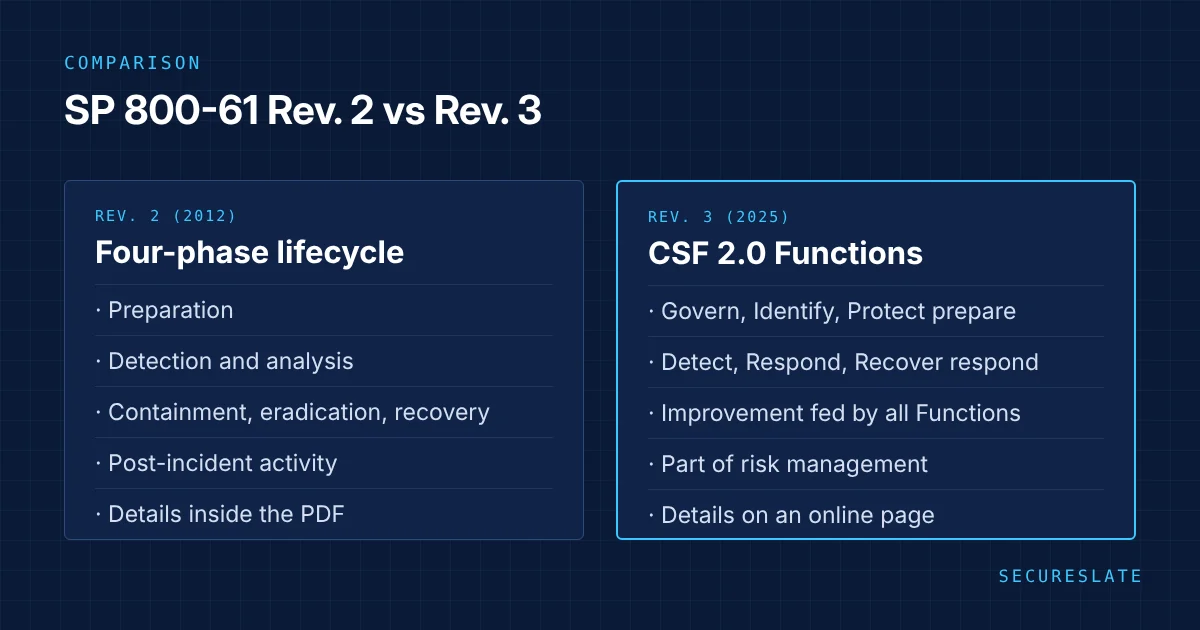
Rev. 2 described incident response as a loop: Preparation; Detection and Analysis; Containment, Eradication and Recovery; and Post-Incident Activity. That model is still widely taught, and many existing plans are organized around it. Rev. 3 keeps the intent but reorganizes it:
| Topic | Rev. 2 (2012, superseded) | Rev. 3 (April 2025) |
|---|---|---|
| Structure | Four-phase lifecycle | Six CSF 2.0 Functions in three layers |
| Preparation | One phase | Govern, Identify and Protect, described as preparation rather than response |
| Response | Detection and analysis, then containment, eradication and recovery | Detect, Respond and Recover |
| Lessons learned | Post-incident phase at the end | Improvement (ID.IM) fed by all Functions, often before recovery ends |
| Detailed guidance | Inside the PDF | Moved to NIST's incident response project page so it can be updated |
| Positioning | Computer security incident handling | Part of overall cybersecurity risk management |
The practical consequence: you do not need to throw away a plan written to Rev. 2. You need to map it to the CSF 2.0 Functions, close gaps in governance and preparation, and make sure lessons learned are captured continuously rather than only in a post-mortem weeks later.
How does incident response map to CSF 2.0?
Rev. 3 places Govern, Identify and Protect underneath incident response as preparation, Detect, Respond and Recover on top as the response itself, and Improvement in the middle.
| CSF 2.0 Function | Role in incident response | What it looks like in a small company |
|---|---|---|
| Govern (GV) | Preparation | Incident response policy approved by leadership, roles assigned, risk appetite and escalation thresholds agreed |
| Identify (ID) | Preparation and improvement | Asset inventory, data classification, risk register, and the Improvement category for lessons learned |
| Protect (PR) | Preparation | MFA, access reviews, logging, backups, training, so incidents are less likely and easier to investigate |
| Detect (DE) | Response | Alerting on cloud, identity and endpoint events, triage rules, a clear way for staff to report issues |
| Respond (RS) | Response | Incident declaration, containment, eradication, communication, documentation |
| Recover (RC) | Response | Restoring systems and data, verifying integrity, communicating recovery status |
NIST also publishes a table mapping the old phases to the CSF Categories, which is the quickest way to convert an existing Rev. 2 plan. If your team is new to the Functions, start with the overview linked at the top of this guide.
Who should be on the incident response team?
An incident response team is a cross-functional group, not only the security engineer on call. Rev. 3 lists roles that range from leadership to third parties, and a small company usually covers several of them with the same people.
- Leadership: approves the plan, funds it and makes high-impact decisions, such as taking a service offline.
- Incident handlers: verify that an incident occurred and run the response. They can be staff, contractors or an on-call provider.
- Technology professionals: engineers and IT staff who contain and fix affected systems.
- Legal: advises on notification duties, contracts and evidence handling.
- Public affairs or communications: handles customer and media messaging.
- Human resources: involved when an incident involves an employee.
- Physical security and facilities: relevant when devices or offices are involved.
- Asset owners: the business owners of affected systems and data.
- Third parties: cloud providers, managed security providers and other vendors, under a shared responsibility model set out in contracts.
For a team of 20 to 200 people, in our experience the workable pattern is a named incident lead, a technical lead, a communications owner and a decision-maker from leadership, with legal and HR on call. Write names and backups into the plan, and recheck them after every reorganization.
How do you build a plan from NIST guidance?
You build a NIST-aligned plan by writing down how your company will perform each CSF Function during an incident, then testing it. A workable sequence:
- Set scope and severity levels. Define what counts as an incident versus an event, and create three or four severity levels with examples relevant to your product.
- Assign roles and escalation paths. Name the incident lead, backups and the decision-maker for each severity level. Include out-of-hours contacts.
- Inventory what you must protect. List critical systems, data stores holding customer data or ePHI, and the vendors those systems depend on.
- Define detection sources. Document which alerts, logs and reporting channels can trigger an incident, and who triages them.
- Write playbooks for likely scenarios. Start with credential compromise, ransomware, a leaked secret in code, a lost device and a vendor breach.
- Plan communications. Prepare templates for internal updates, customer notices and regulator notifications, and record who approves each.
- Document recovery criteria. Define when a system is safe to restore and how you verify integrity, linked to your recovery time objectives.
- Capture lessons continuously. Record decisions and timelines during the incident, then hold a review and track follow-up actions to completion. An incident postmortem template helps.
- Test at least yearly. Run tabletop exercises against your playbooks and update the plan with what you learn.
If you want a ready structure, the incident response plan template linked above follows this order and can be adapted to Rev. 3 terminology.
How NIST incident response supports SOC 2, ISO 27001 and HIPAA
A NIST-aligned incident response program produces most of the evidence other frameworks ask for, because they require similar outcomes.
- SOC 2: The AICPA Trust Services Criteria include CC7.3 (evaluating security events), CC7.4 (responding to incidents) and CC7.5 (recovering from incidents). Auditors typically sample incident tickets and look for evidence of tabletop tests. See SOC 2 incident response.
- ISO 27001:2022: Annex A controls 5.24 to 5.28 cover incident management planning, assessment, response, learning from incidents and collection of evidence. See ISO/IEC 27001.
- HIPAA: The Security Rule requires security incident procedures at 45 CFR 164.308(a)(6): identify and respond to suspected or known incidents, mitigate harmful effects where practicable, and document incidents and outcomes. Breach notification is a separate obligation under the Breach Notification Rule.
Using one plan with a mapping to each framework avoids maintaining three slightly different documents.
Common mistakes when adopting NIST guidance
The most common mistake is treating the NIST guide as a document to copy rather than a model to apply to your own systems.
- Copying generic text. Auditors notice a plan that names tools or teams you do not have.
- Skipping governance. Rev. 3 puts Govern first for a reason. Without leadership approval and clear decision rights, response stalls.
- No definition of an incident. Teams either declare everything or nothing.
- Ignoring vendors. Many incidents start at a supplier. Contracts should state notification duties and contacts.
- Lessons never closed. Post-incident actions that are not tracked to completion repeat the same incident.
- Untested plans. A plan that has never been exercised usually fails on contact details and access, not strategy.
How SecureSlate helps
SecureSlate maps one control set across SOC 2, ISO 27001, HIPAA, NIST CSF and other built-in frameworks, so your incident response policy and evidence count once for all of them. If you want to track SP 800-61 recommendations specifically, you can set them up as a custom framework. Agentless, read-only cloud integrations and the device agent surface configuration issues that often become incidents, code security and secrets detection catch leaked credentials, risk management records the risks behind your playbooks, and vendor risk management tracks supplier notification terms. Audit management keeps tabletop records and incident evidence ready for your auditor.
FAQ
What is the current version of NIST SP 800-61?
Revision 3, published in April 2025. It supersedes Revision 2 from 2012 and is written as a CSF 2.0 Community Profile.
Are the four NIST incident response phases still valid?
The four Rev. 2 phases are still a reasonable way to explain incident handling, but NIST's current guidance organizes the same activities under the CSF 2.0 Functions. Mapping your plan to both is a sensible transition.
Is NIST SP 800-61 mandatory?
Not for most private companies. It is voluntary guidance, although customers, contracts or other requirements may reference it.
How often should an incident response plan be tested?
At least yearly is a common expectation from auditors and customers, plus after major changes to systems, vendors or the team.
Does a NIST-aligned plan satisfy SOC 2 and HIPAA?
It can cover most of the same ground, but each framework has its own requirements, such as HIPAA documentation duties and breach notification rules, so map the plan to each one explicitly.
Disclaimer (legal note)
This article is for general information only and is not legal, regulatory, or professional advice. Requirements vary by framework, industry, and jurisdiction. Consult qualified advisors for your specific obligations.
Need compliance without the complexity?
SecureSlate automates ISO 27001, SOC 2, GDPR, HIPAA, and more. Built for growing teams. See it in action.
Find compliance gaps in 30 seconds