
Short answer: Third-party vulnerability management is how you work out, within hours of a critical disclosure, which vendors and sub-processors run the affected component, how much of your data they touch, and whether they have fixed it. Use your vendor inventory to shortlist, triage by data access and criticality, send targeted questions, and track every answer to documented closure.
Related guides:
- Fourth-party risk management: mapping your vendors' vendors
- How to conduct effective vendor security reviews
- TPRM lifecycle: the 5 stages of third-party risk management
Key takeaways
- A critical vulnerability in widely used software is a vendor event as much as an internal one. Your exposure includes every supplier that runs the affected component and holds your data or access.
- Speed depends on preparation: an inventory that records data types, integrations and vendor technology makes the shortlist fast.
- Triage by data sensitivity, access into your environment and business criticality, then use exploitation signals such as the CISA KEV catalog and EPSS to set urgency.
- Ask short, specific questions with a reply deadline instead of sending a full reassessment.
- Contract clauses on notification timing, remediation commitments and sub-processor flow-down turn a polite request into an obligation, and they support SOC 2, ISO 27001 and HIPAA vendor requirements.
What is third-party vulnerability management?
Third-party vulnerability management is the process of identifying, prioritizing and following up on vulnerabilities that sit in your vendors' systems rather than your own. It is event-driven: it starts when a serious flaw is disclosed in a library, framework, VPN appliance, file-transfer tool or other software many companies share, and it ends when every relevant vendor has confirmed it is unaffected or has remediated.
It is different from the work you already do on a schedule:
| Activity | Trigger | Question it answers |
|---|---|---|
| Periodic vendor review | Calendar (annual, renewal) | Is this vendor's security program still adequate? |
| Fourth-party mapping | Onboarding, contract changes | Who are my vendors' vendors? |
| Internal patching | Disclosure affecting your own stack | Are our systems exposed? |
| Third-party vulnerability management | Disclosure affecting shared software | Which of our vendors are exposed, and what does that mean for our data? |
For a SaaS or HealthTech company, customers will ask you the same question within days. "We are waiting to hear back" is a weak answer. A tracked, evidenced response is a strong one.
How do you find which vendors are exposed?
Start from your vendor inventory, filter to vendors that plausibly run the affected component, and confirm with the vendor rather than guessing. The goal of the first hour is a shortlist, not certainty.
- Understand the vulnerability. Read the advisory and the NIST National Vulnerability Database (NVD) entry, which NIST describes as "a repository of information on software and hardware flaws that can compromise computer security." Note the affected product, versions and whether exploitation requires internet exposure or authentication.
- Check exploitation status. CISA's Known Exploited Vulnerabilities (KEV) catalog is its authoritative list of vulnerabilities that have been exploited in the wild. A KEV listing means you should treat vendor exposure as urgent, not theoretical.
- Filter your inventory by technology. If you record the platforms vendors use (for example, "self-hosted file transfer" or "managed VPN"), filter on that. Vendor trust centers and status pages often reveal technology choices.
- Filter by category. A flaw in a file-transfer product points at vendors that exchange files with you. A flaw in a remote access appliance points at vendors with network or support access.
- Include sub-processors. Your critical vendors' own suppliers may run the component. Ask your direct vendors about their sub-processors rather than contacting fourth parties yourself.
- Watch for vendor statements. Capture published vendor advisories as evidence, but still confirm with high-risk vendors.
If you cannot tell whether a vendor uses the component, mark it unknown rather than ruling it out, and let triage decide the follow-up.
How should you triage vendors after a critical disclosure?
Triage vendors by combining three things: what data or access they have, whether they use the affected component, and how critical they are to your service. A vendor that holds PHI and runs the vulnerable software gets a call today. A vendor with no data, no access and no critical role gets a logged decision.
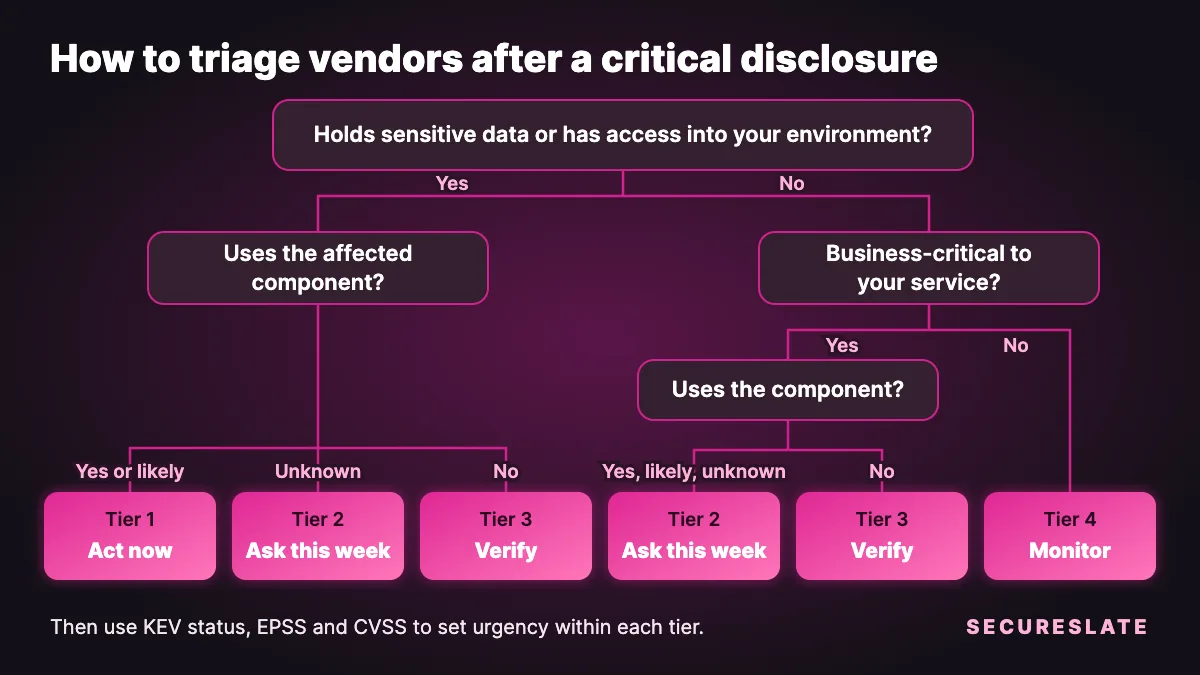
A simple four-tier model works for most SMBs:
| Tier | Typical profile | Response |
|---|---|---|
| Tier 1: Act now | Holds sensitive data (PHI, customer data, credentials) or has access into your environment, and uses or likely uses the affected component | Direct contact today, named owner, daily follow-up |
| Tier 2: Ask this week | Holds sensitive data or access, component use unknown. Or business-critical with limited data, and uses, likely uses or may use the component | Targeted questionnaire with a short deadline |
| Tier 3: Verify | Holds sensitive data or access, or is business-critical, and appears not to use the component | Check vendor advisories, confirm in writing |
| Tier 4: Monitor | No sensitive data, no access, not business-critical | Log the decision, no outreach needed |
Severity scores help set urgency within a tier, but use them carefully. FIRST, which maintains CVSS, says CVSS "is designed to represent the technical severity" of issues and that Base scores "are not risk, and should not be used alone for patch prioritization." FIRST's Exploit Prediction Scoring System (EPSS) "estimates the probability that a published CVE will be exploited in the wild in the next 30 days." FIRST's EPSS usage guidance warns against multiplying EPSS by CVSS, so treat them as separate signals: severity, likelihood and KEV status alongside your own data-access tiering.
Document the triage decision for every vendor, including Tier 4.
What should you ask an exposed vendor?
Ask a small number of direct questions that a vendor can answer quickly, with a reply deadline that matches the tier. A full reassessment can wait. Right now you need facts about exposure, remediation and compromise.
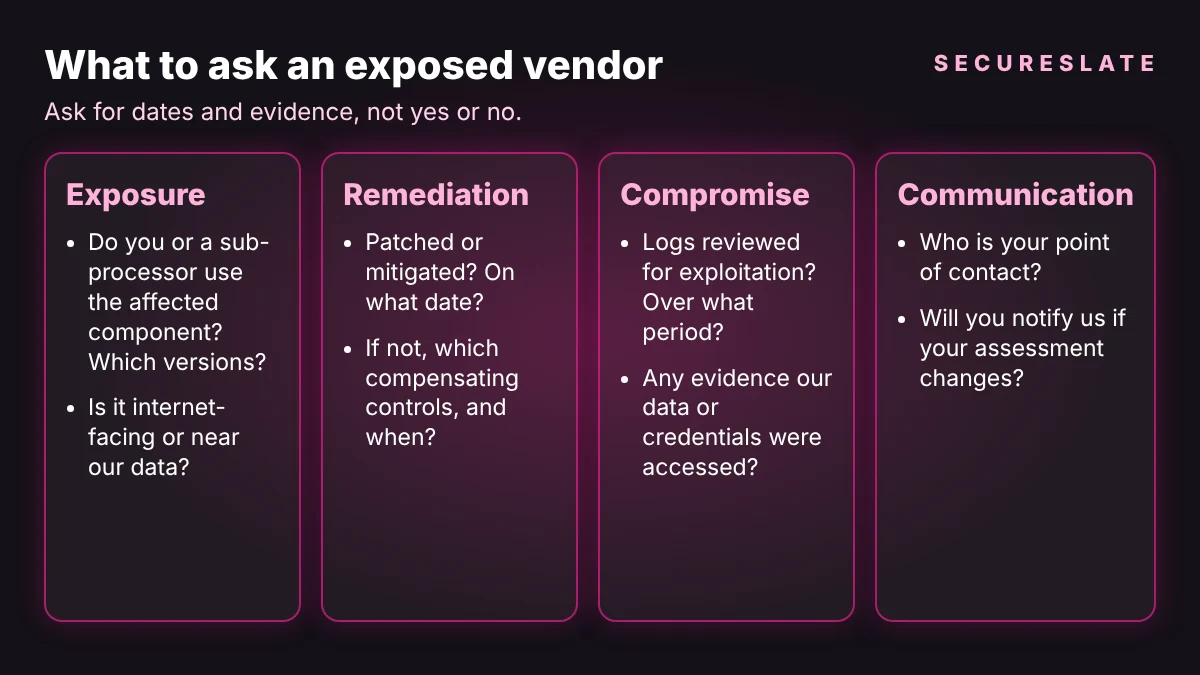
A practical question set:
Exposure
- Do you, or any sub-processor that handles our data, use the affected product or component? Which versions?
- Is the affected component internet-facing or reachable from systems that process our data?
Remediation
- Have you applied the vendor patch or recommended mitigation? On what date?
- If not, what compensating controls are in place, and when do you expect to remediate?
Compromise
- Have you reviewed logs for indicators of exploitation? Over what period?
- Is there any evidence that our data, credentials or integrations were accessed?
Communication
- Who is your point of contact, and will you notify us if your assessment changes?
Ask for dates and evidence rather than yes or no, and keep the question set consistent across vendors so answers can be compared. For the broader questions you ask at onboarding, use our vendor risk assessment checklist.
How do you track vendor responses to closure?
Track each exposed vendor as a dated record that moves through clear statuses until it is closed with evidence, with owners, deadlines and answers in one place.
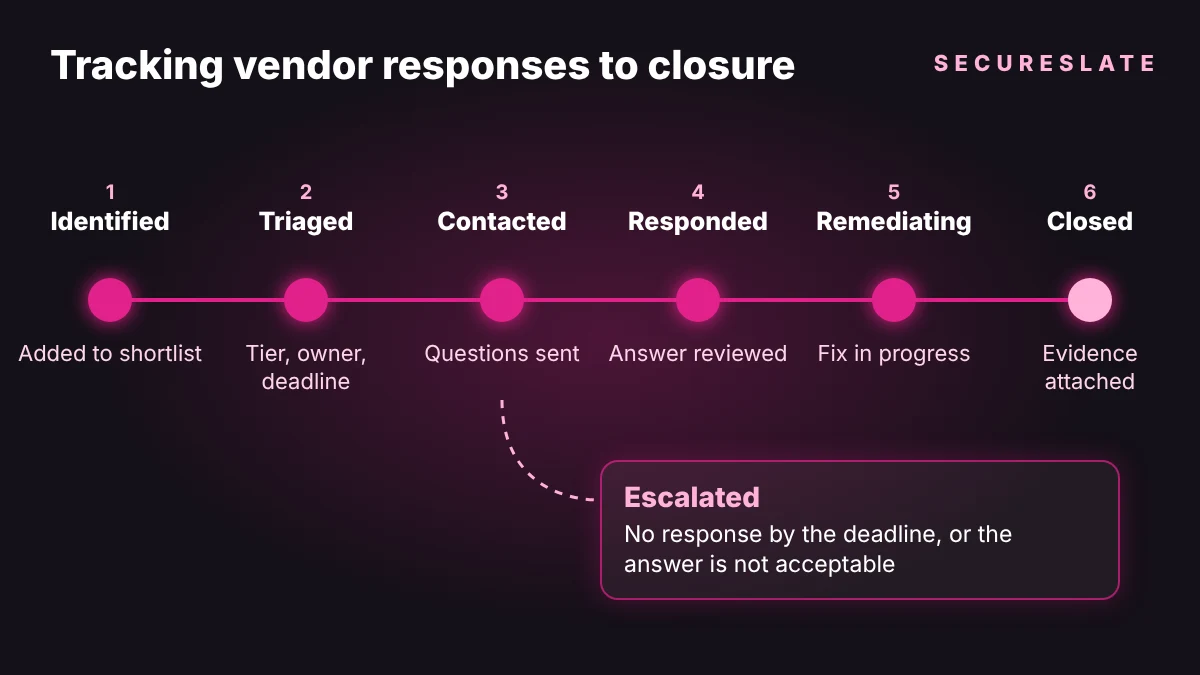
A workable status model:
- Identified: vendor added to the event's shortlist.
- Triaged: tier assigned, owner named, deadline set.
- Contacted: questions sent, date recorded.
- Responded: answer received and reviewed.
- Remediating: vendor affected, fix or mitigation in progress with a target date.
- Closed: unaffected or remediated, with evidence attached.
- Escalated: no response by the deadline, or the answer is not acceptable.
For each record, capture the vendor's response, the evidence, your reviewer's assessment and any follow-up actions for you, such as rotating API keys the vendor holds.
Predefine escalation. If a vendor confirms compromise, the event moves into incident response, and your own customer notification obligations may apply.
When the event closes, write a short summary of vendors assessed, vendors affected, actions taken and lessons learned. It becomes evidence for auditors and customer questionnaires. Feed lessons back into the TPRM lifecycle, for example by recording vendor technology during onboarding so the next shortlist is faster.
Which contract clauses make vendor vulnerability response faster?
Clauses that set notification timing, remediation expectations, cooperation duties and sub-processor flow-down make vendor vulnerability response faster because the vendor already owes you an answer. Consider these in MSAs, DPAs and BAAs:
| Clause | What it does | Example wording to negotiate |
|---|---|---|
| Security incident notification | Sets a deadline for telling you about incidents affecting your data | Notice within an agreed number of hours (example: 72 hours) of discovery |
| Vulnerability notification | Requires notice when a critical vulnerability affects services you use | Notice of critical vulnerabilities affecting the service, with planned remediation |
| Remediation commitment | Sets expectations for fixing critical issues | Remediation or mitigation of critical vulnerabilities within an agreed window |
| Cooperation and information | Obliges the vendor to answer reasonable security questions | Respond to security inquiries within an agreed number of business days |
| Sub-processor flow-down | Pushes the same terms to their suppliers | Equivalent obligations imposed on sub-processors |
| Audit and evidence | Lets you request evidence of remediation | Provide reasonable evidence on request |
The timeframes above are examples only. Set them by vendor tier, and keep them shorter than the windows you have promised your own customers.
For HealthTech, HIPAA sets a floor, not a target. Under 45 CFR 164.410, a business associate must notify the covered entity of a breach of unsecured PHI "without unreasonable delay and in no case later than 60 calendar days after discovery." HHS's sample business associate agreement provisions note that parties may wish to add more specificity, such as a stricter timeframe for reporting a potential breach. In our experience, security-conscious healthcare buyers expect much less than 60 days, and a critical vulnerability is not a breach until it is exploited, so add a separate clause for vulnerability notice.
How does this map to SOC 2, ISO 27001 and HIPAA?
All three frameworks expect ongoing supplier risk management, and a documented vendor vulnerability response is strong evidence of it. None prescribes this exact process, so map it to your existing controls.
| Framework | Relevant requirement | How this process supports it |
|---|---|---|
| SOC 2 | Common Criteria CC9.2 in the AICPA Trust Services Criteria: the entity assesses and manages risks associated with vendors and business partners | Event-driven assessment, tiering and tracked follow-up show risk is managed between periodic reviews |
| ISO 27001 | ISO/IEC 27001:2022 Annex A controls 5.19 (information security in supplier relationships), 5.20 (addressing information security within supplier agreements), 5.21 (managing information security in the ICT supply chain) and 5.22 (monitoring, review and change management of supplier services) | Contract clauses support 5.20, sub-processor questions support 5.21, and event tracking supports 5.22 |
| HIPAA | Business associate contracts under 45 CFR 164.314 must require the business associate to report security incidents it becomes aware of and to flow requirements down to subcontractors | Questions and clauses enforce reporting, and sub-processor checks reflect the subcontractor flow-down |
Keep the event summary, triage list, vendor responses and contract references together. That package answers an auditor's questions about the last critical disclosure and complements your periodic vendor security reviews.
How SecureSlate helps
SecureSlate gives SaaS and HealthTech teams one place to run vendor risk work, including event-driven reviews:
- Vendor risk management: keep a vendor inventory with data types, risk tiers and owners, send security questionnaires, and track responses and follow-ups.
- Security questionnaire automation: answer customer questions about your own vendor response faster, from approved content.
- Risk management: record vendor-related risks, treatment decisions and owners in your risk register.
- Multi-framework control mapping: map vendor management evidence once to SOC 2, ISO 27001, HIPAA and other built-in frameworks.
- Audit management: keep event summaries and vendor evidence ready for your auditor.
FAQ
What is the difference between third-party vulnerability management and vendor risk assessment?
A vendor risk assessment evaluates a vendor's overall security program, usually at onboarding and renewal. Third-party vulnerability management is triggered by a specific disclosure and asks narrower questions: is the vendor exposed to this vulnerability, have they fixed it, and is there evidence of compromise.
How quickly should vendors respond after a critical vulnerability is disclosed?
There is no single legal deadline for vulnerability inquiries. Set reply deadlines by tier, shortest for vendors that hold sensitive data or have access to your environment, and write them into contracts where you can. Breach notification deadlines, such as HIPAA's for business associates, apply only once a breach is discovered.
Should we contact our vendors' sub-processors directly?
Usually not, since you rarely have a contract with them. Ask your direct vendor to confirm the status of sub-processors that handle your data, and rely on flow-down clauses.
What if a vendor does not respond?
Escalate on a predefined path, for example to your security lead and the vendor's account owner. Meanwhile, reduce exposure where you can by rotating credentials the vendor holds, limiting integrations or pausing data flows, and record the decision in your risk register.
Disclaimer (legal note)
This article is for general information only and is not legal, regulatory or professional advice. Requirements vary by framework, industry and jurisdiction. Consult qualified advisors for your specific obligations.
Need compliance without the complexity?
SecureSlate automates ISO 27001, SOC 2, GDPR, HIPAA, and more. Built for growing teams. See it in action.
Find compliance gaps in 30 seconds
