
Short answer: AI agent identity governance means treating each AI agent as its own accountable identity: registered with an owner, given only the permissions its task needs, clear about whose authority it acts under, logged, reviewed like any other account and retired when no longer used. It stops agents from quietly inheriting broad human or shared service-account access.
Related guides:
- AI agents without oversight: a governance guide
- Your auditor is about to ask about AI agents
- Agentic AI security: threats and controls for AI agents
Key takeaways
- An agent that acts in your systems is a non-human identity. It needs a unique identity, an accountable human owner and a defined purpose.
- Most agent incidents trace back to the three root causes OWASP lists for excessive agency: too much functionality, too many permissions and too much autonomy.
- Decide whether an agent acts on behalf of a user (delegation) or as a user (impersonation). Delegation keeps the agent visible in logs; impersonation hides it.
- Put agents through the same lifecycle as human accounts: request, approve, provision, review and remove.
- HIPAA's access control standard already covers software programs granted access to ePHI, so HealthTech teams should bring agents into scope now.
Why do AI agents need their own identities?
Because you cannot limit, monitor or revoke what you cannot tell apart, and agents that borrow a person's login or a shared API key are indistinguishable from everything else using that credential.
In many teams the first agents are wired up quickly: a developer's personal token, a shared service account, or an API key pasted into a configuration file. That works for a demo and fails as soon as you need answers to basic questions:
- Which agent changed this record?
- Who approved giving it write access?
- What else can that credential reach?
- How do we turn off one agent without breaking three others?
Regulation already points the same way for health data. The HIPAA Security Rule's access control standard at 45 CFR 164.312 requires access to systems holding ePHI to be limited to "persons or software programs" that have been granted access rights, requires unique user identification for "identifying and tracking user identity", and requires audit controls that record activity. An AI agent reading patient records is a software program with access, so it needs its own identity, its own rights and its own audit trail.
What goes wrong without agent identity governance?
Agents end up able to do far more than their task requires, and a single bad prompt, bug or manipulated input turns that excess into damage.
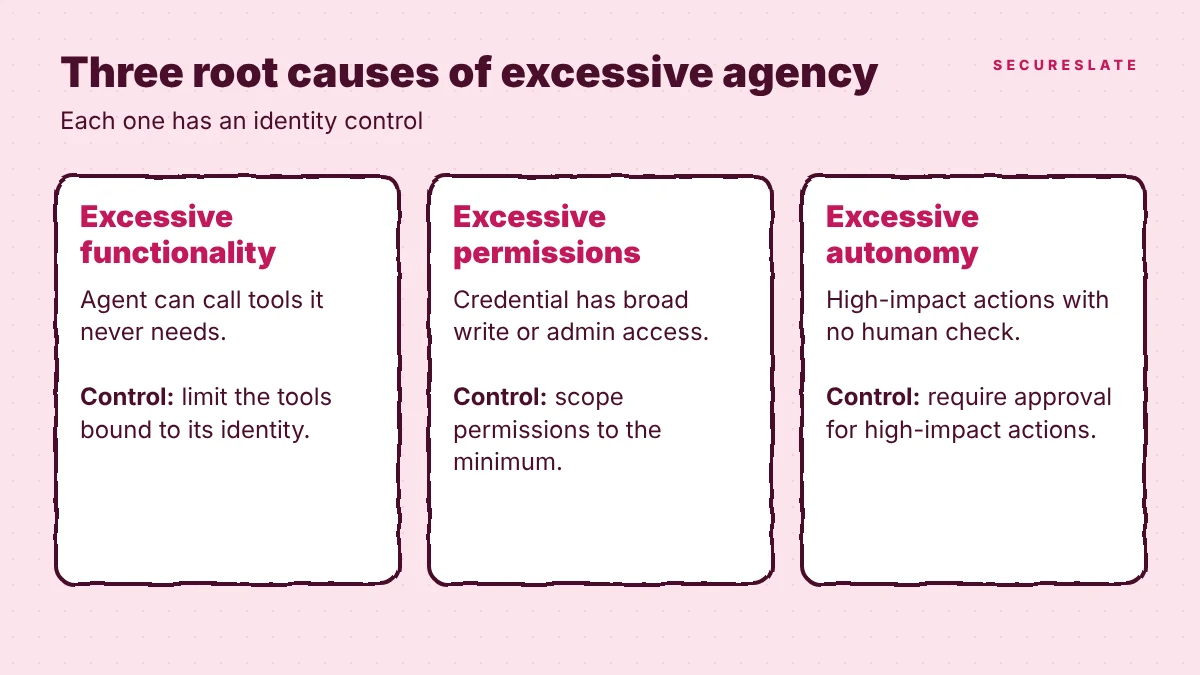
The OWASP Top 10 for LLM Applications describes this as Excessive Agency (LLM06:2025), "the vulnerability that enables damaging actions to be performed in response to unexpected, ambiguous or manipulated outputs" from a model. OWASP names three root causes, and each maps to an identity decision:
| Root cause | What it looks like | Identity control |
|---|---|---|
| Excessive functionality | Agent can call tools it never needs, such as delete or send-email | Limit the tools and functions bound to the agent's identity |
| Excessive permissions | Agent's credential has admin or write access across systems | Scope permissions to the minimum, per system |
| Excessive autonomy | Agent takes high-impact actions with no human check | Require approval for defined high-impact actions |
OWASP's mitigations include limiting extension permissions "to the minimum necessary", executing actions in the user's context, requiring a human to approve high-impact actions, and enforcing authorization "in downstream systems rather than relying on an LLM to decide if an action is allowed or not." That last point matters: the guardrail belongs in the identity and access layer, not in the prompt.
Whose authority is the agent using?
Decide this explicitly for every agent: either the agent acts with its own limited rights, or it acts on behalf of a specific user and the record shows both parties.
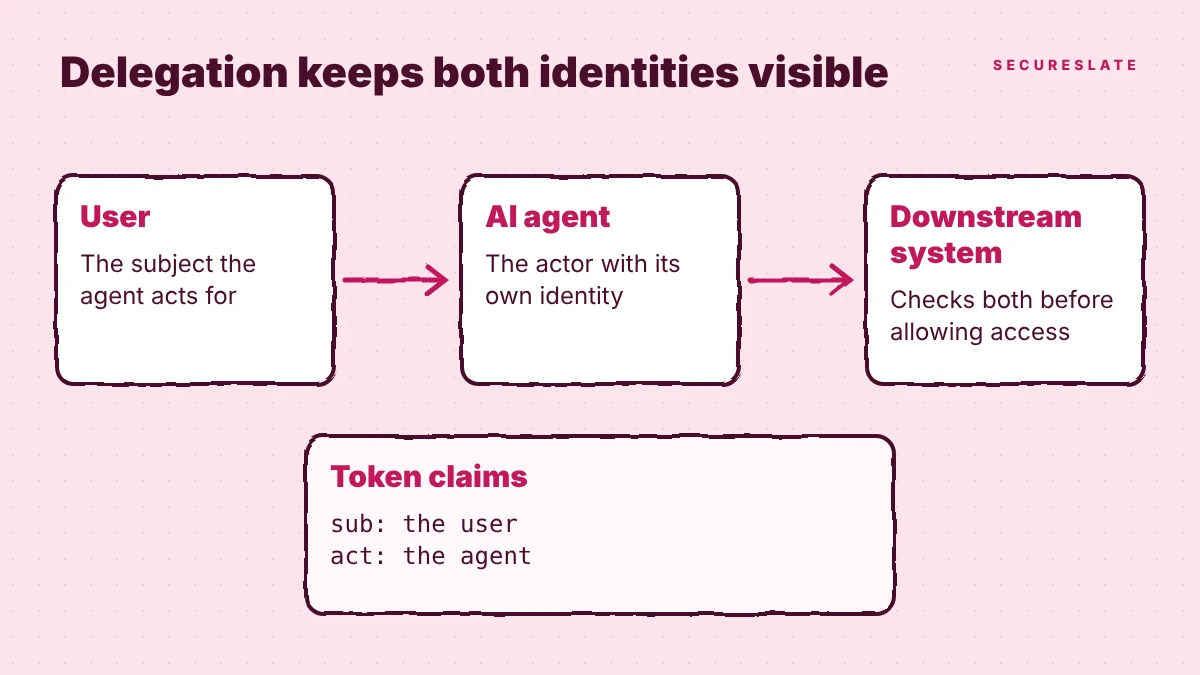
The OAuth 2.0 Token Exchange standard, RFC 8693, draws the distinction clearly. It notes that "delegation semantics are different than impersonation semantics." With delegation, the agent keeps its own identity while acting for the user: the token's subject is the user, and its "act" (actor) claim provides "a means within a JWT to express that delegation has occurred and identify the acting party." With impersonation, the agent is treated as the user and the logs cannot tell them apart.
For governance, prefer delegation wherever the agent acts for a person:
- The audit trail shows both identities, so you can answer "the agent did this for Dana" rather than "Dana did this."
- The agent's effective rights can be narrower than the user's, because the downstream system can check both.
- You can revoke the agent without touching the user's own access.
Agents that run on a schedule with no user in the loop, such as a nightly reconciliation agent, should use their own workload identity with tightly scoped permissions instead.
What does an agent identity lifecycle look like?
Run agents through the same joiner, mover and leaver process you use for people, with a few agent-specific checks.
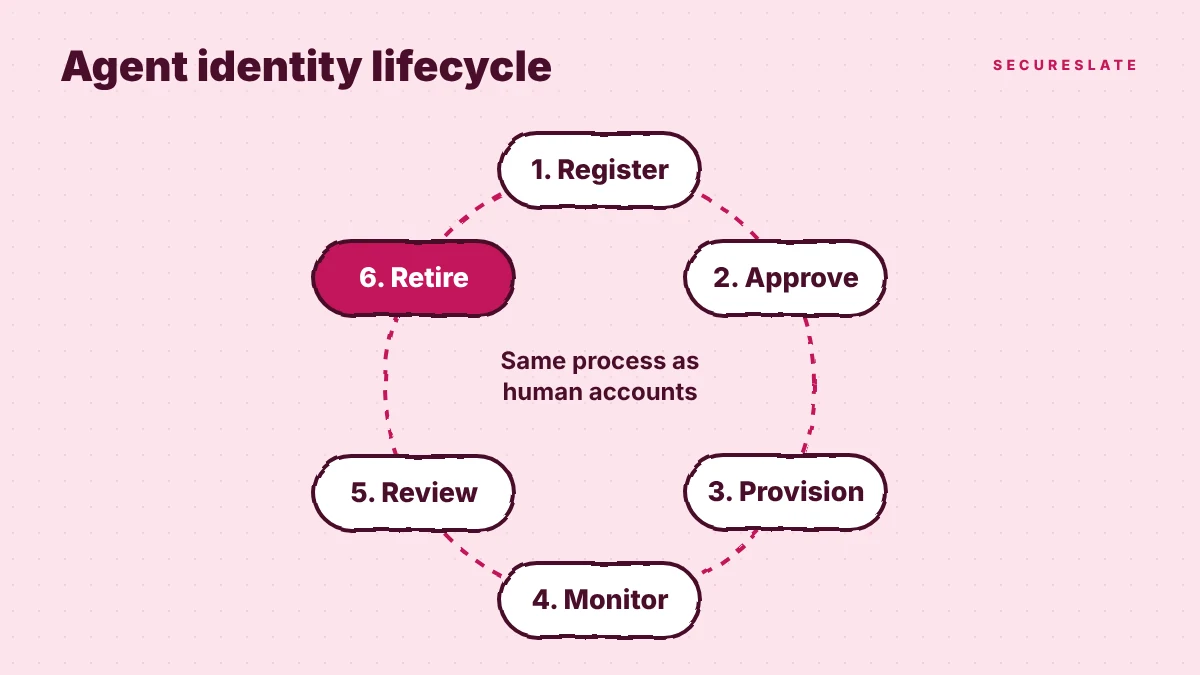
- Register. Record the agent in an inventory with its purpose, owner, model or vendor, the systems it touches and the data categories it can read.
- Approve. Have the system owner approve the requested access, the same way they would for a new employee or service account.
- Provision. Issue a unique credential, prefer short-lived tokens over static keys, and store secrets in a vault rather than in code or configuration files.
- Monitor. Log every action under the agent's identity and alert on unusual volume, new destinations or attempts to use tools outside its scope.
- Review. Include agents in your periodic access reviews. Remove permissions the agent has not used and confirm the owner still exists.
- Retire. When the project ends or the owner leaves, revoke the credential and archive the logs. Orphaned agents with live credentials are the agent equivalent of an ex-employee's active account.
This lifecycle lines up with zero trust architecture principles. NIST SP 800-207 states that access to resources "is granted on a per-session basis" and that "all resource authentication and authorization are dynamic and strictly enforced before access is allowed." Agents are a natural place to apply that thinking, because their behavior can change with every prompt.
What evidence do auditors and customers expect?
The same evidence you produce for human access, extended to cover agents: an inventory, approvals, scoped permissions, logs and completed reviews.
In our experience, security questionnaires and audits are starting to ask directly about AI agents. A simple evidence pack covers most questions:
| Evidence | What it shows |
|---|---|
| Agent inventory with owners | Every agent is known and accountable |
| Access request and approval records | Permissions were granted deliberately |
| Permission listings per agent | Access is scoped to the task |
| Activity logs tagged with agent identity | Actions can be attributed |
| Completed access reviews including agents | Access is checked over time |
| Offboarding records | Retired agents lost access |
These map naturally onto the logical access expectations in SOC 2, the identity and access control requirements in ISO 27001 and, for ePHI, the HIPAA access control and audit control standards. You rarely need a new control. You need your existing access controls to explicitly include agents.
Where are standards for agent identity heading?
Standards bodies are actively working on it, so expect more specific guidance, but the core practices above will not change.
On February 5, 2026, NIST's National Cybersecurity Center of Excellence released a concept paper on software and AI agent identity and authorization, outlining a potential project on applying identity standards and best practices to AI agents. It sought feedback on topics including "identification, authorization, auditing and non-repudiation of AI agents" and controls against prompt injection, with public comment open through April 2, 2026. As of October 2026 it is a concept paper for a potential project, not final guidance.
Until more specific guidance lands, the safest approach is to apply what already works: unique identities, least privilege, delegation over impersonation, logging and regular review.
How SecureSlate helps
SecureSlate helps you bring AI agents into the access program you already run for SOC 2, ISO 27001 and HIPAA:
- Access reviews that can include agent and service accounts alongside human users, with owner sign-off recorded as evidence.
- Custom controls for agent-specific requirements such as inventory, approval and retirement, mapped to your existing frameworks.
- Code security and secrets detection to catch agent API keys and tokens committed to repositories.
- Risk management and vendor risk management to assess the AI vendors and models your agents depend on.
Start your free SecureSlate trial
FAQ
Is an AI agent a user or a service account?
It is a non-human identity, and it behaves like both. Treat it like a service account for provisioning and secrets, and like a user for approvals, owner accountability and access reviews. When it acts for a person, record both identities.
Can an AI agent use my personal credentials?
It can technically, but it should not. Activity becomes indistinguishable from yours, the agent inherits all your access, and you cannot revoke it without revoking yourself. Use delegation with a separate agent identity instead.
How often should we review AI agent access?
At least as often as you review privileged human access, and whenever an agent's purpose, tools or owner changes. Agents are added and changed quickly, so many teams review them quarterly.
Does HIPAA apply to AI agents that access patient data?
HIPAA applies to the covered entity or business associate operating the agent. The Security Rule's access control standard covers software programs granted access to ePHI, so agents need unique identification, appropriate access rights and audit logging like any other system user.
Disclaimer (legal note)
This article is for general information only and is not legal, regulatory or professional advice. Requirements vary by framework, industry and jurisdiction. Consult qualified advisors for your specific obligations.
Need compliance without the complexity?
SecureSlate automates ISO 27001, SOC 2, GDPR, HIPAA, and more. Built for growing teams. See it in action.
Find compliance gaps in 30 seconds
