
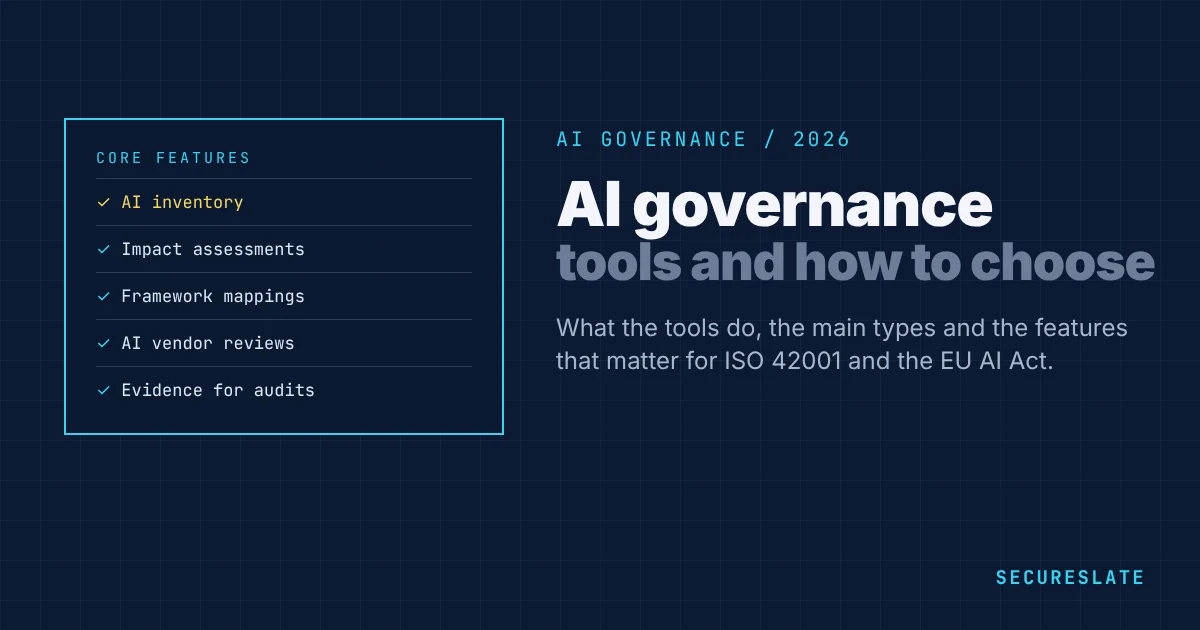
AI governance tools help companies keep track of the AI systems they build and use, assess their risks, apply policies, and prove compliance with standards such as ISO 42001 and laws such as the EU AI Act. As AI features spread through every product and staff use dozens of AI services, spreadsheets stop working quickly. This guide explains what AI governance tools do, the main types, the features that matter, and how a small or mid-sized company should choose one.
Related guides: Designing an AI governance framework · AI governance policy · EU AI Act compliance checklist · ISO 42001 certification
Key takeaways
- AI governance tools cover inventory, risk and impact assessment, policy and controls, monitoring and evidence for AI systems.
- The right tool depends on whether you mainly build AI, buy AI, or both.
- For most growing companies, the priority is a tool that ties AI governance to existing security and privacy compliance, rather than a separate platform.
- Look for mappings to ISO 42001, the EU AI Act and the NIST AI Risk Management Framework.
What do AI governance tools do?
| Capability | What it does | Why it matters |
|---|---|---|
| AI inventory | Records every AI system you build or use, with owner, purpose, data and risk level | You cannot govern what you cannot see. Both ISO 42001 and the EU AI Act start here |
| Risk and impact assessment | Structured assessments of risks to the company, users and affected people | Required by ISO 42001 (clauses 6.1 and 8.4) and for high-risk systems under the EU AI Act |
| Policy and controls | AI policy, acceptable use rules and controls mapped to frameworks | Turns principles into checkable requirements |
| Vendor and model review | Assesses third-party AI services and models | Most companies rely on models from others |
| Monitoring | Tracks model performance, drift, incidents and usage | Shows that systems keep behaving as intended |
| Evidence and reporting | Stores approvals, test results and audit evidence | Needed for audits, customers and regulators |
Types of AI governance tools
- Compliance platforms with AI modules. Extend an existing GRC or compliance automation platform with an AI inventory, ISO 42001 and EU AI Act frameworks, and AI vendor reviews. Best for companies that already run SOC 2 or ISO 27001.
- Dedicated AI governance platforms. Focus on AI inventories, model documentation, impact assessments and responsible AI workflows. Often aimed at large enterprises with many in-house models.
- Model monitoring and MLOps tools. Track model performance, drift, bias metrics and data quality in production. Technical, and usually owned by data science teams.
- AI security tools. Detect prompt injection, data leakage and shadow AI use, and enforce guardrails on AI applications.
Small companies rarely need all four. A compliance platform covering inventory, assessments, policies and evidence, plus the monitoring your engineering team already does, is usually enough.
Must-have features
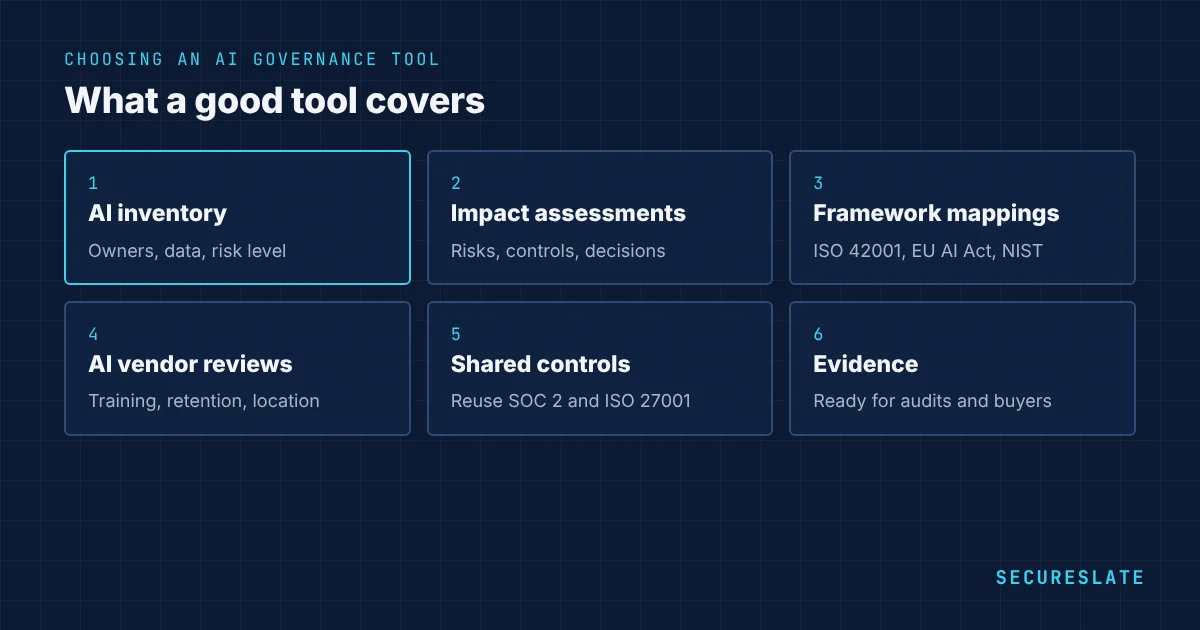
- AI system inventory with owners, purposes, data categories, providers and risk classification
- Framework mappings for ISO 42001 Annex A, the EU AI Act and the NIST AI RMF
- Impact assessment templates that record risks, controls, decisions and review dates
- AI vendor assessments covering training on customer data, retention, data location and security
- Policy management with staff acknowledgment of AI acceptable use rules
- Evidence collection linked to controls, ready for auditors
- Integration with existing compliance so shared controls such as access control, logging and change management are not duplicated
- Reporting for leadership and customers, ideally through a trust center
Questions to ask vendors
- Which frameworks are included, and how are they kept up to date as the EU AI Act guidance changes?
- How does the tool find AI systems, including AI features inside SaaS tools we buy?
- Can impact assessments be customized to our risk method?
- Does it share controls and evidence with our SOC 2 and ISO 27001 programs?
- How does it support an ISO 42001 certification audit?
- What does pricing look like as the number of AI systems and users grows?
Build vs buy
A spreadsheet inventory and document templates can work for a company with a handful of AI use cases. It stops working when you need review dates, approvals, evidence and framework mappings across many systems, or when an ISO 42001 auditor or enterprise customer asks for proof. At that point a tool usually costs less than the staff time it saves.
How AI governance fits with your other frameworks
AI governance is not a separate island. Access control, change management, logging, supplier management and incident response already exist in your ISO 27001 or SOC 2 program, and ISO 42001 was designed to sit alongside ISO 27001 using the same management system structure. A tool that uses a common control framework lets you add AI-specific controls, such as impact assessments and transparency, without rebuilding the rest.
Example AI inventory record
| Field | Example |
|---|---|
| System | Support reply assistant |
| Type | Built in-house on a third-party large language model |
| Owner | Head of Support |
| Purpose | Drafts replies to customer tickets for agents to review |
| Data used | Ticket text, which may include names and emails |
| Model provider | External LLM API, contract bars training on our data |
| Risk level | Limited risk under the EU AI Act; medium internal risk |
| Controls | Human review before sending, PII redaction, logging, output monitoring |
| Impact assessment | Completed and approved, review in 12 months |
| Transparency | Customers told replies may be AI-assisted |
A good tool makes records like this quick to create and keeps them linked to controls, vendors and evidence.
A 90-day plan to put AI governance in place
| Period | Focus |
|---|---|
| Days 1 to 30 | Publish an AI acceptable use policy, name an owner, and build the AI inventory, including AI inside purchased tools |
| Days 31 to 60 | Classify each system by risk, run impact assessments for medium and high-risk use cases, and review AI vendors |
| Days 61 to 90 | Map controls to ISO 42001 and the EU AI Act, set up monitoring and incident reporting, train staff and record it |
After 90 days you will have the foundations auditors and enterprise customers look for, and a clear view of whether ISO 42001 certification makes sense for you.
Common mistakes when choosing a tool
- Buying an enterprise AI platform built for hundreds of in-house models when you have a handful of AI features
- Running AI governance in a separate tool from security compliance, which duplicates controls and evidence
- Ignoring AI used inside SaaS tools, which is often where most of the risk sits
- Treating the tool as the program. A tool helps, but people still need to own systems, assessments and decisions
How SecureSlate helps
SecureSlate includes ISO 42001 and EU AI Act frameworks alongside SOC 2 and ISO 27001, with an AI system inventory, impact assessment templates, AI vendor reviews and shared controls through multi-framework mapping. It is priced for small and mid-sized teams, starting at $2,688 a year.
FAQ
What is an AI governance tool?
Software that helps an organization inventory its AI systems, assess and manage their risks, apply policies and controls, monitor them, and keep evidence for audits and regulators.
Do small companies need AI governance software?
Not always at first. Once you have several AI features or many AI tools in use, or customers ask for ISO 42001 or EU AI Act assurance, a tool saves significant time.
Can a GRC platform handle AI governance?
Many can, if they include AI-specific frameworks, an AI inventory and impact assessments. This is often the simplest option for companies that already use one for SOC 2 or ISO 27001.
What is the NIST AI RMF?
The NIST AI Risk Management Framework is a voluntary US framework organized into four functions: Govern, Map, Measure and Manage. Many tools map controls to it.
Do AI governance tools detect shadow AI?
Some do, through browser extensions, SSO logs, expense data or network monitoring. Others rely on surveys and declarations. Ask how discovery works.
How much do AI governance tools cost?
Prices range widely, from modules inside compliance platforms priced for SMBs to enterprise platforms with six-figure contracts. Compare total cost against the number of AI systems you actually need to govern.
Disclaimer (legal note)
This article is for general information only and is not legal, regulatory, or professional advice. Requirements vary by framework, industry, and jurisdiction. Consult qualified advisors for your specific obligations.
Need compliance without the complexity?
SecureSlate automates ISO 27001, SOC 2, GDPR, HIPAA, and more. Built for growing teams. See it in action.
Find compliance gaps in 30 seconds
