
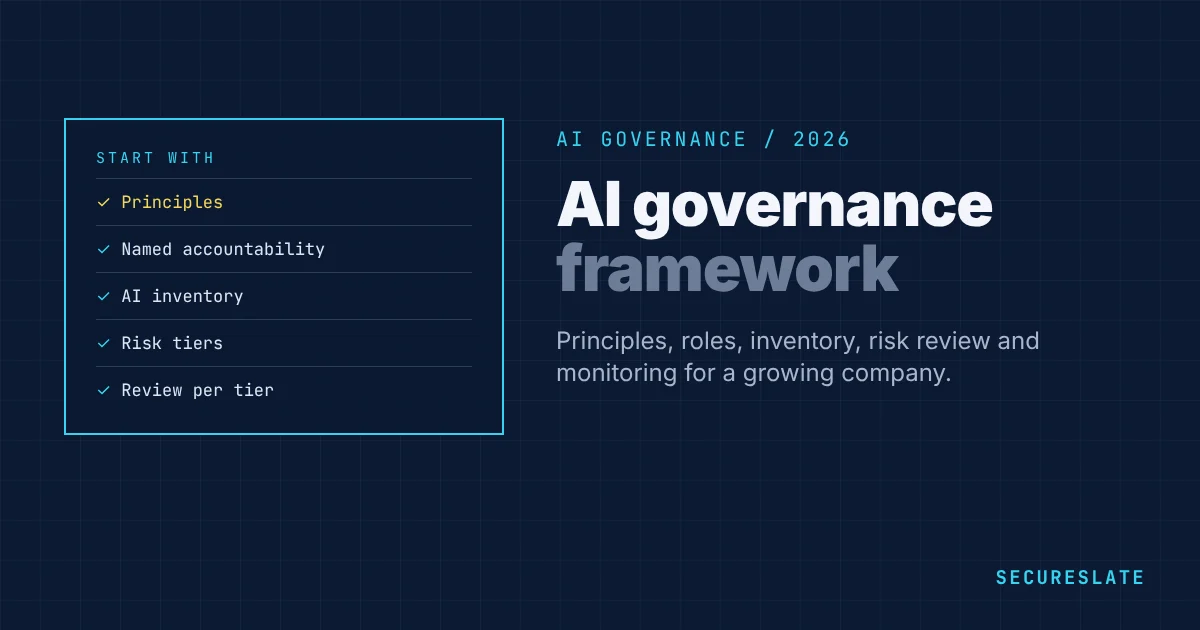
An AI governance framework is the set of principles, roles, policies and processes a company uses to make sure the AI it builds and uses is safe, lawful and trustworthy. For a growing company, it does not need to be heavy. It needs to answer five questions: what AI do we use, who is accountable, what are the risks, what rules apply, and how do we know the rules are followed. This guide shows how to build one step by step, aligned with ISO 42001, the NIST AI RMF and the EU AI Act.
Related guides: EU AI Act compliance checklist · ISO 42001 Annex A controls · NIST AI RMF explained · How generative AI is used in cybersecurity
Key takeaways
- An AI governance framework covers principles, accountability, inventory, risk and impact assessment, policies and controls, monitoring and training.
- Start with an inventory of every AI system you build, sell and use, including AI inside SaaS tools.
- Scale controls to risk. A spam filter and an AI hiring tool should not get the same review.
- Use existing standards: ISO 42001 for the management system, NIST AI RMF for risk thinking, and the EU AI Act for legal obligations.
Why AI governance matters now
AI use has spread faster than most companies' controls. Staff adopt AI assistants, vendors add AI features overnight, and engineering teams ship model-powered features. Without governance, companies face data leaks into AI tools, biased or wrong outputs reaching customers, contract breaches, and regulatory exposure as the EU AI Act and other laws take effect. Customers now ask about AI in security questionnaires, and investors ask boards how AI risk is managed.
Good governance also speeds things up. When teams know which tools are approved and what review a new use case needs, they stop waiting on ad hoc legal opinions.
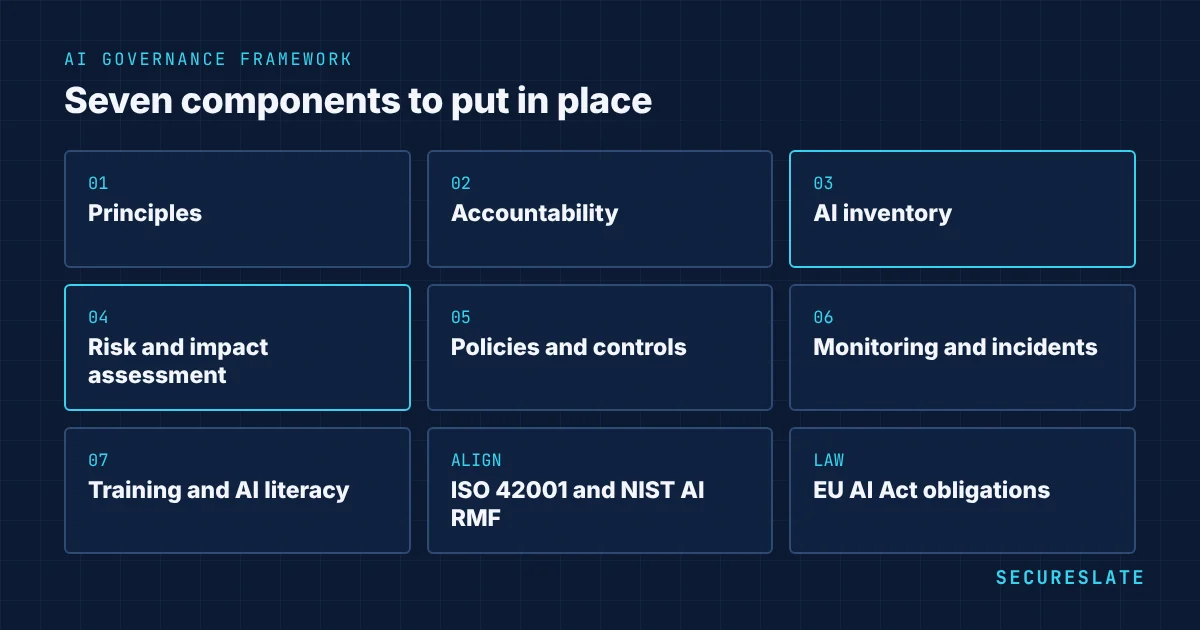
The seven components of an AI governance framework
| Component | What it includes | Typical owner |
|---|---|---|
| 1. Principles | Short statement of values: safety, fairness, transparency, privacy, accountability | Leadership |
| 2. Accountability | Executive sponsor, AI governance lead, review group, system owners | Leadership |
| 3. AI inventory | Every AI system built, provided or used, with owner, purpose, data and risk level | AI governance lead |
| 4. Risk and impact assessment | Method to assess risks to the company and impacts on people before launch or adoption | Governance lead with legal and security |
| 5. Policies and controls | AI policy, acceptable use, data rules, development and testing standards, supplier review | Policy owners |
| 6. Monitoring and incidents | Production monitoring, feedback channels, AI incident handling, periodic review | System owners |
| 7. Training and culture | AI literacy for all staff, deeper training for builders and reviewers | HR and governance lead |
How to build the framework in eight steps
1. Agree principles with leadership
Write five or six short principles, such as "a human is accountable for every AI-assisted decision about a customer or employee." Principles guide decisions where rules do not exist yet.
2. Assign accountability
Name an executive sponsor and an AI governance lead. Create a small review group with engineering, product, security, legal and HR. Every AI system needs a named owner.
3. Build the AI inventory
Survey teams and check your SaaS and expense records for AI tools. Record for each system: owner, purpose, users, data used, whether it is built or bought, and the vendor.
4. Classify by risk
Use simple tiers. Low: internal productivity with no personal or confidential data. Medium: customer-facing features or confidential data. High: decisions that affect people's rights or access, such as hiring, credit, health or safety, or anything in the EU AI Act's high-risk list.
5. Define review steps per tier
Low risk: approval from the system owner against the acceptable use policy. Medium: security and privacy review plus testing. High: full impact assessment, legal review, human oversight design and sign-off by the review group.
6. Write the core policies
At minimum: an AI policy stating principles and responsibilities, an AI acceptable use policy for staff, data rules for training and prompts, development and testing standards for AI features, and supplier requirements for AI vendors.
7. Monitor and handle incidents
Track model performance, errors and complaints in production. Define what counts as an AI incident, such as harmful output, data exposure or a biased outcome, and route it through your incident response process.
8. Train and review
Run AI literacy training for everyone, required under the EU AI Act since February 2025 for providers and deployers. Review the framework at least yearly and whenever laws or your AI use change.
Aligning with standards and regulations
| Framework | What it gives you | How to use it |
|---|---|---|
| ISO/IEC 42001 | Certifiable AI management system with 38 Annex A controls | Structure for policies, roles, impact assessment and audits |
| NIST AI RMF | Voluntary risk framework with Govern, Map, Measure and Manage functions | Practical guidance for identifying and measuring AI risks |
| EU AI Act | Legal obligations by risk category and role | Determines mandatory requirements and deadlines |
| OWASP Top 10 for LLM Applications | Security risks for LLM-based products | Engineering checklist for AI features |
Example AI impact assessment template
A short template works for most medium and high-risk use cases:
| Section | Questions to answer |
|---|---|
| System | What does it do, who uses it, who is affected? |
| Data | What data is used for training, prompts and outputs? Any personal or confidential data? |
| Decisions | Does it make or support decisions about people? How significant? |
| Risks | What could go wrong for users, affected people and the company? |
| Controls | Testing, human oversight, transparency, access limits, monitoring |
| Decision | Approved, approved with conditions, or rejected; by whom; review date |
Sizing the framework for a small company
A company of 20 to 50 people can run AI governance with a one-page AI policy, an acceptable use policy, a spreadsheet or platform inventory, a two-page impact assessment template for higher-risk uses, and a monthly 30-minute review meeting. Add formality as AI becomes a bigger part of your product or as customers and regulators ask for evidence, for example by pursuing ISO 42001 certification.
Common mistakes
- Writing principles but no process for approving new AI use
- Leaving bought AI tools and AI features in existing SaaS out of the inventory
- Applying the same heavy review to every use case, which pushes staff to work around it
- No owner for AI incidents
- Treating governance as a legal project only, without engineering involvement
How SecureSlate helps
SecureSlate helps you run AI governance alongside your security program: an AI system inventory, impact assessments, AI policies with staff attestations, vendor reviews for AI suppliers, and control mapping for ISO 42001 and the EU AI Act.
FAQ
What is an AI governance framework?
It is the structure of principles, roles, policies and processes an organization uses to manage the risks and responsibilities of the AI systems it builds and uses.
Who should own AI governance in a small company?
An executive sponsor, often the CTO or CEO, with a named AI governance lead who coordinates a small review group from engineering, product, security, legal and HR.
What is the difference between AI governance and ISO 42001?
AI governance is the general practice. ISO 42001 is an international standard that specifies a certifiable AI management system, which is one structured way to implement AI governance.
Do we need AI governance if we only use third-party AI tools?
Yes. You still need to control which tools are approved, what data goes into them, how outputs are checked, and how vendors handle your data.
How often should the AI governance framework be reviewed?
At least once a year, and whenever you adopt a significant new AI use, a regulation changes, or an AI incident shows a gap.
What should an AI acceptable use policy cover?
Approved tools, data that must never be entered, when outputs need human review, how to report problems, and how to request approval for a new AI tool.
How do we find AI tools staff already use?
Check expense reports, browser extension lists, SSO logs and SaaS discovery tools, and run a short survey. Make it easy to declare tools without fear of blame.
Disclaimer (legal note)
This article is for general information only and is not legal, regulatory, or professional advice. Requirements vary by framework, industry, and jurisdiction. Consult qualified advisors for your specific obligations.
Need compliance without the complexity?
SecureSlate automates ISO 27001, SOC 2, GDPR, HIPAA, and more. Built for growing teams. See it in action.
Find compliance gaps in 30 seconds