
Related guides:
- How ISO 42001 helps with EU AI Act compliance
- NIST AI RMF: everything you need to know
- Free incident response plan template
Key takeaways
- Generative AI helps security teams work faster: summarizing alerts, drafting detection rules, analyzing phishing and answering security questionnaires.
- Attackers use it too, mainly for convincing phishing, impersonation and faster reconnaissance.
- It brings new risks: data leakage into AI tools, prompt injection, inaccurate output and unreviewed code.
- Adopt it with clear rules: an approved tools list, data handling limits, human review of outputs and monitoring.
Where generative AI helps defenders
| Use case | What it does | Human role |
|---|---|---|
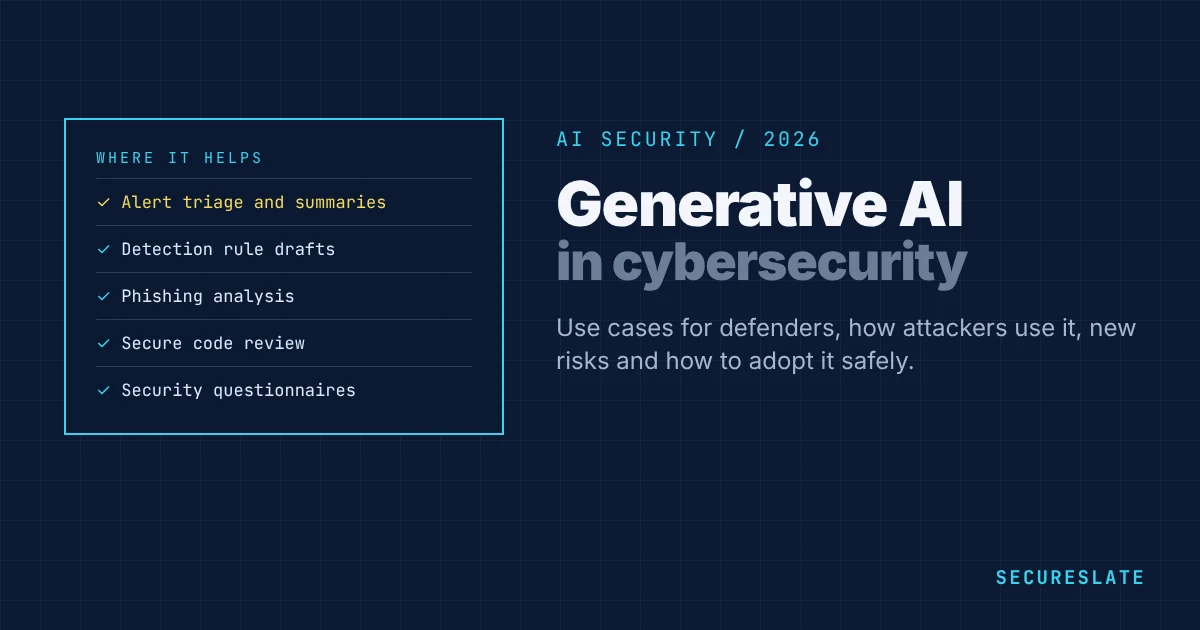
| Alert triage and summarization | Turns noisy alerts and logs into a short summary of what happened | Analyst confirms and decides the response |
| Threat intelligence | Summarizes reports and extracts indicators relevant to your stack | Analyst validates relevance |
| Detection engineering | Drafts detection rules and queries from a plain language description | Engineer tests before deploying |
| Phishing analysis | Explains why a reported email is suspicious and extracts links and senders | Analyst confirms and blocks |
| Secure code review | Flags risky patterns and suggests fixes during review | Developer reviews every change |
| Incident response | Drafts timelines, status updates and postmortem summaries | Incident lead edits and approves |
| Compliance work | Drafts policies, maps controls and answers security questionnaires | Owner checks accuracy against reality |
| Security awareness | Creates realistic training scenarios and phishing simulations | Program owner approves content |
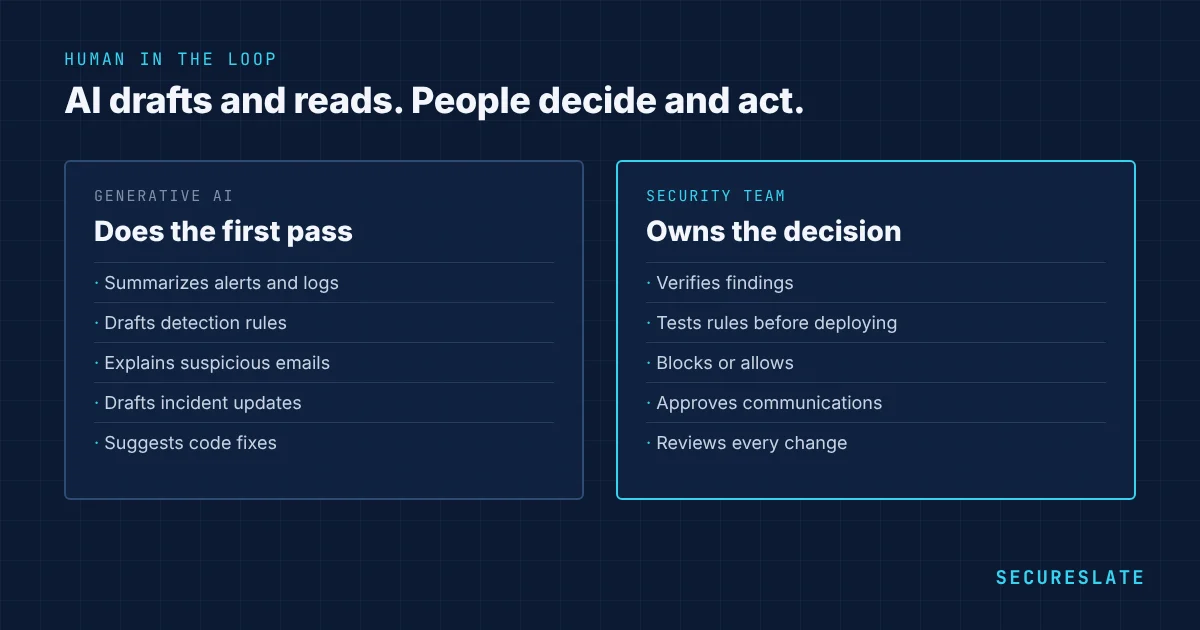
The common pattern is that AI does the first draft and the repetitive reading, and a person makes the decision. Teams that keep that split get the speed without handing judgment to a model.
How attackers use generative AI
- Phishing and business email compromise: fluent, personalized emails in any language, without the spelling mistakes people were trained to spot
- Impersonation: synthetic voice and video used to pressure staff into payments or password resets
- Reconnaissance: fast summaries of public information about a company and its employees
- Malware and exploit help: assistance writing or adapting code, which lowers the skill needed for some attacks
The defense is not new technology alone. Phishing-resistant MFA, verified payment approval processes, call-back rules for urgent requests and updated awareness training remove much of the advantage.
New risks generative AI creates
Data leakage. Staff paste customer data, source code or credentials into public AI tools. Decide which tools are approved and what data may be used in them.
Prompt injection. Attackers hide instructions in emails, documents or web pages so that an AI assistant reading them takes unwanted actions. Limit what AI agents can do, and require approval for sensitive actions.
Inaccurate output. Models can produce confident but wrong answers. Never act on AI security output without verification.
Insecure generated code. AI-written code can include vulnerabilities or outdated libraries. Run it through the same review and scanning as any other code.
Supply chain risk. AI vendors become processors of your data. Review their security, data retention and training policies like any other critical vendor.
The OWASP Top 10 for Large Language Model Applications is a useful checklist for teams building AI features into their own products.
How to adopt generative AI safely
- Inventory AI use. List the AI tools staff use and the AI features in your product.
- Set an AI acceptable use policy. Name approved tools, banned data types and when human review is required.
- Prefer business plans that do not train on your data and support single sign-on and audit logs.
- Start with low-risk use cases such as summarization and drafting, then expand as you build confidence.
- Keep a human in the loop for any decision that blocks users, changes production or communicates externally.
- Monitor and review. Log AI tool usage, review incidents and update the policy at least yearly.
Frameworks such as the NIST AI RMF and ISO 42001 give a structured way to govern AI risk as use grows.
Measuring whether AI is helping
Before rolling AI tools out widely, agree how you will judge them. Useful measures for a security team include:
- Time to triage: average minutes from alert to first decision, before and after AI summarization
- Analyst workload: alerts or tickets handled per analyst per week
- Accuracy: share of AI summaries or classifications that analysts had to correct
- Questionnaire turnaround: days to complete a customer security questionnaire
- Incidents involving AI tools: data shared with unapproved tools, or actions taken on wrong AI output
If accuracy is low or corrections take longer than doing the work by hand, narrow the use case or change the tool.
Building AI features into your own product
If your SaaS product includes generative AI, your customers will ask how you secure it. Expect questions on where prompts and outputs are stored, whether customer data trains any model, how you prevent one customer's data appearing in another's results, how you defend against prompt injection, and how you test outputs. Document the answers, add your model providers to your vendor list and subprocessor page, and include AI features in your threat model and penetration test scope.
How SecureSlate helps
SecureSlate helps you track AI tools as vendors, keep an AI policy and attestations, map AI governance controls for ISO 42001 and the EU AI Act, and connect AI-related risks to your risk register alongside SOC 2 and ISO 27001.
FAQ
Can generative AI replace security analysts?
No. It speeds up reading, summarizing and drafting, but people still need to verify findings, understand business context and make decisions.
Is it safe to paste logs into ChatGPT or similar tools?
Only if the tool is approved by your company and the plan does not use your data for training. Remove secrets and personal data first, and follow your AI acceptable use policy.
What is prompt injection?
It is an attack where hidden instructions in content an AI system reads, such as an email or a web page, cause the AI to ignore its original instructions and take unintended actions.
Do SOC 2 or ISO 27001 cover AI tools?
Yes, indirectly. AI tools are vendors and data processors, so vendor management, access control, data protection and acceptable use controls apply to them.
Which security tasks should not be handed to generative AI?
Avoid letting AI make final decisions that block users, change production systems, approve access or communicate with customers or regulators without review. Use it to prepare and recommend, and keep a person accountable for the action.
How do attackers use deepfakes against companies?
Most often to impersonate executives or suppliers on calls or in voice messages, asking for urgent payments, password resets or sensitive data. Verification through a known, separate channel defeats most of these attempts.
What should an AI acceptable use policy include?
Approved tools, data that must never be entered (such as customer personal data, secrets and source code unless the tool is approved for it), when outputs need human review, how to report problems, and who approves new AI tools.
Disclaimer (legal note)
This article is for general information only and is not legal, regulatory, or professional advice. Requirements vary by framework, industry, and jurisdiction. Consult qualified advisors for your specific obligations.
Need compliance without the complexity?
SecureSlate automates ISO 27001, SOC 2, GDPR, HIPAA, and more. Built for growing teams. See it in action.
Find compliance gaps in 30 seconds
