
Short answer: An employee offboarding security checklist makes sure every account, credential, device and copy of sensitive data is removed or recovered when someone leaves. Disable the identity provider account first, then revoke tokens, keys and non-SSO apps, collect devices, and transfer data ownership. Record each step with a timestamp so you can prove it to an auditor.
Related guides: Personnel management for compliance, device offboarding with MDM, how to perform quarterly access reviews
Key takeaways
- HIPAA, SOC 2 and ISO 27001 all expect you to remove access when someone leaves, and to be able to show you did it.
- The identity provider is the off switch for most systems, but not all of them. API keys, personal access tokens, local accounts and shared passwords survive an SSO shutdown.
- Treat role changes and contractors with the same rigor as departures. Access that outlives the job that needed it is the same risk.
- Your evidence is the ticket trail: who asked, what was removed, when, and a later reconciliation that proves nothing was missed.
Why is offboarding a security risk?
Offboarding is a security risk because every account, token or device that is not removed becomes access nobody is watching. A former employee usually means no harm, but a dormant account with a valid password is still an attack path, and in a HealthTech company it may lead straight to electronic protected health information (ePHI).
In our experience, the gaps are rarely in the main SSO account. They hide in the places teams forget to list:
- SaaS tools signed up for with a password instead of SSO
- Personal access tokens in source control and CI systems
- Cloud IAM users and long-lived access keys
- Shared admin passwords and break-glass accounts
- Data synced to a personal laptop or phone
- Calendar delegation, mail forwarding rules and shared drive ownership
A checklist that names these explicitly is the difference between "we disabled the account" and "we removed the access".
What do HIPAA, SOC 2 and ISO 27001 expect at offboarding?
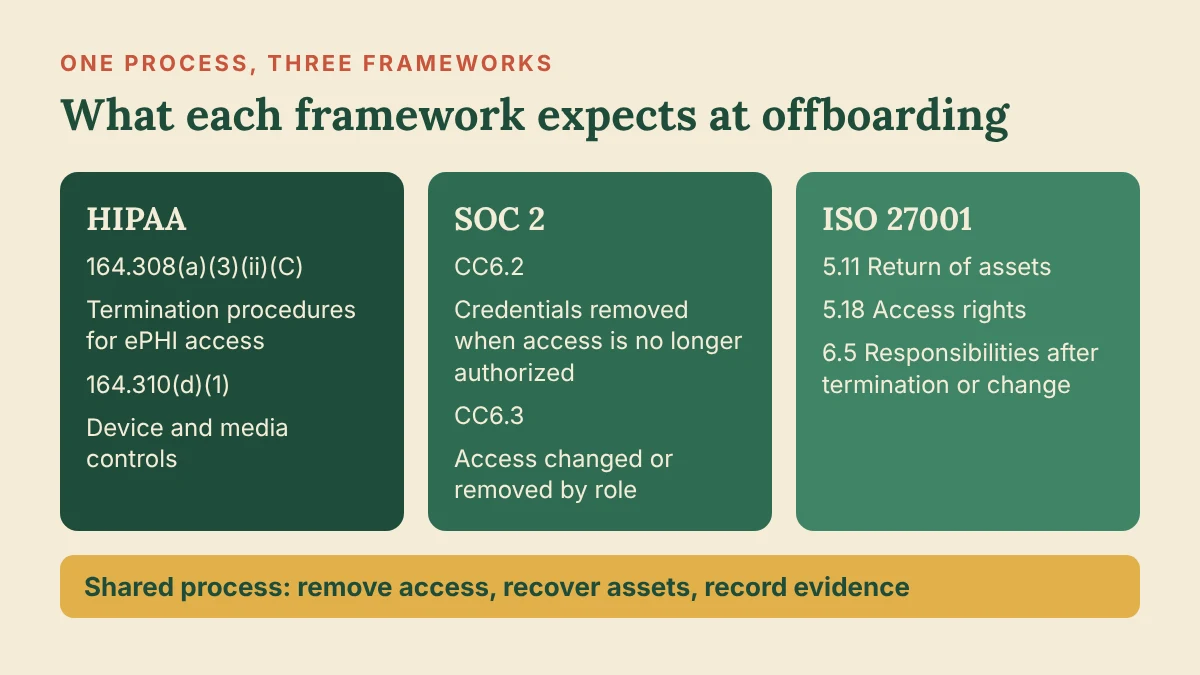
All three expect access to be removed when it is no longer needed, but they describe it in different words. The table maps the main requirements so one process can satisfy each of them.
| Framework | Relevant requirement | What it asks for |
|---|---|---|
| HIPAA Security Rule | 45 CFR 164.308(a)(3)(ii)(C), termination procedures (addressable) | Procedures for terminating access to ePHI when a workforce member's employment or other arrangement ends |
| HIPAA Security Rule | 45 CFR 164.310(d)(1), device and media controls | Policies for the receipt and removal of hardware and electronic media that contain ePHI |
| SOC 2 | Trust Services Criteria CC6.2 and CC6.3 | Credentials removed when access is no longer authorized, and access modified or removed based on roles and responsibilities |
| ISO 27001:2022 | Annex A controls 5.11, 5.18 and 6.5 | Return of assets, management of access rights, and responsibilities that continue after termination or change of employment |
"Addressable" under HIPAA does not mean optional. It means you assess whether the specification is reasonable and appropriate for your environment, and document an equivalent measure if you choose a different approach. For almost every organization that handles ePHI, a documented termination procedure is the reasonable choice.
A note on regulatory change: in its proposed update to the HIPAA Security Rule, HHS proposed requiring notification of certain regulated entities within 24 hours when a workforce member's access to ePHI or certain electronic information systems is changed or terminated. As of November 2026 this is a proposal, not a final rule, but it shows the direction of travel. A fast, documented offboarding process prepares you either way.
For a broader control reference, NIST's SP 800-53 control PS-4 (personnel termination) asks organizations to disable system access within a time period they define, revoke credentials and retrieve organizational property.
What should happen before, on and after the last day?
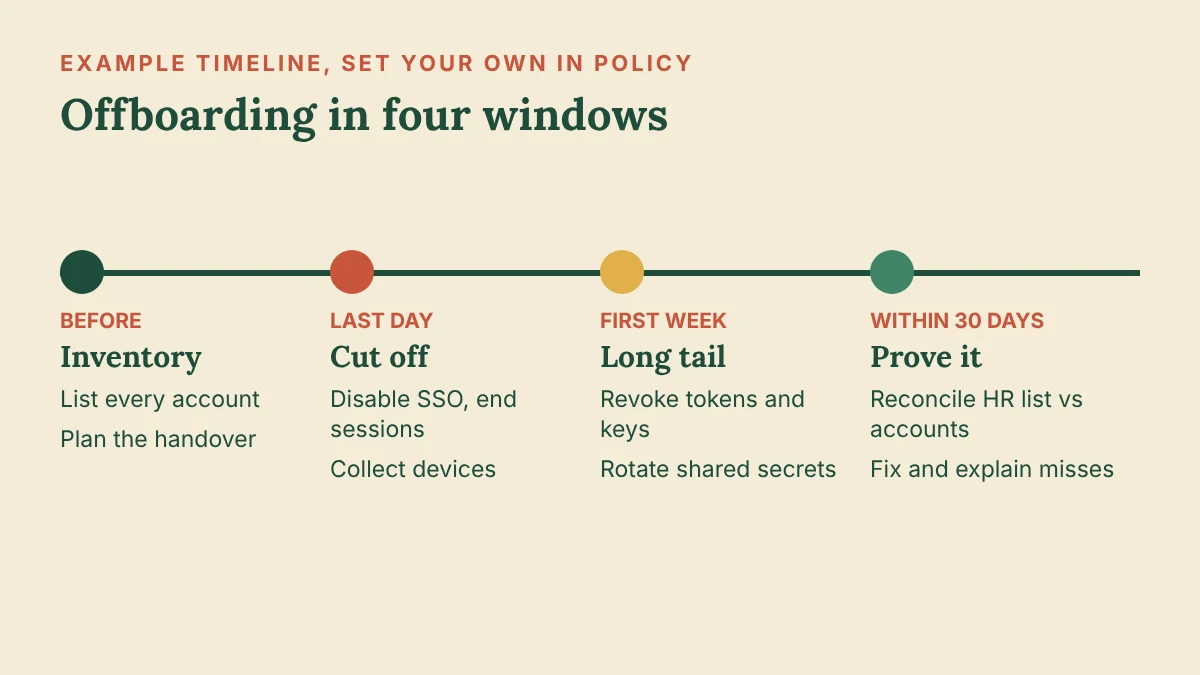
Split offboarding into four windows so each task has an owner and a deadline. The timings below are examples. Set your own in policy and keep to them.
| Window | Goal | Typical owner |
|---|---|---|
| Before the last day | Know everything the person can reach | IT or security, with the manager |
| Last day (or immediately, for involuntary exits) | Cut off access and recover devices | IT, with HR |
| First week | Close the long tail: tokens, shared secrets, data ownership | IT, engineering, system owners |
| Within 30 days | Prove nothing was missed | Security or compliance |
Before the last day. Pull an access inventory for the person from your identity provider, cloud accounts, code platforms and any app that does not use SSO. Ask the manager which shared accounts or secrets the person knew. Plan the handover of files, recurring jobs and customer relationships.
On the last day. Disable the identity provider account and end active sessions. Remove the person from admin groups. Collect laptops, phones, hardware keys and badges. If they used a personal device for work, follow your policy for removing company data from it.
In the first week. Revoke tokens and keys, rotate shared secrets they knew, transfer document ownership, and remove mail forwarding rules. Check that scheduled jobs or integrations do not run under their identity.
Within 30 days. Reconcile the HR leaver list against active accounts across your systems. Anything still active is a finding to fix and explain.
The employee offboarding security checklist
Use this as a starting template and tailor it to your stack.
Identity and access
- Disable the identity provider account and revoke active sessions
- Remove or reset multi-factor authentication factors and hardware keys
- Remove from privileged and admin groups
- Disable accounts in apps that do not use SSO
- Remove from shared vaults and change any shared passwords they knew
Cloud and infrastructure
- Delete or disable cloud IAM users and access keys
- Remove SSH keys from servers and bastion hosts
- Remove VPN and database accounts
- Check that no service accounts or automations depend on their credentials
Code and pipelines
- Remove from code hosting organizations and teams
- Revoke personal access tokens and deploy keys they created
- Rotate secrets stored in CI variables they could read
- Scan for hard-coded credentials tied to the person
Devices and data
- Recover company laptops, phones and removable media
- Lock or wipe managed devices through your device management tool
- Remove company data and ePHI from any personal device used for work
- Transfer ownership of files, shared drives and recurring meetings
People and paperwork
- Remind the person of confidentiality obligations that continue after they leave
- Record the exit date, request time and completion time for each step
- Notify customers or partners whose systems the person could access, where contracts require it
If the person had access to ePHI, add a check that their removal is reflected in your HIPAA risk analysis records of who can access which systems. The same logic applies to departing vendors, covered in our guide to vendor offboarding.
Do role changes and contractors need the same process?
Yes. A person who changes role, or a contractor whose engagement ends, needs the same discipline even though nobody hands back a laptop. SOC 2 CC6.3 covers modifying and removing access based on roles, and ISO 27001 control 6.5 explicitly covers changes of employment, not only terminations.
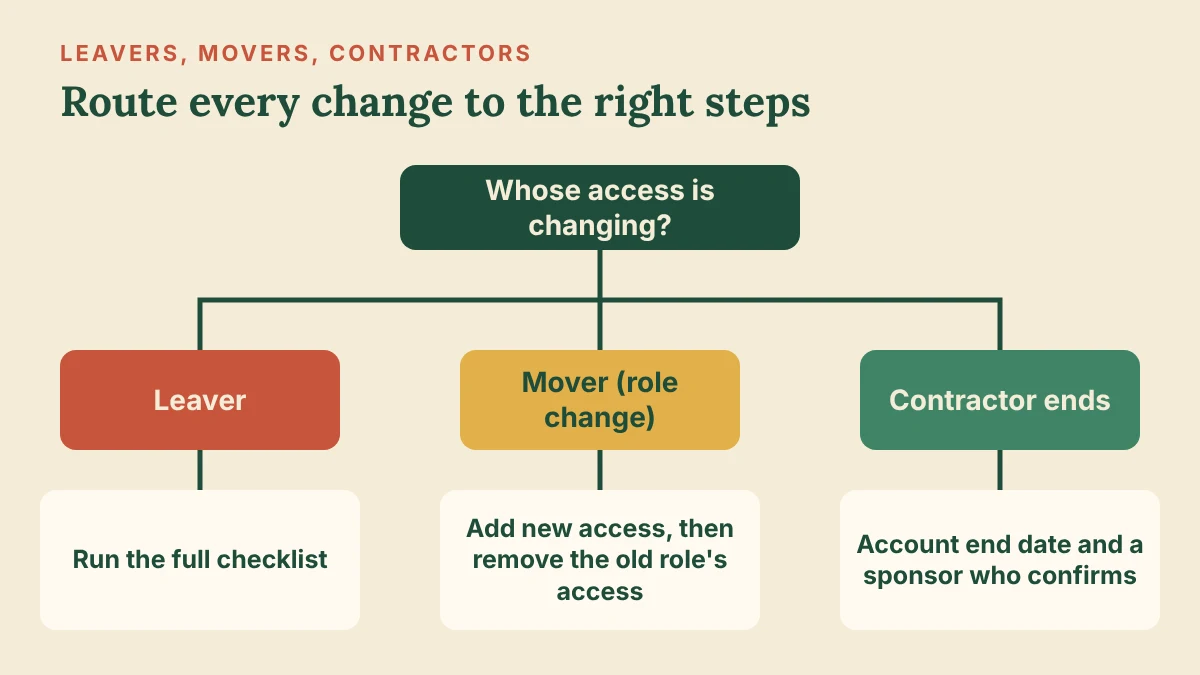
- Leavers: run the full checklist.
- Movers: add the access the new role needs, then remove what the old role had. The common failure is adding without removing, which slowly builds up excessive access.
- Contractors and agency staff: set an end date on their accounts when you create them, and tie access to a named internal sponsor who confirms when the work ends.
What evidence will an auditor ask for?
Auditors want to see a defined process, proof it ran for each leaver in the audit period, and a check that catches misses. Expect requests like these:
- Your offboarding policy or procedure, including the timeframe you commit to for removing access. SOC 2 does not set a number, so pick one you can meet consistently.
- A population of leavers from HR for the audit period.
- Samples from that population, each with a ticket or record showing the request date, the systems removed and the completion time.
- Account reconciliations showing that leavers no longer have active accounts in key systems, often as part of quarterly access reviews.
- Device return records for company hardware.
In our experience, the most common exception is timing: access removed, but days after the termination date with no explanation. A clear policy deadline and an automated trigger from HR to IT closes most of that gap.
How SecureSlate helps
SecureSlate helps HealthTech and SaaS teams run offboarding as a control, not a scramble:
- Agentless read-only cloud integrations to see which accounts exist across your identity provider, cloud and SaaS tools.
- Access reviews to reconcile leavers and movers against active accounts and record the result.
- Device agent to check the security posture of company devices before and after they are returned.
- Code security and secrets detection to find credentials in repositories that should be rotated.
- Multi-framework control mapping across built-in HIPAA, SOC 2 and ISO 27001, so one offboarding control serves all three.
- Audit management to keep tickets, reconciliations and timestamps ready for your auditor.
Start a SecureSlate trial to map your offboarding control across frameworks.
FAQ
How quickly should access be removed when an employee leaves?
HIPAA, SOC 2 and ISO 27001 do not set a fixed number of hours. Define a timeframe in your policy that fits your risk, and remove access immediately for involuntary terminations. Many teams aim for the same business day for core systems, then close the remaining items within a short, documented window.
Is disabling the SSO account enough?
Usually not. SSO shuts off apps that depend on it, but API keys, personal access tokens, local accounts, shared passwords and data on personal devices can remain. Your checklist should cover each of these explicitly.
Is the HIPAA termination procedure required if it is addressable?
Addressable means you must assess whether it is reasonable and appropriate and document your decision, including any alternative measure. It does not mean you can skip it without analysis. For organizations handling ePHI, a documented termination procedure is almost always appropriate.
Does offboarding apply to contractors under SOC 2?
Yes. SOC 2 CC6.2 and CC6.3 apply to users whose access the organization administers, which typically includes contractors. Give contractor accounts an end date and a sponsor who confirms when the engagement finishes.
Disclaimer (legal note)
This article is for general information only and is not legal, regulatory, or professional advice. Requirements vary by framework, industry, and jurisdiction. Consult qualified advisors for your specific obligations.
Need compliance without the complexity?
SecureSlate automates ISO 27001, SOC 2, GDPR, HIPAA, and more. Built for growing teams. See it in action.
Find compliance gaps in 30 seconds