
A cookie policy template gives you a starting point for explaining which cookies and similar technologies your website uses, why, and how visitors can control them. In the EU and UK, the ePrivacy rules require consent before setting non-essential cookies, and GDPR sets the standard for that consent. In the US, laws such as the CCPA and CPRA require notice and the ability to opt out of selling or sharing personal information, which often involves advertising cookies. Below you will find a free cookie policy template you can copy and adapt, followed by the legal rules, banner requirements and tips for keeping the policy accurate.
Related guides: GDPR lawful bases for processing · GDPR privacy policy · GDPR compliance for US companies · Data classification policy
This template is general information, not legal advice. Have it reviewed by counsel for your jurisdictions and business.
Key takeaways
- A cookie policy explains what cookies you use, their purpose, who sets them, how long they last and how to control them.
- In the EU and UK, non-essential cookies need prior consent; strictly necessary cookies do not.
- Consent must be freely given, specific, informed and unambiguous. Pre-ticked boxes do not count.
- Rejecting should be as easy as accepting, and users must be able to withdraw consent at any time.
- Keep the cookie list accurate: scan your site regularly, because tags and vendors change.
What is a cookie policy?
A cookie policy is a public notice, usually linked from your site footer and cookie banner, that describes the cookies and similar technologies (pixels, local storage, SDKs, fingerprinting) used on your website or app. It can be a standalone page or a section of your privacy policy. Its purpose is transparency: visitors should understand what is collected and make an informed choice.
Cookie categories
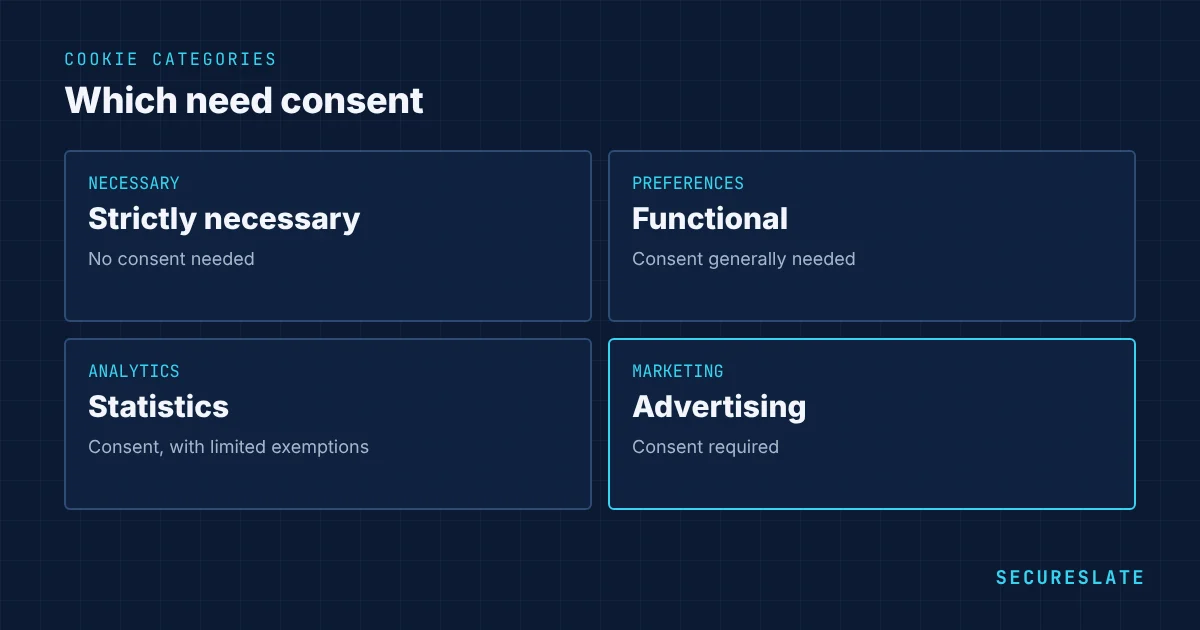
| Category | Purpose | Consent needed in EU and UK? | Examples |
|---|---|---|---|
| Strictly necessary | Required for the site to work or for a service the user explicitly requests | No | Session login, load balancing, shopping cart, security and fraud prevention, storing consent choice |
| Preferences or functional | Remember choices such as language or region | Generally yes | Language setting, chat widget preferences |
| Analytics or statistics | Measure how visitors use the site | Generally yes, with limited exemptions in some countries | Web analytics, heatmaps |
| Marketing or advertising | Track visitors across sites, build profiles, show ads, measure campaigns | Yes | Advertising pixels, retargeting, social media plugins |
Free cookie policy template
Copy the sections below and replace the bracketed text.
Cookie Policy
Last updated: [date]
This Cookie Policy explains how [Company name] ("we", "us") uses cookies and similar technologies on [website URL] and [app name, if relevant]. It should be read together with our [Privacy Policy link].
1. What are cookies?
Cookies are small text files placed on your device when you visit a website. Similar technologies include pixels, tags, local storage and software development kits. We refer to all of these as "cookies" in this policy. Cookies can be "first-party" (set by us) or "third-party" (set by another company), and "session" (deleted when you close your browser) or "persistent" (remain until they expire or you delete them).
2. Why we use cookies
We use cookies to make our website work, remember your preferences, understand how our website is used and, with your consent, to measure and improve our marketing.
3. Types of cookies we use
- Strictly necessary cookies are needed for the website to function and cannot be switched off. They are usually set in response to actions you take, such as logging in or setting privacy preferences.
- Preference cookies remember choices you make, such as language.
- Analytics cookies help us understand how visitors use our website so we can improve it.
- Marketing cookies are used by us and our advertising partners to show relevant ads and measure campaigns.
4. Cookies we use
| Name | Provider | Category | Purpose | Duration |
|---|---|---|---|---|
| [session_id] | [Company] | Strictly necessary | Keeps you signed in | Session |
| [consent_state] | [Consent tool] | Strictly necessary | Stores your cookie choices | [12 months] |
| [lang] | [Company] | Preferences | Remembers your language | [1 year] |
| [analytics cookie] | [Analytics provider] | Analytics | Distinguishes visitors and measures usage | [duration] |
| [ad pixel] | [Ad platform] | Marketing | Measures ad conversions | [duration] |
5. Your choices
When you first visit, we ask for your consent to non-essential cookies. You can accept all, reject all or choose by category. You can change your choices at any time by clicking [Cookie settings link]. You can also block or delete cookies through your browser settings, although some parts of the site may not work.
6. Do Not Sell or Share and Global Privacy Control
[For US visitors where applicable:] Some marketing cookies may be considered a "sale" or "sharing" of personal information under certain US state laws. You can opt out through [Your Privacy Choices link]. We honor Global Privacy Control signals as an opt-out where required by law.
7. International transfers
Some cookie providers may process data outside your country. See our Privacy Policy for how we protect international transfers.
8. Changes to this policy
We may update this policy when our use of cookies changes. The "Last updated" date shows when it was last revised.
9. Contact us
Questions? Contact [privacy email] or [postal address]. [If applicable: our Data Protection Officer can be reached at ...]
The legal rules behind cookies
EU: ePrivacy Directive and GDPR
Article 5(3) of the ePrivacy Directive requires consent before storing or accessing information on a user's device, unless it is strictly necessary for a service the user requested or solely for transmitting a communication. GDPR defines what valid consent means. The Court of Justice of the EU confirmed in the Planet49 case (2019) that pre-ticked boxes are not valid consent. National regulators such as France's CNIL have fined companies for making rejection harder than acceptance.
UK: PECR and UK GDPR
The Privacy and Electronic Communications Regulations apply similar rules. The Data (Use and Access) Act 2025 introduced some new exemptions for low-risk purposes, such as certain analytics, subject to conditions like giving users a way to object. Check current ICO guidance before relying on an exemption.
US: state privacy laws
There is no federal cookie consent law, but states such as California (CCPA as amended by CPRA), Colorado, Connecticut, Virginia and others require privacy notices and opt-outs for targeted advertising or the sale or sharing of personal information. California and some other states require honoring opt-out preference signals such as Global Privacy Control.
Other regions
Brazil's LGPD, Canada's privacy laws and others have their own expectations. If you have global traffic, many companies apply the strictest standard everywhere or use geo-targeted banners.
Cookie banner requirements
| Requirement | Good practice |
|---|---|
| Prior consent | Do not load non-essential cookies until the user consents |
| Equal choice | "Reject all" as visible and easy as "Accept all" on the first layer |
| Granular control | Allow choices by category |
| No pre-ticked boxes | Categories off by default |
| Clear information | Short explanation and a link to the cookie policy |
| Easy withdrawal | Persistent "Cookie settings" link in the footer |
| Records | Keep consent logs with time, version and choices |
| No cookie walls | Avoid blocking access unless consent is truly optional, as many regulators reject cookie walls |
How to keep your cookie policy accurate
- Scan your site with a cookie scanning tool at least monthly and after releases.
- Control tags. Require approval before marketing adds new pixels or tag manager scripts.
- Test consent. Check that non-essential cookies do not fire before consent and stop after withdrawal.
- Review vendors. Confirm contracts and data protection terms with analytics and ad providers.
- Update the date and the cookie table whenever something changes.
Common mistakes
- Copying another company's cookie list that does not match your site
- Banner that only has "Accept" and "Settings"
- Analytics or ad tags firing before consent
- No way to change choices after the first visit
- Cookie policy last updated years ago
- Ignoring app SDKs and server-side tracking
How SecureSlate helps
SecureSlate helps small and mid-size teams manage the privacy program behind the cookie policy: GDPR and CCPA control mapping, privacy policy and data processing templates, vendor risk reviews for analytics and advertising providers, records of processing and evidence for auditors. Surface monitoring helps you see what your public website exposes.
FAQ
Do I need a cookie policy?
If your website uses cookies and you have visitors from the EU, UK or many US states, you need to disclose your cookie use, and in the EU and UK obtain consent for non-essential cookies. A cookie policy is the standard way to disclose it.
Can my cookie policy be part of my privacy policy?
Yes. Many companies include a cookie section in the privacy policy, as long as it is clear and easy to find from the banner.
Do strictly necessary cookies need consent?
No, in the EU and UK they are exempt from consent, but you should still describe them in your policy.
Is Google Analytics allowed without consent?
In most EU countries, analytics cookies require consent. Some countries, and the UK under recent changes, allow limited exemptions for certain analytics configurations. Check local guidance.
How often should I update my cookie policy?
Whenever you add or remove cookies or vendors, and review it at least every few months with a site scan.
Disclaimer (legal note)
SecureSlate is not a law firm, and this article does not constitute or contain legal advice or create an attorney-client relationship. When determining your obligations and compliance with respect to relevant laws and regulations, you should consult a licensed attorney.
Need compliance without the complexity?
SecureSlate automates ISO 27001, SOC 2, GDPR, HIPAA, and more. Built for growing teams. See it in action.
Find compliance gaps in 30 seconds