
Short answer: GDPR training courses teach staff how to handle personal data lawfully. The GDPR does not set one mandatory course, but accountability and security duties make training a practical necessity, and DPOs must oversee staff training. Most organizations need short awareness training for everyone, deeper role-based modules for teams handling personal data, and specialist courses for privacy leads.
Related guides: Security awareness training policy · The 7 GDPR principles · GDPR data subject rights
Key takeaways
- The GDPR has no single mandatory course, but Articles 5(2), 24, 32(4) and 39 make trained staff part of showing compliance.
- One generic e-learning module is not enough for engineers, support agents or marketers who make privacy decisions every day.
- Match courses to roles: awareness for all, role-based for data handlers, specialist for privacy leads and DPOs.
- Judge providers on accuracy, relevance and evidence, not on certificates alone.
- Keep records: who completed what, when, with what score, and how you followed up on gaps.
Is GDPR training a legal requirement?
GDPR training is not spelled out as a standalone obligation for every organization, but several articles make it hard to comply without it.
The GDPR links training to compliance in these places:
| Provision | What it says | Why it points to training |
|---|---|---|
| Article 5(2) | The controller is responsible for, and must be able to demonstrate, compliance with the principles | Training records are common evidence of accountability |
| Article 24(1) | Controllers implement appropriate technical and organisational measures | Staff training is a standard organisational measure |
| Article 32(4) | Controllers and processors take steps so that people acting under their authority process data only on instructions | Staff need to know what the instructions are |
| Article 39(1)(b) | The DPO monitors compliance, including awareness-raising and training of staff | Where a DPO is required, training sits in their remit |
| Article 47(2)(n) | Binding corporate rules must specify data protection training for personnel with permanent or regular access to personal data | An explicit training requirement for groups using BCRs |
Supervisory authorities also tend to look at staff awareness after an incident. If an employee mishandled data and no training existed, it is harder to argue that appropriate organisational measures were in place.
For health tech teams, GDPR training often runs alongside HIPAA, which does require a security awareness and training program under 45 CFR 164.308(a)(5). Our guide to HIPAA training requirements covers that side.
What types of GDPR training courses are there?
GDPR training courses fall into four types: general awareness, role-based modules, specialist practitioner courses and live workshops.
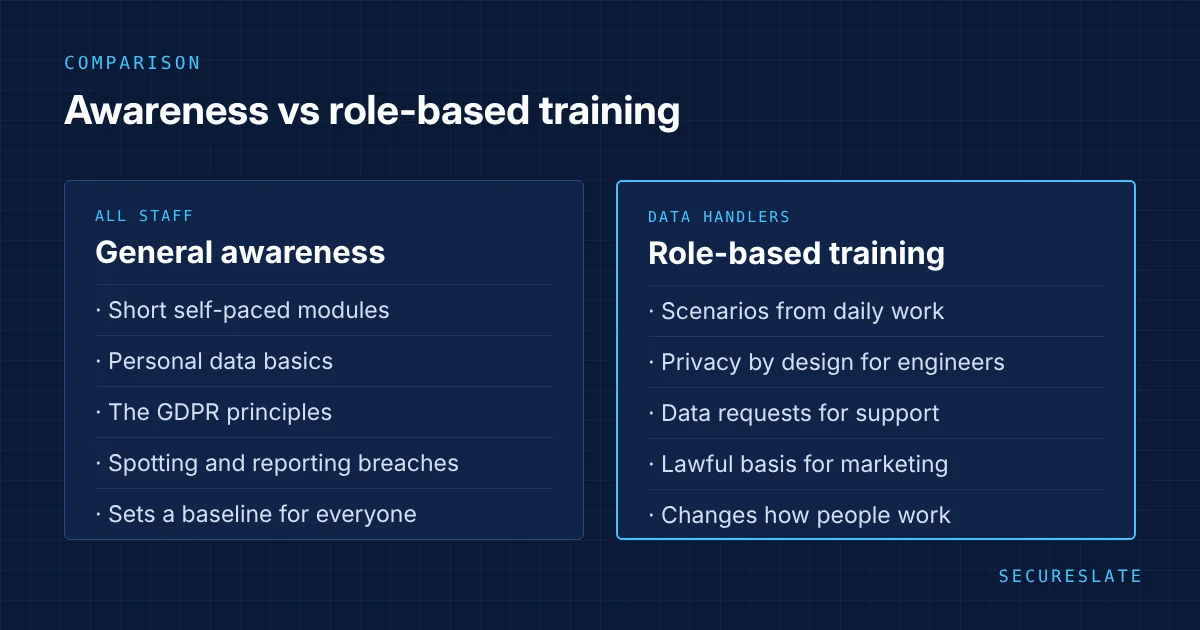
- General awareness e-learning. Short self-paced modules for all staff. They cover what personal data is, the principles, recognizing a breach and who to ask. Good for scale, weak on depth.
- Role-based modules. Targeted content for engineering, support, sales, marketing, HR and leadership. These change behavior because they use scenarios people actually face.
- Specialist and professional courses. Longer programs for DPOs, privacy managers and legal teams, often leading to a personal qualification. They cover DPIAs, transfers, legal bases and regulator engagement in depth.
- Live workshops and tabletop exercises. Facilitated sessions such as a breach simulation or a walkthrough of a real data subject request. Useful for teams that make time-critical decisions.
A practical program combines them. Awareness training sets a floor, and role-based content and exercises do most of the real work. In our experience, the teams that get the most from training revisit real cases from their own product, such as a recent access request or a near-miss, because staff remember situations they recognize far better than abstract rules.
Which staff need which GDPR course?
Every employee needs awareness training, and anyone who designs, accesses or makes decisions about personal data needs role-based training on top.
| Role | Recommended training | Focus topics |
|---|---|---|
| All staff and contractors | Awareness e-learning | Personal data basics, principles, phishing and breach reporting, acceptable use |
| Engineering and product | Role-based module plus design reviews | Privacy by design, data minimisation, logging, test data, retention and deletion |
| Customer support | Role-based module plus request drills | Identity verification, data subject requests, sharing data safely |
| Sales and marketing | Role-based module | Lawful basis for outreach, consent, cookies, ePrivacy rules, lead data sources |
| HR and people teams | Role-based module | Employee data, special category data, retention, monitoring |
| Leadership | Short briefing | Accountability, risk appetite, fines and enforcement, incident decisions |
| Privacy lead or DPO | Specialist practitioner course | DPIAs, transfers, records of processing, regulator engagement |
If you handle health data, add special category data under Article 9 to engineering, support and HR modules, since mistakes there carry higher risk.
What should a GDPR course cover?
A good GDPR course covers the principles, lawful bases, individual rights, security and breach handling, and how each applies to the learner's daily work.
Use this checklist when reviewing a course outline:
- What counts as personal data and special category data, with examples from your sector
- The seven principles in Article 5, including accountability
- Lawful bases for processing and when consent is or is not appropriate
- Data subject rights and the one-month response timeline, extendable in some cases
- Recognizing and escalating a personal data breach, including the 72-hour notification rule for controllers under Article 33
- Security basics: access control, phishing, device and password hygiene
- International transfers in plain terms
- Working with processors and sub-processors
- Where to find your internal policies and who to contact
For breach handling detail, see our guide to GDPR breach notification requirements.
How do you evaluate a GDPR training provider?
Evaluate a GDPR training provider on accuracy, relevance to your roles, learning design and the evidence it produces.
- Check accuracy. Ask who writes and reviews the content, and when it was last updated. Outdated material on transfers or cookies is common.
- Test relevance. Look for role-based paths and scenarios that resemble your product and sector. A course built for retail may confuse a health tech support team.
- Review learning design. Short modules, realistic scenarios and knowledge checks beat long slide decks.
- Confirm language and accessibility for every country where you employ people.
- Look at the evidence output. You need completion records with names, dates, versions and scores that you can export or sync.
- Check integration. Can it connect to your identity provider or HR system so new joiners are enrolled automatically?
- Decide on build versus buy. Off-the-shelf awareness courses plus short internal modules on your own policies is a common, effective mix.
Be cautious with course marketing. A completion certificate shows a person finished a course. It does not make your company "GDPR certified."
How often should you train, and what should you record?
Train at onboarding, refresh at least yearly and add targeted sessions when roles, systems or rules change.
The GDPR does not set a frequency. Annual refreshers are a common practice and match what many security frameworks expect, and onboarding training means new joiners are not handling data untrained. Add sessions after incidents, new product launches that involve personal data and significant regulatory changes.
Keep records that would satisfy an auditor or regulator:
- Training matrix by role, showing which course each role must complete
- Completion records with name, course version, date and score
- Overdue list and follow-up actions
- Policy acknowledgments linked to training
- Evidence of role-based sessions, such as attendance and materials for workshops
- An annual review of the program, with changes made
How SecureSlate helps
SecureSlate helps you track GDPR training as part of the wider compliance program. It does not provide GDPR courses or issue certifications.
- Multi-framework control mapping with built-in GDPR, ISO 27001, SOC 2 and HIPAA frameworks, so one training program evidences several frameworks.
- Device agent and access reviews to evidence the security measures your training describes.
- Risk management to record training gaps and follow-up actions.
- Vendor risk management to assess third-party training providers that receive employee data.
- Audit management to collect training evidence for auditors in one place.
FAQ
Is GDPR training mandatory for all employees?
The GDPR does not name a mandatory course for every employee. In practice, accountability and security duties make training a standard measure, and binding corporate rules must include data protection training for staff with regular access to personal data.
How long should GDPR awareness training take?
There is no set length. Short modules that staff complete in one sitting usually work better than long courses, with deeper role-based content for teams that handle personal data.
Do GDPR training certificates count as company certification?
No. A training certificate shows an individual completed a course. Organizational certification under the GDPR works through approved Article 42 schemes.
Who should deliver GDPR training?
Many organizations use an external provider for general awareness and have the privacy lead or DPO deliver short internal sessions on company policies and real scenarios.
Can one course cover GDPR and HIPAA?
A combined privacy and security awareness course can cover shared basics such as phishing and breach reporting, but the legal rules differ, so keep separate modules for GDPR and HIPAA specifics.
Disclaimer (legal note)
This article is for general information only and is not legal, regulatory, or professional advice. Requirements vary by framework, industry, and jurisdiction. Consult qualified advisors for your specific obligations.
Need compliance without the complexity?
SecureSlate automates ISO 27001, SOC 2, GDPR, HIPAA, and more. Built for growing teams. See it in action.
Find compliance gaps in 30 seconds