
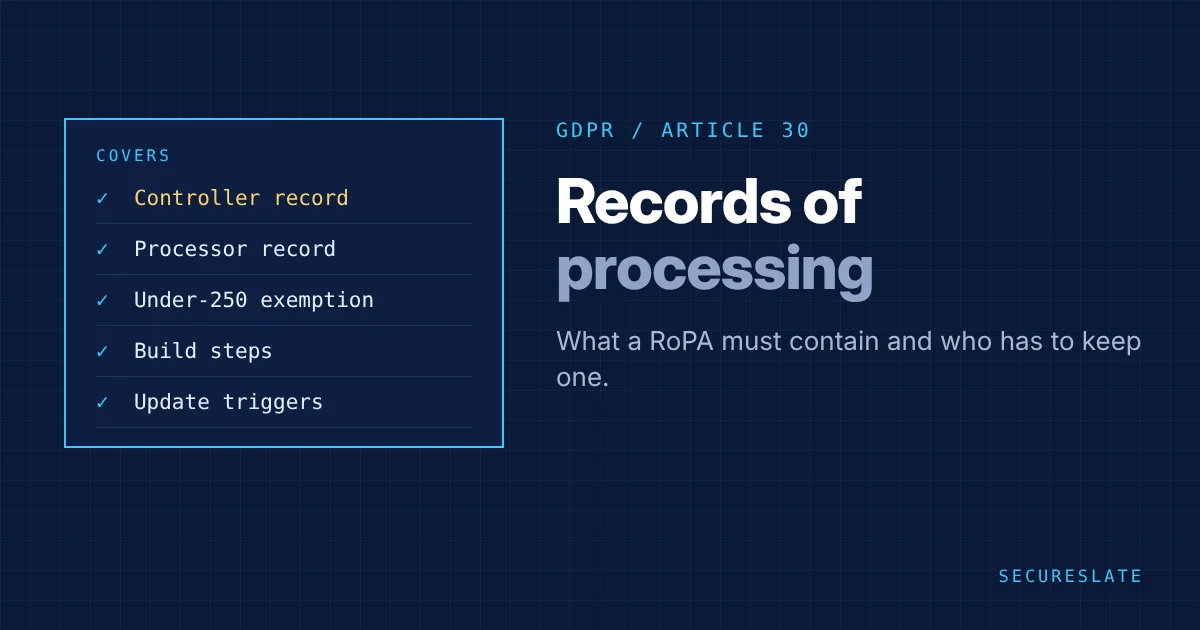
Short answer: GDPR Article 30 requires controllers and processors to keep a written record of their processing activities, often called a RoPA. A controller's record lists purposes, data categories, recipients, transfers, retention periods and security measures. The record must be given to a supervisory authority on request. A narrow exemption exists for organisations with fewer than 250 employees.
Related guides: GDPR data mapping · GDPR Article 32 security of processing · Data processing agreements
Key takeaways
- Article 30 applies to both controllers and processors, with a different list of required content for each.
- The record must be in writing, including electronic form, and available to the supervisory authority on request. You do not file it proactively.
- The under-250-employee exemption rarely applies in practice, because it falls away when processing is not occasional, is likely to result in a risk, or involves special category or criminal offence data.
- A RoPA is the foundation for the rest of your GDPR program: privacy notices, DPIAs, access requests and breach response all depend on it.
- Treat the record as a living document with an owner per processing activity and a fixed review cycle.
What does GDPR Article 30 require?
Article 30 requires each controller and processor to maintain a record of the processing activities under its responsibility. The text sits in Chapter IV of the GDPR, next to the other accountability duties such as data protection by design (Article 25), processor contracts (Article 28) and security of processing (Article 32).
The article has five paragraphs:
| Paragraph | What it says |
|---|---|
| 30(1) | Controllers, and their representatives where applicable, keep a record with seven listed items. |
| 30(2) | Processors, and their representatives where applicable, keep a record of all categories of processing carried out on behalf of each controller. |
| 30(3) | Records must be in writing, including in electronic form. |
| 30(4) | The controller, processor or representative makes the record available to the supervisory authority on request. |
| 30(5) | Organisations employing fewer than 250 persons are exempt, unless one of three conditions applies. |
Article 30 is one of the main ways an organisation shows accountability under Article 5(2), the principle that a controller must be able to demonstrate compliance. When a supervisory authority opens an inquiry, the record is typically one of the first documents it asks for, because it shows in a few pages whether the organisation knows what personal data it handles and why.
Who must keep a record, and who is exempt?
Almost every organisation that processes personal data as a regular part of its business must keep a record, because the exemption in Article 30(5) is much narrower than it first appears.
The exemption covers an enterprise or organisation employing fewer than 250 persons. It does not apply if any one of the following is true:
- The processing is likely to result in a risk to the rights and freedoms of data subjects.
- The processing is not occasional.
- The processing includes special categories of data under Article 9(1), or personal data relating to criminal convictions and offences under Article 10.
The second condition is the one that catches most small companies. Payroll, customer accounts, marketing lists and support tickets are all regular, ongoing processing. A ten-person SaaS startup that runs a CRM and pays staff every month is processing personal data on a non-occasional basis, so it needs a record for those activities. A HealthTech company handling health data needs one regardless of headcount, because health data is a special category.
A proposed change to watch. In May 2025 the European Commission proposed targeted amendments to the GDPR that would raise the threshold to fewer than 750 employees and limit the record-keeping duty for those organisations to processing likely to result in a high risk. The European Data Protection Board and European Data Protection Supervisor commented on the proposal in a joint opinion in July 2025. This is a proposal. Until an amendment is adopted and applies, the current Article 30(5) text governs, so check the legislative status before relying on any wider exemption.
What must a controller's record contain?
A controller's record must contain the seven items listed in Article 30(1)(a) to (g) for each processing activity.
| Article 30(1) item | What to record | Example entry (recruitment) |
|---|---|---|
| (a) Identity and contacts | Name and contact details of the controller and, where applicable, any joint controller, the controller's representative and the data protection officer | Company legal name, privacy contact, DPO email |
| (b) Purposes | Why the data is processed | Assess candidates and manage hiring |
| (c) Data subjects and data categories | Categories of people and of personal data | Job applicants: CV, contact details, interview notes |
| (d) Recipients | Categories of recipients, including those in third countries or international organisations | Applicant tracking system provider, hiring managers |
| (e) International transfers | Transfers to a third country or international organisation, naming the destination, plus documentation of suitable safeguards for transfers under the second subparagraph of Article 49(1) | Transfer to a US-based vendor under standard contractual clauses |
| (f) Retention | Where possible, the envisaged time limits for erasure of each data category | Unsuccessful applicants deleted after a defined period |
| (g) Security | Where possible, a general description of the technical and organisational security measures referred to in Article 32(1) | Role-based access, encryption, SSO with MFA |
Article 30 does not require you to record the lawful basis, the source of the data or a link to the relevant DPIA. Most organisations add those columns anyway, because other articles require you to know them. Recording the lawful basis supports the transparency duties in Articles 13 and 14, and noting whether a data protection impact assessment exists makes the record far more useful during an audit.
What must a processor's record contain?
A processor's record is shorter and is organised by customer rather than by purpose. Under Article 30(2), a processor records:
- the name and contact details of the processor or processors and of each controller on whose behalf it acts, and where applicable the representative and the data protection officer
- the categories of processing carried out on behalf of each controller
- transfers to a third country or international organisation, naming the destination, with documentation of safeguards for transfers under the second subparagraph of Article 49(1)
- where possible, a general description of the technical and organisational security measures referred to in Article 32(1)
Most B2B software companies are both. They are a controller for employee, prospect and billing data, and a processor for the data customers load into the product. That means two records, or one register with two clearly separated parts. A processor that uses sub-processors should make sure its record of transfers and its sub-processor list tell the same story, because customers and regulators compare them.
How do you build a RoPA step by step?
Build the record by inventorying processing activities across each business function, then filling in the Article 30 fields for each one and assigning an owner.
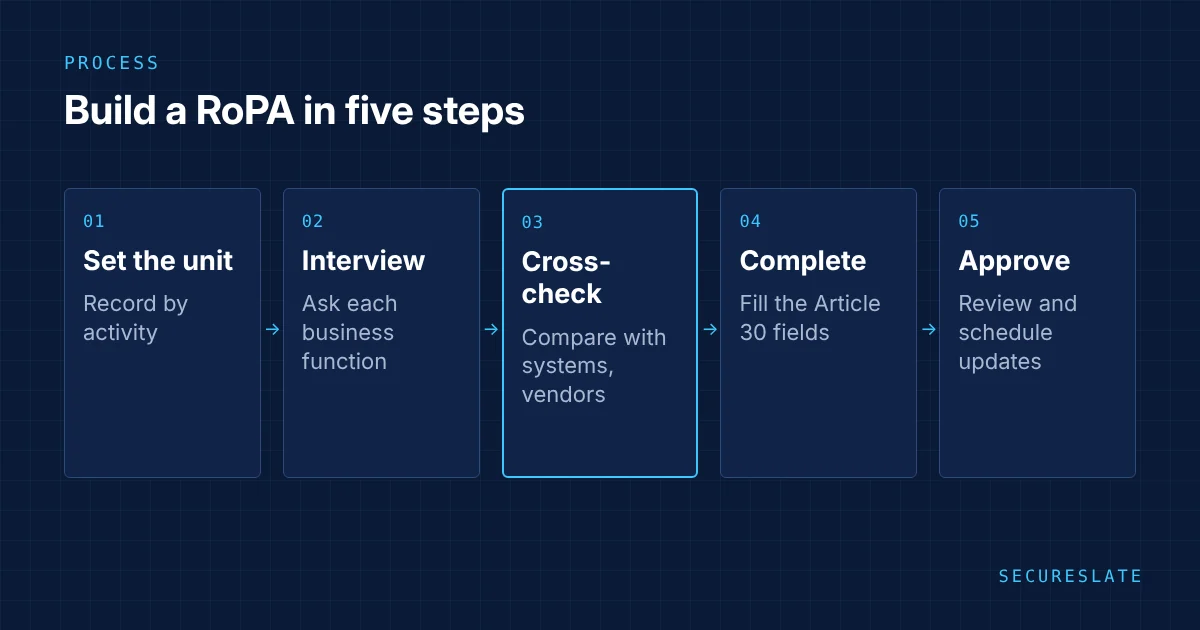
- Decide the unit of record. Record by processing activity (for example "payroll", "customer support", "product analytics"), not by system or by individual data field. A typical small company ends up with a few dozen activities, which is manageable.
- Interview each function. Speak with HR, sales, marketing, product, engineering, support and finance. Ask what personal data they collect, why, where it is stored, who receives it and when it is deleted.
- Cross-check against systems. Compare the answers with your SaaS inventory, cloud accounts and vendor list. Shadow tools and forgotten exports usually surface here. A data mapping exercise gives you this input.
- Complete the Article 30 fields. Fill in every required item, then add the optional columns you need: lawful basis, source, DPIA reference, processor contract in place, and owner.
- Review, approve and schedule. Have the privacy lead or DPO review entries for consistency, record an approval date, and set the next review.
A spreadsheet is a valid format. Article 30(3) only requires that the record is in writing, including electronic form. What matters is that it is complete, current and can be produced quickly when asked.
How do you keep the record current?
Keep the record current by tying updates to the events that change processing, and by running a scheduled review as a backstop.
Use this checklist of update triggers:
- A new vendor or sub-processor that handles personal data is onboarded
- A new product feature collects a new category of data or uses data for a new purpose
- Data starts moving to a new country
- A retention period changes or a system is decommissioned
- A DPIA is completed or revised
- A business function is reorganised, acquired or closed
The simplest way to make these triggers work is to embed one question in existing processes: procurement intake, product design review and change management should each ask "does this change what personal data we process, and has the record been updated?" In addition, review the full record at least annually. In our experience, records that depend only on an annual review drift out of date within months.
What mistakes do regulators and auditors find?
The most common finding is a record that exists but does not match reality. Other frequent problems:
- Claiming the small-organisation exemption without checking the three conditions that remove it.
- Recording systems instead of activities, which produces hundreds of rows nobody maintains.
- Vague entries such as "business purposes" or "as long as necessary" that do not let a reader understand the processing.
- Missing processor record, where a SaaS company documents its own data but not what it does for customers.
- Transfers left blank, even though vendors host or access data outside the EEA.
- No owner or review date, so nobody is responsible for accuracy.
Article 30 sits within the group of controller and processor obligations in Articles 25 to 39. Under Article 83(4)(a), infringements of those obligations can attract administrative fines of up to EUR 10 million or 2% of total worldwide annual turnover of the preceding financial year, whichever is higher. More often, a weak record is a symptom that leads a regulator to look harder at everything else.
How SecureSlate helps
SecureSlate gives you one place to manage GDPR alongside your other frameworks. GDPR is a built-in framework, with controls mapped across SOC 2, ISO 27001, HIPAA and others, so evidence collected once supports several requirements. Vendor risk management tracks the processors and sub-processors that appear in your record, and agentless read-only cloud integrations help you confirm which systems actually hold data. Risk management and audit management keep reviews, owners and findings in one workflow, and you can add custom controls for record-keeping tasks specific to your business.
SecureSlate does not perform audits or issue certifications. It helps you organise and evidence the work. Start a free trial to see how it fits your program.
FAQ
Is a RoPA mandatory under GDPR?
Yes, for most organisations. Article 30 requires controllers and processors to keep a record of processing activities. The exemption for organisations with fewer than 250 employees does not apply when processing is regular, risky, or involves special category or criminal offence data.
Do you have to submit the record to a supervisory authority?
No. There is no duty to file the record proactively. Article 30(4) requires you to make it available to the supervisory authority on request, so it must be ready to hand over at short notice.
Does a processor need its own record?
Yes. Article 30(2) requires processors to keep a record of the categories of processing carried out on behalf of each controller, plus transfers and a general description of security measures.
How often should a RoPA be updated?
The GDPR sets no fixed interval, but the record must reflect current processing. Update it whenever processing changes, and run a full review at least once a year.
Disclaimer (legal note)
This article is for general information only and is not legal, regulatory, or professional advice. Requirements vary by framework, industry, and jurisdiction. Consult qualified advisors for your specific obligations.
Need compliance without the complexity?
SecureSlate automates ISO 27001, SOC 2, GDPR, HIPAA, and more. Built for growing teams. See it in action.
Find compliance gaps in 30 seconds