
Short answer: GDPR certification exists, but not as a single company-wide "GDPR certified" badge. Article 42 lets approved schemes certify specific processing operations, issued by accredited certification bodies or supervisory authorities for up to three years. It is voluntary, it helps demonstrate compliance, and it does not reduce your legal responsibility.
Related guides: ISO 27701 vs GDPR · How GDPR and ISO 27001 work together · GDPR processor due diligence
Key takeaways
- Article 42 certification is real and voluntary. Schemes must be approved by a supervisory authority or, for EU-wide seals, through the European Data Protection Board.
- Certification covers processing operations, not your whole company, and lasts a maximum of three years, renewable.
- It does not reduce your responsibility under GDPR, but the regulation lets you use it as an element to demonstrate compliance in several places.
- Most SaaS and health tech teams, in our experience, meet buyer expectations with ISO 27001, ISO 27701 or SOC 2 plus a solid GDPR program, rather than an Article 42 scheme.
- Be careful with the phrase "GDPR certified" in marketing. It can mislead buyers if no approved scheme stands behind it.
Is there an official GDPR certification?
Yes, there is an official route, but it certifies defined processing operations under approved schemes rather than declaring an organization "GDPR compliant."
Article 42 of the GDPR tells Member States, supervisory authorities, the European Data Protection Board (EDPB) and the Commission to encourage data protection certification mechanisms, seals and marks. The regulation does not create one central certificate. Instead, scheme owners write certification criteria, and those criteria must be approved before certificates can be issued.
There are two kinds of approved scheme:
| Scheme type | Who approves the criteria | Where it applies |
|---|---|---|
| National certification | The competent supervisory authority, after an EDPB opinion | Usually the Member State of that authority |
| European Data Protection Seal | The EDPB, as common certification | Across the EEA |
The EDPB keeps a register of certification mechanisms, seals and marks. As of November 2026, it lists national schemes approved in individual Member States and Europrivacy as a European Data Protection Seal. Check the register directly before relying on any scheme, because entries change.
How does Article 42 certification work?
Article 42 certification works through accredited bodies that audit a defined processing operation against approved criteria and issue a time-limited certificate.
The key rules in Articles 42 and 43 are:
- Voluntary and transparent. Article 42(3) says certification "shall be voluntary and available via a process that is transparent."
- Issued by accredited bodies or authorities. Under Article 42(5), certificates come from certification bodies under Article 43 or from the competent supervisory authority.
- Accreditation standard. Article 43 provides for certification bodies to be accredited by the supervisory authority, the national accreditation body or both. National accreditation bodies work to EN-ISO/IEC 17065/2012 plus additional requirements set by the supervisory authority.
- Three-year maximum. Article 42(7) limits certificates to a maximum of three years. They can be renewed if requirements are still met and withdrawn if they are not.
- No reduction in responsibility. Article 42(4) says certification does not reduce the responsibility of the controller or processor.
A typical certification project follows these steps:
- Pick an approved scheme that matches your role (controller or processor) and the jurisdiction you need.
- Define the target of evaluation: the processing operations, systems and data flows to be certified.
- Run a gap assessment against the scheme's criteria, which usually go deeper than general GDPR checklists.
- Remediate and document, including records of processing, legal bases, data subject rights handling, security measures and processor contracts.
- Undergo the audit by an accredited certification body.
- Maintain the certificate through monitoring and renewal before the three-year limit.
Where does GDPR certification count?
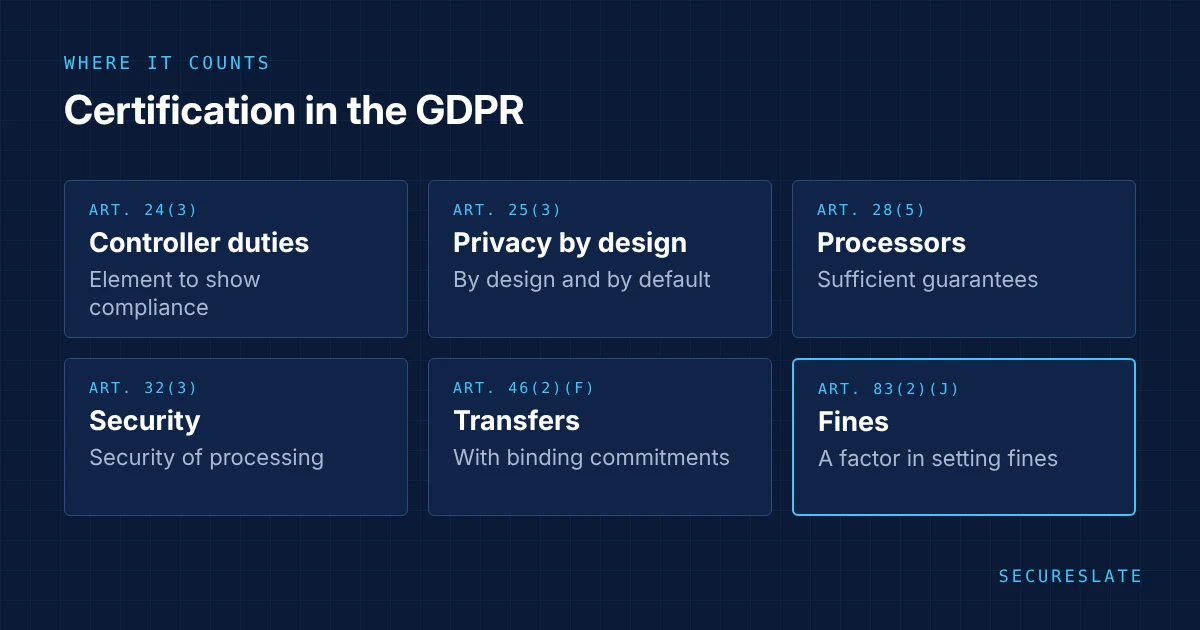
GDPR certification counts wherever the regulation says an approved certification mechanism may be used as an element to demonstrate compliance.
| GDPR provision | How certification is used |
|---|---|
| Article 24(3) | Element to demonstrate the controller's compliance with its obligations |
| Article 25(3) | Element to demonstrate data protection by design and by default |
| Article 28(5) | Element to show a processor gives sufficient guarantees |
| Article 32(3) | Element to demonstrate security of processing |
| Article 46(2)(f) | Transfer safeguard when combined with binding and enforceable commitments in the third country |
| Article 83(2)(j) | Adherence to approved certification is one factor authorities consider when setting fines |
The wording matters: certification is "an element" of demonstrating compliance, not proof on its own. A regulator or customer can still look behind the certificate. Our guide to GDPR enforcement and penalties explains how fines are assessed.
For processors, Article 28(5) is the most commercially useful. A certificate can make it easier for customers to document that they chose a processor with sufficient guarantees, which is why it sometimes appears in data processing agreements.
What are the alternatives to GDPR certification?
The common alternatives are ISO/IEC 27001, ISO/IEC 27701 and SOC 2, which buyers recognize widely but which are not Article 42 certifications.
| Option | What it is | How it relates to GDPR |
|---|---|---|
| Article 42 scheme or seal | Certification of processing operations against approved GDPR criteria | Directly referenced in the GDPR |
| ISO/IEC 27701 | Privacy information management standard, certifiable by accredited bodies | Maps well to GDPR duties but is not an approved Article 42 scheme |
| ISO/IEC 27001 | Information security management system certification | Strong evidence for Article 32 security, but does not cover lawful basis, rights or transparency |
| SOC 2 | Attestation report by a CPA firm on controls against the AICPA Trust Services Criteria | Security and optional privacy criteria help with due diligence, not a GDPR certification |
| Personal privacy credentials | Qualifications for individuals, such as DPOs and privacy managers | Show staff competence, not organizational compliance |
In our experience, B2B buyers in Europe ask first for ISO 27001 and a signed DPA, then for evidence of GDPR processes such as records of processing and breach procedures. Article 42 schemes are more often requested in specific sectors or public procurement.
Can you call your company GDPR certified?
Only if you hold a certificate under an approved Article 42 scheme, and even then the claim should name the scheme and the processing operations it covers.
Phrases such as "GDPR certified platform" without an approved scheme behind them can mislead buyers into thinking a regulator or accredited body has approved the whole company. Safer wording describes what you actually have:
- "ISO 27001 certified, with a GDPR program covering records of processing, DPIAs and data subject requests."
- "Our [named] processing service holds certification under [scheme], valid until [date]."
- "We sign GDPR-compliant DPAs with standard contractual clauses for transfers."
Training course certificates for staff are also not company certifications. They show that individuals completed a course.
How to decide which route fits
Choose the route that answers what your buyers and regulators actually ask for, starting with the GDPR program itself.
Use this checklist:
- Do customers or tenders explicitly name an Article 42 scheme or the European Data Protection Seal? If yes, scope that scheme.
- Do customers mainly ask for security assurance? ISO 27001 or SOC 2 is usually the faster win.
- Do you process large volumes of personal or health data as a processor? ISO 27701 on top of ISO 27001 often helps.
- Do you transfer data out of the EEA and want a certification-based safeguard? Talk to counsel, because Article 46(2)(f) also needs binding commitments.
- Is your core GDPR program in place: records of processing, legal bases, DPIAs, rights handling, breach procedures and processor contracts? Certification of any kind will expose gaps here first.
How SecureSlate helps
SecureSlate helps teams run the GDPR program that any certification rests on. It does not perform audits or issue certifications.
- Multi-framework control mapping with built-in GDPR, ISO 27001, SOC 2 and HIPAA frameworks. An Article 42 scheme or ISO 27701 can be set up as a custom framework.
- Vendor risk management for processor due diligence and sub-processor tracking.
- Risk management for DPIA follow-up and privacy risks.
- Agentless, read-only cloud integrations, a device agent and access reviews to evidence Article 32 security measures.
- Trust center and security questionnaire automation to share accurate privacy and security information with buyers.
- Audit management to work with your certification body.
FAQ
Is GDPR certification mandatory?
No. Article 42(3) says certification is voluntary. GDPR compliance is mandatory for organizations in scope, but certification is optional.
How long does a GDPR certificate last?
Under Article 42(7), a maximum of three years. It can be renewed if the requirements continue to be met and withdrawn if they are no longer met.
Does ISO 27701 certification mean GDPR compliance?
No. ISO 27701 is a privacy management standard that maps well to GDPR duties, but it is not an approved Article 42 scheme and does not guarantee compliance.
Who can issue GDPR certification?
Accredited certification bodies under Article 43, or the competent supervisory authority, using criteria approved by that authority or by the EDPB.
Can a GDPR course make my company GDPR certified?
No. A training certificate shows that a person completed a course. It is not an organizational certification under the GDPR.
Disclaimer (legal note)
This article is for general information only and is not legal, regulatory, or professional advice. Requirements vary by framework, industry, and jurisdiction. Consult qualified advisors for your specific obligations.
Need compliance without the complexity?
SecureSlate automates ISO 27001, SOC 2, GDPR, HIPAA, and more. Built for growing teams. See it in action.
Find compliance gaps in 30 seconds