
Short answer: GDPR processor due diligence is the check a controller runs before letting a vendor process personal data on its behalf. Article 28(1) says you may only use processors that give "sufficient guarantees" of appropriate technical and organisational measures. In practice that means reviewing the vendor's security, sub-processors, transfers and contract terms, with depth scaled to the risk.
Related guides: Data processing agreements under GDPR, GDPR sub-processors, data controller vs data processor
Key takeaways
- The duty sits with the controller. Signing a data processing agreement (DPA) is not enough on its own. You need to be able to show why you trusted the processor in the first place.
- The European Data Protection Board (EDPB) points to four things to weigh: the processor's expert knowledge, reliability, resources, and adherence to an approved code of conduct or certification.
- Verification is always required, but its depth should follow the risk of the processing. Health data, large volumes and transfers outside the EEA call for a closer look.
- Due diligence does not end at signature. Plan for re-reviews, sub-processor change notices and the audit rights in your DPA.
What does GDPR require before you use a processor?
GDPR requires you to choose processors that can protect personal data to the regulation's standard, and to be able to prove you checked. Three provisions of the General Data Protection Regulation work together here:
- Article 28(1): a controller "shall use only processors providing sufficient guarantees to implement appropriate technical and organisational measures" so that processing meets GDPR and protects data subjects' rights.
- Article 5(2) and Article 24: the controller is responsible for compliance and must be able to demonstrate it. A vendor review you cannot evidence is, for accountability purposes, close to no review at all.
- Article 28(3): once you have chosen the processor, the relationship must be governed by a contract with specific minimum terms. Our DPA guide covers those clauses in detail.
The stakes are real. Under Article 83(4), infringements of the controller and processor obligations in Articles 25 to 39, which include Article 28, can lead to administrative fines of up to EUR 10 million or 2% of total worldwide annual turnover, whichever is higher.
If you are not sure which side of the relationship you sit on, settle that first. Our explainer on data controllers vs data processors walks through the test.
What counts as sufficient guarantees?
Sufficient guarantees means credible evidence that the processor can actually deliver the protections GDPR expects, not just a promise in a contract. The EDPB's Guidelines 07/2020 on the concepts of controller and processor name the elements a controller should take into account.
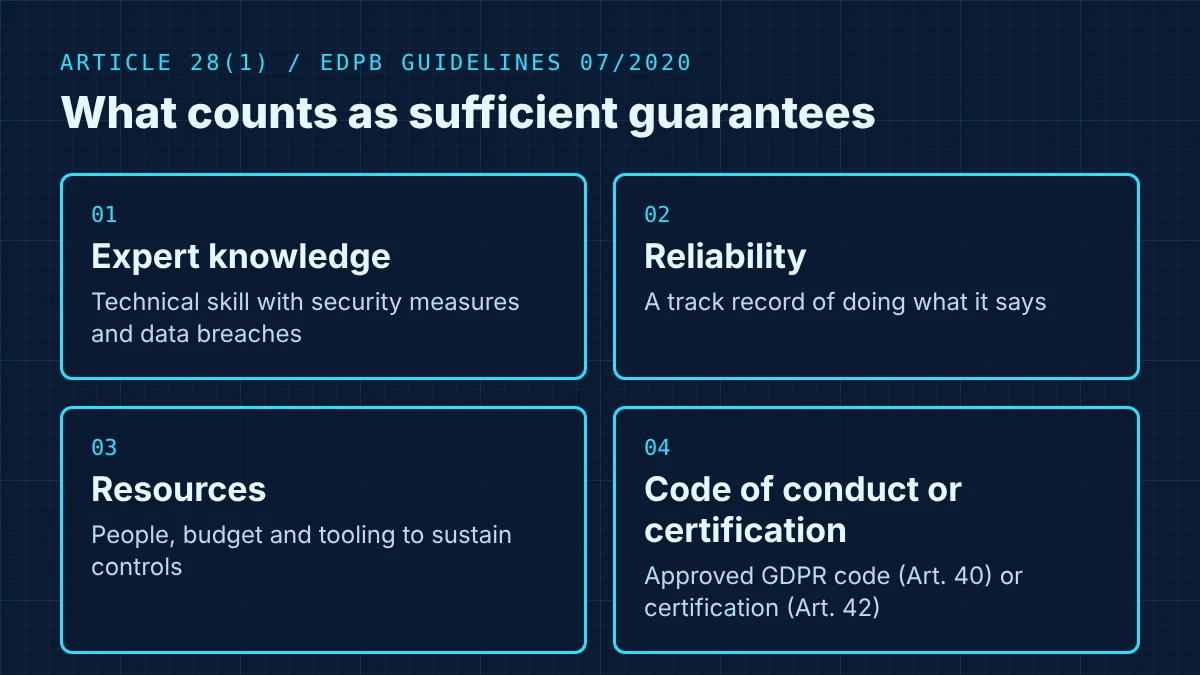
| Element | What it means in practice | Questions to ask |
|---|---|---|
| Expert knowledge | Technical skill with security measures and data breaches | Who runs security? How are incidents handled and tested? |
| Reliability | A track record of doing what it says | Are there public enforcement actions or breaches? Do references hold up? |
| Resources | Enough people, budget and tooling to sustain the controls | Is there a dedicated security or privacy owner? Is the control set realistic for the company's size? |
| Code of conduct or certification | Adherence to an approved GDPR code of conduct or certification mechanism | Is the vendor bound by an approved code under Article 40 or certified under Article 42? |
Article 28(5) confirms that adherence to an approved code of conduct or certification "may be used as an element" to demonstrate sufficient guarantees. Note the word "element". It supports your assessment. It does not replace it.
Security frameworks such as ISO 27001 certification or a SOC 2 report are not GDPR certification mechanisms, but they are strong evidence for the security part of the question, which maps to Article 32 security of processing. Read the scope and any exceptions in those reports rather than treating the logo as the answer.
How deep should the assessment go?
The depth of your review should rise with the risk of the processing, but some level of verification always applies. In Opinion 22/2024, adopted in October 2024, the EDPB said the obligation to verify that processors and sub-processors present sufficient guarantees applies regardless of risk, while the extent of verification can vary, with more checking expected for high-risk processing.
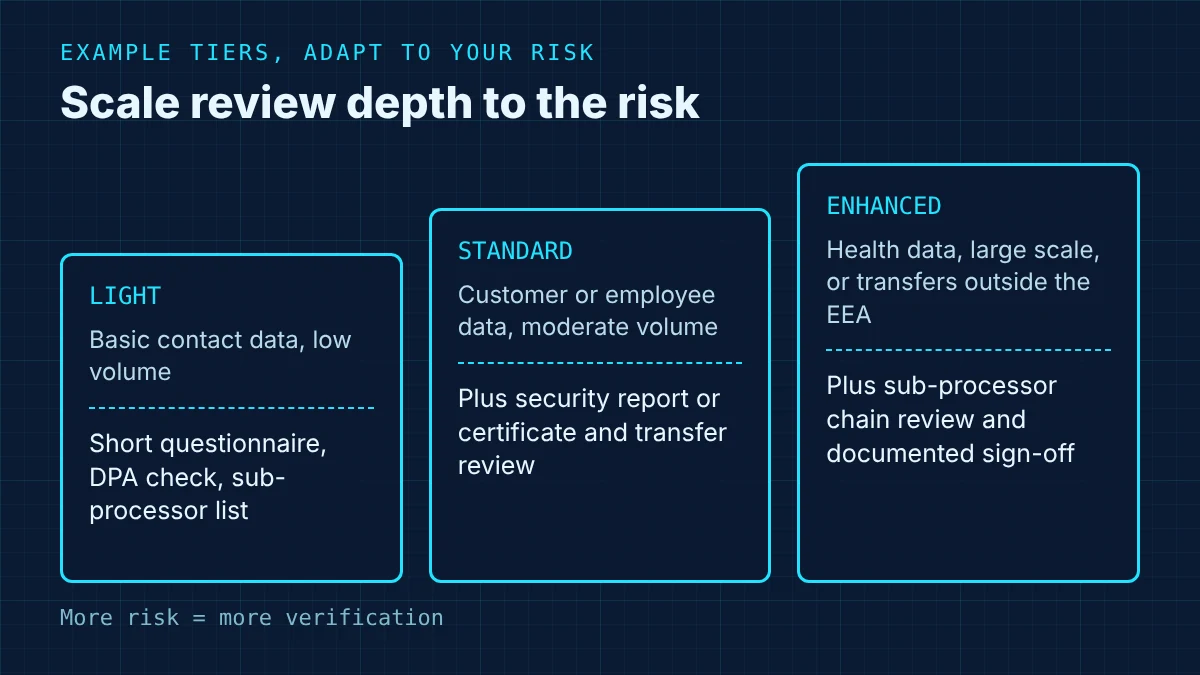
A simple tiering model keeps the effort proportionate. The tiers below are an example to adapt, not a legal standard.
| Example tier | Typical processing | Review depth |
|---|---|---|
| Light | Low volume of basic contact data, no sensitive categories | Short questionnaire, DPA check, sub-processor list |
| Standard | Customer or employee data at moderate volume | Full questionnaire, security report or certificate, transfer review |
| Enhanced | Special category data such as health data, large scale processing, or transfers outside the EEA | All of the above, plus a review of the sub-processor chain, deeper evidence, and a documented sign-off |
Health data is a special category under Article 9, so HealthTech teams should expect most clinical, patient or wellness data processors to land in the enhanced tier. If the processing is likely to result in a high risk, check whether a data protection impact assessment is also needed, and feed the vendor findings into it.
What evidence should you ask a processor for?
Ask for evidence that maps to each GDPR obligation the processor will help you meet, so every request has a reason behind it. The checklist below links each request to the relevant article.
| Area | Evidence to request | GDPR reference |
|---|---|---|
| Security measures | ISO 27001 certificate and scope, SOC 2 report, or a description of technical and organisational measures | Article 32 |
| Sub-processors | Current list with names, locations and the service each performs | Article 28(2) and 28(4) |
| International transfers | Where data is stored and accessed, and the transfer mechanism used, such as standard contractual clauses | Articles 44 to 46 |
| Breach handling | Incident response process and how quickly the controller will be told | Article 33(2) |
| Records | Confirmation the processor keeps its own records of processing | Article 30(2) |
| End of contract | How data is deleted or returned, and how that is confirmed | Article 28(3)(g) |
| Audit support | How the processor makes information available and supports audits or inspections | Article 28(3)(h) |
| Data subject rights | How the processor helps you answer access, erasure and other requests | Article 28(3)(e) |
Two tips from running these reviews:
- Ask for documents before questionnaires. A current certificate, report or published trust page often answers half your questions and reduces back-and-forth.
- Record what you relied on. Save the version and date of every document you reviewed. If a regulator asks why you chose this processor, that file is your answer.
Which answers should pause the deal?
Pause when the vendor cannot show how it protects the data or will not commit to the contract terms GDPR requires. Common stop signs include:
- No sub-processor list, or a list that is vague about locations and functions. Our guide to GDPR sub-processors explains what a usable list looks like.
- Refusal of Article 28 terms, such as acting only on documented instructions, confidentiality of staff, or deletion at the end of the service.
- No answer on transfers. If data leaves the EEA and the vendor cannot name a transfer mechanism, you cannot complete the review.
- No incident commitment. A processor that will not commit to notifying you without undue delay after becoming aware of a breach leaves you exposed to your own deadlines.
- Security evidence that does not cover the service you are buying. A certificate scoped to a different product or entity is not evidence for this one.
- Data use beyond your instructions, for example terms that let the vendor use your personal data to train its own models without a clear basis and your agreement.
A red flag does not always mean "no". It can mean "not yet", with remediation agreed in writing, or "only for a narrower use" with less data.
How do you run processor due diligence, step by step?
A repeatable sequence of seven steps keeps reviews consistent across teams and vendors.
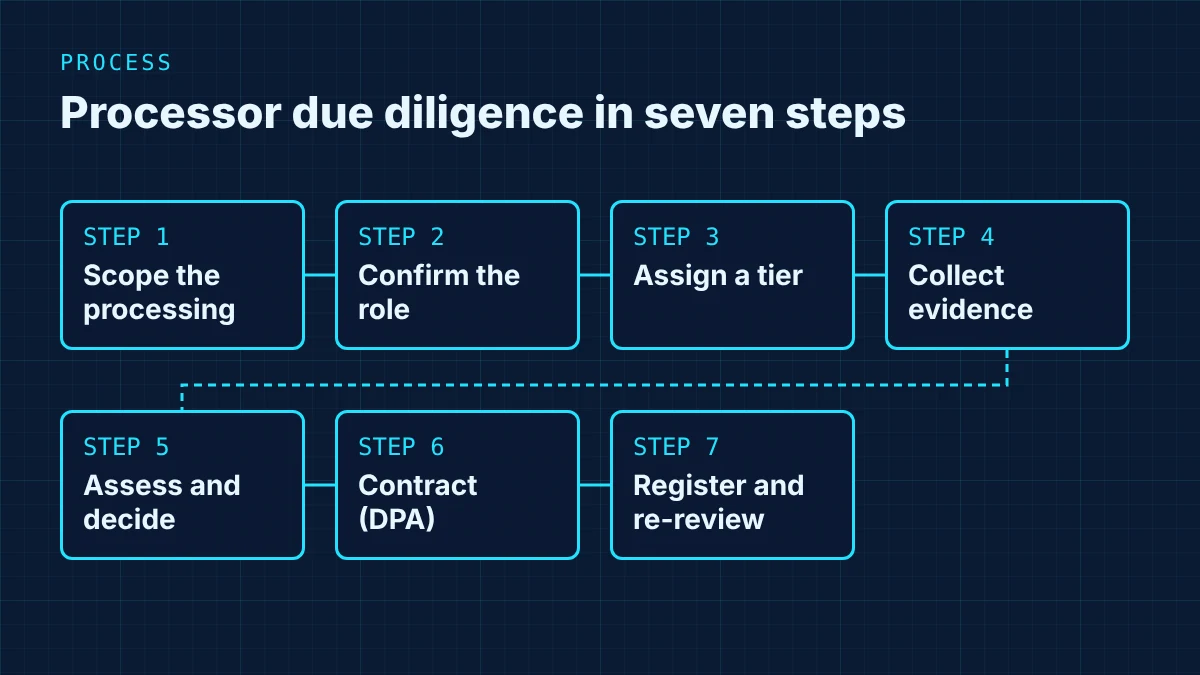
- Scope the processing. Record what personal data the vendor will receive, whose data it is, the purpose, the volume and where it will be processed.
- Confirm the role. Make sure the vendor really is a processor for this service and not a controller or joint controller.
- Assign a tier. Use your tiering model to set the depth of review.
- Collect evidence. Request the documents in the checklist above, starting with what the vendor already publishes.
- Assess and decide. Score the evidence against the four EDPB elements and your security baseline. Record gaps, compensating controls and the decision owner.
- Contract. Sign a DPA that covers the Article 28(3) terms and any remediation commitments, plus transfer clauses if needed.
- Register and schedule. Add the processor to your vendor inventory and records of processing, and set the next review date.
Your general vendor due diligence process can host these steps. The GDPR-specific parts are the role check, the transfer review and the Article 28 contract terms.
How often should you reassess a processor?
Reassess on a schedule set by the tier and whenever something material changes. GDPR does not fix a frequency, so pick one you can defend and keep to it. For example, some teams re-review enhanced-tier processors every year and light-tier processors every two to three years.
Trigger an early review when:
- The processor adds or changes a sub-processor, especially one in a new country.
- The scope grows, for example a new product feature that sends health data to the vendor.
- The vendor reports a security incident or its certificate or report lapses.
- The legal basis for a transfer changes.
Opinion 22/2024 also says controllers should have information on the identity of all processors and sub-processors readily available at all times. Keeping the sub-processor chain current is part of ongoing due diligence, not a one-time task.
How SecureSlate helps
SecureSlate gives privacy and security teams one place to run processor reviews alongside the rest of their compliance program:
- Vendor risk management to inventory processors, assign risk tiers, send assessments and track remediation.
- Built-in GDPR framework with multi-framework control mapping, so processor controls also count toward SOC 2, ISO 27001 or HIPAA where they overlap.
- Risk management to record vendor risks, owners and treatment decisions.
- Audit management to keep the evidence you relied on, with dates, ready for an auditor or regulator.
- Trust center and security questionnaire automation for when you are the processor answering your customers' due diligence.
SecureSlate supports your process. It does not decide whether a processor gives sufficient guarantees on your behalf.
Start a SecureSlate trial to set up your processor review workflow.
FAQ
Is a signed DPA enough to show GDPR processor due diligence?
No. A DPA is required under Article 28(3), but Article 28(1) separately requires you to choose a processor that gives sufficient guarantees. You should keep evidence of the assessment that led to the decision, not just the signed contract.
Do I have to audit every sub-processor myself?
You must verify them, but you do not have to audit each one directly. The EDPB says controllers may rely on information from their processor to verify that sub-processors present sufficient guarantees, with more checking for high-risk processing. Keep the full sub-processor list and review the guarantees most closely where the data is sensitive or leaves the EEA.
Does an ISO 27001 certificate or SOC 2 report satisfy Article 28?
They are strong evidence for the security part of the assessment, but they are not GDPR certifications. You still need to check sub-processors, transfers, breach notification and contract terms, and confirm the certificate or report covers the service you are buying.
How is processor due diligence different from a DPIA?
Processor due diligence asks whether a specific vendor can protect the data. A DPIA asks whether the processing as a whole is likely to result in a high risk to people and how to reduce it. For high-risk processing you often need both, and the vendor review feeds into the DPIA.
Disclaimer (legal note)
This article is for general information only and is not legal, regulatory, or professional advice. Requirements vary by framework, industry, and jurisdiction. Consult qualified advisors for your specific obligations.
Need compliance without the complexity?
SecureSlate automates ISO 27001, SOC 2, GDPR, HIPAA, and more. Built for growing teams. See it in action.
Find compliance gaps in 30 seconds