
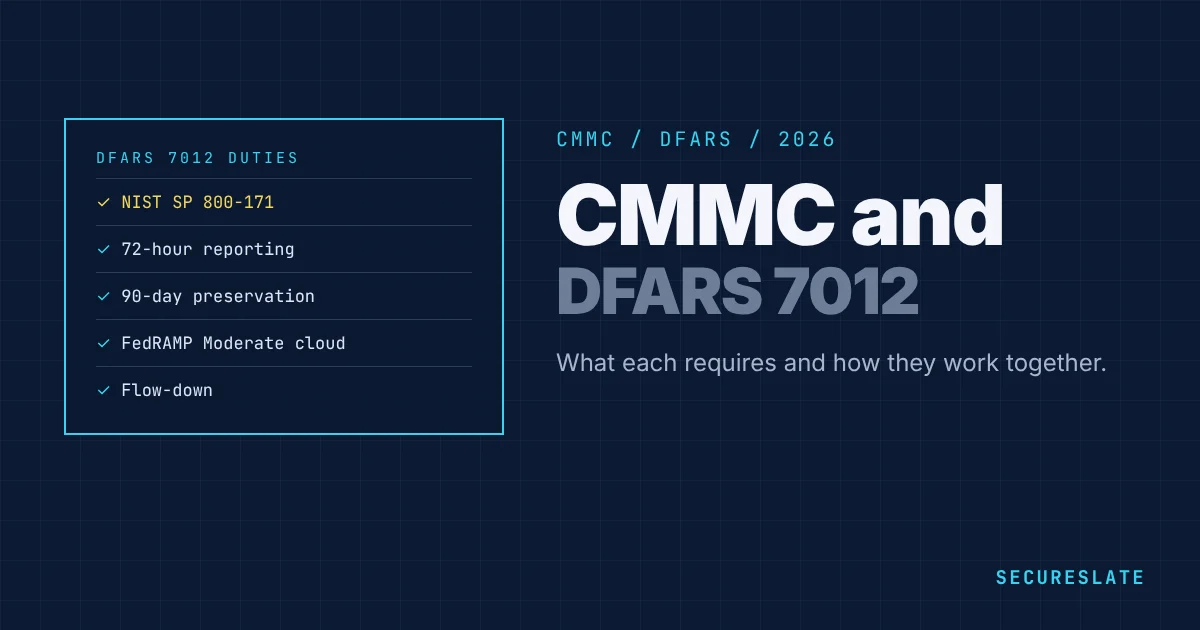
CMMC vs DFARS 7012 is a question about two parts of the same system. DFARS 252.204-7012, "Safeguarding Covered Defense Information and Cyber Incident Reporting," has been in DoD contracts since 2017. It tells contractors what to do: protect covered defense information with NIST SP 800-171, report cyber incidents within 72 hours and use compliant cloud services. CMMC adds verification: it checks whether contractors actually meet those requirements through self-assessments or independent assessments. This guide explains how the two overlap, where they differ and what contractors must do under each.
Related guides: What is CMMC? · CMMC vs NIST 800-53 · How to implement a CMMC program · CMMC assessment types
Key takeaways
- DFARS 7012 requires NIST SP 800-171, 72-hour incident reporting, evidence preservation and FedRAMP Moderate equivalent cloud services for CUI.
- CMMC does not replace 7012. It verifies compliance and adds levels, scoring rules and assessments.
- Three related clauses link them: 7019 (SPRS score), 7020 (DoD assessment access) and 7021 (CMMC requirement).
- Incident reporting, malware submission and cloud rules come from 7012, not from CMMC, and stay in force alongside it.
- Contractors handling CUI need to meet both: the ongoing duties of 7012 and the CMMC status their contract requires.
What DFARS 252.204-7012 requires
DFARS 7012 applies to contractors with covered defense information (CDI), which in practice means CUI provided by or created for DoD. Its main requirements:
- Adequate security. Implement NIST SP 800-171 on covered contractor information systems. Any deviations need DoD CIO approval.
- Cyber incident reporting. Report cyber incidents affecting CDI or the ability to perform operationally critical support to DoD within 72 hours through the DIBNet portal, which requires a medium assurance certificate.
- Malicious software. Submit any malware found to the DoD Cyber Crime Center (DC3) as instructed.
- Media preservation. Keep images of affected systems and relevant monitoring data for at least 90 days after reporting, so DoD can request them.
- Forensic access. Provide DoD access to information and equipment needed for forensic analysis on request.
- Cloud services. If an external cloud service stores, processes or transmits CDI, it must meet requirements equivalent to the FedRAMP Moderate baseline and support incident reporting and access duties.
- Flow-down. Include the clause in subcontracts where CDI is involved, and require subcontractors to report incidents to DoD and to the prime.
The related clauses: 7019, 7020 and 7021
| Clause | What it does |
|---|---|
| DFARS 252.204-7019 | Requires a current NIST SP 800-171 assessment score (no more than three years old) posted in SPRS for consideration for award |
| DFARS 252.204-7020 | Gives DoD access to perform Medium or High assessments and requires flow-down to subcontractors |
| DFARS 252.204-7021 | The CMMC clause: requires the CMMC level and status stated in the contract, annual affirmations and flow-down |
The final DFARS rule implementing CMMC (48 CFR) took effect on November 10, 2025, starting Phase 1 of the rollout.
What CMMC adds
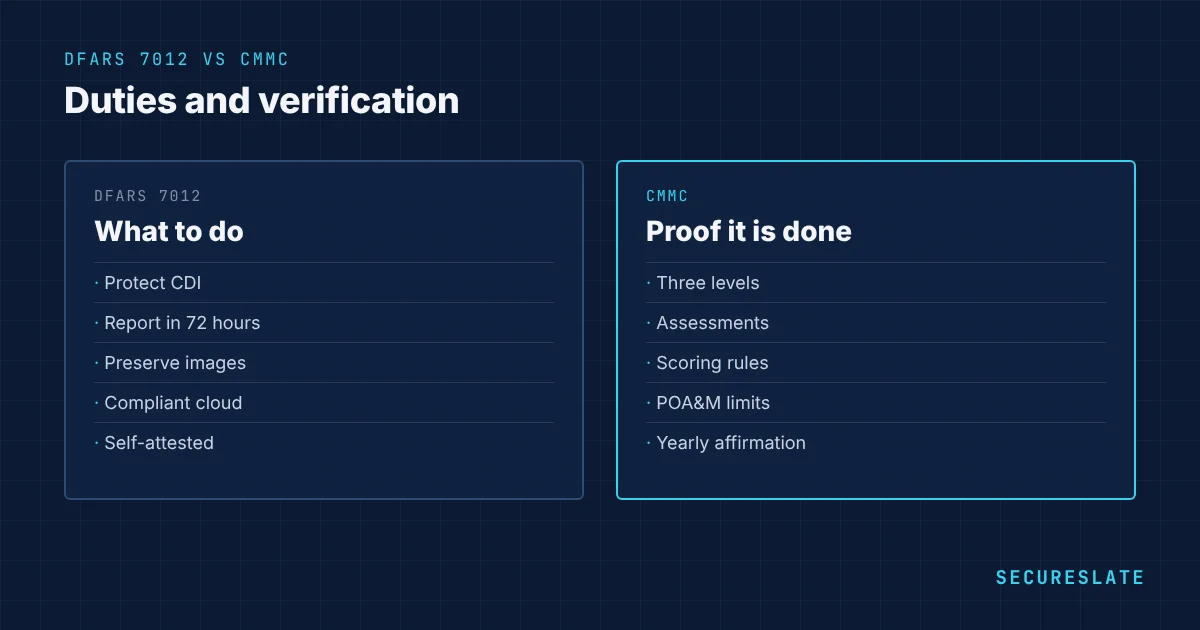
CMMC, defined in 32 CFR part 170, adds:
- Levels. Level 1 for FCI, Level 2 for CUI using NIST SP 800-171, Level 3 for higher-priority CUI with NIST SP 800-172 requirements.
- Assessment types. Self-assessments, C3PAO certification assessments and DIBCAC assessments, each with defined rules.
- Scoring and POA&M limits. A minimum score of 88 for conditional Level 2 status, limits on which requirements can be on a POA&M and 180 days to close them.
- Affirmations. A senior official must affirm continued compliance in SPRS each year.
- Scoping guidance. Definitions for CUI assets, security protection assets and other asset categories.
Overlap and differences
| Topic | DFARS 7012 | CMMC |
|---|---|---|
| Security standard | NIST SP 800-171 | NIST SP 800-171 Rev 2 at Level 2, plus 800-172 items at Level 3 |
| Verification | Self-attestation by contract award | Self-assessment or independent assessment, recorded in SPRS |
| Incident reporting | 72 hours to DoD via DIBNet | Not separately defined; 7012 still applies |
| Cloud | FedRAMP Moderate or equivalent for CDI | Same expectation applies to cloud services in scope |
| FCI | Not covered | Level 1 covers FCI using FAR 52.204-21 |
| Consequence of gaps | Breach of contract terms, False Claims Act risk | Ineligibility for award when status is missing, plus the same legal risks |
| Duration | For the life of the contract | Status valid three years, with yearly affirmation |
Why DoD added CMMC on top of 7012
Under 7012 alone, contractors self-attested to NIST SP 800-171 compliance. DoD Inspector General reviews and DoD's own assessments found many contractors had not fully implemented the requirements, even after years of the clause being in contracts. CMMC provides verification so that DoD and primes can rely on a contractor's stated security posture. The Department of Justice's Civil Cyber-Fraud Initiative has also used the False Claims Act against contractors that misrepresented their cybersecurity compliance, which raises the stakes on accurate scores and affirmations.
What contractors need to do
- Identify CDI and CUI and where it is handled.
- Implement NIST SP 800-171 fully across that scope.
- Post an accurate SPRS score per 7019 and keep it current.
- Prepare incident reporting. Obtain a medium assurance certificate for DIBNet, document who reports, and practice the 72-hour process.
- Plan evidence preservation. Make sure you can image systems and retain data for 90 days.
- Check cloud providers. Confirm FedRAMP Moderate authorization or equivalency documentation for services handling CUI.
- Achieve the required CMMC status and affirm yearly.
- Flow down 7012, 7019, 7020 and 7021 requirements to subcontractors as applicable, and verify their status.
Incident reporting in practice
A 72-hour clock is short. Prepare in advance:
- A written incident response plan that names the DIBNet reporter and backup
- A medium assurance certificate already issued to those people
- A list of the information DoD asks for, so you can collect it quickly
- Logging and forensic capability to identify affected systems and data
- A way to notify your prime contractor at the same time
- Templates for internal communications and legal review
Common gaps
- No DIBNet certificate, so the company cannot report within 72 hours
- Commercial cloud services storing CUI without FedRAMP Moderate status or equivalency evidence
- SPRS scores older than three years or not matching reality
- Subcontractors receiving CUI without the required clauses or verified status
- Incident response plans never tested
Example: one incident under both rules
Imagine a machine shop that holds CUI drawings in a cloud file share discovers ransomware on an engineering workstation on a Monday morning. Under DFARS 7012, the clock starts: within 72 hours it must report through DIBNet with the details it has, submit any malware sample to DC3 as instructed, preserve images of affected systems for at least 90 days and notify its prime. Under CMMC, the incident does not by itself change the company's status, but the response will test controls that assessors check: incident handling (3.6.1), reporting (3.6.2), audit logging, malware protection and backups. If the incident reveals that a requirement was not actually met, the company must correct its SPRS score and SSP, and the senior official must consider that before the next affirmation. Handling the incident well is evidence of a working program; hiding it creates contract and legal risk.
Responsibilities by role
| Role | DFARS 7012 duties | CMMC duties |
|---|---|---|
| Executive or affirming official | Ensure adequate security and reporting capability | Affirm compliance in SPRS each year |
| Program owner | Maintain NIST SP 800-171 implementation | Run assessments, SSP and POA&M |
| IT and security team | Detect incidents, preserve evidence, support forensics | Operate and evidence the 110 requirements |
| Contracts team | Flow down clauses, confirm cloud equivalency | Verify subcontractor CMMC status before sharing CUI |
| Incident reporter | Hold DIBNet certificate and file within 72 hours | Keep records of incidents for assessors |
How SecureSlate helps
SecureSlate helps small and mid-size defense suppliers meet both DFARS 7012 duties and CMMC requirements. It maps controls to NIST SP 800-171, tracks your SPRS score, supports SSP and POA&M work, monitors cloud, identity and device controls continuously, and keeps incident response plans, tests and vendor records in one place, at a price that fits smaller contractors.
FAQ
Does CMMC replace DFARS 7012?
No. DFARS 7012 remains in contracts and continues to require NIST SP 800-171, incident reporting and cloud requirements. CMMC verifies compliance and is added through DFARS 7021.
What is the 72-hour rule in DFARS 7012?
Contractors must report cyber incidents affecting covered defense information to DoD through DIBNet within 72 hours of discovery.
Does DFARS 7012 apply to FCI?
No. DFARS 7012 covers covered defense information. FCI is protected under FAR 52.204-21 and CMMC Level 1.
What does FedRAMP Moderate equivalent mean?
A cloud service that is not FedRAMP authorized must show it meets the FedRAMP Moderate baseline, typically through a full assessment by a FedRAMP-recognized 3PAO with evidence available to the contractor.
Do subcontractors need to follow DFARS 7012?
Yes, when they handle covered defense information. Primes must flow the clause down, and subcontractors report incidents to DoD and to the prime.
Is a SPRS score the same as CMMC certification?
No. A SPRS score under DFARS 7019 is a NIST SP 800-171 self-assessment score. CMMC status is a separate record of a self-assessment or certification assessment completed under the CMMC rule.
Disclaimer (legal note)
This article is for general information only and is not legal, regulatory, or professional advice. Requirements vary by framework, industry, and jurisdiction. Consult qualified advisors for your specific obligations.
Need compliance without the complexity?
SecureSlate automates ISO 27001, SOC 2, GDPR, HIPAA, and more. Built for growing teams. See it in action.
Find compliance gaps in 30 seconds