
Short answer: The MAS TRM Guidelines are the Monetary Authority of Singapore's principles for how regulated financial institutions should manage technology and cyber risk. They are not legally binding on their own, but MAS notices make core parts mandatory. Vendors are not regulated directly, yet banks and insurers apply these expectations to them through due diligence and contracts.
Related guides:
- Singapore compliance frameworks for SaaS and HealthTech
- How to conduct effective vendor security reviews
- DORA compliance checklist
Key takeaways
- Two kinds of instrument. The TRM Guidelines set expectations using "should". The Notices on Technology Risk Management and on Cyber Hygiene are legally binding on the institutions they cover.
- The current Guidelines date from January 2021. MAS is now consulting on changes to the Notices, not the Guidelines, and separately on new third-party risk management guidelines. Both were still proposals as of October 2026.
- Vendors are in scope by contract. A financial institution stays accountable for systems a third party runs for it, so your security program becomes part of its compliance story.
- ISO 27001 and SOC 2 do most of the heavy lifting. The gaps are usually resilience evidence, incident notification commitments, audit access and financial-sector-specific testing.
What are the MAS TRM Guidelines?
The MAS Technology Risk Management (TRM) Guidelines are a set of principles and best practices for managing technology risk at Singapore financial institutions (FIs). MAS issued the current revision on 18 January 2021, responding to faster software delivery and supply chain attacks.
The 2021 revision put new weight on a few themes that matter directly to vendors:
- Board and senior management accountability. Boards should be able to oversee technology and cyber risk, and FIs should appoint people directly responsible for security, such as a chief information security officer.
- Third-party oversight. FIs are expected to exercise strong oversight of arrangements with third-party service providers, including data protection and system resilience.
- Secure development. Security controls belong inside the development and delivery lifecycle, with security-by-design and testing of third-party components.
- Cyber exercises and threat intelligence. FIs should stress test their defences with exercises that simulate real attacker tactics, and share threat information.
Because they are principles rather than a prescriptive checklist, each institution interprets them for its own size, risk profile and services. That is why two banks can send you quite different questionnaires.
How do the TRM Guidelines differ from MAS notices?
Guidelines describe what good looks like; notices are legally binding requirements, and breaching one is a regulatory matter for the institution. For technology risk, two families of notices sit alongside the Guidelines.
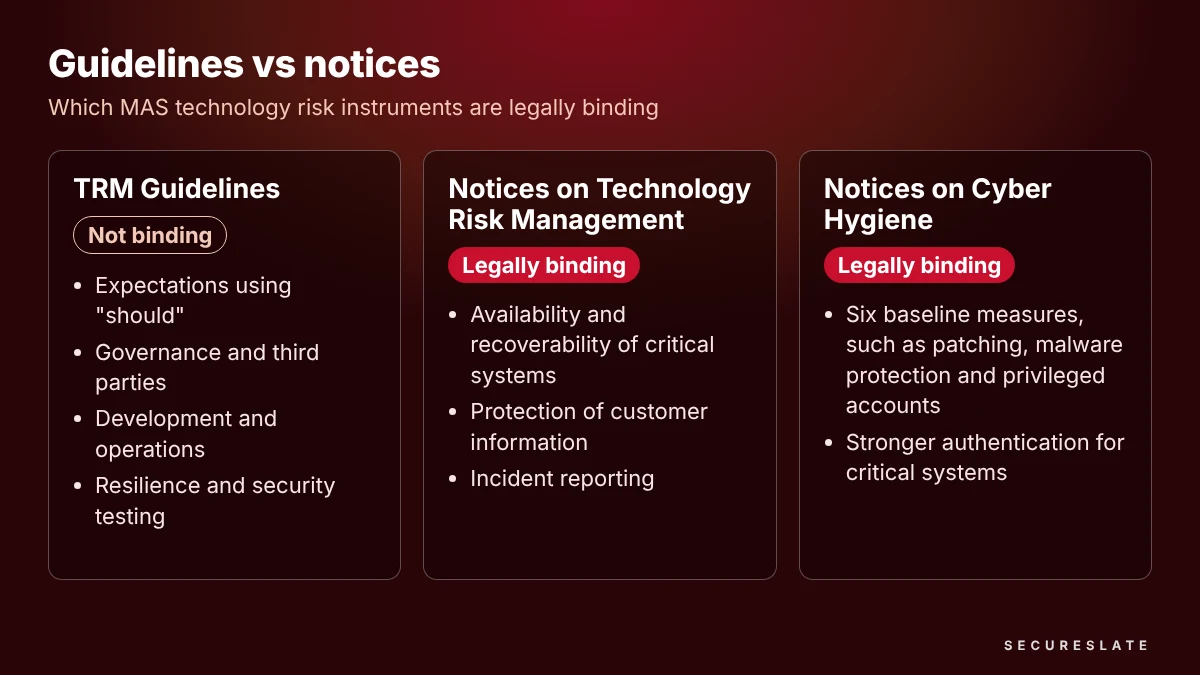
| Instrument | Legally binding? | What it covers |
|---|---|---|
| Technology Risk Management Guidelines | No. Sets expectations using "should" | The full technology risk program: governance, third parties, development, operations, resilience, security testing |
| Notices on Technology Risk Management | Yes, for the FIs they cover | Availability and recoverability of critical systems, protection of customer information, and incident reporting |
| Notices on Cyber Hygiene | Yes, for the FIs they cover | Six baseline measures that make key TRM Guidelines practices mandatory |
The six cyber hygiene measures cover security standards for IT systems, timely security patching, network security devices that restrict unauthorised traffic, malware protection, securing privileged system accounts, and stronger authentication for critical systems and systems used to access customer information.
The Notices on Technology Risk Management also set specific limits for critical system downtime, recovery and incident notification. Ask your customer which notice applies and read its exact wording, rather than trusting a number in a questionnaire template.
What is changing in 2026. On 10 June 2026, MAS published a consultation on amendments to the Notices on Technology Risk Management, with feedback due by 31 July 2026. The proposals would add binding requirements on IT asset inventories (including cryptographic and open-source components), IT risk registers, capacity planning, change management, continuous monitoring, immutable or offline backups and incident management, and would make clear that partial or intermittent disruption counts toward unscheduled downtime. They are intended to take effect 12 months after the final notices are published. As of October 2026, treat them as proposed.
Who do the MAS TRM guidelines apply to, and how do they reach vendors?
The Guidelines apply to financial institutions regulated by MAS; vendors are reached indirectly, through their customers' accountability for outsourced and third-party services.
The binding Notices on Technology Risk Management are issued as a series, one per type of institution. According to Rajah & Tann's summary of the 2026 consultation, the series covers banks, merchant banks, finance companies, licensed insurers, insurance brokers, capital markets intermediaries, financial advisers, trust companies, credit bureaus, card licensees, and operators of designated payment systems and digital payment token service providers.
For a SaaS or HealthTech vendor, the key point is that responsibility does not leave the institution when it buys your service. When MAS made the cyber hygiene rules binding, it treated systems provided by third parties as within the institution's control, because the institution can impose contractual terms. In practice, that means the bank's obligations show up in your contract.
Third-party expectations are also tightening. On 6 March 2026, MAS proposed new Guidelines on Third-Party Risk Management that would replace the existing outsourcing guidelines and apply to third-party services generally, not only outsourcing. The draft expects FIs to keep a register of third-party arrangements, manage each arrangement from pre-contract to termination, and oversee sub-contractors. As of October 2026 these remain proposed, but they signal that more vendors will face formal reviews.
What do the MAS TRM requirements cover?
The Guidelines cover the full technology lifecycle, from board oversight to day-to-day security operations. Here is a plain-English summary of the main areas, grouped the way vendor questionnaires usually ask about them. The groupings are ours; check the Guidelines on the MAS website for the authoritative structure and wording.
| Area | What it means for you as a vendor |
|---|---|
| Governance and risk framework | A documented security program, risk register and named owners |
| Third-party arrangements | Answer questionnaires, accept audit and notification clauses, manage your own subprocessors |
| Secure development | SDLC policy, code review, dependency and secrets scanning, pre-release testing |
| IT service management | Change records, patch timelines, an incident response plan your customer can rely on |
| IT resilience | Defined recovery objectives, tested backups and DR, uptime reporting |
| Access control | SSO and MFA, privileged access controls, periodic access reviews |
| Cryptography | Encryption in transit and at rest, key management procedures |
| Data and infrastructure security | Network segmentation, hardened builds, data loss controls |
| Cyber security operations and assessment | Logging and alerting, regular penetration tests, remediation tracking |
Two areas generate the most friction for vendors in our experience. Resilience, because FIs must meet binding availability and recovery limits for critical systems and will want your numbers to fit inside theirs. Incident notification, because the FI has its own reporting duty to MAS and needs you to tell it quickly enough to meet it.
How much do ISO 27001 and SOC 2 already cover?
Most of it, at the level of controls; the gaps are usually in specifics, not in whole domains. Both ISO 27001 and SOC 2 cover governance, risk assessment, access control, cryptography, operations security, change management, incident management, supplier management and business continuity. If you have run an ISO 27001 program or completed a SOC 2 audit, you already hold most of the evidence a Singapore FI will ask for.
Where vendors typically fall short:
- Resilience specifics. ISO 27001 and SOC 2 require continuity planning, but not particular recovery times. An FI may need yours to support its own binding limits on critical systems.
- Notification commitments. Your incident process may promise to notify customers "without undue delay". An FI will often want a contractual timeframe tied to its own reporting duty.
- Audit and access rights. A SOC 2 report or ISO certificate is a strong start, but FIs may also negotiate rights for themselves, their auditors and the regulator to inspect.
- Testing depth. FIs may ask for penetration test scope, frequency and remediation status, and sometimes participation in their own cyber exercises.
Treat MAS TRM as a mapping exercise. Map each area in the table above to controls you already operate, mark the gaps, and add only the controls you are missing.
How should a SaaS or HealthTech vendor prepare?
Start from the customer's obligations, then work back to your evidence. This sequence works for most small teams.
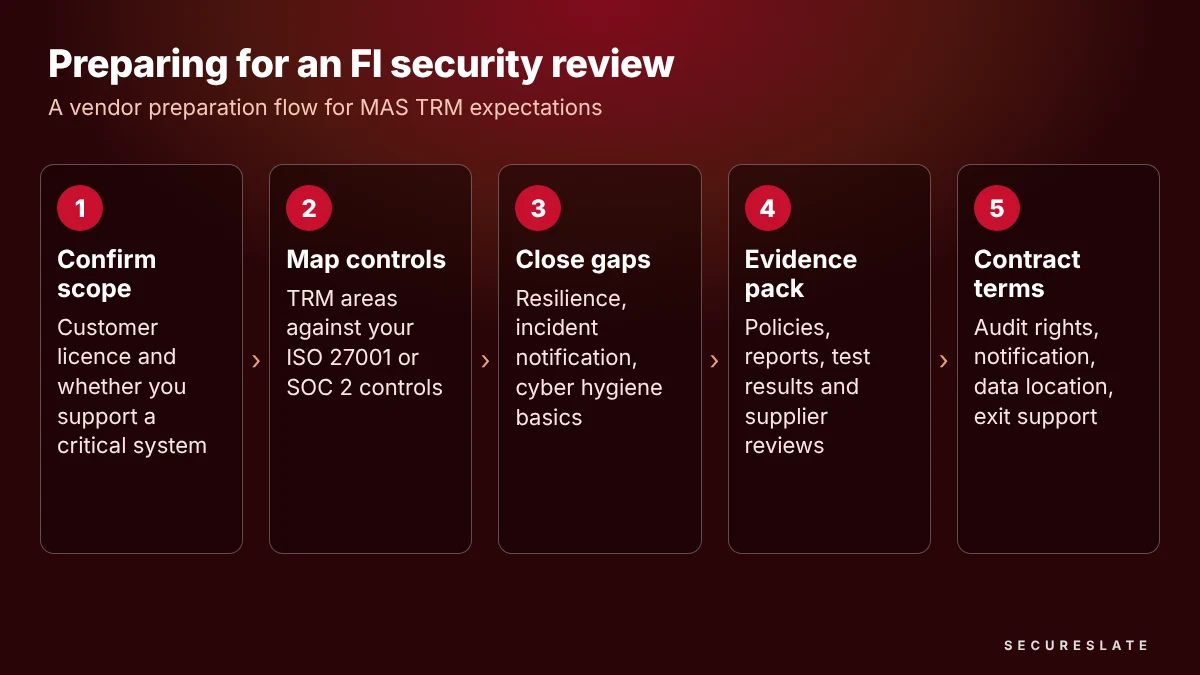
- Confirm scope with the customer. Ask which licence it holds and whether your service supports a critical system.
- Map your controls to the TRM areas. Use the areas above as a checklist against your ISO 27001 or SOC 2 control set and record each gap with an owner.
- Write down resilience commitments. Define recovery time and recovery point objectives per service, test backups and disaster recovery, and keep the results.
- Tighten incident response. Add a customer notification step with a timeframe you can actually meet, named contacts, and a template for root cause reports.
- Cover the cyber hygiene basics. Hardening, patching, network controls, malware protection, privileged accounts and MFA.
- Review your own suppliers. List the subprocessors that touch customer data and show how you assess them. A structured vendor risk assessment process makes this easy to evidence.
- Build a reusable evidence pack. Keep policies, reports and test results current so each new FI review starts from the same set.
- Prepare for contract terms. Brief legal on audit rights, notification clauses, data location, subcontracting and exit support.
What evidence do financial institutions ask vendors for?
In our experience, FIs ask for a consistent core set, then follow up on resilience and incident handling. Expect requests for:
- Your ISO 27001 certificate and Statement of Applicability, or your SOC 2 Type 2 report
- Information security, access control, encryption and incident response policies
- A recent independent penetration test summary and remediation status
- Business continuity and disaster recovery plans with recent test results
- Uptime history and your service level commitments
- A subprocessor list and your third-party risk process
- Evidence of MFA, privileged access controls and periodic access reviews
- Secure development practices, such as code review and dependency scanning
Keep answers consistent across customers, and refresh the pack whenever a control changes.
How SecureSlate helps
SecureSlate does not have a built-in MAS TRM framework, so you would set up the TRM areas and cyber hygiene measures as a custom framework with custom controls, then use multi-framework control mapping to link them to the ISO 27001 and SOC 2 controls you already run. Agentless, read-only cloud integrations and a device agent help keep evidence such as MFA, encryption and endpoint settings current. Access reviews, risk management, vendor risk management and code security with secrets detection cover areas FIs ask about most. Security questionnaire automation and a trust center help you answer FI reviews consistently, and audit management keeps your ISO 27001 or SOC 2 audits organised.
Start your free SecureSlate trial
FAQ
Are the MAS TRM Guidelines legally binding?
No. The TRM Guidelines set out expectations and best practices for regulated institutions. Binding obligations sit in the Notices on Technology Risk Management and the Notices on Cyber Hygiene, which turn key parts of the Guidelines into legal requirements for the institutions they cover.
Do the MAS TRM guidelines apply to a SaaS vendor outside Singapore?
Not directly. MAS regulates the financial institution, not you. But the institution remains accountable for services it receives from third parties, so it will apply TRM expectations to you through due diligence, contract clauses and ongoing monitoring, wherever you are based.
What is the latest version of the MAS TRM Guidelines?
The current revision was issued on 18 January 2021. As of October 2026, MAS's 2026 consultation targets the binding Notices on Technology Risk Management rather than the Guidelines. Check the MAS website before relying on any version.
Disclaimer (legal note)
This article is for general information only and is not legal, regulatory or professional advice. Requirements vary by framework, industry and jurisdiction. Consult qualified advisors for your specific obligations.
Need compliance without the complexity?
SecureSlate automates ISO 27001, SOC 2, GDPR, HIPAA, and more. Built for growing teams. See it in action.
Find compliance gaps in 30 seconds
