
Short answer: Threat modeling for HealthTech is a structured design review that asks how patient data could be exposed, altered or made unavailable, and what you will do about it. It gives your HIPAA risk analysis concrete, system-level inputs, and for connected medical devices FDA's premarket cybersecurity guidance recommends submitting threat modeling documentation.
Related guides: STRIDE threat model, HIPAA risk assessment, FDA SBOM requirements for medical devices
Key takeaways
- Threat modeling is a design-time activity. It finds problems while they are still cheap to fix, before code and contracts lock them in.
- Every threat model answers four questions: what are we working on, what can go wrong, what are we going to do about it, and did we do a good enough job.
- In HealthTech, the output feeds your HIPAA risk analysis, your secure development evidence for SOC 2 and ISO 27001, and, for cyber devices, your FDA premarket submission.
- Start small. One diagram, one hour and one product feature beats a perfect model that never gets finished.
What is threat modeling, in plain terms?
Threat modeling is looking at a picture of your system and asking what could go wrong with its security and privacy. The Threat Modeling Manifesto defines it as "analyzing representations of a system to highlight concerns about security and privacy characteristics", and frames the work around four questions.
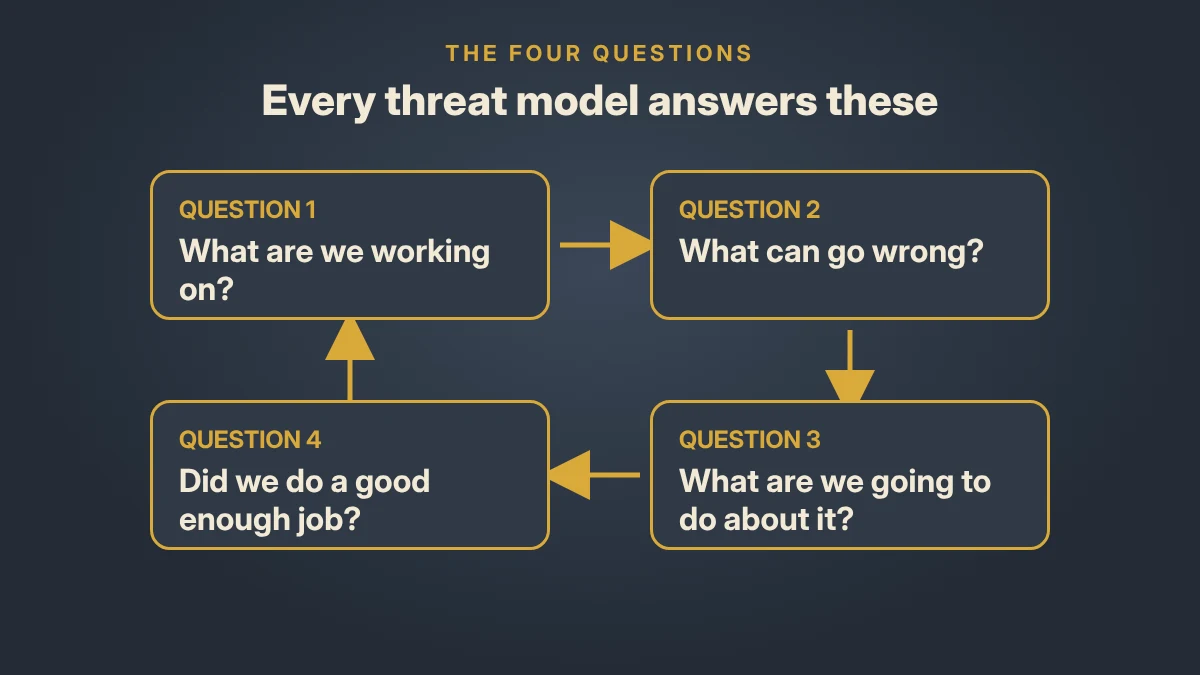
- What are we working on? Usually a data flow diagram that shows users, services, data stores, third parties and the trust boundaries between them.
- What can go wrong? The threats, found by walking the diagram with a method or checklist.
- What are we going to do about it? Mitigate, accept, transfer or avoid each threat, with an owner.
- Did we do a good enough job? Check the model against reality and review it when the system changes.
That is the whole idea. The methods described below are different ways of answering question two.
Why does threat modeling matter more in HealthTech?
It matters more because the data is sensitive, the regulations expect you to analyze risk, and some products are medical devices with their own premarket expectations. A breach of protected health information (PHI) hurts patients, triggers notification duties and damages trust with the health systems you sell to.
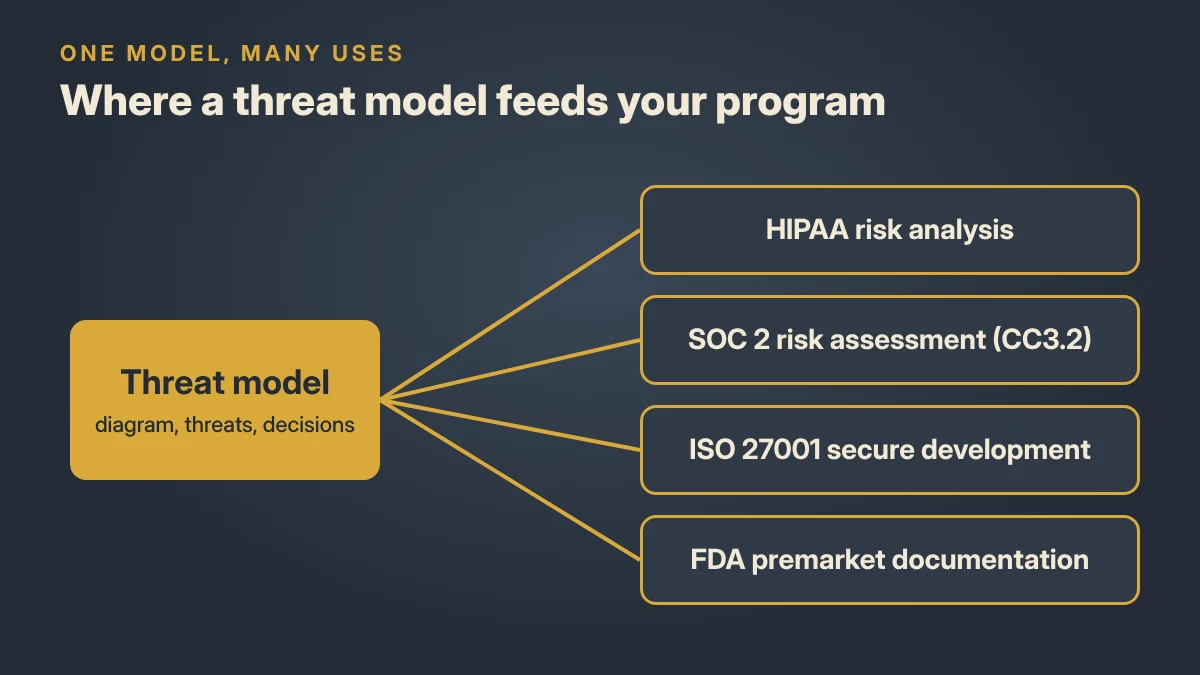
| Requirement | What it asks for | How a threat model helps |
|---|---|---|
| HIPAA risk analysis, 45 CFR 164.308(a)(1)(ii)(A) | An accurate and thorough assessment of potential risks and vulnerabilities to the confidentiality, integrity and availability of ePHI | Supplies system-specific threats and data flows instead of generic risk statements |
| SOC 2 CC3.2, Trust Services Criteria | Identify risks to objectives and analyze them as a basis for managing them | Shows how product risks were identified and treated |
| ISO 27001:2022, Annex A 8.25 and 8.27 | Secure development life cycle and secure system architecture and engineering principles | Provides evidence that security is considered during design |
| FDA premarket cybersecurity guidance | For devices in scope, FDA recommends premarket submissions include threat modeling documentation | The model and its mitigations become part of the submission |
On the medical device side, FDA's guidance Cybersecurity in Medical Devices: Quality Management System Considerations and Content of Premarket Submissions, in the version issued in February 2026, recommends that threat modeling be performed throughout the design process and included in premarket submissions. Section 524B of the Federal Food, Drug, and Cosmetic Act sets cybersecurity requirements for "cyber devices", which the guidance describes as devices that include sponsor-authorized software, can connect to the internet, and have characteristics that could be vulnerable to cybersecurity threats. If your product may be a medical device, confirm its regulatory status with qualified advisors early. Our guide to FDA SBOM requirements covers another part of the same submission.
Which threat modeling method should you use?
Use the method your team will actually run. For most HealthTech software teams that means STRIDE for security threats, plus a privacy lens for PHI. The table compares common options.
| Method | Focus | Good fit when | Effort |
|---|---|---|---|
| STRIDE | Six security threat categories applied to each element of a diagram | You want a quick, repeatable checklist for engineers | Low to moderate |
| PASTA | Seven-stage, risk-centric process tied to business impact | You need to connect threats to business risk and attack simulation | High |
| LINDDUN | Privacy threats such as linkability and identifiability | You process PHI or other personal data and want a privacy view | Moderate |
| Attack trees | A goal at the root, ways to reach it as branches | You want to explore one high-impact scenario in depth | Variable |
See our explainers on the STRIDE threat model and PASTA threat modeling for how each one works. For connected medical devices, the Playbook for Threat Modeling Medical Devices, developed by a team including MITRE and the Medical Device Innovation Consortium (MDIC), is a useful free reference.
What does a threat model look like for a telehealth app?
A worked example makes the idea concrete. Imagine a telehealth product with a patient mobile app, a clinician web portal, an API, a database of visit notes, a third-party video provider, an EHR integration and a product analytics tool.
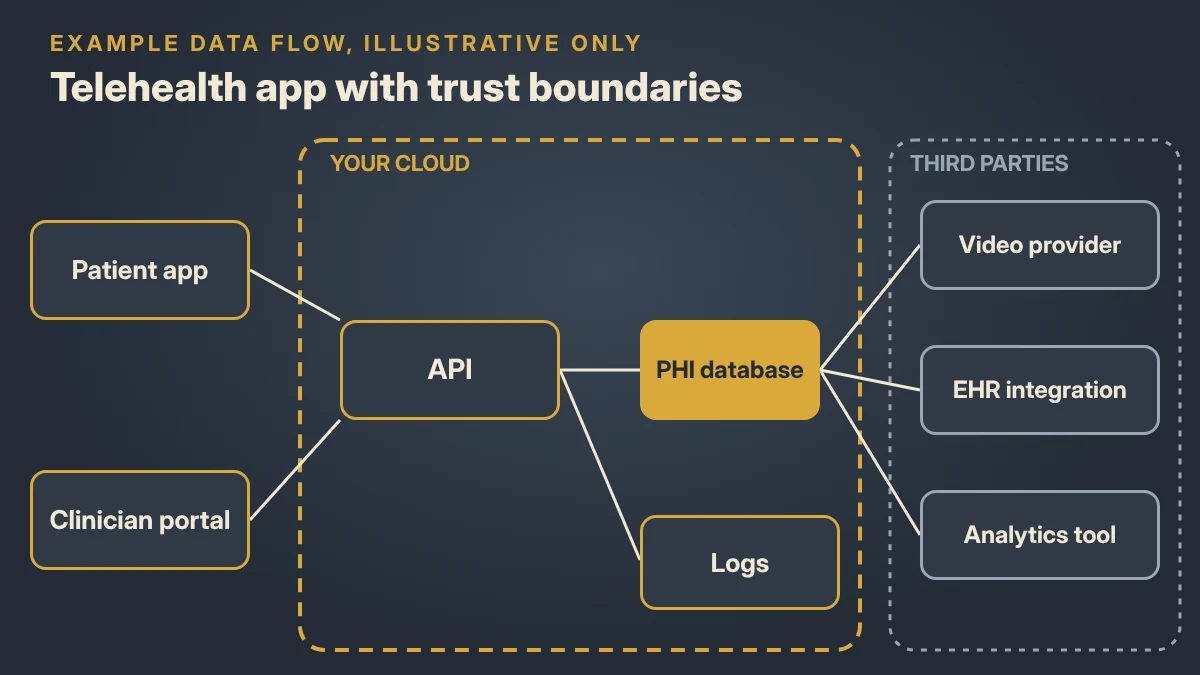
Walking that diagram produces threats like these. They are illustrative, not a complete model.
| Example threat | Where it sits | Example mitigation |
|---|---|---|
| A patient changes a record ID in an API call and sees another patient's notes | API to database | Object-level authorization checks on every request, with automated tests |
| PHI ends up in analytics events through screen names or form fields | Mobile app to analytics tool | Strip identifiers before events are sent, and review the vendor's terms and BAA position |
| A clinician session token is stolen from a shared workstation | Clinician portal | Short session lifetimes, re-authentication for sensitive actions, phishing-resistant MFA |
| The video provider processes PHI without a business associate agreement | Trust boundary to vendor | Confirm a BAA is signed before go-live and record it in your vendor inventory |
| Application logs capture visit notes in plain text | API to logging service | Log redaction rules and restricted log access |
| The EHR integration credentials are hard-coded in the repository | Integration service | Secrets manager, rotation, and secrets scanning in CI |
Notice how many of these threats sit at trust boundaries: between the patient and your API, between your systems and a vendor, between production data and logs. Drawing the boundaries is often where teams find their biggest risks.
How do you run your first threat modeling session?
Pick one feature, invite the people who built it, and timebox the session to about an hour. A simple agenda:
- Scope. Choose a single feature or service, ideally a new one that touches PHI.
- Diagram. Draw the data flow on a whiteboard: actors, processes, data stores, external services and trust boundaries.
- Mark the PHI. Highlight every flow and store that carries ePHI.
- Find threats. Walk each element and boundary with your chosen method. Write threats as short sentences: "an attacker could..."
- Rate and decide. Give each threat a rough likelihood and impact, then choose a response and an owner.
- Track. Turn mitigations into tickets and add the residual risks to your risk register.
- Store the model. Save the diagram, threat list and decisions with a date so you can show them later.
Keep the first one small. In our experience, teams that try to model the whole platform in one go often stall. Bake the habit into your secure SDLC policy so new features get modeled as part of design review.
When should you update a threat model?
Update a threat model whenever the system changes in a way that affects data flows or trust boundaries, and review it on a regular schedule. Typical triggers include:
- A new feature that collects or displays PHI
- A new third-party service, SDK or integration
- A change to authentication, hosting or network architecture
- A security incident or a significant penetration test finding
- Your annual HIPAA risk analysis, so the two stay consistent
A model that matches last year's architecture gives false comfort. Small, frequent updates are easier than rare rewrites.
How SecureSlate helps
SecureSlate helps HealthTech teams turn threat modeling outputs into tracked risks and audit-ready evidence:
- Risk management to record threats, owners, ratings and treatment decisions in one register.
- Built-in HIPAA, SOC 2 and ISO 27001 frameworks with multi-framework control mapping, so design-review evidence supports all three.
- Code security and secrets detection to catch issues such as hard-coded credentials that threat models often flag.
- Vendor risk management to track third parties that sit across your trust boundaries, including BAA status.
- Audit management to keep dated threat models and decisions ready for auditors and customer reviews.
SecureSlate does not prepare FDA submissions or determine whether your product is a medical device.
Start a SecureSlate trial to connect your threat models to your risk register.
FAQ
Does HIPAA require threat modeling?
HIPAA does not name threat modeling. It requires an accurate and thorough risk analysis of potential risks and vulnerabilities to ePHI. A threat model is a practical way to produce system-level inputs for that analysis, especially for software products.
Is STRIDE enough for a HealthTech product?
STRIDE covers core security threats well, but it was not designed specifically for privacy. Many HealthTech teams pair it with a privacy-focused review of how PHI is collected, linked and shared, for example using LINDDUN or a simple PHI data-flow check.
Who should attend a threat modeling session?
Include the engineers who build the feature, someone who understands the architecture, and a security or compliance lead. For features that handle PHI, a product owner who knows how clinicians and patients use the feature is also valuable.
How long does threat modeling take?
A focused session on one feature can take about an hour once the team is familiar with the process. Larger systems or medical device submissions take longer because they need fuller documentation and traceability to mitigations.
Disclaimer (legal note)
This article is for general information only and is not legal, regulatory, or professional advice. Requirements vary by framework, industry, and jurisdiction. Consult qualified advisors for your specific obligations.
Need compliance without the complexity?
SecureSlate automates ISO 27001, SOC 2, GDPR, HIPAA, and more. Built for growing teams. See it in action.
Find compliance gaps in 30 seconds