
The short version
SecureSlate and Vanta both automate compliance evidence, monitor controls continuously, and get you to a SOC 2 or ISO 27001 audit. They diverge on what happens after a control fails, how much security work stays inside the platform, and what the renewal looks like.
- Choose SecureSlate if you want failing controls fixed inside the platform, broader security operations included rather than bought separately, and pricing you can forecast without a sales cycle.
- Choose Vanta if auditor and investor familiarity carries weight in your process, your stack leans on integrations only a mature catalog covers, or you want the option of a large partner network.
- The honest split: Vanta is the safer brand purchase. SecureSlate covers more ground per dollar. Below is the category detail behind that, including where Vanta wins.
How we compare these platforms
This is a vendor comparison published by SecureSlate, so read it with that in mind. To keep it useful rather than promotional, capability is rated in three states rather than a simple yes or no:
| Rating | What it means |
|---|---|
| 🟢 | Built in and usable without add-ons |
| 🟠 | Present but limited or partial, or dependent on scope, tier, or a separate module |
| 🔴 | Not available natively |
Three further rules apply to every category below:
- Vanta gets credit where it earns it. Categories where Vanta is stronger are named in the comparison tables and collected in one section.
- Pricing is directional. Vanta is quote-based, so any figure is an estimate. Verify both numbers against a written proposal covering the same frameworks, headcount, modules, and contract term.
- Claims map to documentation. SecureSlate capabilities described here link to product or documentation pages you can check.
Nothing here replaces your own trial. Run the same five controls through both platforms using your real stack before you decide.
SecureSlate vs Vanta at a glance
| Category | SecureSlate | Vanta |
|---|---|---|
| Framework coverage | 🟢 Multi-framework, shared control mapping | 🟢 Multi-framework, shared control mapping |
| Evidence automation | 🟢 Continuous, integration-driven | 🟢 Continuous, integration-driven |
| Integration catalog maturity | 🟠 Growing, covers common stacks | 🟢 Larger, longer-established |
| Failing-control remediation | 🟢 Auto-remediation agents act on the source system | 🟠 Alerts and tasks, fix happens elsewhere |
| Access reviews | 🟢 Built-in inventory with one-click fixes | 🟢 Built-in |
| Vendor risk and questionnaires | 🟢 Included | 🟢 Included |
| Security operations breadth | 🟢 DAST, secrets, dark web, phishing included | 🔴 Compliance-first, security tooling stays external |
| Audit evidence workspace | 🟢 Data room with knowledge base | 🟠 Evidence lives against controls |
| Auditor and market familiarity | 🟠 Growing | 🟢 Widely recognized |
| Pricing transparency | 🟢 Published list pricing | 🔴 Quote-based |
Each category is explained below. If you only read one section, make it remediation or pricing, which is where the two platforms actually separate.
Frameworks and control coverage
Both platforms handle the frameworks most teams need first. SOC 2, ISO 27001, HIPAA, GDPR, and PCI DSS are table stakes in 2026, and neither vendor will be the constraint on which standard you pursue.
The difference shows up on the second framework. Both platforms map a single control to multiple frameworks so evidence collected once satisfies several requirements, but the commercial treatment differs. SecureSlate lists additional frameworks at roughly $2,000 each on top of the base plan. Vanta prices additional frameworks through your quote, which means the cost of adding ISO 27001 a year after SOC 2 is a negotiation rather than a line item.
If you expect to run one framework indefinitely, this category is a tie. If your 24-month plan includes two or three, model the multi-framework cost on both sides before signing.
| SecureSlate | Vanta | |
|---|---|---|
| SOC 2, ISO 27001, HIPAA, GDPR | 🟢 | 🟢 |
| Cross-framework control mapping | 🟢 | 🟢 |
| Custom controls and tests | 🟢 Documented | 🟢 |
| Additional framework cost | 🟢 ~$2,000 published | 🟠 Quote-based |
Evidence collection and integrations
This is the category where Vanta's head start is real and worth stating plainly. Vanta has been building its integration catalog longer, and for teams on less common tooling, the odds that a given system has a native connector are better there.
SecureSlate covers the stack most SMB and mid-market teams actually run: AWS (including Organizations and Control Tower), Azure, GCP, Google Workspace, GitHub, GitLab, Cloudflare, Okta, Auth0, 1Password, Jira, Asana, Notion, Salesforce, MongoDB Atlas, Deel, and Hexnode, among others. Both platforms pull configuration state on a schedule and attach it to controls as evidence, so recurring screenshots go away either way.
The buying advice is identical for both vendors. Build an inventory of the systems that matter to you, label each as native, API-supported, manual, or unavailable, then make each vendor demonstrate five of your controls end to end. A large catalog number means nothing if it misses the three systems your auditor will sample.
| SecureSlate | Vanta | |
|---|---|---|
| Automated evidence collection | 🟢 | 🟢 |
| Cloud, identity, code, HR, device coverage | 🟢 | 🟢 |
| Catalog breadth for uncommon tools | 🟠 | 🟢 |
| Device monitoring agent | 🟢 Documented | 🟢 |
Continuous monitoring and remediation
Both platforms run tests continuously and tell you when a control drifts. That part is solved industry-wide. The question that separates them is what happens in the twenty minutes after the alert fires.
With a compliance-first platform, a failed test produces a notification and a task. Someone opens Google Workspace, finds the user without MFA, enables the requirement, returns to the platform, and marks the task done. Multiply that by a few hundred findings a quarter and the automation savings get eaten by the follow-up.
SecureSlate runs auto-remediation agents that act on the source system directly. The MFA enforcement agent scans connected platforms for accounts without MFA, enforces the policy through admin APIs where supported, suspends or restricts accounts that stay non-compliant, notifies the owner, and records the policy state and the action taken as audit evidence. Comparable agents cover account deprovisioning at offboarding, dependency vulnerabilities, pull request review enforcement, repository visibility, Cloudflare SSL and TLS settings, and security issue SLA triage.
The practical effect is that the remediation trail and the evidence trail are the same record. Your auditor sees the detection, the action, and the timestamp in one place instead of a platform note pointing at work done somewhere else.
| SecureSlate | Vanta | |
|---|---|---|
| Continuous control testing | 🟢 | 🟢 |
| Drift alerts between audit periods | 🟢 | 🟢 |
| Automated fix applied to source system | 🟢 | 🔴 |
| Remediation recorded as evidence | 🟢 | 🟠 Manual close-out |
Access reviews and user access
Access reviews are a recurring audit requirement and, for most teams, the most tedious one. Both platforms pull account data from connected systems so you are not exporting CSVs from six admin consoles.
SecureSlate keeps a live access inventory that flags accounts with no assigned owner, MFA disabled, or no recent activity. Flagged accounts carry an Auto Fix action that launches the access review remediation workflow, so the cleanup happens before the review rather than becoming the review. The reviewer then confirms decisions against a list that is already tidy.
The workflow shape matters more than the feature checkbox here. Ask both vendors to show you a review cycle on your own directory, not a demo tenant.
| SecureSlate | Vanta | |
|---|---|---|
| Automated account inventory | 🟢 | 🟢 |
| Periodic review campaigns | 🟢 | 🟢 |
| Issue flags on accounts | 🟢 Unassigned, MFA off, inactive | 🟢 |
| One-click remediation from the review | 🟢 | 🔴 |
Vendor risk and questionnaires
Both platforms cover the vendor lifecycle: inventory, risk tiering, security review, and periodic reassessment. Both automate inbound security questionnaires, and both offer a trust center to deflect questionnaires before they reach your inbox.
SecureSlate includes vendor risk, questionnaire automation, and the trust center in the platform rather than as separately priced modules. With Vanta, confirm which of these sit inside your quoted tier, because trust and questionnaire workflows are frequently where a quote expands.
| SecureSlate | Vanta | |
|---|---|---|
| Vendor inventory and risk tiering | 🟢 Documented | 🟢 |
| Questionnaire automation | 🟢 Included | 🟠 Confirm tier |
| Trust center | 🟢 Included | 🟠 Confirm tier |
| Vendor import in bulk | 🟢 Documented | 🟢 |
Security operations beyond compliance
This is the widest gap between the two platforms, and it is a deliberate difference in scope rather than a feature Vanta forgot to build. Vanta is a compliance and trust platform. The security tooling that produces findings sits outside it and reports in.
SecureSlate includes that tooling. Code security and SAST, surface monitoring and DAST, secrets detection, dark web monitoring, outdated and end-of-life software tracking, and open source license risk are part of the platform, alongside phishing simulation and security awareness training.
Whether that matters depends entirely on what you already own. If you are paying for a DAST tool, a secrets scanner, and a phishing simulator on separate contracts, consolidating them changes the total cost comparison substantially, and the findings land in the same system as your controls. If your security team is committed to best-of-breed tools it already trusts, this breadth is not a reason to switch, and you should weight the other categories instead.
| SecureSlate | Vanta | |
|---|---|---|
| SAST and code scanning | 🟢 | 🔴 |
| DAST and surface monitoring | 🟢 | 🔴 |
| Secrets detection | 🟢 | 🔴 |
| Dark web monitoring | 🟢 | 🔴 |
| Phishing simulation | 🟢 | 🔴 |
| Security awareness training | 🟢 | 🟢 |
| Open source license risk | 🟢 | 🔴 |
Audit preparation and the data room
Evidence that lives only against individual controls is fine during the year and awkward during fieldwork, when an auditor asks for a folder of artifacts organized the way they think rather than the way your control library is structured.
SecureSlate's data room is a dedicated evidence workspace with Files, Archived, and Knowledge Base tabs. You organize folders by framework, audit, team, or theme, archive superseded versions instead of deleting them, and the knowledge base feeds your own documentation to the platform's AI agent so its guidance reflects how your company actually operates. Audit management then runs the engagement itself.
| SecureSlate | Vanta | |
|---|---|---|
| Evidence attached to controls | 🟢 | 🟢 |
| Dedicated evidence workspace | 🟢 | 🟠 |
| Archived version history | 🟢 | 🟠 |
| Knowledge base feeding an AI agent | 🟢 | 🟠 |
| Auditor collaboration workflow | 🟢 Audit management | 🟢 |
Pricing and contract
SecureSlate publishes list pricing. Starter is $2,688 per year for one framework and Pro is $4,788 per year, with additional frameworks at approximately $2,000 each. You can model a three-year cost before you talk to anyone, and you can check it yourself with the savings calculator.
Vanta is quote-based. Public estimates for a single framework commonly land around $11,500 annually, but the real number depends on frameworks, employee count, modules, support tier, and term. That is not a criticism of Vanta specifically, since most of the category prices this way, but it does mean the two numbers above are not directly comparable until you have a written proposal in hand.
Three questions worth asking any compliance vendor before signing:
- What does year two cost at our expected headcount, not today's?
- Which of trust center, questionnaires, vendor risk, and training are inside this tier versus priced separately?
- What is the cost of adding our second framework, in writing?
Pricing note: figures are directional and vary by team size, implementation scope, contract terms, and add-ons. Confirm current terms with both vendors.
| SecureSlate | Vanta | |
|---|---|---|
| Published list pricing | 🟢 | 🔴 |
| Entry cost, one framework | 🟢 $2,688/year | 🟠 ~$11,500 estimated |
| Additional framework cost | 🟢 ~$2,000 published | 🟠 Quote-based |
| Modules bundled vs priced separately | 🟢 Broadly bundled | 🟠 Varies by tier |
Where Vanta wins
A comparison where one vendor sweeps every category is not a comparison. These are the situations where Vanta is the better purchase, and they are not edge cases.
Auditor, customer, and investor familiarity. Vanta is the most recognized name in the category. Auditors have seen its exports, enterprise security reviewers recognize its trust center, and investors do not ask follow-up questions. Familiarity has genuine value in a procurement cycle, and it is the single strongest argument for choosing Vanta.
Integration catalog depth. Vanta has been building connectors longer. If your evidence depends on a less common system, Vanta is more likely to have a native integration for it, and a manual evidence workflow is a real recurring cost.
Partner and service ecosystem. A larger network of vCISOs, auditors, and implementation partners already works in Vanta daily. If you plan to run your program with outside help, the odds your partner knows the platform are higher.
Market track record. More companies have completed more audits in Vanta than in any newer platform. For a risk-averse buyer, that history is a legitimate reason to pay more.
If two or more of those describe your situation, Vanta is likely the right call and the price difference is what you are paying for it.
Who each platform is for
Choose SecureSlate if
- You want failing controls remediated inside the platform instead of alerted and handed off.
- You are consolidating a DAST tool, a secrets scanner, a phishing simulator, or a training vendor into one contract.
- Budget predictability matters and you would rather read a price than negotiate one.
- You are adding frameworks over the next two years and want that cost published up front.
- Your team is small enough that operational overhead per finding is the real constraint.
Choose Vanta if
- Brand recognition materially shortens your enterprise security reviews.
- Your stack depends on integrations that a longer-established catalog is more likely to cover.
- You are working with an external partner who already runs programs in Vanta.
- You want a compliance-only platform and your security tooling is settled elsewhere.
What G2 reviewers say
A verified G2 reviewer (Computer Software, mid-market, February 2025) rated Vanta 0/5 and titled the review "Not Suggested." They noted documentation and time savings, but said support and customization are limited and that Vanta is a bit costly for small business:
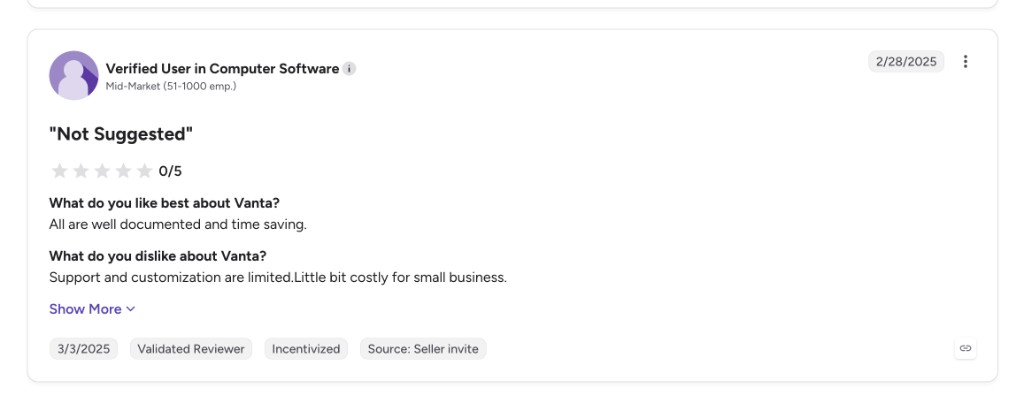
Source: G2 Vanta reviews. This is one review among many, and Vanta's overall G2 rating is considerably higher. Individual experiences vary, so read a spread of reviews at your own company size before drawing conclusions.
Switching from Vanta
Most migrations run in phases rather than as a cutover. Teams typically map existing controls and policies first, reconnect integrations second, then move evidence and run one review cycle in parallel before retiring the old subscription. Running both platforms for a single cycle costs one month of overlap and removes most of the risk.
Elfie's migration is the documented example: roughly 70% lower platform cost and close to five times the included capability. Your numbers will differ based on what you are consolidating.
Start a SecureSlate trial or model the cost difference against your current Vanta quote.
Frequently asked questions
Is SecureSlate a true Vanta alternative?
For compliance automation plus broader security operations in one platform, yes. Both cover the frameworks, evidence automation, and continuous monitoring you need for SOC 2 or ISO 27001. SecureSlate adds remediation and security tooling. Vanta brings more market familiarity.
How much cheaper is SecureSlate than Vanta?
SecureSlate Starter is $2,688 per year for one framework. Vanta is quote-based, with public estimates around $11,500 annually for comparable scope. The gap widens if you are also consolidating separate security tools, and narrows if your Vanta quote is smaller than the public estimate. Compare against your actual proposal.
What is the biggest functional difference?
Remediation. Both platforms detect a failing control. SecureSlate's auto-remediation agents can fix it in the source system and log the action as evidence. Vanta alerts you and tracks the task while the fix happens elsewhere.
How hard is it to switch from Vanta?
Plan a phased migration over a few weeks rather than a weekend. Map controls and policies, reconnect integrations, migrate evidence, then run one review cycle in parallel before cancelling. See how Elfie switched.
Can we keep our current frameworks and evidence?
Yes. Existing framework goals carry over, and evidence is imported or reconnected through integrations and control mapping. Historical evidence from your last audit period can be uploaded into the data room and archived for reference.
Which platform is better for SMB compliance programs?
SMB teams adding frameworks, vendors, and security workflows over time usually prefer broader built-in coverage, because tool sprawl costs more in operational time than in licence fees. Teams that need auditor and customer name recognition more than breadth often still prefer Vanta.
Is this comparison biased?
It is published by SecureSlate, so yes, treat it as a vendor's argument. What we have tried to do is make it checkable: capability claims link to documentation, pricing is published rather than implied, and the categories where Vanta is genuinely stronger are named in Where Vanta wins. Verify both platforms against your own stack before deciding.
Related guides:
- Vanta review 2026: pricing, features, pros and cons
- Vanta pricing and discounts explained
- How Elfie switched from Vanta to SecureSlate: 70% lower cost, nearly 5x more features
- 10 best compliance automation platforms in 2026
- Case Study: Senbee A/S achieves ISO 27001:2022 certification with SecureSlate
Need compliance without the complexity?
SecureSlate automates ISO 27001, SOC 2, GDPR, HIPAA, and more. Built for growing teams. See it in action.
Find compliance gaps in 30 seconds
