
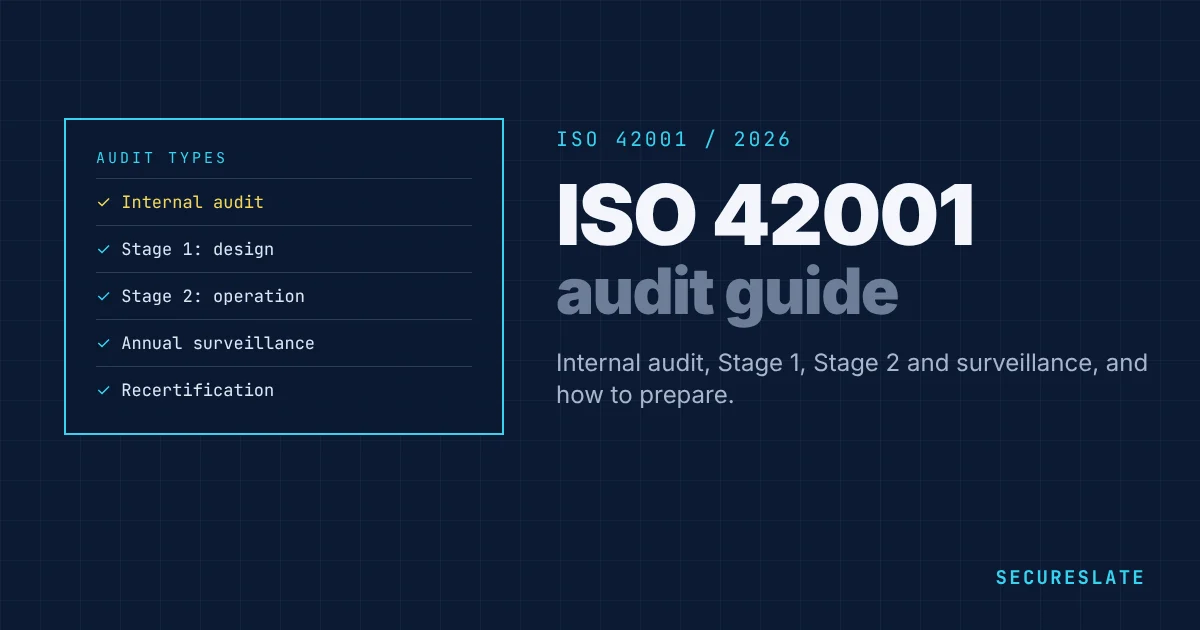
An ISO 42001 audit checks whether your AI management system (AIMS) meets ISO/IEC 42001:2023 and works in practice. There are three kinds you will meet: the internal audit you run yourself, the two-stage certification audit by an accredited certification body, and the surveillance audits that follow. This guide explains each one, what ISO 42001 auditors look for, and how to prepare.
Related guides: ISO 42001 certification timeline and steps · ISO 42001 Annex A controls · Who needs ISO 42001 · Lessons from our own ISO 42001 audit
Key takeaways
- Certification uses a two-stage audit: Stage 1 reviews design and readiness, Stage 2 tests whether the AIMS works.
- An internal audit and a management review must be completed before Stage 2.
- Auditors usually follow one or two AI systems end to end, from requirements and data to deployment and monitoring.
- Certificates last three years, with surveillance audits in years two and three.
Types of ISO 42001 audits
| Audit | Who performs it | Purpose |
|---|---|---|
| Internal audit | An objective internal auditor or external consultant | Required by clause 9.2. Checks conformity and effectiveness before and between certification audits |
| Stage 1 audit | Accredited certification body | Reviews documentation, scope and readiness for Stage 2 |
| Stage 2 audit | Accredited certification body | Tests implementation and effectiveness, leading to the certification decision |
| Surveillance audits | Certification body | Annual checks in years two and three |
| Recertification audit | Certification body | Renews the certificate before it expires |
Certification bodies that audit AI management systems work to ISO/IEC 42006, which sets the competence and process requirements for them. Check that your chosen body is accredited for ISO 42001.
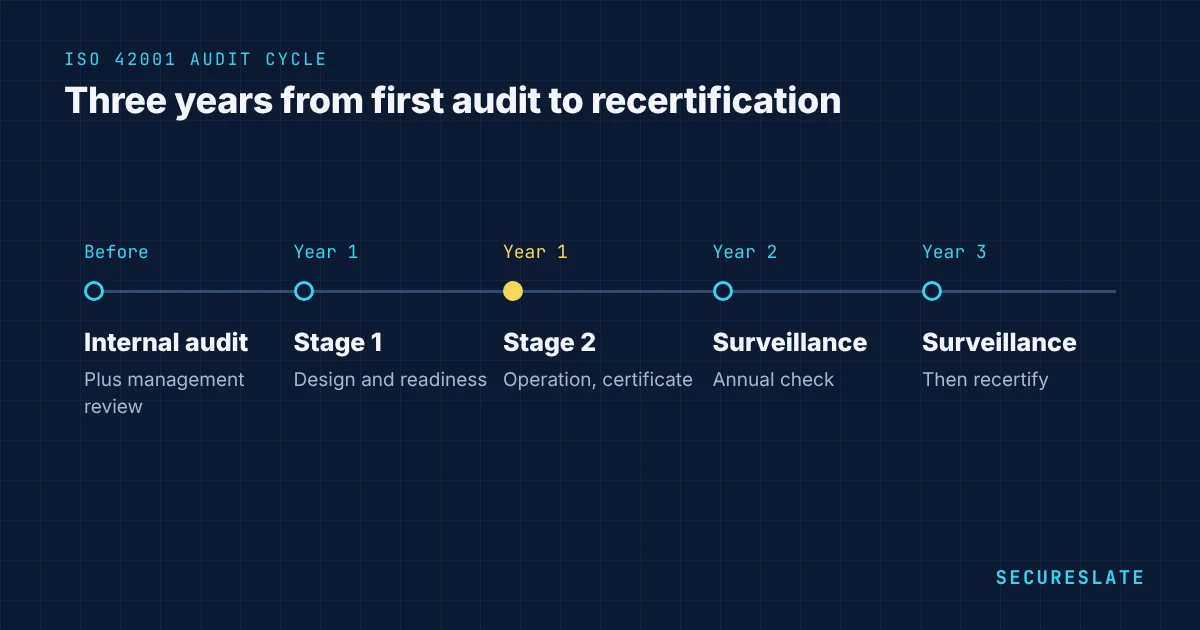
What happens in a Stage 1 audit?
Stage 1 is mostly a documentation and readiness review, often done remotely over one or two days for a small organization. The auditor checks:
- The scope of the AIMS and the AI systems it covers
- The AI policy and AI objectives
- Roles and responsibilities for AI governance
- The AI risk assessment and AI system impact assessment methods, and their results
- The Statement of Applicability for the 38 Annex A controls
- The internal audit program and management review records
- Whether you are ready for Stage 2
The auditor issues a Stage 1 report listing areas of concern. Fix them before Stage 2, usually a few weeks to two months later.
What happens in a Stage 2 audit?
Stage 2 tests whether the AIMS operates as documented. Expect interviews with leadership, the AIMS owner and the people who build and run AI systems. Auditors typically pick one or two AI systems and follow the evidence:
| Area | Typical evidence requested |
|---|---|
| AI system inventory | Complete list with owners, purpose and risk level |
| Impact assessment | Completed assessment for the sampled system, with sign-off and review date |
| Life cycle | Requirements, design decisions, data sources, testing and validation results, deployment approval |
| Data | Data quality checks, provenance records, preparation steps |
| Monitoring | Production monitoring results, incident records, drift or performance reviews |
| Transparency | User documentation, model information, how users are told they are interacting with AI |
| Suppliers | Due diligence on third-party models and AI services |
| Improvement | Nonconformities, corrective actions and management review outputs |
Nonconformities and how they are handled
- Major nonconformity: a requirement is missing or a failure puts the AIMS's effectiveness in doubt, for example no impact assessments at all. It must be corrected and verified before the certificate is issued.
- Minor nonconformity: an isolated lapse, such as one impact assessment overdue for review. You submit a corrective action plan, and the auditor checks it at the next visit.
- Opportunity for improvement: a suggestion, not a finding.
How to prepare for an ISO 42001 audit
- Complete the AI system inventory and confirm it matches the scope.
- Finish impact assessments for every AI system in scope, and keep them dated and signed.
- Run the internal audit across all clauses and Annex A, using someone objective.
- Hold the management review and record decisions and actions.
- Trace one AI system end to end yourself, as the auditor will, and fill any gaps in evidence.
- Brief interviewees on their responsibilities and where their records are.
- Organize evidence by clause and control so requests are answered in minutes.
Questions auditors commonly ask
Prepare your team to answer questions like these:
- How did you decide which AI systems are in scope, and how do you find new ones?
- Who approved the AI policy, and how is it communicated?
- Walk me through the impact assessment for this AI system. Who signed it off?
- How do you test and validate a model before release? Show me the last results.
- How do you monitor this system in production, and what happens when performance drops?
- How do users know they are interacting with AI?
- Which third-party models or AI services do you use, and how did you assess them?
- What did your last internal audit find, and what did you change?
How to choose a certification body
Check that the body is accredited for ISO/IEC 42001 by a recognized accreditation body, ask how many ISO 42001 audits it has completed, request auditor profiles with AI and software experience, and compare quotes for the full three-year cycle, not just the first year. If you hold ISO 27001, prefer a body that can run integrated audits.
Combining ISO 42001 and ISO 27001 audits
If you hold ISO 27001, ask your certification body for an integrated audit. Shared clauses such as document control, internal audit, management review, competence and supplier management are audited once, which reduces audit days and disruption.
How SecureSlate helps
SecureSlate organizes your ISO 42001 inventory, impact assessments, Statement of Applicability and evidence by clause and control, gives auditors structured access, and shares evidence with ISO 27001 where requirements overlap. SecureSlate holds its own ISO 42001 certification (announcement).
FAQ
How long does an ISO 42001 certification audit take?
For a small organization, Stage 1 often takes one to two days and Stage 2 two to four days. The certification body sets audit days based on scope, headcount and the number of AI systems.
Who can perform an ISO 42001 certification audit?
An accredited certification body. Check its accreditation covers ISO/IEC 42001 and ask about the auditors' experience with AI systems.
Is the internal audit required before certification?
Yes. Clause 9.2 requires an internal audit, and the certification body checks that it was completed, along with a management review, before Stage 2.
What is the difference between an ISO 42001 auditor and an AI auditor?
An ISO 42001 auditor checks your management system against the standard. An algorithmic or AI audit tests a specific model's behavior, such as bias or accuracy. ISO 42001 expects you to test and monitor AI systems, but the certification audit focuses on whether your governance works.
Can we fail an ISO 42001 audit?
The certificate is withheld until major nonconformities are fixed and verified. Most organizations fix findings and are certified after a short delay.
How much does an ISO 42001 audit cost?
Fees depend on the certification body, the number of audit days, scope and headcount. See our guide to ISO 42001 certification costs for typical ranges.
What evidence do we need for the first surveillance audit?
Records showing the AIMS kept running: updated inventory, new or reviewed impact assessments, monitoring results, an internal audit, a management review and closed corrective actions.
Can the internal audit be done by our own staff?
Yes, if the auditor is objective and impartial, meaning they do not audit their own work. Small companies often use an external consultant for this reason.
What happens if we miss a surveillance audit?
The certification body can suspend or withdraw the certificate. Schedule surveillance audits well ahead and keep the AIMS running between them.
How many AI systems will the auditor sample?
It depends on scope and audit days. For a small organization, auditors often follow one or two systems in depth and check the inventory for the rest.
Do auditors test the AI models themselves?
Not usually. They check that you test, validate and monitor models and act on the results, rather than running technical tests on the models.
Disclaimer (legal note)
This article is for general information only and is not legal, regulatory, or professional advice. Requirements vary by framework, industry, and jurisdiction. Consult qualified advisors for your specific obligations.
Need compliance without the complexity?
SecureSlate automates ISO 27001, SOC 2, GDPR, HIPAA, and more. Built for growing teams. See it in action.
Find compliance gaps in 30 seconds