
Short answer: ISO 42001 is worth it for a startup when enterprise or regulated buyers ask how you govern AI, or when AI is central to your product. Certification is voluntary. A startup can keep it lean by scoping one product, reusing ISO 27001 or SOC 2 foundations, and building only the policies, assessments and records the standard requires.
Related guides: What is ISO 42001? · ISO 42001 checklist · ISO 42001 certification cost
Key takeaways
- ISO/IEC 42001:2023 is a certifiable AI management system (AIMS) standard with clauses 4 to 10 and 38 Annex A controls across nine control objectives.
- Pursue it when buyers ask for it or AI is core to what you sell. It is a weak first investment if AI is a minor feature and nobody is asking.
- Keep scope tight: one product or AI service, the teams that build and run it, and the models and data it depends on.
- If you already have ISO 27001, the shared management system structure lets you reuse a large part of the work.
- Certification is a three-year cycle with surveillance audits, so plan for the ongoing work, not just the first audit.
Should a startup pursue ISO 42001?
A startup should pursue ISO 42001 when customers, partners or regulators expect structured AI governance and certification would remove friction in sales or diligence.
| Situation | Is ISO 42001 a good next step? | Why |
|---|---|---|
| AI is the core product and enterprise buyers send AI questionnaires | Usually yes | A certificate answers many governance questions at once |
| You sell into health, finance or public sector with AI features | Often yes | These buyers scrutinize data use, oversight and impact |
| You have no security certification yet | Usually start with SOC 2 or ISO 27001 | Buyers ask for security assurance first in most deals |
| AI is a small feature using a third-party model | Often not yet | A documented AI policy and vendor review may be enough |
| You are preparing for the EU AI Act | Helpful, not sufficient | ISO 42001 supports AI Act readiness but does not equal compliance |
In our experience, the trigger is usually a large prospect's AI questionnaire or a procurement requirement, not a regulator. Our guide to AI startup enterprise security requirements covers what those buyers ask for.
What does ISO 42001 actually require?
ISO 42001 requires a management system for AI: defined scope, leadership commitment, AI risk and impact assessment, controls selected from Annex A, and continual monitoring and improvement.
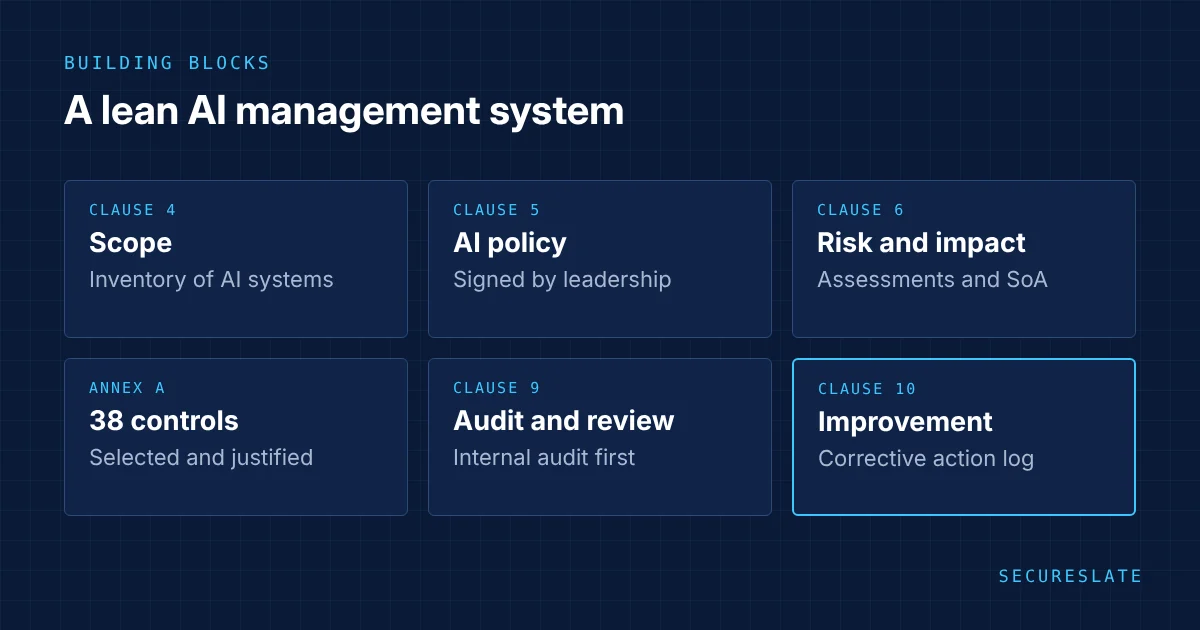
The standard follows the same high-level structure as other ISO management system standards. For a startup, each clause translates into a small number of concrete outputs:
| Clause | What it asks for | Lean startup output |
|---|---|---|
| 4 Context | Understand context, interested parties and your AI roles; define scope | One-page scope statement and AI system inventory |
| 5 Leadership | Commitment, AI policy, roles and responsibilities | AI policy signed by founders; named AIMS owner |
| 6 Planning | AI risk assessment, AI system impact assessment, objectives, Statement of Applicability | Risk register, impact assessments for in-scope systems, SoA |
| 7 Support | Resources, competence, awareness, communication, documented information | Training records and a document register |
| 8 Operation | Run the planned processes, risk treatment and impact assessments | Evidence that assessments and controls happen in practice |
| 9 Performance evaluation | Monitoring, internal audit, management review | One internal audit and one management review before Stage 1 |
| 10 Improvement | Nonconformities, corrective action, continual improvement | Corrective action log |
Annex A holds 38 controls under nine objectives, covering topics such as AI policies, internal organization, resources, impact assessment, the AI system life cycle, data for AI systems, information for interested parties, use of AI systems and third-party relationships. You justify inclusions and exclusions in your Statement of Applicability. Our ISO 42001 checklist lists them.
How should a startup scope its AI management system?
A startup should scope its AIMS around the AI systems customers care about, the people who build and operate them, and the data and models they rely on.
Questions to settle before writing anything:
- Which AI systems are in scope? Usually your customer-facing AI product. Internal tools such as coding assistants can be listed and managed under policy without full impact assessments if they are outside scope.
- What is your role? You may develop models, integrate third-party models, provide an AI service or use AI internally. Your role shapes which controls apply.
- Which third parties matter? Model providers, data vendors, labeling services and cloud platforms.
- Which data is involved? Training, fine-tuning, evaluation and production data, especially personal or health data.
- Who is in scope? Product, engineering, data science and the people who handle customer escalations about AI behavior.
Write the scope so a customer can understand it. Vague scopes cause auditor questions and buyer doubts.
What is a lean path to ISO 42001 certification?
A lean path runs from scoping and gap assessment through risk and impact assessment, implementation, internal audit and a two-stage certification audit.
- Confirm the business case. Name the deals, customers or partners that need certification.
- Define scope and inventory AI systems, with owners, purposes, models and data sources.
- Run a gap assessment against clauses 4 to 10 and Annex A.
- Write the core documents: AI policy, roles, risk and impact assessment methods, and the Statement of Applicability.
- Assess risks and impacts for each in-scope AI system, including effects on individuals and groups, and decide treatments.
- Implement controls across the AI life cycle: requirements, data quality and provenance, testing, release approval, monitoring and incident handling.
- Train the team and collect evidence that processes run, not just that documents exist.
- Run an internal audit and a management review, then fix findings.
- Choose an accredited certification body and complete Stage 1 (documentation and readiness) and Stage 2 (effectiveness).
- Operate the cycle, with surveillance audits in the following years and recertification at year three.
Timelines depend on scope, existing maturity and team capacity, so treat any fixed estimate with care. Startups with ISO 27001 already in place usually move faster because the management system processes exist. Our guide to the ISO 42001 audit explains what each stage involves.
Can a startup reuse ISO 27001 or SOC 2 work?
Yes. ISO 27001 overlaps most because it shares the management system structure, and SOC 2 controls provide useful security evidence.
| Existing work | What carries over | What ISO 42001 adds |
|---|---|---|
| ISO 27001 | Scope and context method, document control, internal audit, management review, corrective action, supplier management, many security controls | AI policy, AI risk and impact assessments, AI life cycle and data controls, transparency to users |
| SOC 2 | Access control, change management, monitoring, vendor management and incident response evidence | A formal management system, plus all AI-specific requirements |
| Privacy program (GDPR or HIPAA) | Data mapping, DPIAs, records of processing, retention rules | Impact assessment that looks beyond privacy at fairness, safety and societal effects |
See ISO 42001 vs ISO 27001 for a detailed comparison and advice on which to do first.
Pitfalls that slow startups down
The most common pitfall is writing a large document set before the team has decided how AI is actually governed day to day.
- Copying templates wholesale. Auditors test whether processes run. Policies that describe a larger company's process will fail Stage 2.
- Scoping everything. Including every experiment and internal tool multiplies impact assessments.
- Treating impact assessment as a privacy DPIA. ISO 42001 asks about effects on individuals, groups and society, not only personal data.
- Ignoring third-party models. Your model provider's terms, data handling and change notices are part of your risk picture.
- Forgetting year two. Surveillance audits check that monitoring, reviews and improvements continued after certification.
- Assuming certification equals EU AI Act compliance. The EU AI Act applies in phases and has its own obligations by risk category. ISO 42001 helps you organize, but legal obligations still need separate review.
How SecureSlate helps
SecureSlate helps startups run ISO 42001 without a dedicated compliance team. It does not perform audits or issue certifications.
- Multi-framework control mapping with built-in ISO 42001, EU AI Act, ISO 27001, SOC 2, GDPR and HIPAA frameworks, so shared controls are implemented once.
- Risk management for AI risks and treatment decisions.
- Vendor risk management for model providers, data vendors and other AI suppliers.
- Agentless, read-only cloud integrations, a device agent and access reviews for security evidence.
- Audit management to work with your certification body, plus a trust center and security questionnaire automation for AI governance questions from buyers.
- Code security and secrets detection for the repositories behind your AI product.
FAQ
Is ISO 42001 mandatory for AI startups?
No. ISO 42001 is a voluntary standard. Some customers or contracts may require it, but no law requires certification as such.
Should a startup do ISO 42001 or ISO 27001 first?
In most cases ISO 27001 or SOC 2 comes first, because buyers ask for security assurance more often. Startups whose buyers focus on AI governance may start with ISO 42001 or do both together.
How long does ISO 42001 certification last?
Certificates follow a three-year cycle, with surveillance audits in the intervening years and recertification at the end.
Can a small team implement ISO 42001?
Yes. The standard scales to organization size. A small team should keep scope narrow, reuse existing security processes and focus on evidence that the processes actually run.
Does ISO 42001 make us compliant with the EU AI Act?
No. ISO 42001 supports structured AI governance that can help with AI Act readiness, but the AI Act has its own legal obligations that need separate assessment.
Disclaimer (legal note)
This article is for general information only and is not legal, regulatory, or professional advice. Requirements vary by framework, industry, and jurisdiction. Consult qualified advisors for your specific obligations.
Need compliance without the complexity?
SecureSlate automates ISO 27001, SOC 2, GDPR, HIPAA, and more. Built for growing teams. See it in action.
Find compliance gaps in 30 seconds