
Short answer: Enterprises expect AI startups to meet normal SaaS security requirements, usually shown with a SOC 2 report, and then to explain how the AI itself is governed. That means clear commitments on customer data and model training, disclosed model providers, controls for prompt injection and agent permissions, and documented human oversight.
Related guides: SOC 2 for AI startups, enterprise security review, the AI vendor questionnaire
Key takeaways
- A strong AI demo rarely shortens security review. In our experience it often adds questions, because the product touches more sensitive data.
- Write your data use position first, since it shapes the answers to many of the other questions.
- Treat each model provider as a subprocessor and disclose it.
- Expect reviewers to ask about prompt injection, sensitive data exposure and what your agents are allowed to do.
- SOC 2 is usually the entry ticket. ISO 42001 can help when buyers ask how AI is governed, but it is not a replacement.
Why do enterprises review AI startups differently?
Enterprises review AI startups differently because an AI product adds new data paths, third-party model dependencies and non-deterministic behavior on top of ordinary application risk. A standard questionnaire was not written for a system that can be steered through its inputs or take actions on its own.
Buyers are also working from published guidance now. The NIST AI Risk Management Framework and its Generative AI Profile, NIST AI 600-1, published in July 2024, give risk teams a shared vocabulary, and many AI questionnaires borrow from them. Security engineers often reach for the OWASP Top 10 for LLM Applications as well.
The people in the room change too. In our experience, a deal with an AI product can pull in security, legal, privacy and an AI governance committee, each with a separate set of concerns. Preparing one reusable evidence pack keeps those parallel reviews from consuming your engineers.
What evidence will an enterprise security team request?
Expect requests in two layers: the baseline any SaaS vendor must show, and a set of AI-specific materials. If you have the first layer and not the second, you will still get stuck.
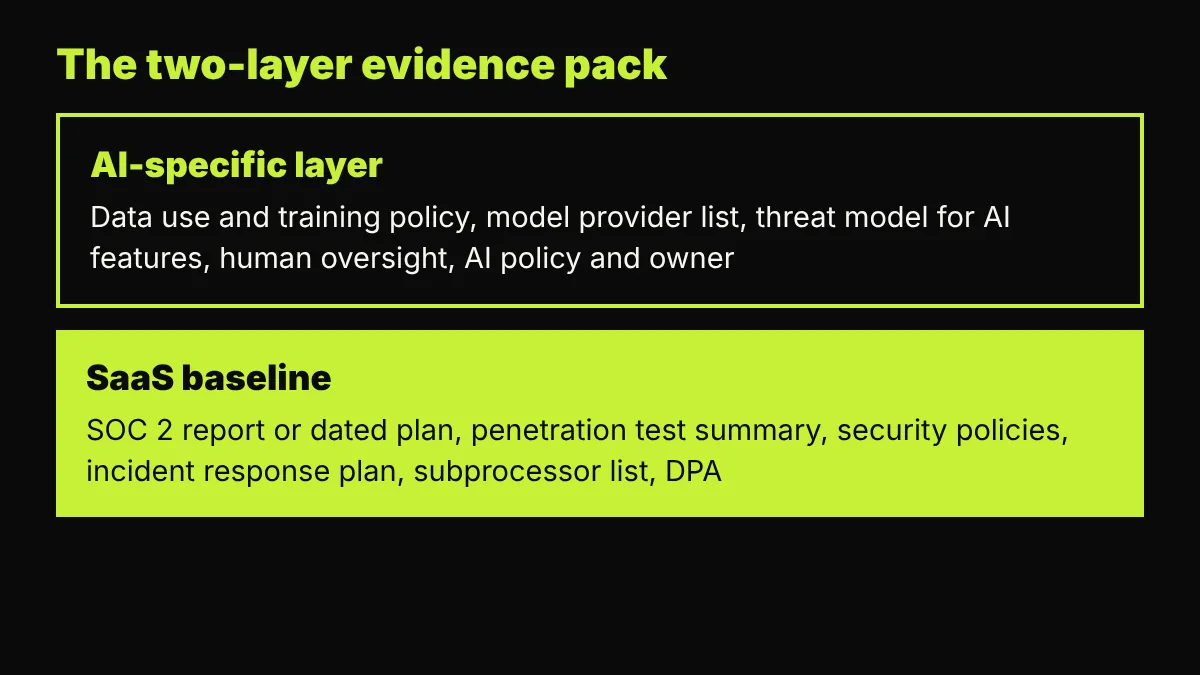
| Layer | What to have ready |
|---|---|
| SaaS baseline | SOC 2 report or a dated plan to obtain one, penetration test summary, security policies, incident response plan, subprocessor list, data processing agreement |
| AI data handling | Written data use and training policy, retention for prompts and outputs, tenant isolation description |
| AI supply chain | List of model providers and hosting locations, provider terms that support your commitments |
| AI behavior and safety | Threat model for AI features, evaluation approach, known limitations, human oversight description |
| AI governance | AI policy, named owner, process for approving model changes and new AI use cases |
Keep this material in one place and gate access through an NDA where needed. A trust center lets buyers help themselves and cuts back-and-forth.
How should you answer questions about customer data and training?
Give a direct, written answer that says whether customer data trains any model, who can see it, how long it is kept and where it is processed. Vague language is the most common reason this part of a review drags on, in our experience.
Your answer should address each of these points:
- Training: Do you or your model providers train on customer content? If the answer differs by plan or setting, say so.
- Retention: How long are prompts, outputs, embeddings and logs kept, and can a customer change this?
- Isolation: How are vector stores, caches and fine-tuned models kept separate between tenants?
- Provider terms: Does each provider's contract actually support what you have promised? Your commitment is only as strong as the agreement behind it.
- Human access: Which employees can view customer content, under what approval and with what logging?
Then make sure the product, contract and security documentation all say the same thing. Reviewers compare them.
Which AI-specific controls do reviewers test?
Reviewers focus on how the system handles hostile input, what it can leak and how far an agent can act. The 2025 OWASP list is a practical checklist, because it names prompt injection as LLM01, sensitive information disclosure as LLM02 and excessive agency as LLM06.
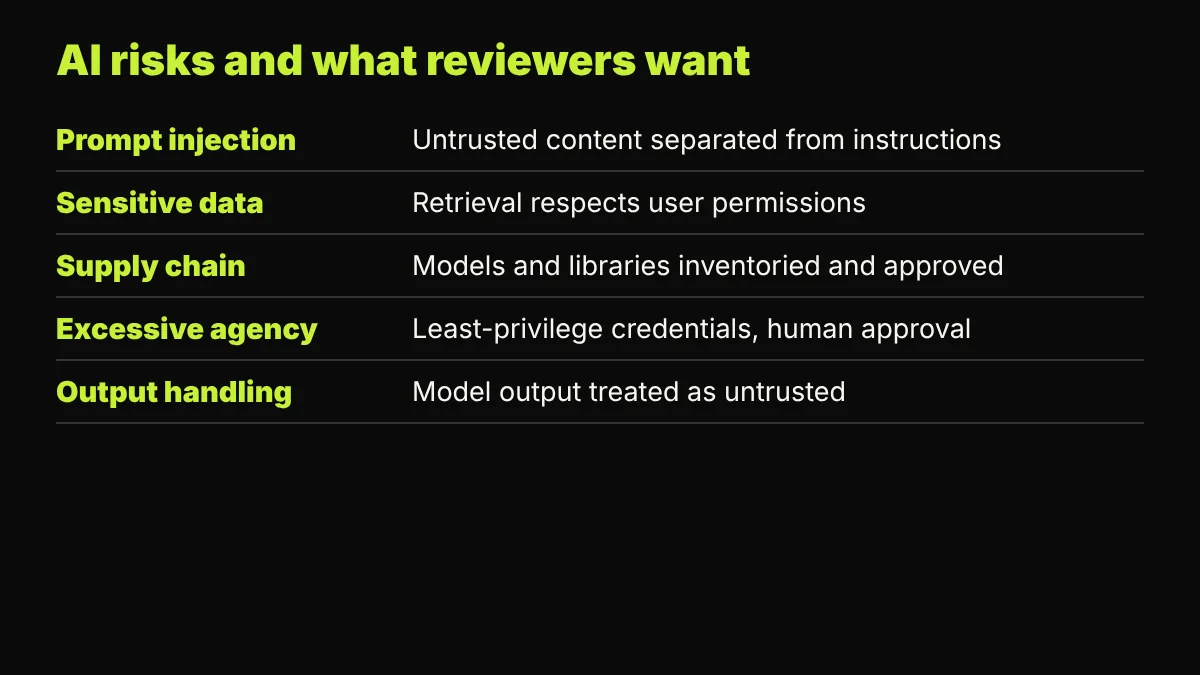
| Risk | What a reviewer wants to see |
|---|---|
| Prompt injection | Untrusted content is separated from instructions, and tests cover indirect injection through documents and web content |
| Sensitive information disclosure | Retrieval respects the requesting user's permissions, and outputs are checked for leaked data |
| Supply chain | Models and libraries are inventoried, versioned and approved |
| Excessive agency | Agents use least-privilege credentials, and high-impact actions need human approval |
| Improper output handling | Model output is treated as untrusted before it reaches code, queries or browsers |
Logging ties these together. Be ready to show that you can reconstruct what a user asked, what the model returned and which tools it called, within limits your retention policy allows. Be candid about residual risk too, since no current defense fully removes prompt injection. A reviewer will trust "here is how we limit the damage" more than "we have solved it."
Do you need SOC 2, ISO 42001 or both?
Most AI startups selling to enterprises in the US should start with SOC 2, then add ISO 42001 if buyers begin asking for evidence of AI governance. They answer different questions: SOC 2 reports on controls for your service, while ISO/IEC 42001 specifies a management system for how an organization governs AI.
| Situation | Sensible order |
|---|---|
| US mid-market or enterprise buyers | SOC 2 first, AI governance documents alongside it |
| Buyers with formal AI committees | SOC 2, then ISO 42001 |
| Europe-heavy pipeline | ISO 27001 or SOC 2 based on buyer preference, then ISO 42001 |
| Healthcare customers | SOC 2 and HIPAA readiness before any AI-specific certification |
Neither one proves that your model is accurate or unbiased. For that, buyers will look at your evaluations. Our ISO 42001 framework guide goes deeper on the certification path.
What changes when you sell to healthcare or EU buyers?
Regulated buyers add legal requirements on top of security review. Two situations come up most often for AI startups.
Healthcare. If your product handles protected health information for a covered entity or business associate, you are likely a business associate. HHS guidance says that business associates need written contracts with subcontractors that create, receive, maintain or transmit that information on their behalf. A model provider that processes PHI for you falls into that chain, so confirm a BAA is available before you route clinical data to it.
European Union. Expect buyers to ask for your role under the EU AI Act, usually whether you are a provider or a deployer, and how your system is classified. Application dates for some obligations have been the subject of amending legislation, so check the current position before you put a date in a contract or questionnaire answer. Under GDPR, your model providers are also likely to be sub-processors that you must disclose.
What should an early-stage team do first?
Build the evidence in the order buyers will ask for it, and keep the first version short. A two-page document that is accurate beats a long one that is out of date.
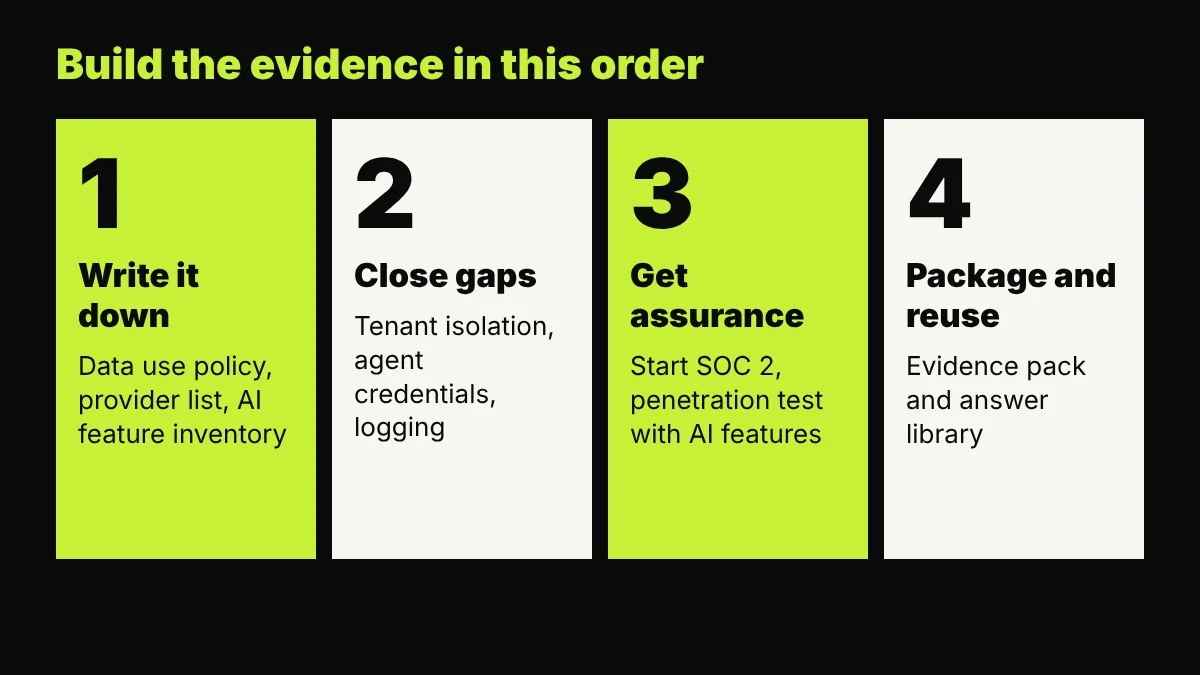
- Write it down: data use policy, model provider list and a short AI feature inventory.
- Close the obvious gaps: tenant isolation, least-privilege agent credentials and logging.
- Get independent assurance: start SOC 2 and commission a penetration test that includes AI features.
- Package and reuse: keep an evidence pack and a questionnaire answer library, and update both whenever you change a model or provider.
Assign one owner for keeping this current. Model changes are frequent, and an out-of-date subprocessor list can undermine a review that was otherwise going well.
How SecureSlate helps
SecureSlate gives small teams one place to run this work. Multi-framework control mapping covers SOC 2, ISO 27001, ISO 42001, HIPAA, GDPR and the EU AI Act, so shared controls do not have to be tested twice, and custom controls can capture your AI-specific commitments.
Agentless read-only cloud integrations and access reviews support evidence collection, code security and secrets detection cover your repositories, and vendor risk management helps you track model providers and other suppliers. A trust center and security questionnaire automation help you reuse approved answers during a review. Outcomes still depend on your controls, scope and auditor.
Start a SecureSlate trial to build your enterprise evidence pack.
FAQ
Do AI startups need SOC 2 before selling to enterprises?
Not legally, but many enterprise buyers expect it. If you do not have a report yet, share a dated plan, a current penetration test summary and your policies so that the review can proceed.
Should we list our model provider as a subprocessor?
Yes, if it processes customer data on your behalf. Include its role, the type of data involved and where processing takes place, and tell customers when that changes.
Is ISO 42001 required to sell AI to enterprises?
It is a voluntary standard, and not every buyer will ask for it. It is most useful when customers want independent evidence of how you govern AI.
How do we answer a questionnaire not written for AI products?
Answer the questions as asked, then attach a short AI addendum covering data use, model providers, AI-specific controls and human oversight. That often heads off a second round of questions.
Disclaimer (legal note)
This article is for general information only and is not legal, regulatory or professional advice. Requirements vary by framework, industry and jurisdiction. Consult qualified advisors for your specific obligations.
Need compliance without the complexity?
SecureSlate automates ISO 27001, SOC 2, GDPR, HIPAA, and more. Built for growing teams. See it in action.
Find compliance gaps in 30 seconds
