
Short answer: ISO 42001 training is any education that gives people the competence and awareness the standard asks for. ISO/IEC 42001 does not mandate a specific course. Clause 7.2 requires you to define competence for roles that affect AI performance, close gaps and keep records. Clause 7.3 requires everyone to understand the AI policy and their part in it.
Related guides: What is ISO 42001 · ISO 42001 checklist · ISO 42001 audit
Key takeaways
- ISO 42001 asks for demonstrated competence and awareness, not for a particular certificate or training provider.
- Most organisations need three layers: organisation-wide awareness, role-based training for AI builders and owners, and specialist training for the people who run and audit the AI management system (AIMS).
- Lead implementer courses suit the person running the program. Internal auditor or lead auditor courses suit the people who audit it.
- Auditors look for records: a competence matrix, training completions, and proof that you checked whether the training worked.
- If you already run ISO 27001 or SOC 2 awareness training, you can extend it with AI-specific modules instead of starting again.
What does ISO 42001 require for training?
ISO 42001 requires competence and awareness, and it leaves the method of getting there up to you. The standard follows the same harmonized structure as ISO 27001, so the support clauses will look familiar.
| Requirement | What it asks | Typical evidence |
|---|---|---|
| Clause 7.2 Competence | Decide the competence needed for people whose work affects AI performance, make sure they have it through education, training or experience, act on gaps and evaluate whether the action worked | Competence matrix, training records, CVs or role profiles, effectiveness checks |
| Clause 7.3 Awareness | People working under the organisation's control know the AI policy, how they contribute to the AIMS and what happens if they do not follow it | Awareness module completions, policy acknowledgements, onboarding records |
| Clause 7.4 Communication | Decide what to communicate about the AIMS, when, to whom and how | Communication plan, announcements, team briefings |
| Annex A control A.4.6 (Human resources) | Document the people and competences used across the AI system life cycle | Role descriptions and skills mapped to AI systems in scope |
"Retain documented information as evidence of competence" is the line that turns training into an audit topic. A course that leaves no record does not help you in an audit.
What types of ISO 42001 training exist?
Training falls into a few recognisable types, each built for a different job. ISO itself publishes the standard but does not run or endorse courses, so content and quality vary between providers.
| Training type | Who it is for | What it covers | Typical format |
|---|---|---|---|
| Awareness | All staff and contractors who use or influence AI | AI policy, acceptable use, how to raise concerns, why the AIMS matters | Short online module, refreshed regularly |
| Foundation | Managers, product owners, compliance staff | Clauses 4 to 10, Annex A at a high level, key terms | One or two days, sometimes with an exam |
| Lead implementer | The person who builds and runs the AIMS | Scoping, AI risk and impact assessments, Statement of Applicability, documentation, preparing for certification | Multi-day course, usually with an exam |
| Internal auditor | Staff who audit the AIMS under clause 9.2 | Audit planning, sampling, interviews, writing findings | Two or three days |
| Lead auditor | People who lead audits, including certification body auditors | Managing audit teams and full audit programmes, often based on ISO 19011 | Multi-day course with an exam |
| Role-based technical | Data scientists, ML engineers, product and security teams | Data quality, model monitoring, impact assessment inputs, life cycle controls | Workshops and internal guidance |
A personal certificate from a course shows that an individual passed an exam. It does not certify your organisation. Only an accredited certification body can certify your AIMS against ISO 42001.
Which roles need which training?
Match training to what each person actually does in the AI management system. A simple mapping works for most small and mid-sized teams:
- Executive sponsor and top management: a short briefing on their clause 5 duties, such as approving the AI policy, assigning roles and providing resources.
- AIMS owner or compliance lead: lead implementer or an equivalent level of experience, plus deep familiarity with your own AI risk and impact assessment process.
- Internal auditors: internal auditor training, ideally from someone independent of the AI teams they audit.
- Engineers and data scientists: role-based training on data provenance, model validation, monitoring and change control for AI systems.
- Product, legal and customer-facing staff: training on transparency obligations, intended use and how to escalate AI incidents or complaints.
- Everyone else: awareness training on the AI policy and approved tools.
In our experience, the gap auditors find most often is not a missing course for the AIMS owner. It is engineers who build AI features without any recorded AI-specific training.
How do you build an ISO 42001 training plan?
Build the plan as a loop that follows clause 7.2: define, deliver, check and record.
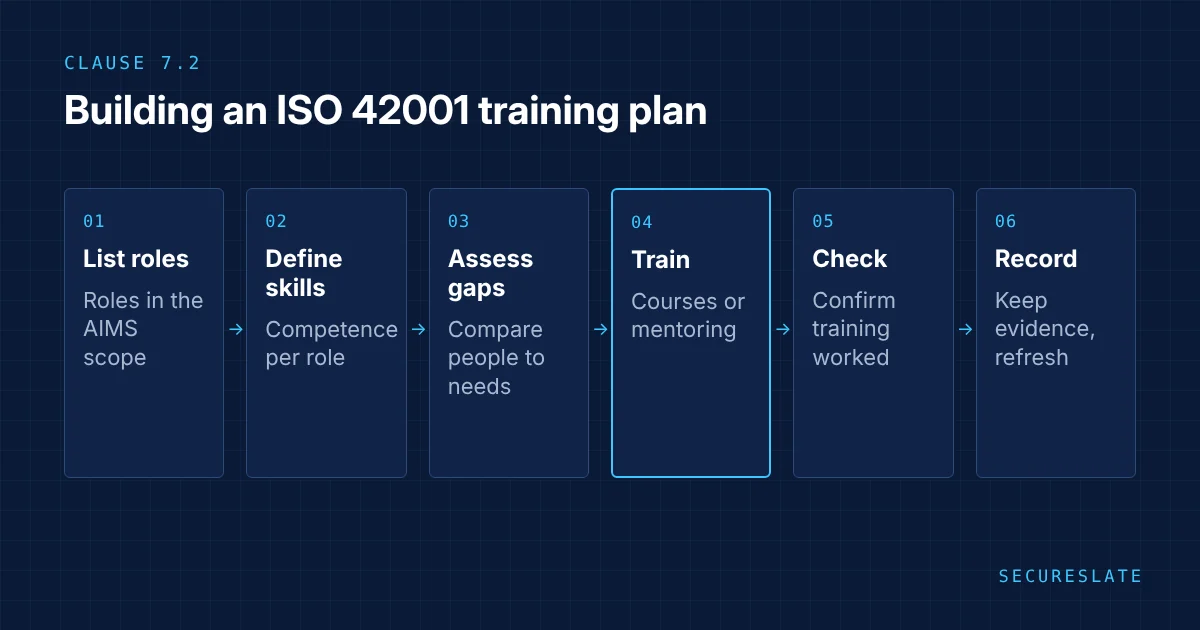
- List roles in scope. Use your AIMS scope and AI system inventory to find every role that designs, develops, deploys, operates or oversees AI.
- Define required competence. For each role, write two to five competence statements, such as "can complete an AI system impact assessment".
- Assess current competence. Compare people against the statements using experience, past training and manager input.
- Close the gaps. Choose the training type from the table above, or use mentoring and on-the-job learning where that fits better.
- Check effectiveness. Use quizzes, observed work or audit results to confirm the training worked, as clause 7.2 requires.
- Keep records and refresh. Store completions and effectiveness checks, and repeat awareness training on a set cycle and when the AI policy changes.
Keep the plan in one place. A spreadsheet or GRC tool that links each person to their role, required competence and evidence is easier to show an auditor than scattered certificates.
What will the certification auditor check?
The auditor checks that competence is defined, achieved and recorded, and that people actually understand the AI policy. Expect them to sample records and interview staff.
Use this checklist before Stage 1 and Stage 2:
- A competence matrix covers every role in the AIMS scope.
- Training records exist for each person sampled, with dates.
- Effectiveness checks are recorded, not just attendance.
- Awareness content references your current AI policy version.
- Internal auditors are trained and independent of the area they audit.
- New joiners complete awareness training within a defined period.
- Training gaps found in internal audits or management review have actions.
Certification bodies also have their own rules. ISO/IEC 42006, published in July 2025, sets additional requirements for bodies that audit and certify AI management systems, including the competence of their audit teams. That affects the auditors you hire, not your internal training, but it is a useful question to ask when choosing a certification body.
How do you choose an ISO 42001 course?
Pick a course on fit and depth, not on the name of the certificate. Useful criteria:
- Level: awareness, implementer or auditor. Do not send an internal auditor to an implementer course or the other way round.
- Trainer experience: look for trainers who have implemented or audited an AIMS, not only ISO 27001.
- Practical content: case studies on impact assessments, the Statement of Applicability and Annex A controls are more useful than slides that restate the clauses.
- Exam and certificate scheme: check who issues the personal certificate and whether it is recognised by the clients or certification bodies you work with.
- Format: live classes help with discussion, self-paced courses help with scheduling. Both can work.
- Fit with your stack: if you already hold ISO 27001, a course that explains how ISO 42001 and ISO 27001 overlap will save time.
Ask providers for a syllabus before you book. If it does not mention impact assessments or the AI system life cycle, it is probably too generic.
How SecureSlate helps
SecureSlate includes ISO 42001 as a built-in framework, with control mapping to ISO 27001, SOC 2 and other frameworks you may already run. You can assign training and awareness controls to owners, link completion evidence to clauses 7.2 and 7.3, and track open gaps in risk management alongside your AI risks. Access reviews and the device agent help show that the people with access to AI systems are the ones you trained. Audit management keeps the evidence ready for your certification body, which performs the audit and issues the certificate.
Start a free trial to map your ISO 42001 training evidence.
FAQ
Is ISO 42001 training mandatory?
No specific course is mandatory. The standard requires competence and awareness and evidence of both. Training is the most common way to meet that, but experience and education also count when they are recorded.
Do I need a lead implementer certificate to get ISO 42001 certified?
No. Your organisation is certified, not individuals. A lead implementer course can help the person running the program, but auditors judge whether the AIMS works, not whether staff hold a particular certificate.
How often should ISO 42001 awareness training be repeated?
The standard does not set a frequency. Many organisations repeat it annually and whenever the AI policy or approved tools change. Define the cycle in your training plan and follow it.
Can we combine ISO 42001 and ISO 27001 training?
Yes. The clause structures match, so a combined awareness module with AI-specific sections works well. Keep separate records or tags so you can show coverage for each standard.
What is the difference between internal auditor and lead auditor training?
Internal auditor training prepares staff to audit your own AIMS. Lead auditor training goes further into leading audit teams and managing full audit programmes, and it is the usual route for people who want to audit for a certification body.
Disclaimer (legal note)
This article is for general information only and is not legal, regulatory, or professional advice. Requirements vary by framework, industry, and jurisdiction. Consult qualified advisors for your specific obligations.
Need compliance without the complexity?
SecureSlate automates ISO 27001, SOC 2, GDPR, HIPAA, and more. Built for growing teams. See it in action.
Find compliance gaps in 30 seconds