
Short answer: HIPAA has no separate rulebook for AI. If an AI tool creates, receives, maintains or transmits protected health information (PHI) for a covered entity or business associate, the Privacy, Security and Breach Notification Rules apply in full. That means a business associate agreement with the AI vendor, a permitted purpose for every use of PHI, and documented safeguards.
Related guides: HIPAA regulations and rules explained · AI, security and compliance in healthcare · AI governance policy
Key takeaways
- HIPAA is technology neutral. An AI model that processes PHI is treated like any other system that holds PHI.
- No BAA, no PHI. An AI vendor that handles PHI on your behalf is a business associate, and the agreement must be signed before any data flows.
- Training on PHI needs a legal basis. Treatment, payment and health care operations cover some uses. A vendor improving its own product usually needs de-identified data or patient authorization.
- AI belongs in your risk analysis. Prompts, outputs, logs, embeddings and training sets can all contain ePHI.
- There is no official "HIPAA certified AI". HHS does not certify products. Compliance depends on how you configure, contract for and use the tool.
Does HIPAA apply to AI tools?
Yes, whenever the tool touches PHI on behalf of a covered entity or business associate. HIPAA regulates who handles health information and for what purpose, not which technology they use.
| Scenario | Does HIPAA apply? | Why |
|---|---|---|
| A clinic uses an AI scribe to draft visit notes | Yes | The vendor handles PHI for a covered entity |
| A HealthTech SaaS vendor adds an LLM feature that processes customer patient records | Yes | The vendor is a business associate and the LLM provider becomes its subcontractor |
| A staff member pastes patient details into a consumer chatbot with no BAA | Yes, and it is likely an impermissible disclosure | PHI went to a third party without a BAA |
| A model is trained only on data de-identified under the HIPAA standard | No, for that dataset | Properly de-identified data is not PHI |
| A direct-to-consumer fitness app uses AI coaching, with no provider or plan involved | Generally no | The developer is not a covered entity or business associate |
When is an AI vendor a business associate?
An AI vendor is a business associate when it creates, receives, maintains or transmits PHI to perform a function for a covered entity, or for another business associate. In that case the Privacy Rule requires a written contract before PHI is shared, and the Security Rule sets the contract terms for electronic PHI in 45 CFR 164.314.
The chain matters. If you are a HealthTech vendor and your product calls a third-party model API with customer PHI, the model provider is your subcontractor business associate. You need a BAA with that provider, and your customers need a BAA with you. Each link in the chain is directly liable for its own Security Rule compliance.
A BAA with an AI vendor should answer questions that a generic template often skips:
- Permitted uses: Can the vendor use prompts, outputs or uploaded files to train or improve its models? The default answer for PHI should be no.
- Retention: How long are prompts, outputs and logs kept, and can retention be set to zero or a short window?
- Human review: Can vendor staff read conversations for abuse monitoring or quality review, and under what controls?
- Subprocessors: Which hosting and model providers sit behind the service, and are they covered by downstream BAAs?
- Covered services: Many providers sign a BAA only for specific products or enterprise tiers. Confirm the exact service you use is listed.
- Breach reporting: How fast will the vendor notify you of a security incident involving your data?
Can you use PHI to train or improve AI models?
Sometimes, but only with a Privacy Rule basis for that specific use. Training a model is a use of PHI like any other, so it needs to fit a permitted purpose, rely on patient authorization, or use data that is no longer PHI.
| Purpose | Typical HIPAA basis | Watch for |
|---|---|---|
| A covered entity uses its own PHI to improve its own care quality or operations | May qualify as health care operations | Minimum necessary applies; document the reasoning |
| A business associate builds or tunes a model for one customer, using that customer's PHI | Permitted if the BAA allows it and the covered entity could do it itself | Keep data and model access scoped to that customer |
| A vendor uses customer PHI to improve its general product for all customers | Usually not permitted as PHI | Use de-identified data if the BAA allows de-identification, or obtain authorization |
| Research that produces generalisable knowledge | Patient authorization, or a waiver approved by an IRB or privacy board | Research rules are separate from operations |
| Marketing or sale of data | Patient authorization | Strict limits apply |
De-identification is the most common route for model development. The Privacy Rule recognises two methods: Safe Harbor, which removes 18 listed types of identifiers, and Expert Determination, where a qualified expert concludes the re-identification risk is very small. Two cautions apply to AI work. First, free text such as clinical notes is hard to de-identify reliably, so automated scrubbing needs validation. Second, a business associate may only de-identify PHI if its BAA permits that activity.
Models can also memorise training data. If a model was trained on PHI, treat the model weights and any fine-tuned versions as potentially containing PHI, and restrict who can query or export them.
Which Security Rule safeguards matter most for AI?
The same administrative, physical and technical safeguards apply, but AI adds new places where ePHI lives. The starting point is the risk analysis required by 45 CFR 164.308, which must cover every system that holds ePHI, including AI pipelines.
| Safeguard | Rule reference | What it means for an AI system |
|---|---|---|
| Risk analysis and risk management | 164.308(a)(1) | Add each AI use case, its data flows and its vendors to the risk analysis. Reassess when the model or vendor changes. |
| Workforce training and sanctions | 164.308(a)(5), (a)(1) | Tell staff which AI tools are approved for PHI and which are prohibited. |
| Business associate contracts | 164.308(b), 164.314 | BAA in place with the AI vendor and its relevant subcontractors. |
| Access control | 164.312(a) | Unique user IDs, role-based access to prompts, outputs, vector stores and training data. |
| Audit controls | 164.312(b) | Log who submitted what and who viewed outputs. Protect the logs, since they contain PHI. |
| Integrity | 164.312(c) | Controls against tampering with training data, prompts and model outputs that feed clinical records. |
| Transmission security | 164.312(e) | Encrypt API calls to model providers and between internal services. |
| Documentation | 164.316 | Keep policies, risk decisions and assessments for six years. |
AI-specific risks deserve their own lines in the risk register: prompt injection that causes a model to reveal other patients' data, retrieval systems that ignore the user's permissions, outputs written into the record without review, and PHI copied into debugging tools or evaluation datasets.
The minimum necessary standard also applies. Send the model only the fields it needs for the task.
How do you evaluate an AI tool for HIPAA compliance?
Work through a fixed sequence before any PHI reaches the tool, and keep the answers as evidence.
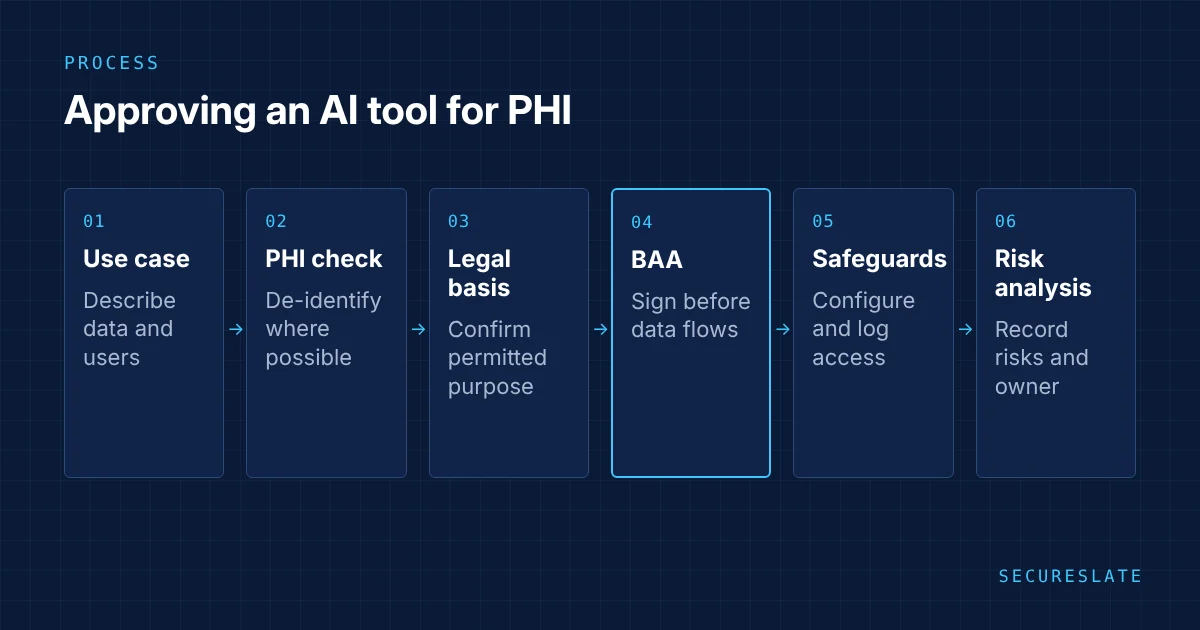
- Describe the use case. Write down what the tool does, who uses it, and which data it receives and produces.
- Decide whether PHI is involved. If the data can be de-identified or replaced with synthetic data without hurting the outcome, do that and reduce the scope.
- Confirm the Privacy Rule basis. Identify the permitted purpose (treatment, payment, operations, authorization or another permission) and apply minimum necessary.
- Sign the BAA. Confirm it covers the exact product and tier, bans training on your data unless you agree otherwise, and sets retention.
- Review the vendor's security. Ask for independent assurance such as a SOC 2 report or ISO 27001 certificate, plus details on encryption, access, logging and subprocessors.
- Configure the safeguards. Turn on SSO and MFA, restrict access by role, set retention, and enable audit logging.
- Update the risk analysis. Record the new risks, the controls and the residual risk, with an owner.
- Define human oversight. State who reviews AI output before it affects care, billing or the patient record.
- Train and monitor. Add the tool to workforce training, review logs, and repeat the assessment at least yearly or after major changes.
What is changing in HIPAA and AI regulation?
As of November 2026, the HIPAA rules themselves have not been amended for AI, but several related developments are worth tracking.
- Proposed Security Rule update. HHS published a notice of proposed rulemaking on January 6, 2025 that would make more safeguards mandatory, including encryption, multi-factor authentication and a technology asset inventory. Its preamble discusses AI and states that ePHI used in AI tools is protected by the Security Rule. The rule is still proposed, not final. Plan against the current rule and treat the proposal as a preview of direction.
- Nondiscrimination in decision support. The Section 1557 regulations at 45 CFR 92.210 require covered health programs to make reasonable efforts to identify and mitigate discrimination risk from patient care decision support tools, which include AI.
- State laws. Several states now regulate AI in health care directly. California, for example, requires disclaimers on certain AI-generated patient communications, and Texas requires health care providers to disclose AI use to patients. A vendor risk assessment should ask AI vendors which of these state rules they support.
Common AI HIPAA mistakes
- Treating a vendor's "HIPAA compliant" marketing page as proof, without a signed BAA for the specific service.
- Staff using personal or free AI accounts for work that involves patient details.
- Letting a vendor train on customer PHI because the default setting allowed it.
- Calling data de-identified after removing names only, without meeting Safe Harbor or Expert Determination.
How SecureSlate helps
SecureSlate gives HealthTech teams one place to run HIPAA alongside AI governance. HIPAA is a built-in framework, mapped to shared controls with SOC 2, ISO 27001, HITRUST and ISO 42001, so one control can satisfy several requirements. Vendor risk management tracks each AI vendor, its BAA and its security review. Risk management holds AI use cases in your risk register with owners and treatment plans. Agentless, read-only cloud integrations and access reviews help show who can reach systems that hold ePHI. SecureSlate does not perform audits or issue certifications.
FAQ
Is ChatGPT HIPAA compliant?
No tool is HIPAA compliant on its own. Consumer chatbot accounts are generally not covered by a BAA, so PHI should not be entered into them. Some AI providers offer a BAA for specific enterprise or API services. Whether your use is compliant depends on that agreement, your configuration and your safeguards.
Do I need a BAA with an AI vendor?
Yes, if the vendor creates, receives, maintains or transmits PHI on your behalf. This applies even when the vendor says it does not look at the data, and even when the data is encrypted and the vendor stores it.
Can PHI be used to train AI models?
Only with a Privacy Rule basis. A covered entity's own quality improvement may qualify as health care operations. A vendor improving a general product normally needs de-identified data or patient authorization.
Does de-identified data fall under HIPAA?
No. Data de-identified under the Safe Harbor or Expert Determination method is not PHI. The work of de-identifying it is a use of PHI, so the party doing it needs permission to do so.
Is there a HIPAA certification for AI products?
No. HHS does not certify or endorse products. Independent reports such as SOC 2 or HITRUST can support a vendor review, but they do not replace a BAA or your own risk analysis.
Disclaimer (legal note)
This article is for general information only and is not legal, regulatory, or professional advice. Requirements vary by framework, industry, and jurisdiction. Consult qualified advisors for your specific obligations.
Need compliance without the complexity?
SecureSlate automates ISO 27001, SOC 2, GDPR, HIPAA, and more. Built for growing teams. See it in action.
Find compliance gaps in 30 seconds