
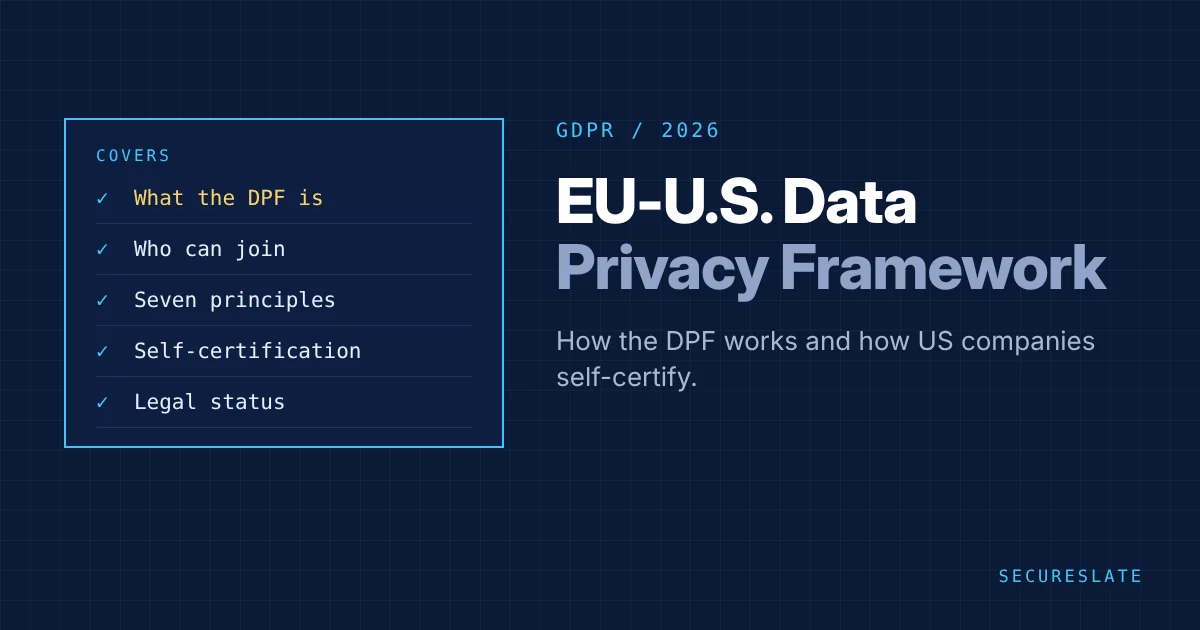
Short answer: The EU-U.S. Data Privacy Framework (DPF) lets US organizations receive personal data from the EU without extra transfer tools, provided they self-certify with the US Department of Commerce and follow the DPF Principles. The European Commission adopted the adequacy decision on 10 July 2023. UK and Swiss versions work the same way.
Related guides: How to transfer data under the GDPR · GDPR compliance for US companies · Data processing agreement
Key takeaways
- The DPF is a self-certification program run by the US Department of Commerce, backed by an EU adequacy decision adopted on 10 July 2023.
- Only organizations subject to the jurisdiction of the Federal Trade Commission or the Department of Transportation can join.
- Participants commit to seven principles and must re-certify every year.
- The UK Extension and the Swiss-U.S. DPF cover transfers from the UK and Switzerland.
- The EU General Court upheld the adequacy decision in September 2025, and an appeal is before the Court of Justice, so keep a fallback such as Standard Contractual Clauses.
What is the Data Privacy Framework?
The DPF is a mechanism under GDPR Article 45 that treats certified US organizations as offering adequate protection for personal data.
Under the GDPR, personal data can leave the European Economic Area only through an approved route: an adequacy decision, appropriate safeguards such as Standard Contractual Clauses (SCCs), or a narrow derogation. The DPF is the third attempt at a US adequacy arrangement, after Safe Harbor and Privacy Shield, both of which the Court of Justice struck down.
The European Commission adopted the DPF adequacy decision on 10 July 2023. It relies on US commitments in an executive order on signals intelligence (Executive Order 14086), which limits intelligence access to what is necessary and proportionate and created a redress route that includes the Data Protection Review Court. The Commission notes that these US safeguards apply to all transfers to US companies, so they also support SCCs and binding corporate rules.
There are three linked programs:
| Program | Covers transfers from | Effective for transfers |
|---|---|---|
| EU-U.S. DPF | EU and EEA | 10 July 2023 |
| UK Extension to the EU-U.S. DPF | United Kingdom | 12 October 2023, under the UK-US data bridge |
| Swiss-U.S. DPF | Switzerland | 15 September 2024, after the Swiss Federal Council decision |
An organization can join the UK Extension only if it also participates in the EU-U.S. DPF.
Who can join the Data Privacy Framework?
Any US legal entity subject to the investigatory and enforcement powers of the Federal Trade Commission or the US Department of Transportation can self-certify.
That covers most commercial companies, including SaaS vendors, HealthTech platforms and service businesses. Organizations outside those agencies' jurisdiction, such as many banks, insurers and nonprofits, are generally not eligible and need SCCs or another tool instead.
Joining is voluntary. Once an organization certifies publicly, the commitment becomes enforceable under US law, and misrepresenting participation can be treated as a deceptive practice. The Commerce Department's launch announcement describes self-certification through the program website.
What are the DPF Principles?
Participants commit to seven core principles, supported by supplemental principles that explain them in detail.
| Principle | What it requires in practice |
|---|---|
| Notice | A privacy policy that states DPF participation, data types, purposes, rights, recourse and the regulator with jurisdiction |
| Choice | Opt-out for new purposes or disclosures to third parties, and opt-in for sensitive data |
| Accountability for onward transfer | Contracts with third parties and agents that limit use and require the same level of protection |
| Security | Reasonable and appropriate measures to protect data from loss, misuse and unauthorized access |
| Data integrity and purpose limitation | Data that is relevant, accurate and kept only as long as it serves the stated purpose |
| Access | Individuals can access, correct, amend or delete their data, with limited exceptions |
| Recourse, enforcement and liability | An independent recourse mechanism, verification of compliance and a last-resort binding arbitration option |
For HealthTech and other sensitive data, the Choice and Security principles carry the most weight. Health data is sensitive, so opt-in consent is the default for new uses, and security controls should be documented and tested.
How do you self-certify?
Self-certification is an online submission to the Department of Commerce, backed by changes you make inside your organization first.
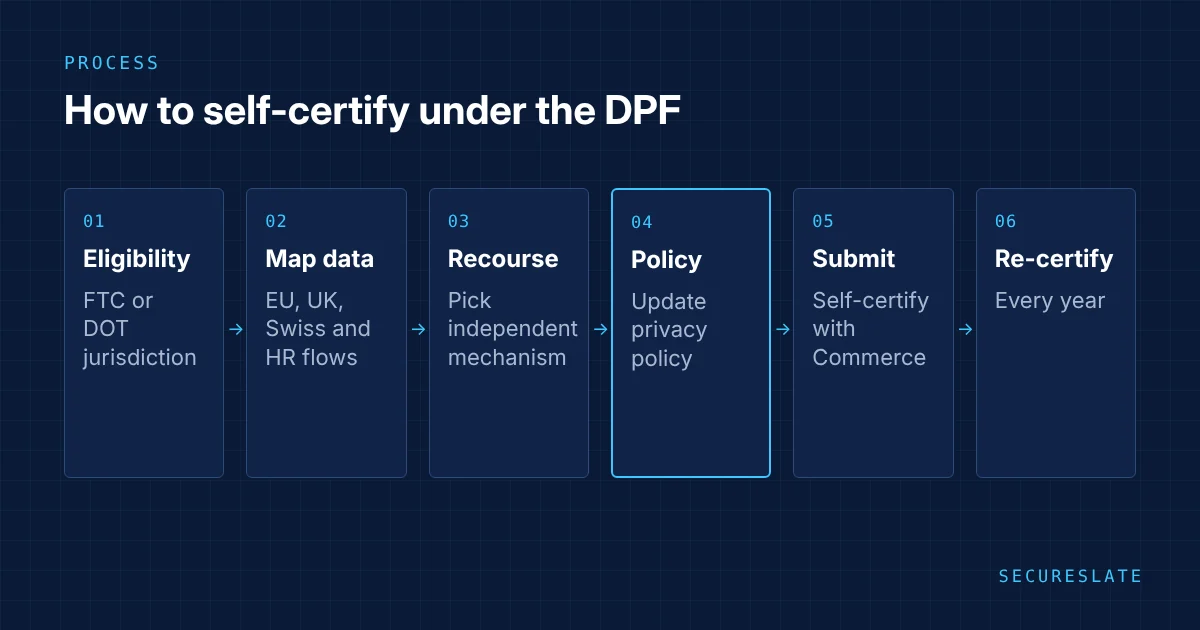
- Confirm eligibility under FTC or Department of Transportation jurisdiction.
- Map your EU, UK and Swiss data flows, including HR data, which has its own designation and requires cooperation with EU data protection authorities.
- Choose an independent recourse mechanism, such as an alternative dispute resolution provider, for non-HR complaints.
- Update your privacy policy to reflect the DPF Principles and state your participation.
- Put onward transfer contracts in place with vendors that receive the data. A GDPR sub-processors list helps here.
- Submit the self-certification on the program website and pay the annual fee.
- Re-certify every year and run a verification of compliance, either a self-assessment or an outside review.
If you withdraw or let certification lapse, you must keep applying the principles to data you received while you participated, or return or delete it.
For data exporters in Europe, the key step is simpler: check the official DPF List to confirm that the US recipient is active and that its certification covers the type of data you send.
Is the Data Privacy Framework still valid?
Yes. As of November 2026, the adequacy decision is in force, but it faces an appeal.
A French member of parliament, Philippe Latombe, asked the EU General Court to annul the decision. On 3 September 2025 the court dismissed the action, finding that the Data Protection Review Court is independent and that US law gives essentially equivalent protection. Latombe lodged an appeal with the Court of Justice (Case C-703/25 P) on 31 October 2025. The Commission also continues to monitor the framework and can suspend, amend or repeal the decision if US law changes.
In our experience, many companies certify to the DPF and keep SCCs in their data processing agreements as a fallback. That way transfers can continue on another basis if the decision is ever invalidated.
What should EU customers check before relying on the DPF?
An EU customer should confirm that the certification is active and covers the data in question before treating a transfer as covered.
US vendors are often asked about this during security reviews, so it helps to have answers ready. The checks a careful EU customer makes are:
- Active status. The organization appears on the official DPF List as active, not inactive or withdrawn.
- Correct entity. The certified legal entity is the one that signs the contract, not a parent or sister company.
- Data scope. The certification covers the right data type. HR data is only covered if the organization certified for it.
- UK and Swiss coverage. Transfers from the UK or Switzerland need the matching extension or framework.
- Onward transfers. Sub-processors that receive the data are bound by contracts that give the same protection.
- Fallback. The data processing agreement includes SCCs or another tool in case the framework stops applying.
For a US HealthTech vendor, being able to show this in a trust center or questionnaire answer can shorten EU procurement reviews.
Other meanings of data privacy framework
The phrase is also used for privacy program frameworks that help organize controls, which are a different thing from the transfer mechanism.
| Framework | Type | Typical use |
|---|---|---|
| EU-U.S. DPF | Legal transfer mechanism | Receiving EU, UK or Swiss personal data in the US |
| GDPR | Law | Privacy obligations for EU personal data |
| NIST Privacy Framework | Voluntary framework | Structuring a privacy risk program |
| ISO/IEC 27701 | International standard | Privacy information management alongside ISO 27001 |
If you are building a privacy program, combine a legal baseline such as the GDPR with a program framework. If you are moving data across the Atlantic, the DPF is the one that matters.
How SecureSlate helps
DPF participation depends on keeping commitments in place year after year. SecureSlate helps you organize the controls and evidence behind them.
- Built-in GDPR and ISO 27001 frameworks, with multi-framework control mapping to SOC 2, HIPAA and others, so security controls serve several programs at once.
- Custom frameworks and controls if you want to track the DPF Principles and annual re-certification as their own checklist.
- Vendor risk management to support onward transfer reviews.
- Risk management and audit management to document verification of compliance.
- Trust center to share your security posture with EU customers.
FAQ
Is the Data Privacy Framework the same as Privacy Shield?
No. It replaced Privacy Shield, which the Court of Justice invalidated in 2020. The DPF adds new US safeguards on intelligence access and a new redress mechanism.
Do EU companies need SCCs if the US vendor is DPF certified?
Not for that transfer, as long as the certification is active and covers the data. Many still keep SCCs as a fallback.
Is the DPF mandatory for US companies?
No. It is voluntary. It becomes enforceable once an organization self-certifies.
How often must an organization re-certify?
Every year. A lapsed certification removes the organization from the active DPF List.
Does the DPF cover HR data?
Yes, but HR data has its own designation and requires cooperation with EU data protection authorities for complaints.
Disclaimer (legal note)
This article is for general information only and is not legal, regulatory, or professional advice. Requirements vary by framework, industry, and jurisdiction. Consult qualified advisors for your specific obligations.
Need compliance without the complexity?
SecureSlate automates ISO 27001, SOC 2, GDPR, HIPAA, and more. Built for growing teams. See it in action.
Find compliance gaps in 30 seconds