
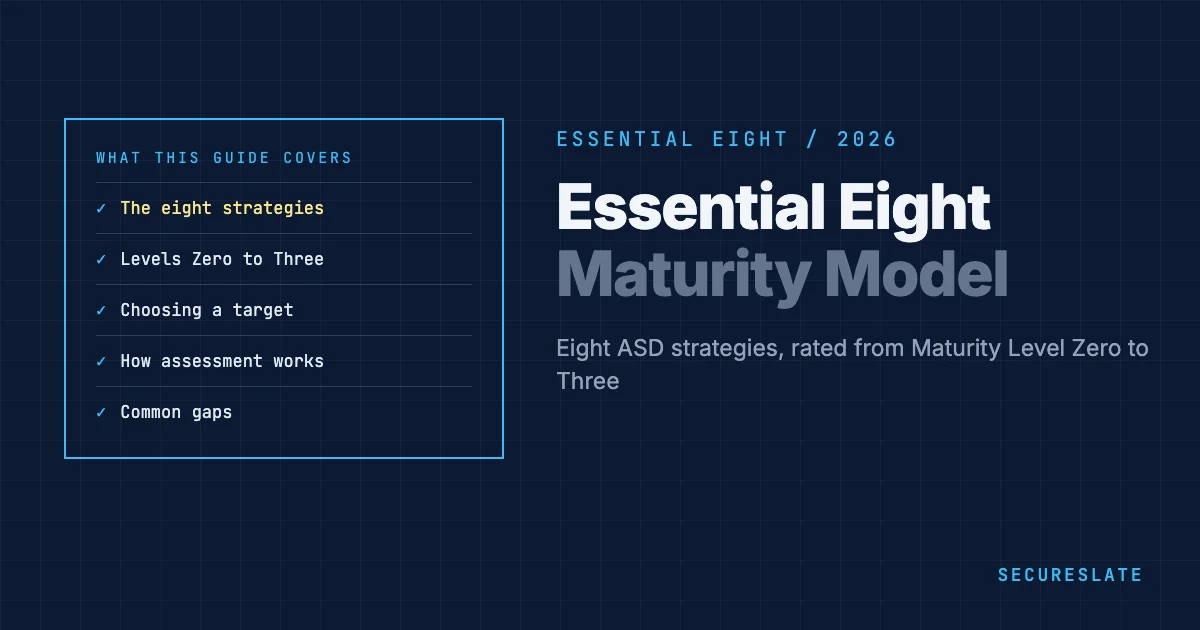
The Essential Eight Maturity Model is the Australian Signals Directorate's (ASD) framework for measuring how well an organisation has implemented eight baseline mitigation strategies against cyber threats. Each strategy is rated from Maturity Level Zero (not aligned with the intent of the strategy) to Maturity Level Three (resistant to adaptive, more capable adversaries). The current version on cyber.gov.au was published in November 2023, and it is still the version organisations are assessed against in November 2026. This guide explains each level, assessment and common gaps.
Related guides: Essential Eight compliance cost · Essential Eight for government suppliers · Cyber Essentials vs Essential Eight · Australian security compliance frameworks
Key takeaways
- The Essential Eight Maturity Model rates eight mitigation strategies on a scale from Maturity Level Zero to Three.
- Each level is defined by the adversary it is designed to resist, from opportunistic attackers at Level One to adaptive attackers at Level Three.
- ASD recommends reaching the same level across all eight strategies before aiming higher on any one of them.
- Assessors rely on evidence quality: testing a control beats a screenshot, and a policy on its own counts for little.
- Application control, restricting administrative privileges and event logging are where organisations most often stall.
What is the Essential Eight Maturity Model?
The Essential Eight Maturity Model is a set of specific, testable requirements that show how mature an organisation's implementation of the Essential Eight is. ASD, through its Australian Cyber Security Centre (ACSC), publishes the model as part of its broader Strategies to Mitigate Cyber Security Incidents. The model is written for Microsoft Windows-based, internet-connected networks; other environments may need alternative controls.
The model is not a certification. It gives you a consistent way to self-assess and report maturity to a board, regulator, customer or insurer. For non-corporate Commonwealth entities it is mandatory: the Protective Security Policy Framework requires them to implement all eight strategies to at least Maturity Level Two.
What are the eight mitigation strategies?
The strategies cover preventing malware, limiting the extent of incidents and recovering data.
| Strategy | Goal | What it looks like in practice |
|---|---|---|
| Patch applications | Remove known vulnerabilities in software | Vulnerability scanning and fast patching of browsers, office suites, PDF readers and internet-facing services |
| Patch operating systems | Remove known vulnerabilities in operating systems | Timely OS updates and removal of unsupported versions |
| Multi-factor authentication | Stop stolen passwords being enough to log in | MFA for online services, remote access and privileged users |
| Restrict administrative privileges | Limit what a compromised account can do | Separate, reviewed admin accounts that cannot browse the web or read email |
| Application control | Only let approved code run | Allow lists for executables, scripts and installers on workstations and servers |
| Restrict Microsoft Office macros | Block a common malware delivery path | Macros disabled unless there is a business need, internet macros blocked |
| User application hardening | Reduce browser and app attack surface | Blocking web ads and Java in browsers, hardening Office and PDF software |
| Regular backups | Recover from ransomware and data loss | Backups of important data, tested restores, protection from deletion |
What do Maturity Levels Zero to Three mean?
Each maturity level describes the kind of adversary the controls are expected to stop, not just a list of tasks. ASD frames them like this in the maturity model:
- Maturity Level Zero means there are weaknesses in your overall security posture. Requirements for Level One are not fully met for that strategy.
- Maturity Level One targets opportunistic adversaries using commodity tradecraft that is widely available, such as public exploits for known vulnerabilities and stolen credentials. They look for any victim, not you in particular.
- Maturity Level Two targets adversaries who are a step up. They are willing to spend more time on a target and use tools such as phishing and social engineering to get past weak MFA.
- Maturity Level Three targets adaptive adversaries who rely less on public tools. They exploit weaknesses in your configuration, steal authentication tokens and move laterally to reach privileged accounts and data.
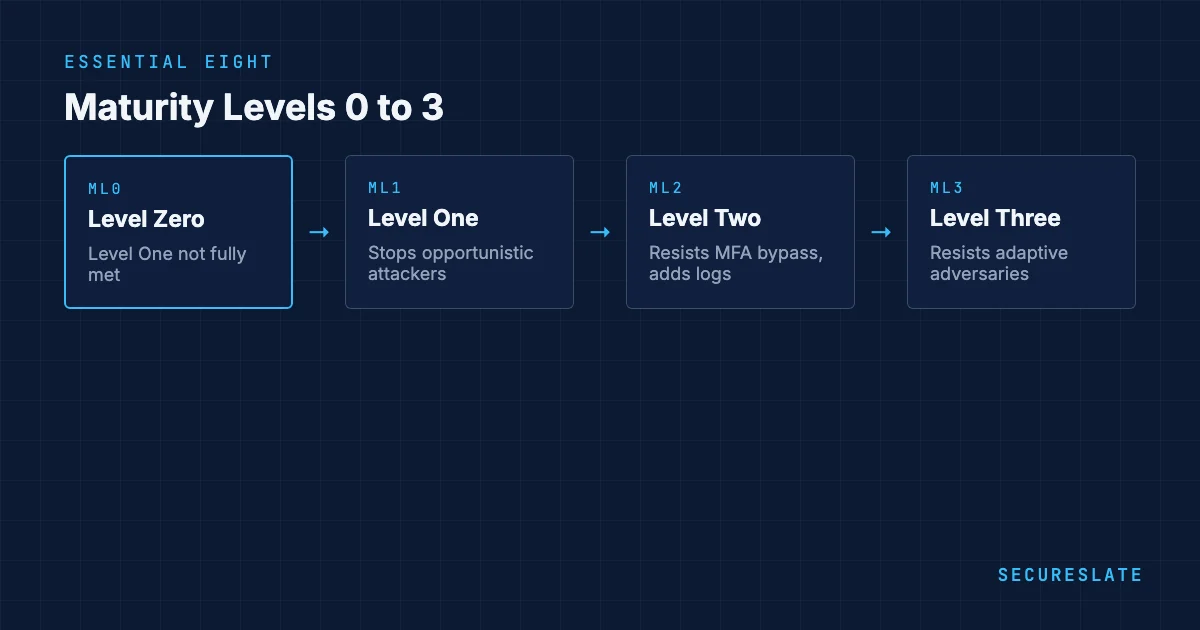
Because levels are tied to adversaries, organisations that are likely targets of more capable attackers should aim higher.
How do requirements change between levels?
As you climb, more systems come into scope and controls must work faster and resist more bypass techniques. The table summarises the shape of that change; read the November 2023 model for the exact wording of each requirement.
| Strategy | Level One | Level Two | Level Three |
|---|---|---|---|
| Patching | Fast patching of internet-facing services and common workstation apps; remove unsupported software | Broader scanning and patching cadence across more software | Tighter timeframes, latest OS releases, and drivers and firmware in scope |
| MFA | MFA for online services and internet-facing systems | Phishing-resistant MFA extended to more users and services; MFA events logged | Phishing-resistant MFA across systems and data repositories |
| Admin privileges | Privileged access validated and limited; admins cannot browse the web or use email | Periodic revalidation and automatic disabling of unused privileged accounts; privileged events logged | Just-in-time administration and stronger isolation of privileged environments |
| Application control | Workstations | Extended to internet-facing servers; events logged | All servers, plus drivers and Microsoft's recommended block rules |
| Macros, hardening, backups | Internet macros blocked, browsers block ads and Java, backup restores tested | More hardening of Office, PDF software and PowerShell; events logged; tighter backup access | Only trusted or signed macros run; backups protected from deletion by privileged accounts |
The big shift at Level Two is event logging: logs must be centrally stored and analysed in a timely manner, turning a configuration project into an operating one.
Which maturity level should you target?
Most organisations should target Maturity Level Two as a practical baseline, then decide on Level Three based on threat and obligations. Reach your target across all eight strategies before progressing; a strong MFA score does not offset weak backups.
Factors to weigh:
- Regulatory or contractual obligations. Commonwealth entities must reach Level Two. Many state agencies and government buyers ask suppliers for a stated level (see our guide to Essential Eight for government suppliers).
- Insurance. Cyber insurers often ask about MFA, backups and patching. Our Essential Eight and cyber insurance guide covers how maturity can come up in underwriting.
- Budget and capacity. Each level adds operating work. Our Essential Eight compliance cost guide breaks down effort by level.
For context, ASD's Commonwealth Cyber Security Posture in 2025 report found that only 22 percent of surveyed Commonwealth entities reached Maturity Level Two overall, even though it is a requirement for them.
How is Essential Eight maturity assessed?
Essential Eight maturity is assessed strategy by strategy, using evidence that each requirement at a level is met across a representative sample of systems. ASD's Essential Eight Assessment Process Guide sets out how assessors should plan, collect evidence and report.
Key points from the guide:
- Evidence is graded. The guide ranks evidence as excellent, good, fair or poor. Excellent evidence comes from testing a control, for example trying to run an unapproved program, while poor evidence is a policy or verbal statement of intent. Aim for the top two grades.
- Sampling matters. Assessors test a sample of workstations, servers and network devices, not one well-configured laptop.
- All requirements count. If any requirement at a level is not met, that strategy does not achieve that level.
- Tools help. ASD's Essential Eight Maturity Verification Tool can gather evidence efficiently.
Organisations can self-assess or engage an external assessor. ASD's maturity model FAQ answers common questions on scope and interpretation.
How do you move up a maturity level?
You move up a level by meeting every requirement of that level for all eight strategies, and then keeping them in place. A practical sequence looks like this:
- Inventory and scope. List workstations, servers, internet-facing services and privileged accounts. Gaps in the inventory become gaps in maturity.
- Baseline assessment. Rate each strategy against the current model using good or excellent evidence.
- Close Level One gaps first. Start with MFA coverage, macro settings, backup restore tests and unsupported software.
- Start the hard strategies early. Application control and admin privilege changes need design, testing and change management.
- Build logging and monitoring. Centralise the logs required at Level Two and assign someone to review them.
- Reassess and maintain. Repeat the assessment on a schedule and track exceptions with an owner and expiry date.
What are the most common gaps?
The most common gaps are controls that exist on paper but are not enforced everywhere:
- Application control in audit mode only, or with broad allow rules such as entire user-writable folders.
- Admins using one account for everything, including email and web browsing.
- MFA that can be phished or bypassed, such as SMS codes or legacy protocols left enabled.
- Backups that have never been restored in a realistic test, or that privileged accounts can delete.
- Logs collected but never reviewed, which fails the "analysed in a timely manner" expectation at Level Two.
ASD's 2025 posture report shows the same pattern: restrict administrative privileges and application control had among the lowest Level Two rates.
Is the Essential Eight changing?
Yes, but the November 2023 maturity model remains the published, assessable version as of November 2026. In June 2026 ASD opened consultation on evolving the Essential Eight into a broader Essentials series, starting with Essentials for Enterprise IT. ASD has said organisations already investing in the Essential Eight can expect strong alignment with the new guidance.
Reporting by iTnews in October 2026 indicates the new framework will report posture area by area rather than as one maturity level, and existing ratings will not convert automatically. Until ASD publishes final guidance and dates, plan against the current model.
How SecureSlate helps
SecureSlate gives you one place to run an Essential Eight program. You can keep controls, evidence and policies for all eight strategies together, assign owners and track exceptions, and map the same controls to other frameworks such as ISO 27001 with multi-framework compliance. Audit management produces audit-ready exports for assessors, customers and insurers, and vendor risk tracks the suppliers that hold your data. Cloud scanning covers AWS and Google Cloud accounts, and the same evidence can support ISO 27001 in Australia.
FAQ
What is the Essential Eight Maturity Model?
ASD's framework that rates an organisation's implementation of eight mitigation strategies from Maturity Level Zero to Maturity Level Three, based on the adversary each level is designed to resist.
What maturity level should my organisation aim for?
Many organisations target Maturity Level Two as a baseline, and Commonwealth entities must reach it. Aim higher if you face more capable attackers.
Is the Essential Eight mandatory?
It is mandatory for non-corporate Commonwealth entities under the Protective Security Policy Framework. For most private organisations it is voluntary, though customers, government buyers and insurers may ask for it.
Is there an Essential Eight certification?
No. ASD does not certify organisations. You self-assess or use an independent assessor and report your level with evidence.
Disclaimer (legal note)
This article is for general information only and is not legal, regulatory, or professional advice. Requirements vary by framework, industry, and jurisdiction. Consult qualified advisors for your specific obligations.
Need compliance without the complexity?
SecureSlate automates ISO 27001, SOC 2, GDPR, HIPAA, and more. Built for growing teams. See it in action.
Find compliance gaps in 30 seconds