
Short answer: An ISO 27001 surveillance audit is a yearly audit by your certification body in the two years between initial certification and recertification. It samples your ISMS instead of re-auditing everything, and checks that internal audits, management reviews, corrective actions and key controls kept running. Pass it and your certificate stays valid.
Related guides: ISO 27001 annual obligations checklist · How to conduct an ISO 27001 internal audit · ISO 27001 certification process
Key takeaways
- A surveillance audit is a sampling audit. It confirms the ISMS is still operating, not that it was designed correctly in the first place.
- The certification cycle is three years: initial certification, two surveillance audits, then a recertification audit.
- Some topics are covered every time: internal audit, management review, previous nonconformities, changes and continual improvement.
- A major nonconformity that is not resolved in the agreed time can lead to suspension of the certificate.
- The teams that pass easily treat the ISMS as a year-round routine, not a project that restarts a month before the auditor arrives.
What is an ISO 27001 surveillance audit?
An ISO 27001 surveillance audit is a periodic, on-site or remote audit that your certification body performs to confirm that a certified information security management system still conforms to ISO/IEC 27001 between full audits.
The requirement does not come from ISO 27001 itself. It comes from ISO/IEC 17021-1, the standard that accredited certification bodies must follow when they audit any management system, with ISMS-specific rules added by ISO/IEC 27006-1. The auditor works to an audit programme for the whole three-year cycle, so each visit covers part of the ISMS. They also look for evidence over time: records that show each process ran during the past twelve months, not just a policy approved once.
When do surveillance audits happen?
Surveillance audits happen at least once a calendar year, and the first one must take place no more than 12 months after the date of your certification decision.
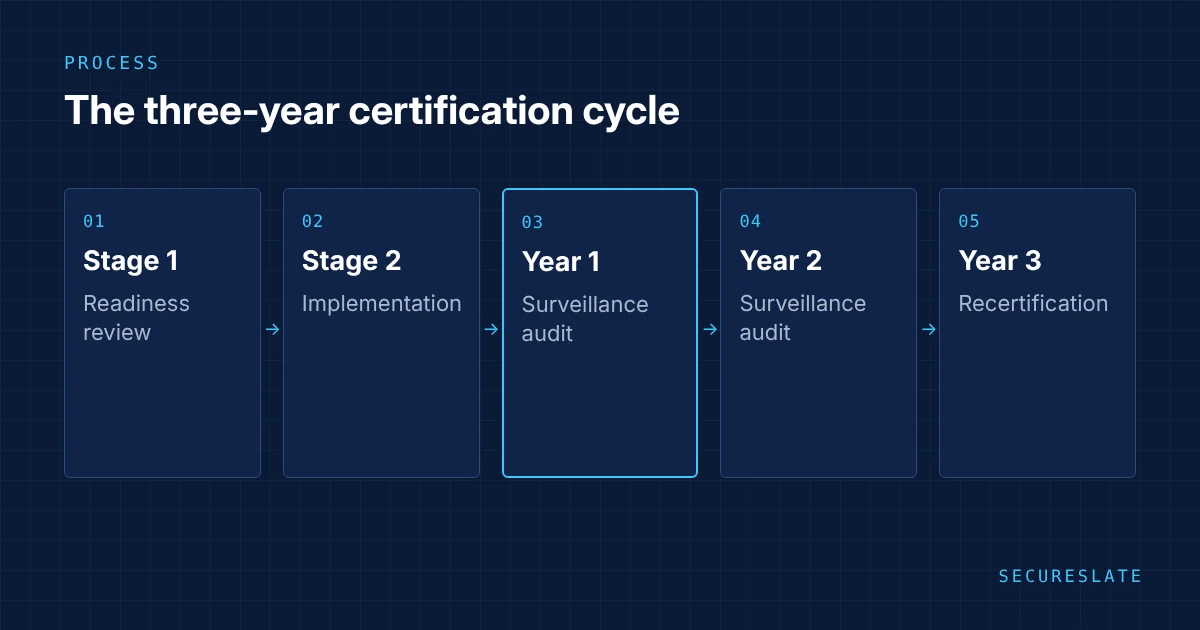
ISO/IEC 17021-1 sets the pattern. The three-year cycle starts with the certification decision. Surveillance audits follow in the first and second years, and a recertification audit takes place in the third year, before the certificate expires.
| Point in the cycle | Audit | What it decides |
|---|---|---|
| Start | Stage 1 and Stage 2 (initial certification) | Whether to issue the certificate |
| Year 1 | First surveillance audit | Whether certification is maintained |
| Year 2 | Second surveillance audit | Whether certification is maintained |
| Year 3 | Recertification audit | Whether to renew for another three years |
Practical notes on timing:
- The 12-month limit counts from the certification decision date, not the last day of the Stage 2 audit. Check your decision letter.
- Agree dates early so your internal audit and management review are finished before the visit.
- A surveillance audit is shorter than the initial audit, because it samples instead of covering every clause and control.
- A certification body can also run a short-notice audit, for example after a serious incident, a complaint or a major scope change.
What does the auditor review?
The auditor reviews a fixed set of management system topics at every surveillance audit, plus a sample of clauses, Annex A controls, teams and locations chosen from the audit programme.
ISO/IEC 17021-1 lists the items that every surveillance audit must include. The table maps them to the ISO 27001 clauses and the evidence you should have ready.
| Reviewed at every surveillance audit | ISO 27001 reference | Evidence to have ready |
|---|---|---|
| Internal audits | Clause 9.2 | Audit programme, audit reports, auditor independence |
| Management review | Clause 9.3 | Agenda covering the required inputs, minutes, decisions and actions |
| Actions on previous nonconformities | Clause 10.2 | Root cause analysis, corrective actions, proof they worked |
| Handling of complaints | Clauses 7.4 and 10.2 | Complaint or feedback log and what was done |
| Effectiveness against objectives | Clauses 6.2 and 9.1 | Security objectives, measurements, results |
| Progress on continual improvement | Clause 10.1 | Improvement log, completed and planned actions |
| Continuing operational control | Clause 8 and sampled Annex A controls | Risk assessment and treatment records, control evidence |
| Changes | Clauses 4 and 6.3 | Scope changes, new systems, reorganizations, updated Statement of Applicability |
| Use of certification marks | Certification body rules | Where and how you display the certificate and logo |
On top of the fixed list, expect sampling of:
- Risk assessment and treatment. Clause 8.2 requires risk assessments at planned intervals or when significant changes occur, so the register must show recent updates.
- Statement of Applicability. It must still match reality. See the Statement of Applicability template.
- Selected Annex A controls, such as access reviews, supplier reviews, backup tests, incident records and awareness training.
How is it different from the other audits?
A surveillance audit is narrower and shorter than the initial or recertification audit, and it is performed by the certification body, unlike the internal audit that you run yourself.
| Audit | Who performs it | Coverage | Result |
|---|---|---|---|
| Internal audit | You, or someone independent you appoint | Your own programme, covering the ISMS over time | Findings for management, input to management review |
| Stage 1 and Stage 2 | Certification body | Full ISMS: documentation readiness, then implementation | Certification decision |
| Surveillance | Certification body | Fixed topics plus a sample | Certification maintained, or findings to resolve |
| Recertification | Certification body | Full ISMS, including performance over the whole cycle | Certificate renewed for three years |
One audit does not replace another. A clean surveillance audit does not remove the Clause 9.2 requirement to run your own internal audits, and the auditor will ask to see them.
How do you prepare for a surveillance audit?
You prepare by running the recurring ISMS activities on schedule during the year and then checking, about two months before the audit, that the records are complete.
- Reread last year's audit report. List every nonconformity and observation. Confirm each corrective action is closed and that you can show it fixed the cause, not only the symptom.
- Finish the internal audit. Complete this year's planned audits, issue the report and log the findings before the certification body arrives.
- Hold the management review. Cover the inputs that Clause 9.3 lists, including audit results, risk status, objectives, incidents and feedback from interested parties. Record decisions and owners.
- Refresh the risk assessment. Update the risk register and treatment plan for new systems, vendors, incidents and changes in the business.
- Update the Statement of Applicability. Make sure added or removed controls, justifications and implementation status are current, and record the version and approval.
- Check recurring control evidence. Pull the last twelve months of access reviews, training completion, backup restore tests, supplier reviews, vulnerability scans and incident records. Look for gaps in the calendar.
- Document changes. Write a short summary of what changed in scope, organization, technology and legal or contractual requirements, and how the ISMS was adjusted.
- Brief the people who will be interviewed. Control owners should be able to explain their process and show evidence without help.
For a month-by-month view of these duties, use the ISO 27001 annual obligations checklist.
What happens if the auditor finds a nonconformity?
If the auditor finds a nonconformity, you must analyze the cause and submit a correction and corrective action plan within the time the certification body sets, and the certificate stays valid while you do so unless the problem is serious and left unresolved.
Findings usually fall into three groups:
- Major nonconformity. A failure that affects the ability of the ISMS to achieve its intended results. Typical examples are no internal audit during the year, no management review, or a required process that has stopped working. The certification body needs evidence that it has been corrected before it confirms that certification continues.
- Minor nonconformity. An isolated lapse that does not undermine the system, such as one missed access review or a few overdue training records. You submit a corrective action plan, and the auditor checks its effectiveness at the next audit.
- Opportunity for improvement or observation. Not a nonconformity. No formal response is required, but repeated observations on the same topic tend to become nonconformities later.
If a major nonconformity is not resolved within the agreed time, the certification body can suspend the certificate, and it can withdraw it if the issues behind the suspension are not fixed. A minor nonconformity that is still open a year later can be raised as a major one.
Why do teams struggle in year two?
Teams struggle in year two because the certification project ended and nobody was assigned to keep the routine going. In our experience, the same gaps come up again and again:
- The internal audit was skipped or done in the week before the surveillance audit.
- The management review was a short meeting with no minutes or missing inputs.
- The risk register has the same date as the Stage 2 audit.
- Corrective actions from the previous audit were marked closed without evidence.
- The Statement of Applicability does not reflect new tools or retired systems.
- The person who ran the certification project left, and the knowledge left with them.
The fix is ownership and a calendar. Assign every recurring activity to a named owner with a due date, and review progress quarterly. The ISO 27001 guide explains how the clauses fit together if you need to rebuild that routine.
How SecureSlate helps
SecureSlate is a compliance automation platform that helps you keep an ISMS running between audits. It does not perform audits or issue certificates. Your accredited certification body does that.
- Built-in ISO 27001 framework with control mapping to SOC 2, HIPAA, GDPR and other frameworks, so one piece of evidence can support several requirements.
- Agentless, read-only cloud integrations and a device agent that collect control evidence through the year.
- Access reviews and vendor risk management on a schedule, with records kept for the auditor.
- Risk management with a register and treatment tracking.
- Audit management to organize evidence requests and findings for internal and external audits.
Start a free SecureSlate trial to see how your current evidence maps to ISO 27001.
FAQ
How often are ISO 27001 surveillance audits?
At least once a calendar year, except in the year of recertification. In a normal three-year cycle that means two surveillance audits, followed by a recertification audit in year three.
Can you fail a surveillance audit?
There is no pass or fail grade, but the outcome can put the certificate at risk. Unresolved major nonconformities can lead the certification body to suspend and later withdraw certification. Minor nonconformities need a corrective action plan and are checked at the next audit.
Is a surveillance audit the same as an internal audit?
No. An internal audit is run by your organization under Clause 9.2 of ISO 27001. A surveillance audit is run by the certification body. The surveillance auditor will review your internal audit records as part of the visit.
Does a surveillance audit cover all Annex A controls?
Not usually. The auditor samples controls based on the audit programme, your risks and what changed. Across the three-year cycle, the certification body covers the full scope of the ISMS.
Can a surveillance audit be done remotely?
Often it can, in full or in part, depending on your certification body's rules, your scope and whether physical controls need to be seen on site. Ask your certification body when you agree the audit plan.
Disclaimer (legal note)
This article is for general information only and is not legal, regulatory, or professional advice. Requirements vary by framework, industry, and jurisdiction. Consult qualified advisors for your specific obligations.
Need compliance without the complexity?
SecureSlate automates ISO 27001, SOC 2, GDPR, HIPAA, and more. Built for growing teams. See it in action.
Find compliance gaps in 30 seconds