
Short answer: A PCI DSS compensating control is an alternative control you can use when a legitimate, documented technical or business constraint stops you from meeting a requirement as written. It must meet the intent and rigor of the original requirement, go above and beyond other PCI DSS requirements, be documented in the Appendix C worksheet and be validated at each annual assessment.
Related guides: PCI DSS compliance checklist · Which PCI SAQ do you need? · How to pass your PCI compliance audit
Key takeaways
- Compensating controls are part of the defined approach in PCI DSS v4.0.1 and are covered in Appendix B (criteria) and Appendix C (worksheet).
- You need a legitimate and documented constraint. Preference, convenience or a missed deadline is not enough.
- The control must go above and beyond what PCI DSS already requires for the item in question.
- A compensating control cannot fix a past failure, such as a quarterly task that was skipped.
- Expect the assessor to re-evaluate every compensating control each year, and keep it working between assessments.
What is a PCI DSS compensating control?
A compensating control is a different set of safeguards that mitigates the risk a PCI DSS requirement was designed to address, used only when the requirement cannot be met as stated. It is part of the defined approach to PCI DSS, alongside the standard's normal requirements and testing procedures.
The PCI DSS v4.0.1 standard describes the conditions in section 8 and in Appendix B. On an annual basis, compensating controls must be documented by the entity, reviewed and validated by the assessor, and included with the assessment report. Compensating control results are recorded in the relevant requirement section of the Report on Compliance (ROC) or Self-Assessment Questionnaire (SAQ).
Common reasons organizations reach for compensating controls include legacy systems that cannot support a required setting, third-party platforms the entity cannot configure, and vendor updates that are not yet available. The PCI Security Standards Council's own blog on compensating controls and the customized approach gives legacy systems as a typical example.
What criteria must a compensating control meet?
Appendix B of PCI DSS v4.0.1 sets six criteria, and an assessor will test your control against each one.
- Meet the intent and rigor of the original requirement. The Customized Approach Objective for the requirement, or the Purpose in the guidance column where there is no objective, tells you what the intent is.
- Provide a similar level of defense. The control must sufficiently offset the risk the original requirement defends against.
- Be above and beyond other PCI DSS requirements. Simply complying with other PCI DSS requirements is not a compensating control.
- Apply the above-and-beyond test correctly. Existing requirements cannot count if they are already required for the item under review. They may count if they are required elsewhere but not for this item, and they may be combined with new controls.
- Address the additional risk created by not meeting the original requirement.
- Address the requirement now and in the future. A compensating control cannot cover a requirement that was missed in the past.
The standard also notes that a control's effectiveness depends on the environment, the surrounding controls and its configuration, so a compensating control accepted in one environment will not automatically work in another.
How do you complete the compensating controls worksheet?
Appendix C provides a six-part worksheet, and you complete one for every requirement where a compensating control is used.
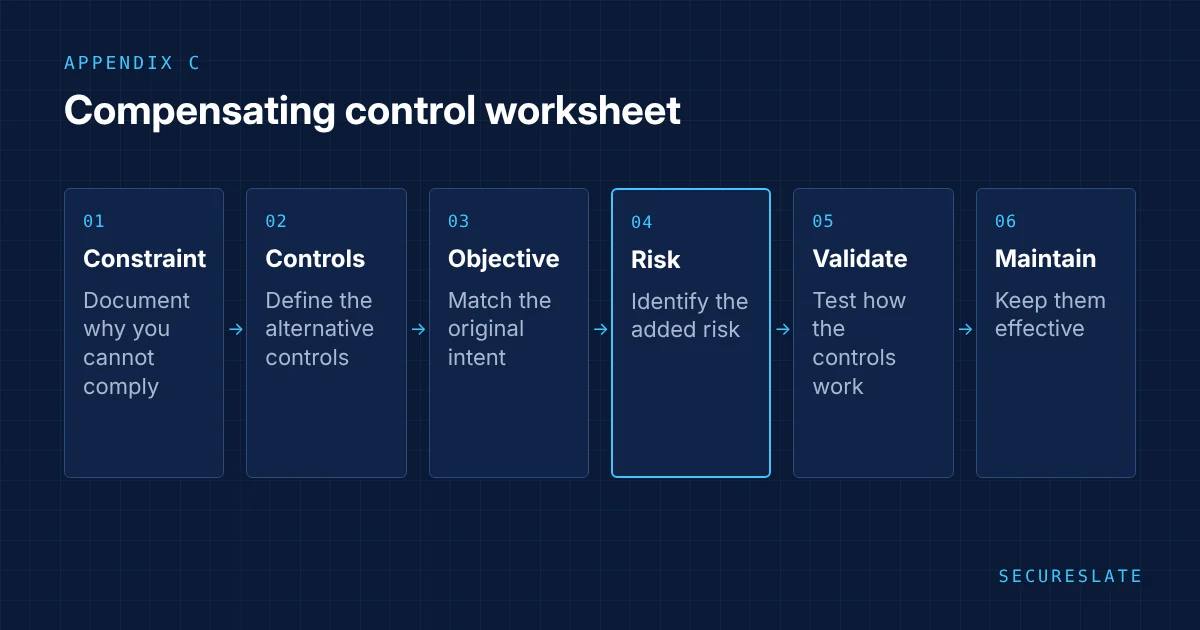
| Worksheet section | What to write | Evidence to keep |
|---|---|---|
| 1. Constraints | The legitimate technical or business constraint that prevents compliance with the original requirement | Vendor statements, system documentation, change records |
| 2. Definition of compensating controls | Each control, and how together they address the original objective and any added risk | Configurations, architecture diagrams, procedures |
| 3. Objective | The objective of the original requirement and the objective the compensating control meets | Reference to the Customized Approach Objective or Purpose |
| 4. Identified risk | Any additional risk caused by not having the original control | Risk analysis notes, threat scenarios |
| 5. Validation | How the controls were validated and tested | Test results, screenshots, logs, scan output |
| 6. Maintenance | The processes and controls that keep the compensating controls effective | Monitoring alerts, review schedules, owner assignments |
Practical tips:
- Write the constraint so an outsider understands it. "The system is old" is weak. Name the system, the version, why the setting is not supported and what you have done to look for alternatives.
- Be specific about each control. List the rule, tool or process, where it applies and who owns it.
- Plan the exit. Most compensating controls are temporary. Record the plan and target date to remove the constraint, such as a system replacement.
- Agree early with your assessor. Raise proposed compensating controls with your QSA or ISA before the assessment, not during fieldwork.
What do compensating controls look like in practice?
Good compensating controls usually layer several safeguards around the gap, so that together they cover the risk the original requirement addressed.
| Situation | Requirement affected | Example compensating controls |
|---|---|---|
| A network-exploitable vulnerability with no vendor security update yet | Patching of known vulnerabilities | Internal segmentation, limiting access to the vulnerable interface to required devices only, and IDS/IPS monitoring of all traffic to that interface (this combination is the example given in Appendix B) |
| A legacy application in the CDE that cannot enforce MFA itself | MFA for non-console access into the CDE | Access only through a hardened jump host that enforces MFA, source IP restrictions, session recording and alerting on direct connection attempts |
| A third-party appliance whose logging cannot be configured to the required detail | Audit log content | Network-level logging of all sessions to the appliance, restricted admin access, and regular review of those logs |
These are illustrations, not pre-approved answers. Whether a given set of controls is sufficient is a decision for your assessor, based on your environment.
How do compensating controls differ from the customized approach?
Compensating controls are a constraint-driven exception within the defined approach, while the customized approach is a deliberate choice to meet a requirement's objective with your own control design.
| Aspect | Compensating control | Customized approach |
|---|---|---|
| When used | A legitimate, documented constraint prevents meeting the requirement as written | The entity chooses to meet the objective a different way |
| Where defined | Appendices B and C | Appendices D and E, plus Requirement 12.3.2 |
| Core documentation | Compensating controls worksheet | Controls matrix and targeted risk analysis for each customized control |
| Testing | Assessor reviews and validates the control | Assessor derives testing procedures for each customized control |
| SAQ entities | Can be documented in the SAQ | Not eligible when completing an SAQ |
| Eligible requirements | Any requirement where a constraint exists | Only requirements with a Customized Approach Objective |
Per Appendix D, entities completing an SAQ are not eligible to use the customized approach, although they may choose to have a QSA or ISA perform the assessment and document it in a ROC. The customized approach is also aimed at risk-mature organizations. An entity can use compensating controls for one system component and the customized approach for another under the same requirement.
Why do assessors reject compensating controls?
Most rejections come from controls that duplicate existing requirements or from constraints that are not really constraints.
- Reusing required controls. Appendix B's own example: you cannot use password complexity or lockout to compensate for sending admin passwords unencrypted, because those do not address interception and are already required.
- Weak constraint statements. In our experience, assessors look hard at constraints that amount to cost, convenience or lack of time.
- Trying to cover the past. A missed quarterly scan cannot be fixed with a compensating control.
- No ongoing operation. Controls that worked on assessment day but have no owner, monitoring or review.
- Missing risk analysis. The worksheet asks for the additional risk. Leaving it blank signals the analysis was not done.
- Scope drift. The compensating control covers some affected systems but not all of them. Good network segmentation helps keep this manageable.
How SecureSlate helps
SecureSlate includes PCI DSS as a built-in framework and lets you document compensating controls as custom controls mapped to the requirement they cover. Risk management records the constraint, added risk and treatment plan, audit management keeps worksheets and evidence together for your assessor, and agentless read-only cloud integrations and the device agent help show the supporting controls keep operating between assessments. SecureSlate does not perform PCI assessments or validate compensating controls. That remains the job of your QSA or ISA.
FAQ
When can you use a PCI DSS compensating control?
Only when a legitimate and documented technical or business constraint prevents you from meeting a requirement as written, and only if the alternative controls meet all the criteria in Appendix B.
Do compensating controls need to be renewed every year?
Yes. Compensating controls must be documented and reviewed and validated by the assessor on an annual basis, and processes must keep them effective between assessments.
Can SAQ merchants use compensating controls?
Yes. Compensating control results are documented in the relevant requirement section of the SAQ or ROC. SAQ entities cannot use the customized approach, which is a separate option.
What is Appendix C in PCI DSS?
Appendix C is the Compensating Controls Worksheet. It records the constraint, the compensating controls, the objective, the identified risk, how the controls were validated and how they are maintained.
Can a compensating control fix a missed requirement?
No. Appendix B states a compensating control cannot address a requirement that was missed in the past, such as a task that should have been done two quarters ago.
Disclaimer (legal note)
This article is for general information only and is not legal, regulatory, or professional advice. Requirements vary by framework, industry, and jurisdiction. Consult qualified advisors for your specific obligations.
Need compliance without the complexity?
SecureSlate automates ISO 27001, SOC 2, GDPR, HIPAA, and more. Built for growing teams. See it in action.
Find compliance gaps in 30 seconds