
Short answer: AI-powered pentesting tools use machine learning and large language models to discover assets, chain weaknesses and attempt exploitation with little human input. They are strong at frequent, broad testing of known weakness classes. They are weaker at business logic and novel attacks, so most teams pair them with a periodic human-led test.
Related guides: Best penetration testing tools · Penetration testing vs vulnerability scanning · Penetration testing best practices
Key takeaways
- "AI pentesting" covers six different tool types, from autonomous agents to copilots that assist human testers. Know which one you are buying.
- The best fit for AI tools is continuous coverage between manual tests: every release, every new asset, every week.
- AI tools still struggle with business logic, authorization design and multi-step abuse that depends on understanding what the application is for.
- Proof of exploit, safe operation in production and clear data handling matter more in an evaluation than the size of a findings list.
- No major framework names AI tools. Auditors look at scope, methodology, tester qualification and remediation, whoever or whatever ran the test.
What are AI-powered pentesting tools?
AI-powered pentesting tools are security testing products that use AI models to plan and carry out parts of a penetration test that a human tester would otherwise do by hand. A traditional scanner matches what it sees against a list of known signatures. An AI-driven tool goes further: it reads responses, forms a hypothesis about what might be exploitable, tries it, and uses the result to decide the next step.
The label is used loosely. Some products are fully autonomous agents. Others are established scanners with an AI layer that ranks findings or writes remediation text. Both are sold as "AI pentesting", and they solve different problems.
What types of AI pentesting tools are there?
There are six broad types, and they differ mainly in how much they do without a human and what they are pointed at.
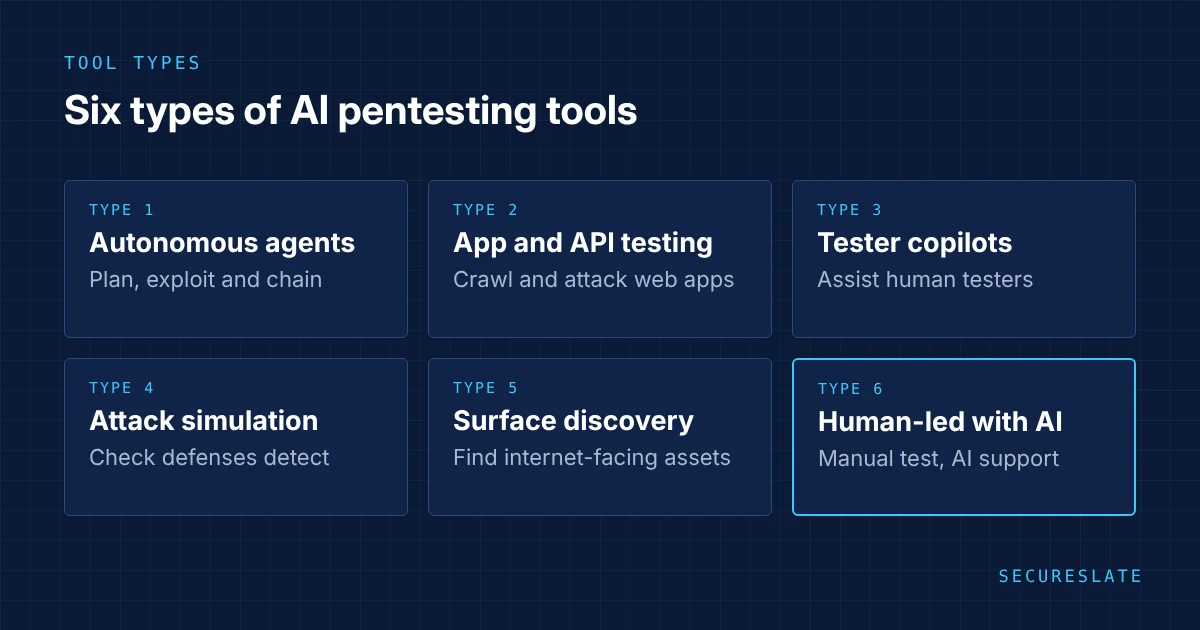
| Type | What it does | Best for | Main limit |
|---|---|---|---|
| Autonomous pentest agents | Plan, exploit and chain findings across networks or applications with minimal input | Frequent internal and external tests | Needs tight scope and safety controls |
| AI-assisted application and API testing | Crawl and attack web apps and APIs, using models to understand flows and generate payloads | Teams shipping web software often | Complex business logic |
| Tester copilots | Help a human tester with recon notes, payload ideas, script writing and report drafts | In-house security engineers and consultancies | Output quality depends on the operator |
| Continuous attack simulation | Replay attacker techniques against your defenses to check that controls detect and block them | Validating detection and response | Tests defenses, not unknown flaws |
| AI attack surface discovery | Find and classify internet-facing assets, then prioritize likely weak points | Organizations with sprawling or changing estates | Discovery, not deep exploitation |
| Human-led testing with AI support | A testing firm delivers a manual test and uses AI internally to cover more ground | Compliance-driven annual tests | Point in time, priced per engagement |
A separate, newer category tests AI systems themselves, for example probing a chatbot for prompt injection or data leakage. That is AI red teaming rather than AI-powered pentesting. If you ship LLM features, the OWASP Top 10 for LLM Applications is a good starting list of what such a test should cover, and our guide to agentic AI security covers the controls.
What can AI pentesting tools find, and what do they miss?
AI tools are good at finding known classes of weakness quickly and repeatedly, and weaker at anything that requires understanding intent. The table below reflects what we see when teams compare tool output with a manual report on the same target.
| Area | AI tools usually do well | Human testers usually do better |
|---|---|---|
| Coverage and speed | Test every asset, every release, without scheduling | Limited by engagement days |
| Known weakness classes | Injection, misconfiguration, weak credentials, exposed services, missing patches | Same, with less breadth per day |
| Simple access control flaws | Swapping identifiers between test accounts | Complex role models and tenant isolation |
| Business logic | Limited | Abuse of workflows, pricing, approvals, state |
| Chained attacks | Improving, strongest on network paths | Creative chains across systems and people |
| Reporting | Consistent format, instant retests | Context, risk judgment, remediation advice |
Three limits deserve attention before you rely on a tool:
- False positives and invented findings. A model can describe a vulnerability convincingly without having proved it. Favor tools that attach evidence of a successful exploit, such as the request, the response and the data returned.
- Scope drift. An agent that decides its own next step can wander to assets you do not own. Scope enforcement needs to be technical, not just a setting in a form.
- Reproducibility. Two runs against the same target can take different paths. That is fine for discovery, but it makes "we tested this and found nothing" a weaker statement than it sounds.
How do you evaluate an AI pentesting tool?
Evaluate it on a real target of your own, and judge it on proof, safety and fit rather than on the vendor's demo. A practical sequence:
- Define the job. Decide whether you need continuous testing of a web product, internal network validation, or an annual report for an audit. The tool types above map to different jobs.
- Run a trial against staging. Seed the environment with a few known flaws, including one access control issue and one logic flaw, and see which ones the tool finds.
- Check every finding for evidence. Count findings that include a working proof of exploit separately from those that only assert a problem.
- Review safety controls. Ask how the tool prevents destructive actions, rate limits itself, respects scope and stops on command.
- Read the data handling terms. Find out where your traffic, credentials and findings are stored, which model providers process them, and whether they are used for training.
- Test the workflow. Confirm that findings reach your ticketing system, that a fix can be retested on demand and that reports can be exported.
- Show a sample report to your auditor. If the output has to support a compliance requirement, ask before you buy.
Questions worth putting to any vendor:
| Question | Why it matters |
|---|---|
| Does each finding include reproducible proof? | Separates validated issues from guesses |
| Can it test authenticated areas with several roles? | Most serious application flaws sit behind login |
| How is scope enforced? | Prevents testing systems you do not own |
| Is it safe to run against production? | Decides how often you can test |
| Who reviews the results, if anyone? | Some services add human validation, some do not |
| What happens to our data? | Test traffic can contain secrets and personal data |
| What does the final report contain? | Auditors expect scope, method, findings and retest results |
Do AI pentesting tools satisfy compliance requirements?
Sometimes, because frameworks describe what a penetration test must achieve and who may perform it, not which technology runs it. Whether an AI-driven test is accepted depends on the framework and, in our experience, on the individual auditor or assessor.
| Framework | What it says about penetration testing |
|---|---|
| SOC 2 | The Trust Services Criteria do not mandate a penetration test. Points of focus under CC4.1 mention penetration testing as one type of evaluation, and CC7.1 covers vulnerability detection. Many auditors expect a test anyway. |
| ISO 27001:2022 | ISO 27001 does not name penetration testing as mandatory. Annex A 8.8 (management of technical vulnerabilities) and 8.29 (security testing in development and acceptance) are where testing is usually evidenced. |
| PCI DSS v4.0.1 | Requirement 11.4 requires a defined methodology, internal and external penetration tests at least once every 12 months and after significant changes, and testing by a qualified internal resource or qualified external third party with organizational independence. See the PCI SSC document library. |
| HIPAA Security Rule | The current rule does not explicitly require penetration testing. 45 CFR 164.308(a)(8) requires periodic technical and nontechnical evaluation. A proposed rule published in January 2025 would require penetration testing at least once every 12 months. It is still a proposal as of November 2026. |
Whatever the tool, the report needs to show the scope, the methodology, who or what performed the test and their qualification, the findings with severity, and evidence that issues were fixed and retested. NIST SP 800-115 remains a useful reference for what a testing methodology should include. PCI DSS is the strictest on tester qualification and independence, so confirm with your assessor before relying on an autonomous tool alone for that requirement.
How should AI tools and manual pentests work together?
Use AI tools for frequency and breadth, and human testers for depth, then feed both into one remediation process. A pattern that works for small and mid-sized teams:
- On every release or weekly: automated AI-driven testing of the application and external perimeter, with findings routed to engineering tickets.
- Continuously: attack surface discovery, so new subdomains, cloud services and exposed ports are picked up without waiting for a scheduled test.
- Annually and after major changes: a human-led test focused on business logic, authorization design, tenant isolation and anything new. Give the testers the AI tool's output so they do not spend their days on what is already known.
- Always: one tracker for all findings with owners, due dates by severity and retest evidence. See our guide to vulnerability management.
HealthTech teams should take extra care with production testing. An autonomous tool that reads records to prove a flaw may be touching real patient data. Test against environments with synthetic data where possible, and treat the tool vendor as a party that may need a business associate agreement if it can reach protected health information.
How SecureSlate helps
SecureSlate does not perform penetration tests. It helps you manage what surrounds them, so that testing counts toward your compliance program.
- Multi-framework control mapping: link your penetration test and vulnerability management controls once and map them across SOC 2, ISO 27001, HIPAA, PCI DSS and other built-in frameworks.
- Audit management: store test reports, remediation tickets and retest evidence against the relevant controls so they are ready when the auditor asks.
- Risk management: record significant findings as risks with owners and treatment plans.
- Vendor risk management: assess the security of the testing vendor or AI tool provider before you give it access.
- Cloud integrations and code security: agentless, read-only cloud integrations, code security and secrets detection surface misconfigurations and exposed credentials between tests.
Start a free trial to see how testing evidence fits into your control set.
FAQ
Can AI replace human penetration testers?
Not fully. AI tools cover known weakness classes quickly and often, but human testers are still better at business logic, complex authorization models and creative attack chains. Most teams use AI tools to raise testing frequency and keep a periodic human-led test for depth.
Is automated AI pentesting safe to run in production?
It can be, if the tool has safeguards against destructive actions, rate limiting, enforced scope and a way to stop a run immediately. Start in staging, review what the tool actually did, and only then decide whether production testing is acceptable for your systems and data.
Will an auditor accept an AI-generated pentest report?
It depends on the framework and the auditor. Reports that show scope, methodology, validated findings, remediation and retesting are more likely to be accepted. For PCI DSS, tester qualification and organizational independence are explicit requirements, so confirm with your assessor first.
How often should we run AI-driven tests?
As often as your team can act on the results. Many teams run them on each release or weekly for applications and continuously for external asset discovery. Frequency without remediation capacity adds little.
What is the difference between AI pentesting and vulnerability scanning?
A vulnerability scanner reports potential weaknesses based on signatures and versions. An AI pentesting tool attempts to exploit and chain weaknesses to show real impact. The first tells you what might be wrong, the second tries to prove it.
Disclaimer (legal note)
This article is for general information only and is not legal, regulatory, or professional advice. Requirements vary by framework, industry, and jurisdiction. Consult qualified advisors for your specific obligations.
Need compliance without the complexity?
SecureSlate automates ISO 27001, SOC 2, GDPR, HIPAA, and more. Built for growing teams. See it in action.
Find compliance gaps in 30 seconds