
Short answer: Vendor concentration risk is the exposure you take on when too much of your business depends on one supplier, one small group of related suppliers, or one shared underlying provider. If that dependency fails, many services fail together. You manage it by mapping dependencies, scoring how hard each vendor is to replace, and building exit and continuity plans.
Related guides: Vendor tiering model · Fourth-party risk management · Risk transfer in cybersecurity
Key takeaways
- Concentration risk is about correlated failure: several services breaking at once because they share a vendor, a cloud region or a fourth party.
- It hides in fourth parties. Two "different" vendors may run on the same hosting provider or the same identity service.
- The most useful measure is substitutability: how long and how costly it would be to move off a vendor.
- Regulators are paying attention. The EU Digital Operational Resilience Act (DORA) explicitly requires financial entities to assess ICT concentration risk before contracting.
- You rarely eliminate concentration. You document it, reduce it where it is cheap, and plan for failure where it is not.
What is vendor concentration risk?
Vendor concentration risk is the chance that one supplier's failure, outage, breach, price change or exit causes outsized harm because many of your processes rely on it. A single vendor is not a problem by itself. The problem appears when a vendor is both critical and hard to replace, or when several of your vendors quietly depend on the same upstream provider.
For a small SaaS or HealthTech company, the common pattern looks like this: production runs in one cloud provider and one region, employee login runs through one identity provider, customer support and billing sit on two tools that both use the same payment processor, and the electronic health record integration goes through one interface vendor. Each choice is sensible on its own. Together they form a short list of single points of failure.
Concentration risk sits inside the wider discipline of third-party risk management. Standard vendor reviews ask "is this vendor secure?" Concentration analysis asks a different question: "what happens to us if this vendor, or the thing it depends on, disappears tomorrow?"
What forms does concentration risk take?
Concentration shows up in at least six forms, and most organizations have more than one at the same time.
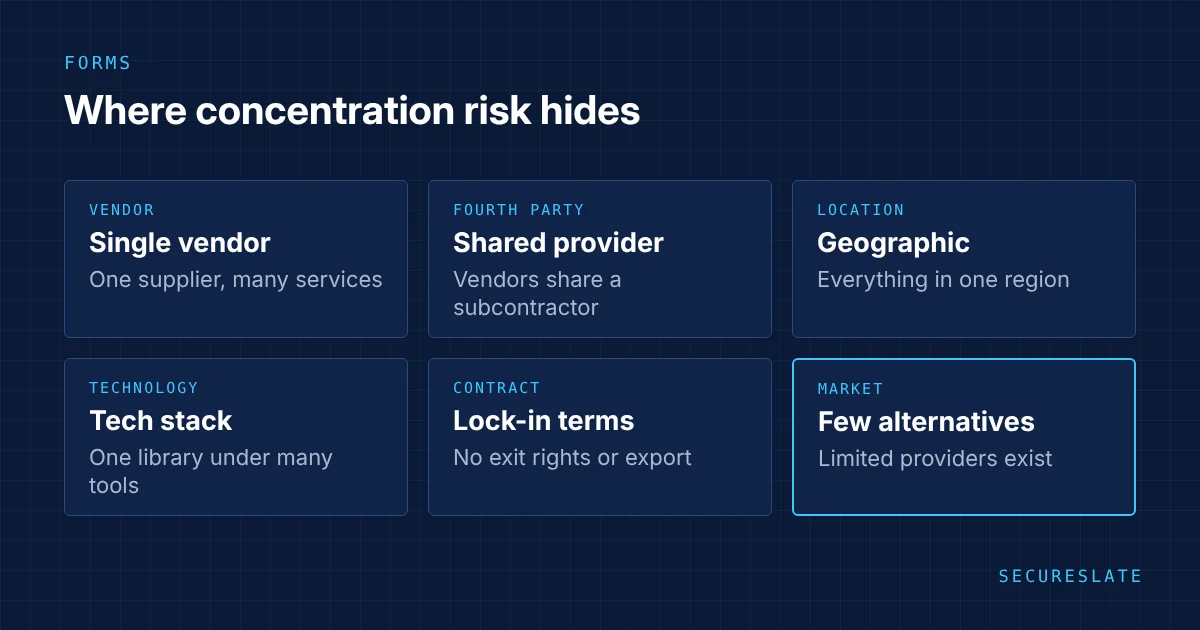
| Form | What it looks like | Typical example |
|---|---|---|
| Single-vendor dependency | One vendor supports several critical functions | Hosting, database, queueing and logging all from one cloud provider |
| Shared fourth party | Different vendors rely on the same subcontractor | Your CRM and your support desk both run on the same hosting provider |
| Geographic | Vendors or data centers cluster in one region | All production and backups in a single cloud region |
| Technology stack | One open source library, protocol or platform underpins many services | A widely used logging or authentication library with a critical flaw |
| Contractual | Long lock-in terms, proprietary data formats or no exit rights | Data exportable only in a vendor-specific format |
| Market | Few providers exist for a service, so alternatives are limited | Specialist healthcare interface engines or clearinghouses |
The fourth-party and technology-stack forms are the hardest to see because they do not appear in your vendor inventory. You only find them by asking vendors who they depend on, which is why concentration work and fourth-party risk management usually run together.
Why does it matter for compliance?
Concentration risk matters because frameworks and regulators expect you to plan for supplier disruption, not just supplier security. Some address concentration by name, others through continuity and supplier management requirements.
| Framework or law | Where concentration shows up |
|---|---|
| DORA (EU) | Regulation (EU) 2022/2554, Article 29, requires financial entities to consider, before contracting ICT services that support critical or important functions, whether the provider is not easily substitutable and whether multiple arrangements with the same or closely connected providers would result. It also asks them to weigh long or complex subcontracting chains. |
| SOC 2 | The Trust Services Criteria include CC9.1 (mitigating risks from potential business disruptions) and CC9.2 (assessing and managing risks from vendors and business partners). |
| ISO 27001:2022 | ISO/IEC 27001 Annex A covers supplier relationships (5.19 to 5.22), cloud services (5.23) and ICT readiness for business continuity (5.30). |
| HIPAA Security Rule | The contingency plan standard in 45 CFR 164.308(a)(7) requires data backup, disaster recovery and emergency mode operation plans, which must account for vendors that hold or process ePHI. |
| NIST SP 800-161 | NIST's supply chain risk guidance treats supplier dependency as part of cybersecurity supply chain risk. See our NIST SP 800-161 guide. |
In our experience, customer security reviews are moving the same way. Enterprise and health system buyers increasingly ask which cloud regions you use, what happens if a key subprocessor fails, and how quickly you could recover. A documented concentration analysis gives you a clear answer.
How do you find concentration in your vendor list?
You find concentration by mapping which business services depend on which vendors, and which vendors depend on the same upstream providers. A spreadsheet is enough to start. Follow these steps:
- List your critical business services. Examples: customer-facing application, login, payments, support, data backups, EHR integration. Start from services, not vendors, so you see dependency chains.
- Map each service to its vendors. Include infrastructure, SaaS tools, managed service providers and key open source components.
- Tier the vendors. Use a vendor tiering model so the deepest analysis goes to vendors that support critical services or hold sensitive data.
- Ask critical vendors about their own dependencies. Their subprocessor lists, SOC 2 reports (look at the carved-out or inclusive subservice organizations) and trust pages usually name hosting and key subcontractors.
- Look for overlaps. Mark any provider that appears under more than one critical service, either directly or as a fourth party. Also mark shared regions.
- Record substitutability. For each critical vendor, estimate how long a migration would take, what data would need to move and whether an alternative exists.
- Write it down in the risk register. Each meaningful concentration becomes a risk with an owner, a rating and a treatment decision.
How do you measure and score it?
Measure concentration with a few simple indicators rather than one composite score. The goal is to rank which dependencies deserve attention first.
| Indicator | Question to ask | Higher risk when |
|---|---|---|
| Criticality | Which critical services stop if this vendor stops? | More than one critical service depends on it |
| Substitutability | How long would a move to an alternative take? | Months rather than days, or no alternative exists |
| Data portability | Can you export your data in a usable format? | Export is partial, manual or proprietary |
| Fourth-party overlap | Do other critical vendors share this provider? | The same provider sits under several vendors |
| Location | Where are the vendor's operations and your data? | Everything sits in one region or one jurisdiction |
| Financial and market health | Is the vendor stable and are there competitors? | Single-source market or a vendor under stress |
A practical approach is to rate each indicator low, medium or high and then discuss the results with the service owners. Avoid false precision. A numeric score is only useful if the inputs are honest, and most teams get more value from a short conversation about the top five dependencies than from a weighted formula.
How do you reduce vendor concentration risk?
You reduce concentration risk by lowering the impact of a vendor failure, not only by adding more vendors. Multi-vendor setups add cost, complexity and their own security exposure, so use them selectively.
Architectural options
- Spread production across multiple availability zones, and keep backups in a separate region or account.
- Keep an independent backup copy of critical data outside the primary vendor's control, tested by restore exercises.
- Use open formats and standard interfaces where you can, so a future migration is realistic.
- Provide a break-glass login path in case the identity provider is unavailable, with tightly controlled credentials.
Contractual options
- Negotiate exit and transition assistance clauses, data return in a usable format and reasonable notice periods. Contracts shift some consequences, but the operational dependency stays with you.
- Require notice of material subcontractor changes for critical vendors.
- Align vendor recovery time commitments with your own customer commitments.
Operational options
- Build vendor failure scenarios into your business continuity and disaster recovery tests.
- Keep a short, maintained list of alternative providers for each critical service.
- Reassess concentration when you add a critical vendor, when a vendor changes ownership or subprocessors, and at least once a year as part of vendor risk assessment.
When is concentration acceptable?
Concentration is acceptable when the business has consciously chosen it, understands the impact and has a tested plan for failure. For many small companies, running on one major cloud provider is the right decision. A second cloud would double the operational work and may introduce more risk than it removes.
What auditors and customers look for is evidence of a deliberate decision. A good risk acceptance record names the dependency, explains why alternatives were rejected, lists compensating controls such as multi-zone deployment and independent backups, names the approver and sets a review date. That record turns an invisible risk into a managed one.
How SecureSlate helps
SecureSlate gives you one place to manage the inputs a concentration analysis needs. Its vendor risk management module keeps your vendor inventory, tiers and assessments together, and risk management lets you record each concentration as a risk with an owner, rating and treatment plan. Built-in mappings for SOC 2, ISO 27001, HIPAA and DORA connect those records to the controls auditors test, and agentless read-only cloud integrations show how your own infrastructure is configured, so you can see where production and backups actually sit.
FAQ
What is vendor concentration risk in simple terms?
It is the risk that relying heavily on one supplier, or on suppliers that share the same upstream provider, means a single failure disrupts several parts of your business at once.
What is the difference between concentration risk and fourth-party risk?
Fourth-party risk is about the security and reliability of your vendors' vendors. Concentration risk is about dependency. They overlap when several of your vendors rely on the same fourth party.
Does DORA require a concentration risk assessment?
Yes, for financial entities in scope. Article 29 of DORA requires them to consider ICT concentration risk when contracting ICT services that support critical or important functions, including substitutability and subcontracting chains.
Do I need a second cloud provider to manage concentration risk?
Not necessarily. Many organizations accept dependency on one cloud provider and reduce impact with multiple availability zones, independent backups, tested recovery and a documented risk acceptance.
How often should concentration risk be reviewed?
Review it when you onboard or change a critical vendor, when a vendor changes key subprocessors or ownership, and at least once a year as part of your vendor risk review cycle.
Disclaimer (legal note)
This article is for general information only and is not legal, regulatory, or professional advice. Requirements vary by framework, industry, and jurisdiction. Consult qualified advisors for your specific obligations.
Need compliance without the complexity?
SecureSlate automates ISO 27001, SOC 2, GDPR, HIPAA, and more. Built for growing teams. See it in action.
Find compliance gaps in 30 seconds