
Related guides:
- Audit evidence requests: how to answer them faster
- Mapping SOC 2 and ISO 27001 common criteria
- Your guide to SOC 2 audits
- What is a GRC audit?
Key takeaways
- Audit fatigue is the exhaustion teams feel when audits, assessments and security questionnaires keep coming, often asking for the same evidence in different formats.
- The main causes are duplicate requests across frameworks, manual evidence collection and treating each audit as a one-off project.
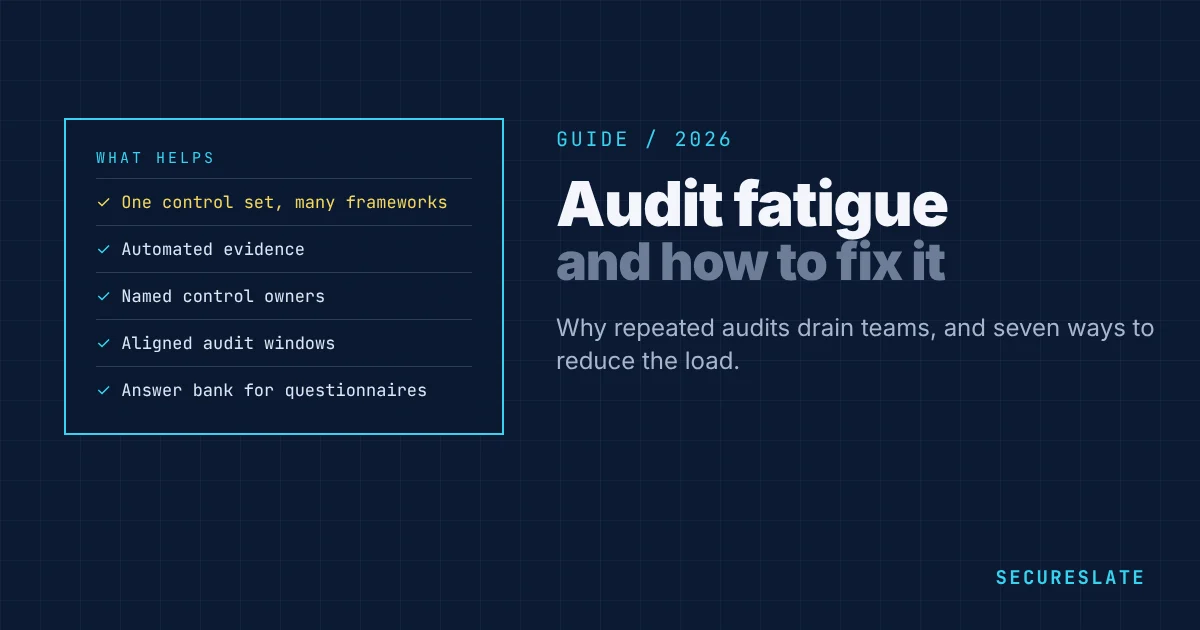
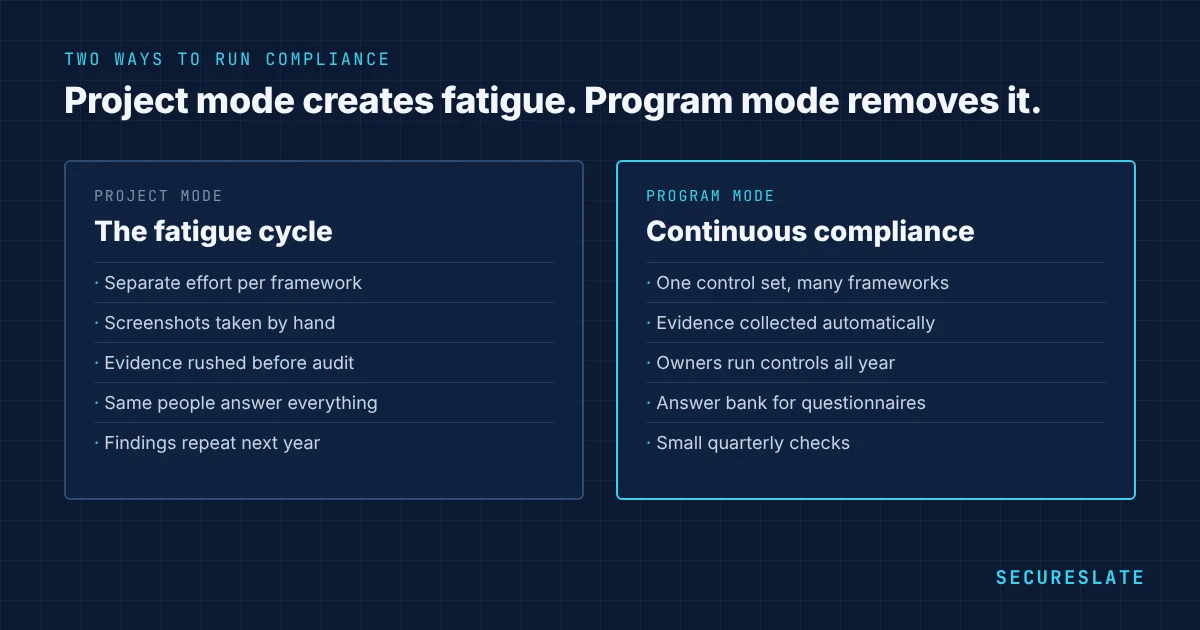
- The fix is to run compliance as a continuous program: one control set mapped to every framework, evidence collected automatically and clear owners.
- Reducing audit fatigue protects security as well as morale, because tired teams cut corners.
What is audit fatigue?
Audit fatigue is the strain that builds up when a team faces a steady stream of compliance work: a SOC 2 Type II audit, an ISO 27001 surveillance audit, a HIPAA assessment, penetration tests and dozens of customer security questionnaires every year. Each one asks for screenshots, policies, tickets and interviews. Many ask for the same things in a slightly different way.
For a company of up to 50 people, the load usually lands on a handful of engineers and one person responsible for compliance. When audits pile up, product work slows, deadlines slip and evidence quality drops.
Warning signs
- Engineers dread the audit window and push back on every evidence request
- The same screenshot is taken several times for different auditors or customers
- Evidence is gathered in the last two weeks before each audit
- Nobody is sure which version of a policy is current
- Findings from the last audit reappear in the next one
- Security questionnaires take days and are answered from scratch each time
- The compliance lead is the only person who knows where anything is
If three or more of these sound familiar, audit fatigue is already costing you time and quality.
Why it happens
Overlapping frameworks. SOC 2, ISO 27001, HIPAA and GDPR overlap heavily, especially on access control, change management, incident response and vendor management. Without a shared control set, each framework becomes a separate project.
Manual evidence. Screenshots and exports collected by hand are slow, go out of date quickly and have to be redone every period.
Project thinking. When an audit is a once-a-year project, everything is rushed at the end. Controls that should run weekly are only checked when the auditor asks.
Unclear ownership. If controls have no named owner, every request goes to the same few people.
Questionnaire overload. Sales teams forward every customer questionnaire to security, with no library of approved answers.
Seven ways to reduce audit fatigue
- Build one control set. Map each control once to every framework you follow. A single access review then counts for SOC 2, ISO 27001 and HIPAA.
- Automate evidence collection. Connect your cloud, identity, code and HR systems so evidence is collected continuously instead of captured by hand before the audit.
- Name an owner for every control. Owners keep their controls running all year and answer the auditor's questions about them.
- Align audit periods. Where possible, line up SOC 2 and ISO 27001 audit windows and use one auditor for both, so interviews and evidence requests happen once.
- Keep a living evidence library. Store evidence by control, with dates, so requests can be answered from the library rather than from scratch.
- Create an answer bank for questionnaires. Keep approved answers to common questions and share a trust center or your SOC 2 report under NDA so customers can serve themselves.
- Run small internal checks. A quarterly mini-review of a few controls catches problems early and removes surprises from the real audit.
A sample annual compliance calendar
| Quarter | Activities |
|---|---|
| Q1 | Annual risk assessment, policy review and approval, security awareness training |
| Q2 | Access reviews, vendor reviews, internal audit or readiness check |
| Q3 | Penetration test, disaster recovery test, access reviews |
| Q4 | External audit fieldwork, management review, access reviews, plan for next year |
Spreading the work across the year turns four stressful weeks into a steady, manageable routine.
Measuring progress
Track a few simple numbers each audit cycle: hours spent by engineering on audit requests, number of evidence requests, number of findings, and average time to answer a security questionnaire. If they fall year on year, your program is working.
Audit fatigue and customer security reviews
For many SaaS companies the heaviest load is not the formal audit but the stream of customer security reviews. A single enterprise deal can bring a 300-question spreadsheet, a request for policies and a call with the customer's security team.
A few habits cut this work sharply:
- Lead with your report. Offer your SOC 2 report or ISO 27001 certificate first. Many reviewers accept it in place of most questions.
- Publish a trust center. List your certifications, policies, subprocessors and security practices, with gated access to sensitive documents.
- Reuse approved answers. Keep one answer bank owned by security, with a review date on each answer.
- Agree the process with sales. Sales should send questionnaires through one intake route with a realistic deadline, not straight to individual engineers.
When to get outside help
Bring in help when the same people have carried every audit for more than a year, when findings repeat, or when you add a new framework. Options include a compliance automation platform, a fractional compliance lead or vCISO, or a readiness assessment from an auditor before the formal audit. The goal is to move routine work off your engineers so they only handle the questions that need their expertise.
How SecureSlate helps
SecureSlate maps one set of controls to SOC 2, ISO 27001, HIPAA and other frameworks, collects evidence automatically from your systems, assigns owners and reminds them when evidence is due. A trust center and questionnaire automation take repetitive customer requests off your team.
FAQ
What is audit fatigue?
It is the exhaustion and loss of quality that comes from facing frequent audits, assessments and questionnaires, often with overlapping requests and manual evidence collection.
How can I reduce audit fatigue with several frameworks?
Use one control set mapped to all frameworks, automate evidence collection, align audit periods and, where possible, use one audit firm for more than one framework.
Does compliance automation remove audits?
No. You still need an independent auditor. Automation reduces the time spent preparing and answering evidence requests, and keeps controls running between audits.
Who should own audit preparation in a small company?
One person should coordinate, usually a compliance or security lead, but each control should have its own owner in engineering, IT, HR or operations.
Can we use one auditor for SOC 2 and ISO 27001?
Often, yes. Some firms are both licensed CPA firms for SOC 2 and accredited certification bodies for ISO 27001, or work with a partner. A combined engagement can share interviews, evidence requests and timing, which cuts the load on your team.
Disclaimer (legal note)
This article is for general information only and is not legal, regulatory, or professional advice. Requirements vary by framework, industry, and jurisdiction. Consult qualified advisors for your specific obligations.
Need compliance without the complexity?
SecureSlate automates ISO 27001, SOC 2, GDPR, HIPAA, and more. Built for growing teams. See it in action.
Find compliance gaps in 30 seconds
