
Related guides:
- Free BCP and disaster recovery plan template
- Free business impact analysis (BIA) template
- Business continuity plan testing
- Backup and recovery policy
Key takeaways
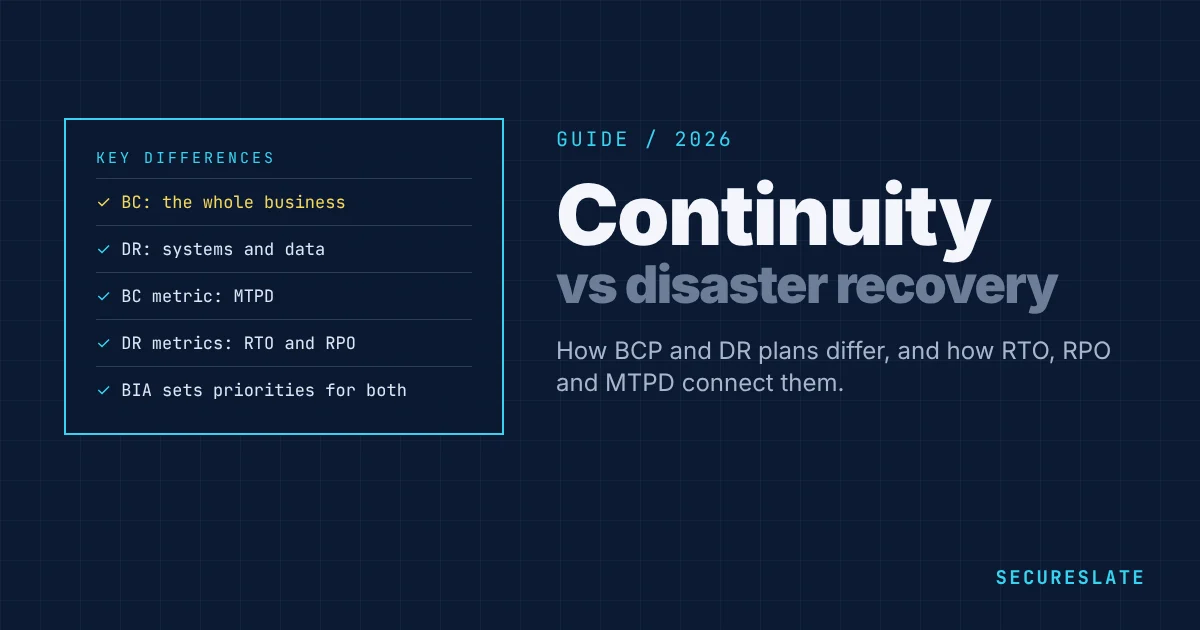
- Business continuity keeps the whole business running during a disruption. Disaster recovery restores the technology the business depends on.
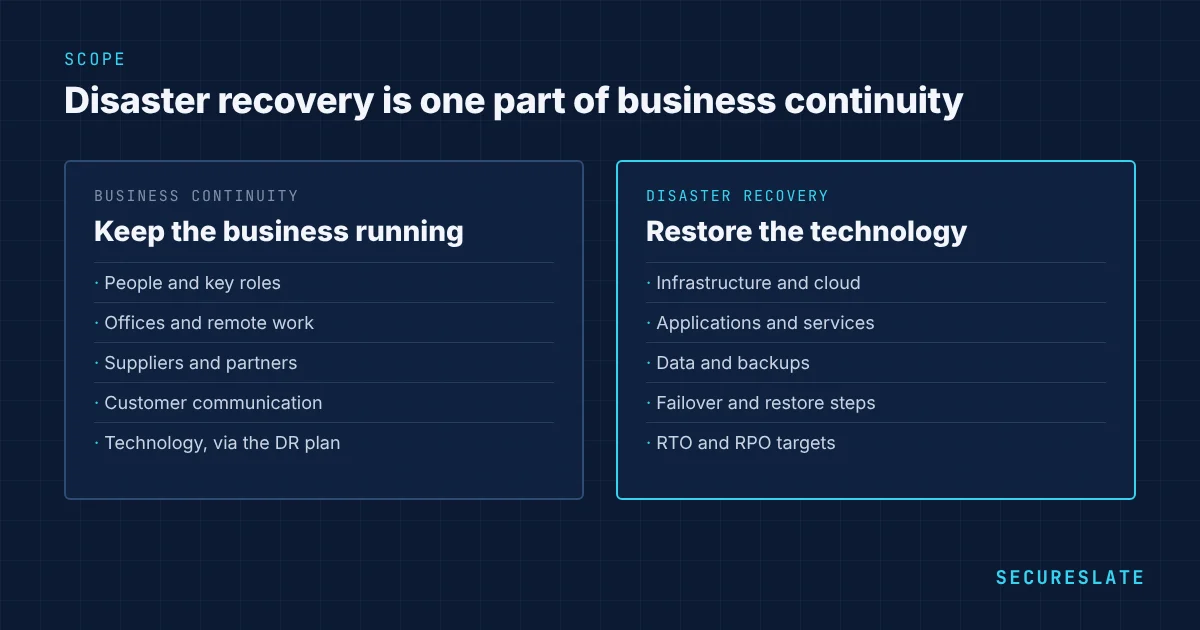
- Disaster recovery is one part of business continuity, not a replacement for it.
- A business impact analysis (BIA) links the two by setting how quickly each function and system must be back.
- SOC 2, ISO 27001 and many customer contracts expect both a plan and evidence that it has been tested.
The short answer
Business continuity is about the business: how you keep serving customers, paying staff and meeting obligations when something goes wrong. Disaster recovery is about technology: how you restore systems, applications and data after an outage, attack or data loss.
If your office floods, business continuity covers where people work and how customers are kept informed. If your primary cloud region fails, disaster recovery covers how you fail over and restore data. In a real event you usually need both at once.
Side-by-side comparison
| Business continuity (BC) | Disaster recovery (DR) | |
|---|---|---|
| Main goal | Keep critical business functions running | Restore IT systems and data |
| Scope | People, processes, locations, suppliers, communication and technology | Infrastructure, applications, data, backups and networks |
| Timing | Before, during and after a disruption | Mainly after a technical failure |
| Typical owner | Operations or executive leadership | Engineering or IT |
| Key document | Business continuity plan (BCP) | Disaster recovery plan (DRP) |
| Key metrics | MTPD (maximum tolerable period of disruption) | RTO and RPO |
| Example scenario | A key supplier goes out of business | A database is corrupted by ransomware |
| Related standard | ISO 22301 | ISO 27031, plus ISO 27001 Annex A 5.30 |
How RTO, RPO and MTPD connect the two
The three metrics show how continuity and recovery fit together:
- MTPD comes from the business. It is the longest a function can be down before the harm becomes unacceptable.
- RTO (recovery time objective) is the target time to restore a system. It must be shorter than the MTPD of the functions that depend on it.
- RPO (recovery point objective) is the maximum data loss you can accept, measured in time. It decides how often you back up or replicate.
A business impact analysis sets the MTPD for each function. The DR plan then sets RTO and RPO targets for each system so recovery happens well within that window.
Examples for a SaaS company
Scenario 1: cloud region outage. The DR plan fails the application over to a second region and restores the database from replicated backups. The business continuity plan covers status page updates, customer communication, support scripts and the decision on SLA credits.
Scenario 2: ransomware on staff laptops. The DR plan restores clean devices and rotates credentials. The business continuity plan covers how staff keep working on spare or personal devices, who talks to customers and whether to involve insurers and regulators.
Scenario 3: loss of a key person. There may be no DR action at all. The business continuity plan covers documented procedures, a named backup for critical roles and access that is not tied to one person.
Do you need both plans?
For most companies, yes, although they can live in one document. A small SaaS company often writes one combined plan with a short continuity section and a detailed recovery section, because the product is the business. The BCP and DR plan template is built this way.
What matters to auditors and customers is that the plan covers people, suppliers and communication as well as technology, that recovery targets are based on business impact, and that the plan has been tested.
What auditors and frameworks expect
- SOC 2: the Availability criteria expect recovery plans, backups and periodic testing. Many SOC 2 reports also cover business continuity under risk mitigation in the common criteria.
- ISO 27001:2022: Annex A 5.29 covers information security during disruption and 5.30 covers ICT readiness for business continuity. Auditors look for a plan, recovery objectives and test records.
- ISO 22301: the international standard for business continuity management systems, used by organizations that want a dedicated continuity certification.
- HIPAA: the Security Rule requires a contingency plan, including data backup, disaster recovery and emergency mode operation plans for electronic protected health information.
How to test both
Test at least once a year. Start with a tabletop exercise that walks through a scenario with leadership, engineering and support. Then test a backup restore and time it against your RPO and RTO. Record what happened, what failed and the follow-up actions. Our guide to business continuity plan testing covers the formats in detail.
Building your first combined plan
If you are starting from nothing, this order works for most small companies:
- Run a short BIA. Interview each function owner and agree which functions and systems matter most and how long each can be down.
- List dependencies. For each critical system, write down what it relies on: cloud provider, identity provider, database, payment provider, DNS and key staff.
- Write the recovery steps. For each Tier 1 system, document how to restore it, who does it and how long it takes.
- Write the continuity steps. Cover who leads, how staff communicate if normal tools are down, how customers are told and which manual workarounds exist.
- Test and fix. Run a tabletop exercise and a backup restore, record the results and fix the gaps you find.
- Schedule the review. Put the annual review and test in the calendar now, with a named owner.
Common mistakes
- Treating a backup policy as a full disaster recovery plan
- Writing a business continuity plan that never mentions technology dependencies
- Setting RTO and RPO targets that have never been tested
- Keeping the only copy of the plan inside the systems that might fail
- Forgetting third-party services such as the identity provider, payment provider or DNS
How SecureSlate helps
SecureSlate tracks your continuity and recovery controls, reminds owners when tests and reviews are due, and stores test results as audit evidence for SOC 2, ISO 27001 and HIPAA.
FAQ
Is disaster recovery part of business continuity?
Yes. Disaster recovery is the technology part of business continuity. A complete continuity program also covers people, locations, suppliers and communication.
What comes first, the BCP or the DRP?
Start with a business impact analysis, which sets the priorities for both. Then write the continuity plan and the recovery plan together so their targets match.
How often should BC and DR plans be tested?
At least once a year, and after major changes such as a new cloud provider, a new critical vendor or a significant incident.
What is a good RTO for a small SaaS company?
It depends on your customer commitments. Many SaaS companies target an RTO of 1 to 4 hours for their production application and an RPO of 15 to 60 minutes for customer data.
Disclaimer (legal note)
This article is for general information only and is not legal, regulatory, or professional advice. Requirements vary by framework, industry, and jurisdiction. Consult qualified advisors for your specific obligations.
Need compliance without the complexity?
SecureSlate automates ISO 27001, SOC 2, GDPR, HIPAA, and more. Built for growing teams. See it in action.
Find compliance gaps in 30 seconds
