
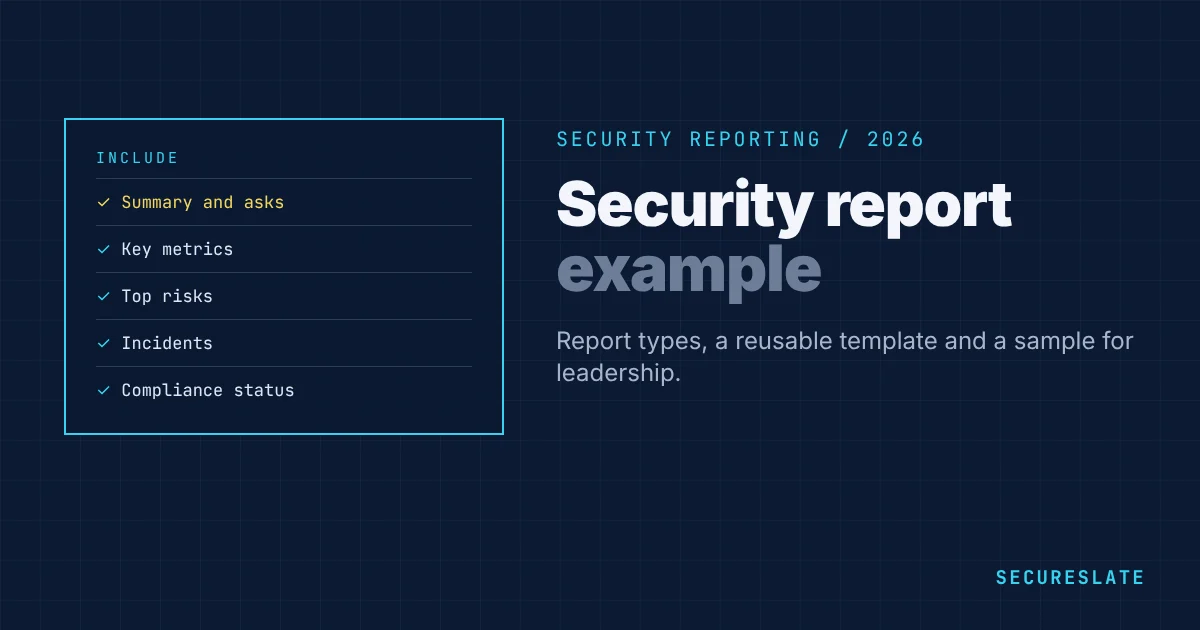
A cyber security report turns security data into decisions. Leaders want to know whether risk is going up or down, auditors want evidence that controls work, and customers want proof their data is safe. Each audience needs a different report. This guide covers the main types of cyber security reports, what each should include, a reusable template and a short sample report you can adapt.
Related guides: Compliance report template and examples · Cybersecurity metrics and KPIs · Cybersecurity risk assessment · Incident response plan template
Key takeaways
- Match the report to the audience: board, management, auditors, customers or engineers.
- Lead with a one-paragraph summary and the decisions needed, then the detail.
- Use trends and a few metrics, not long lists of findings.
- Link every claim to evidence, especially for compliance and audit reports.
Types of cyber security reports
| Report | Audience | Purpose | Frequency |
|---|---|---|---|
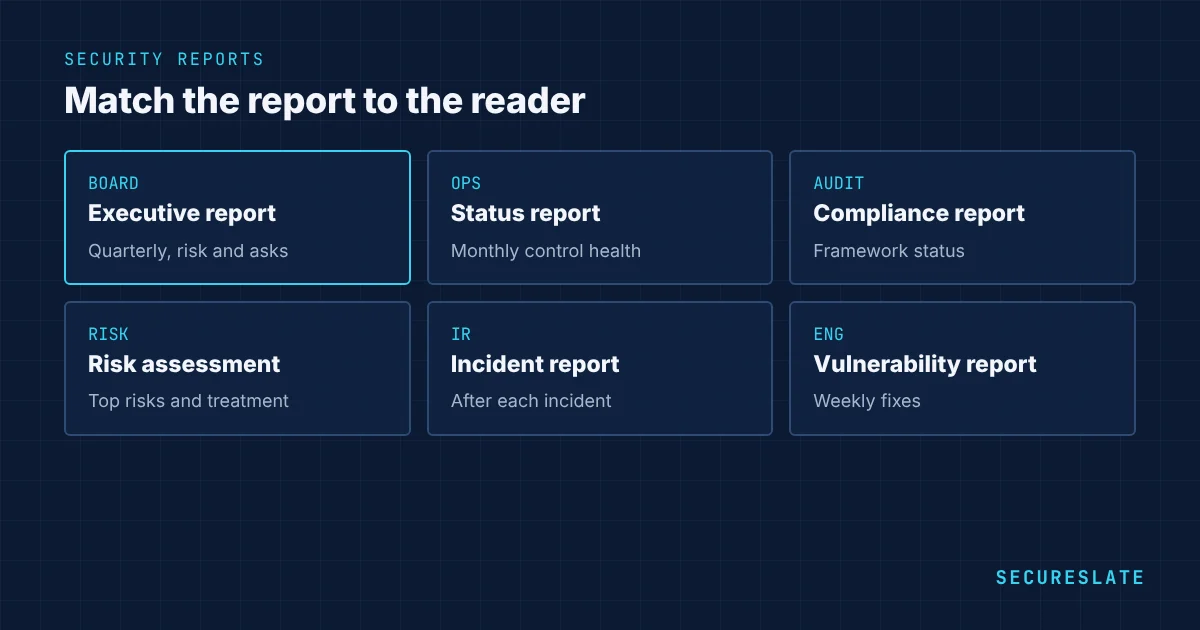
| Board or executive security report | Board, CEO, leadership | Risk posture, trends, decisions and budget | Quarterly |
| Security status report | Management, security team | Operational health of controls and projects | Monthly |
| Compliance report | Leadership, auditors, customers | Status against SOC 2, ISO 27001, HIPAA or other frameworks | Quarterly or before audits |
| Risk assessment report | Leadership, risk owners | Top risks, scores and treatment plans | Yearly and on major change |
| Incident report | Leadership, legal, regulators, customers | What happened, impact, response and lessons | After each significant incident |
| Penetration test report | Security and engineering, customers (summary) | Findings, severity and fixes | Yearly or after major changes |
| Vulnerability report | Engineering | Open vulnerabilities and time to fix | Weekly or monthly |
Cyber security report template
| Section | What to include |
|---|---|
| 1. Summary | Overall status in two or three sentences and decisions needed |
| 2. Scope and period | Systems, teams and dates covered |
| 3. Key metrics | Five to eight metrics with trends, such as MFA coverage, critical vulnerabilities open, time to fix and training completion |
| 4. Top risks | Three to five risks with scores, owners and treatment status |
| 5. Incidents | Notable incidents, impact and lessons |
| 6. Compliance status | Progress against frameworks and upcoming audits |
| 7. Projects | Security initiatives, progress and blockers |
| 8. Requests | Budget, people or decisions needed |
| 9. Appendix | Detailed findings and evidence links |
Cyber security report sample
Quarterly security report, Q3 2026, for the leadership team of a 60-person SaaS company
Summary: Security posture improved this quarter. Phishing-resistant MFA now covers all admins, critical vulnerabilities are fixed within 7 days on average, and the SOC 2 Type 2 observation period is on track. One medium incident, a compromised contractor email account, was contained within 2 hours with no customer data exposed. We request approval for an external penetration test in Q4.
| Metric | Q2 | Q3 | Trend |
|---|---|---|---|
| Users with MFA | 96% | 100% | Better |
| Admins with phishing-resistant MFA | 60% | 100% | Better |
| Critical vulnerabilities open over 7 days | 4 | 0 | Better |
| Average days to fix high vulnerabilities | 21 | 12 | Better |
| Security training completion | 88% | 97% | Better |
| Controls passing automated tests | 91% | 95% | Better |
Top risks: (1) phishing against finance staff, medium, extra training and payment verification in place; (2) a critical vendor without a current SOC 2 report, medium, review scheduled; (3) secrets in older repositories, low, scanning added and rotation under way.
Tips for better security reports
- Use the same metrics every period so trends are meaningful
- Explain what changed and why, not only the numbers
- Translate technical findings into business impact
- Keep the main report to two or three pages
- Automate data collection so reports take hours, not days
Incident report example structure
| Section | What to include |
|---|---|
| Summary | What happened, when, and current status in a few sentences |
| Timeline | Detection, containment, eradication and recovery times |
| Impact | Systems, data and customers affected, if any |
| Root cause | How the attacker or failure got in |
| Response | Actions taken and who was involved |
| Notifications | Regulators, customers or partners notified and when |
| Lessons and actions | Fixes with owners and due dates |
Keep incident reports factual and blameless. They often become evidence for auditors and, in serious cases, regulators.
Compliance status report example
| Framework | Controls passing | Open findings | Next milestone |
|---|---|---|---|
| SOC 2 Type 2 | 95 of 100 | 5, none high | Observation period ends December 31 |
| ISO 27001 | 88 of 93 Annex A applicable controls in place | 3 minor | Surveillance audit in February |
| HIPAA | Risk analysis complete | 2 policy updates | Yearly review in March |
A short table like this lets leadership see status at a glance, with detail in an appendix for anyone who wants it.
Common reporting mistakes
- Reporting raw counts, such as "1,200 vulnerabilities", without severity or trend
- Using technical jargon the audience does not understand
- Leaving out what the reader needs to decide
- Changing metrics every quarter, so trends cannot be compared
- Spending days building reports by hand from many tools
Metrics that work well in security reports
| Metric | Why it is useful |
|---|---|
| MFA coverage | Simple, high-impact control that leaders understand |
| Critical vulnerabilities open past target | Shows exposure and engineering follow-through |
| Mean time to fix by severity | Tracks remediation speed over time |
| Security training completion | Shows people controls are working |
| Controls passing automated tests | Overall compliance health |
| Incidents by severity | Outcome measure for the program |
| Critical vendors reviewed on time | Supply chain coverage |
Pick five to eight and keep them stable. See cybersecurity metrics and KPIs for more.
How SecureSlate helps
SecureSlate collects the data behind your security and compliance reports automatically: control pass rates, vulnerability findings, training completion and risk register status, mapped to SOC 2, ISO 27001 and other frameworks, ready to share with leadership and auditors.
FAQ
What should a cyber security report include?
A summary, scope, key metrics with trends, top risks, incidents, compliance status, projects and the decisions or resources needed.
How often should cyber security reports be produced?
Monthly for operational teams, quarterly for leadership and the board, and after every significant incident.
What is a cybersecurity compliance report?
A report showing status against frameworks or regulations such as SOC 2, ISO 27001 or HIPAA, with control results, findings and remediation plans.
What metrics belong in a board security report?
A few trend metrics such as MFA coverage, time to fix critical vulnerabilities, incidents, training completion and progress on top risks.
How long should a cyber security report be?
Two or three pages for leadership, with detail in appendices or linked dashboards.
Who should write the cyber security report?
The security or compliance lead usually owns it, with input from IT, engineering and risk owners. For board reports, the CISO or CTO presents it.
Should customers receive security reports?
Customers usually receive compliance evidence such as a SOC 2 report or trust center access, and incident notifications when they are affected, rather than internal security reports.
What tools help create security reports?
Compliance platforms, vulnerability scanners and SIEM tools provide the data. A platform that pulls control status and findings into one dashboard makes reports quick to produce.
What is a security status report?
A regular, usually monthly, report on the operational health of security controls and projects for managers and the security team.
How do we show improvement in a security report?
Compare each metric with the previous period and explain what drove the change, such as a new control, a completed project or better tooling.
Should security reports include costs?
Board and executive reports often include budget status and requests, linked to the risks they reduce. Operational reports usually do not.
Disclaimer (legal note)
This article is for general information only and is not legal, regulatory, or professional advice. Requirements vary by framework, industry, and jurisdiction. Consult qualified advisors for your specific obligations.
Need compliance without the complexity?
SecureSlate automates ISO 27001, SOC 2, GDPR, HIPAA, and more. Built for growing teams. See it in action.
Find compliance gaps in 30 seconds