
A cybersecurity risk assessment identifies the threats to your systems and data, estimates how likely they are and how much harm they could cause, and decides what to do about each one. It is required by ISO 27001, HIPAA and many other frameworks, and it is expected by SOC 2 auditors. This guide covers the main methods, how to use a risk matrix, a step-by-step process and a worked example a small company can follow.
Related guides: Risk register · ISO 27001 risk assessment · Risk appetite statement · Compliance risk assessment
Key takeaways
- A risk assessment has four parts: identify, analyze, evaluate and treat.
- Common methods are NIST SP 800-30, ISO/IEC 27005 and the quantitative FAIR model.
- Most small companies use a qualitative 5x5 matrix of likelihood and impact.
- Record results in a risk register, with owners, treatments and review dates, and repeat at least yearly.
What is a cybersecurity risk assessment?
Risk combines likelihood, how probable it is that a threat exploits a weakness, with impact, the harm if it does. A risk assessment looks at your important assets, such as customer data, production systems and source code, the threats to them, such as phishing, ransomware, insider misuse or cloud misconfiguration, and the weaknesses those threats could exploit. The result is a ranked list of risks so you spend effort where it matters most.
Risk assessment methodologies
| Method | Type | Best for |
|---|---|---|
| NIST SP 800-30 | Qualitative or semi-quantitative | US organizations, NIST CSF and NIST 800-53 programs, HIPAA |
| ISO/IEC 27005 | Qualitative or quantitative | ISO 27001 programs |
| FAIR (Factor Analysis of Information Risk) | Quantitative, in financial terms | Mature programs that need dollar estimates for leadership and insurance |
| OCTAVE | Qualitative, workshop-based | Organizations that want business-led assessments |
| Asset-based vs scenario-based | Approach | Asset-based lists assets and threats; scenario-based starts from realistic attack scenarios |
Qualitative methods score risks on scales such as low to high. They are fast and easy to explain. Quantitative methods estimate loss in money, which helps prioritize spending but needs more data and skill. Many companies start qualitative and add quantitative analysis for their top risks.
The risk assessment matrix
A 5x5 matrix multiplies likelihood (1 rare to 5 almost certain) by impact (1 negligible to 5 severe) for a score from 1 to 25.
| Likelihood / Impact | 1 Negligible | 2 Minor | 3 Moderate | 4 Major | 5 Severe |
|---|---|---|---|---|---|
| 5 Almost certain | 5 | 10 | 15 | 20 | 25 |
| 4 Likely | 4 | 8 | 12 | 16 | 20 |
| 3 Possible | 3 | 6 | 9 | 12 | 15 |
| 2 Unlikely | 2 | 4 | 6 | 8 | 10 |
| 1 Rare | 1 | 2 | 3 | 4 | 5 |
A common banding is 1 to 4 low, 5 to 9 medium, 10 to 16 high and 20 to 25 critical. Define what each score means in your context, for example "major impact" as a breach of customer data or a full day of downtime, so different people score consistently.
How to do a cybersecurity risk assessment in seven steps
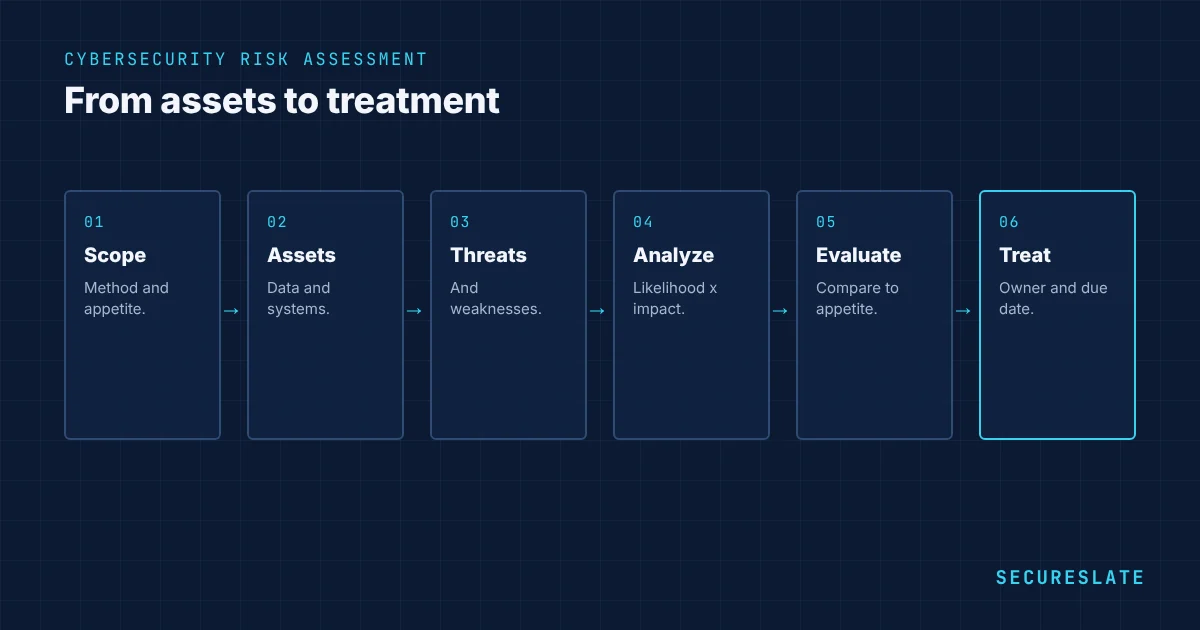
- Set the scope and method. Decide which systems and data are included, the scales you will use, and your risk appetite, meaning which levels of risk are acceptable.
- Identify assets. List the information and systems that matter, with owners.
- Identify threats and vulnerabilities. Use threat catalogs, past incidents, scan results, penetration test findings and team workshops.
- Assess existing controls. Note what already reduces each risk, such as MFA, backups or encryption.
- Analyze likelihood and impact for each risk, considering existing controls.
- Evaluate and prioritize. Compare scores with your risk appetite.
- Decide on treatment. For each risk, choose to mitigate, transfer (for example through insurance), avoid or accept, assign an owner and a due date.
Document everything in a risk register and get leadership to approve the treatment plan and any accepted risks.
Example risks for a SaaS company
| Risk | Likelihood | Impact | Score | Treatment |
|---|---|---|---|---|
| Phishing leads to account takeover | 4 | 4 | 16 High | Phishing-resistant MFA, training, email filtering |
| Misconfigured cloud storage exposes customer data | 3 | 5 | 15 High | Configuration monitoring, least privilege, encryption |
| Ransomware on employee laptops | 2 | 4 | 8 Medium | Endpoint protection, device management, backups |
| Critical vendor outage | 3 | 3 | 9 Medium | Vendor review, failover plan, SLAs |
| Secrets committed to source code | 3 | 4 | 12 High | Secrets scanning, rotation, pre-commit hooks |
How often should you assess risk?
At least once a year, and whenever something significant changes: a new product, a major architecture change, a new type of data, an acquisition, or a serious incident. Continuous monitoring of controls and vulnerabilities between assessments keeps the picture current.
Risk assessment template outline
A simple template has these columns:
| Column | What to record |
|---|---|
| Risk ID | A unique reference, such as R-012 |
| Asset | The system or data at risk |
| Threat | What could happen, such as credential phishing |
| Vulnerability | The weakness exploited, such as no MFA on an admin tool |
| Existing controls | What already reduces the risk |
| Likelihood and impact | Scores from your matrix |
| Inherent and residual score | Before and after controls |
| Treatment | Mitigate, transfer, avoid or accept, with actions |
| Owner and due date | Who acts and by when |
| Status and review date | Open, in progress or closed, and next review |
Common mistakes
- Listing threats without linking them to specific assets and weaknesses
- Scoring everything high, which makes prioritization impossible
- No agreed definitions for likelihood and impact levels
- Treatment plans with no owner or due date
- Doing the assessment once for an audit and never updating it
- Forgetting third parties, even though vendor incidents cause many breaches
Risk assessment requirements by framework
| Framework | Requirement |
|---|---|
| ISO 27001 | Clauses 6.1.2 and 8.2 require a defined risk assessment process, performed at planned intervals and on significant change |
| SOC 2 | CC3.1 to CC3.4 cover risk identification, analysis, fraud risk and change |
| HIPAA | The Security Rule requires an accurate and thorough risk analysis of ePHI (164.308(a)(1)(ii)(A)) |
| NIST CSF 2.0 | The Identify function includes risk assessment (ID.RA) |
| PCI DSS v4.0.1 | Targeted risk analyses for requirements that allow flexible frequencies |
How SecureSlate helps
SecureSlate risk management includes a risk register with a ready-made library of common SaaS risks, a configurable matrix, treatment plans linked to controls, and review reminders, mapped to ISO 27001, SOC 2, HIPAA and NIST CSF.
FAQ
What is the difference between a risk assessment and a vulnerability scan?
A vulnerability scan finds technical weaknesses. A risk assessment considers threats, vulnerabilities, likelihood and business impact to decide what matters most and what to do.
Which risk assessment method should a small company use?
A simple qualitative method with a 5x5 matrix, based on NIST SP 800-30 or ISO 27005, is enough for most small companies and is accepted by auditors.
Is a risk assessment required for SOC 2?
Yes. The SOC 2 Trust Services Criteria require a risk assessment process (CC3), and auditors will ask to see the results.
What is a residual risk?
The risk that remains after controls and treatments are applied. Leadership should approve residual risks that remain above your risk appetite.
How long does a cybersecurity risk assessment take?
For a small SaaS company, a first assessment usually takes a few days of work spread over one to three weeks, including workshops and review.
Should we include vendors in our risk assessment?
Yes. Critical vendors that host or process your data are a major source of risk. Include vendor risks in the register and link them to your vendor review process.
Disclaimer (legal note)
This article is for general information only and is not legal, regulatory, or professional advice. Requirements vary by framework, industry, and jurisdiction. Consult qualified advisors for your specific obligations.
Need compliance without the complexity?
SecureSlate automates ISO 27001, SOC 2, GDPR, HIPAA, and more. Built for growing teams. See it in action.
Find compliance gaps in 30 seconds