
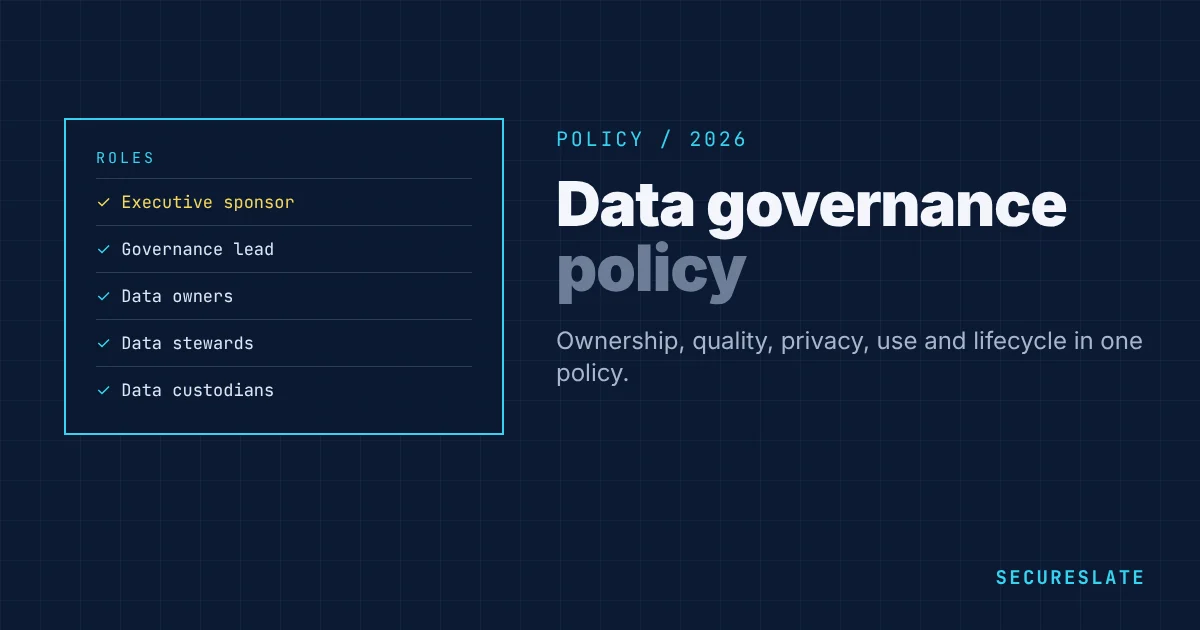
A data governance policy sets out how an organization manages its data as an asset: who owns it, how quality is maintained, how it is protected, how it can be used and how long it is kept. While a data classification policy tells people how sensitive data is, data governance covers the full picture of accountability, quality, privacy, security and lifecycle. It matters more every year as companies rely on analytics and AI, face privacy laws such as GDPR and US state laws, and must answer customer questions about how their data is used. This guide explains what to include, the key roles and a template you can adapt.
Related guides: Data classification policy · Data retention policy · GDPR lawful bases · Document control procedure
Key takeaways
- Data governance defines ownership, quality, security, privacy, use and lifecycle of data.
- Key roles are the data governance lead or council, data owners, data stewards and data custodians.
- The policy should link to classification, retention, access control and privacy policies rather than repeat them.
- Clear rules on data use for analytics and AI are now essential.
- Start small: govern your most important data domains first, such as customer and financial data.
What data governance covers
| Area | Questions it answers |
|---|---|
| Ownership and accountability | Who decides how this data is collected, used and shared? |
| Data quality | Is the data accurate, complete, consistent and timely? |
| Metadata and catalog | What data do we have, where is it and what does it mean? |
| Security | Who can access it and how is it protected? |
| Privacy and compliance | What laws and contracts apply, and what is the lawful basis? |
| Data use | Which uses are allowed, including analytics and AI training? |
| Lifecycle | How long is data kept and how is it disposed of? |
| Sharing | When can data go to vendors, partners or customers? |
Key roles
| Role | Responsibilities |
|---|---|
| Executive sponsor | Provides authority and resources; resolves escalations |
| Data governance council or lead | Owns the policy, sets standards, tracks progress |
| Data owner | Senior person accountable for a data domain; approves access and use |
| Data steward | Maintains definitions, quality rules and metadata day to day |
| Data custodian | IT or engineering team that operates systems and applies technical controls |
| Data protection officer or privacy lead | Advises on privacy law, DPIAs and data subject rights |
| Data users | Use data according to the policy |
Data governance policy template
1. Purpose
State that the policy ensures data is accurate, secure, compliant and used responsibly to support business goals.
2. Scope
All data the organization collects, creates, stores or processes, in all systems, including data processed by vendors.
3. Principles
- Data is a shared asset with clear accountability.
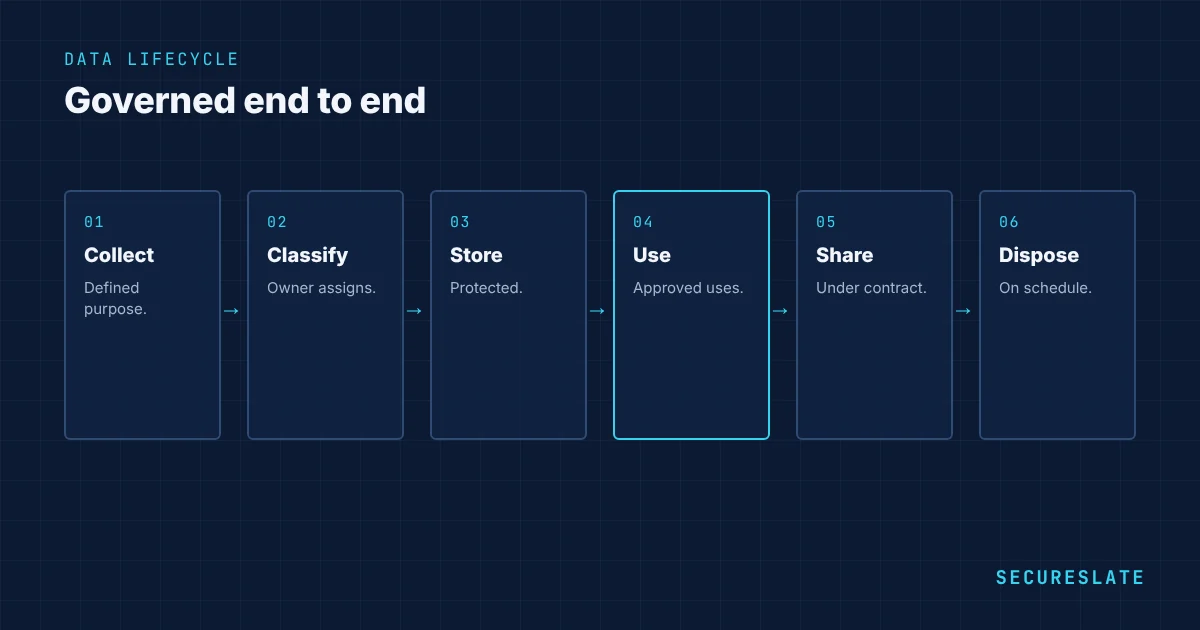
- Data is collected for defined purposes and used only for compatible purposes.
- Data quality is measured and maintained.
- Data is protected according to its classification.
- Data is kept only as long as needed.
- Data use is transparent to the people it relates to.
4. Roles and responsibilities
Define the roles above and name the current holders for each major data domain.
5. Data inventory and catalog
Maintain an inventory of data stores, data domains, owners, classifications and legal bases. For GDPR, this supports records of processing activities under Article 30.
6. Data quality
Define quality dimensions (accuracy, completeness, consistency, timeliness, validity, uniqueness), set rules for critical data elements, monitor them and fix issues through stewards.
7. Security and access
Follow the access control and data classification policies. Access to Confidential and Restricted data requires owner approval.
8. Privacy
Identify personal data, document lawful bases, complete DPIAs for high-risk processing, honor data subject rights and apply data minimization.
9. Data use, analytics and AI
- New uses of personal or customer data require owner and privacy review.
- Customer data is not used to train AI models unless contracts and notices allow it.
- Only approved AI tools may process Confidential or Restricted data.
- Outputs from AI that drive decisions about people are reviewed by humans where required.
10. Data sharing
External sharing requires a contract with data protection terms, a vendor review and owner approval.
11. Retention and disposal
Follow the data retention schedule; delete or anonymize data at the end of its retention period.
12. Issue management
Report data quality, privacy or security issues to the steward or governance lead; track them to resolution.
13. Monitoring and metrics
Track quality scores, access review completion, retention compliance and open issues.
14. Exceptions and review
Exceptions require documented approval. The policy is reviewed yearly.
Data governance frameworks
Organizations often draw on established frameworks to structure governance:
| Framework | Focus |
|---|---|
| DAMA-DMBOK | Comprehensive body of knowledge for data management functions |
| DCAM (EDM Council) | Capability assessment for data management programs |
| ISO/IEC 38505 | Governance of data for boards and executives |
| NIST Privacy Framework | Privacy risk management aligned with the NIST CSF structure |
| ISO/IEC 27701 | Privacy information management extension to ISO 27001 |
| ISO/IEC 42001 | AI management system, including data used by AI |
Rolling out data governance
- Pick priority domains. Start with customer data and financial data, where errors or misuse cost most.
- Name owners and stewards. Give them time and authority.
- Build the inventory. Map systems, data types, classifications and flows.
- Define critical data elements. For example customer ID, email, contract value.
- Set quality rules and measure. Start with a few metrics.
- Connect to privacy and security. Link inventory to records of processing and access reviews.
- Publish the policy and train. Focus on what changes for each team.
- Report progress. Share metrics with the sponsor quarterly.
Metrics to track
| Metric | What it shows |
|---|---|
| Percentage of data stores with owners | Accountability coverage |
| Data quality score for critical elements | Reliability for decisions |
| Access reviews completed on time | Security of sensitive data |
| Records past retention date | Lifecycle compliance |
| Data subject requests completed on time | Privacy performance |
| Open data issues and age | Responsiveness |
Common mistakes
- Writing a long policy with no named owners
- Trying to govern every data set at once
- Treating governance as an IT project rather than a business responsibility
- No rules for AI and analytics use of customer data
- No link between the data inventory and privacy records
Data governance for small companies
A startup does not need a governance council with monthly meetings. A practical starting point is: one named owner for customer data and one for financial data, a simple inventory of systems and the data they hold, a classification and retention schedule, a rule that new uses of customer data are checked with the privacy lead, and a quarterly 30-minute review of open issues. This covers most of what customers, auditors and regulators expect, and it can grow into a fuller program later.
How SecureSlate helps
SecureSlate supports the security and compliance side of data governance for small and mid-size teams. It provides policy templates, tracks acknowledgments, runs access reviews for sensitive systems, records which vendors receive which data, and maps controls across GDPR, SOC 2, ISO 27001 and ISO 27701 with multi-framework mapping.
FAQ
What is a data governance policy?
A policy that defines how an organization manages data, including ownership, quality, security, privacy, use, sharing and lifecycle.
What is the difference between data governance and data management?
Data governance sets the rules and accountability. Data management is the day-to-day work of collecting, storing, integrating and maintaining data under those rules.
Who is responsible for data governance?
An executive sponsor and governance lead own the program, data owners are accountable for their domains, stewards maintain quality and custodians apply technical controls.
Does GDPR require a data governance policy?
GDPR does not name one, but its accountability principle requires organizations to demonstrate compliance, which a governance policy and data inventory support.
How does data governance relate to AI?
AI depends on data. Governance defines which data may be used for AI, under what conditions, and how quality and privacy are protected.
Disclaimer (legal note)
This article is for general information only and is not legal, regulatory, or professional advice. Requirements vary by framework, industry, and jurisdiction. Consult qualified advisors for your specific obligations.
Need compliance without the complexity?
SecureSlate automates ISO 27001, SOC 2, GDPR, HIPAA, and more. Built for growing teams. See it in action.
Find compliance gaps in 30 seconds