
Short answer: The UK GDPR is the United Kingdom's version of the EU General Data Protection Regulation, kept in UK law after Brexit. It works together with the Data Protection Act 2018 and is enforced by the Information Commissioner's Office. The core rules match the EU GDPR, but fines, transfers and several details now differ.
Related guides: UK cybersecurity laws and regulations · GDPR data subject rights · GDPR breach notification requirements
Key takeaways
- UK data protection law is a package: the UK GDPR, the Data Protection Act 2018 and the Privacy and Electronic Communications Regulations (PECR).
- The Data (Use and Access) Act 2025 amended that package rather than replacing it. The ICO has confirmed its outstanding provisions took effect by 19 June 2026.
- Maximum fines are £17.5 million or 4% of total worldwide annual turnover, whichever is higher.
- The UK GDPR applies to organisations outside the UK that offer goods or services to, or monitor, people in the UK.
- A company serving both UK and EU customers must comply with both regimes. They overlap heavily, but one does not satisfy the other automatically.
What is the UK GDPR?
The UK GDPR is the retained UK version of Regulation (EU) 2016/679, which has applied as domestic UK law since the end of the Brexit transition period on 31 December 2020. Its principles, lawful bases, individual rights and accountability duties were carried over from the EU GDPR with amendments so they work in a UK-only context.
It does not stand alone. Three instruments work together:
| Instrument | What it covers |
|---|---|
| UK GDPR | The core rules: principles, lawful bases, rights, controller and processor duties, transfers, breach notification |
| Data Protection Act 2018 | Supplements the UK GDPR: exemptions, conditions for special category and criminal offence data, the regulator's powers and penalties, plus separate regimes for law enforcement and intelligence services processing |
| PECR | Electronic marketing, cookies and similar technologies, and security of electronic communications services |
The Information Commissioner's Office (ICO) regulates all three. The Data (Use and Access) Act 2025 provides for the regulator to be restructured as a body corporate called the Information Commission.
Who does the UK GDPR apply to?
The UK GDPR applies to controllers and processors established in the UK, and to organisations outside the UK that target or monitor people in the UK.
In practical terms, you are in scope if any of these is true:
- You have an establishment in the UK and process personal data in the context of its activities, wherever the processing physically happens.
- You are outside the UK but offer goods or services to individuals in the UK, whether paid or free.
- You are outside the UK but monitor the behaviour of individuals in the UK, for example through tracking or profiling.
An overseas organisation caught by the second or third limb must generally appoint a UK representative under Article 27 of the UK GDPR, unless its processing is only occasional, low risk and does not involve large-scale special category or criminal offence data. This is separate from the EU representative requirement, so a US company selling into both markets may need both.
Controllers that process personal data must also pay a data protection fee to the ICO unless an exemption applies. This is a UK-specific duty with no direct EU equivalent.
How does UK GDPR differ from EU GDPR?
The two regimes share the same structure and most of the same wording, but they differ on the regulator, penalties, transfer tools and a growing list of details.
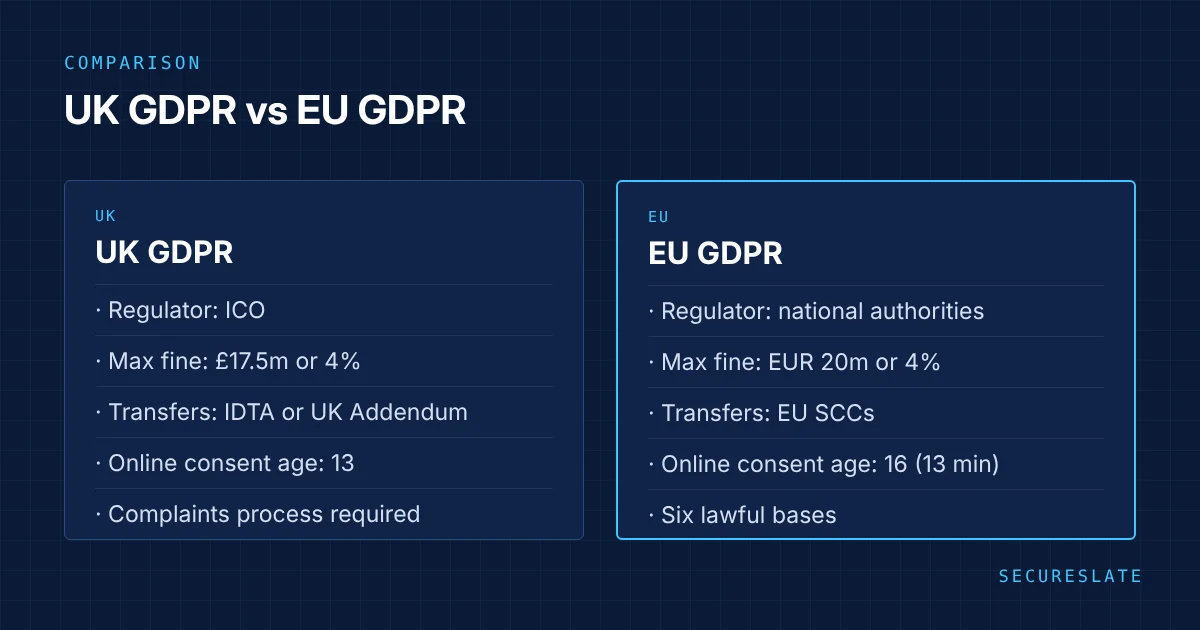
| Topic | UK GDPR | EU GDPR |
|---|---|---|
| Regulator | ICO, a single national regulator | A supervisory authority in each member state, coordinated through the one-stop-shop mechanism and the European Data Protection Board |
| Maximum fine | £17.5 million or 4% of worldwide annual turnover, whichever is higher | EUR 20 million or 4% of worldwide annual turnover, whichever is higher |
| Lower-tier maximum | £8.7 million or 2% | EUR 10 million or 2% |
| Age of consent for online services | 13 | 16, with member states able to lower it to no less than 13 |
| Transfer tools | International Data Transfer Agreement (IDTA) or the UK Addendum to the EU standard contractual clauses; UK adequacy regulations | EU standard contractual clauses; European Commission adequacy decisions |
| Lawful bases | Six original bases plus "recognised legitimate interests" added by the 2025 Act | Six bases |
| Complaints | Controllers must operate a complaints process | No equivalent explicit duty on controllers |
| Representative | UK representative for overseas organisations | EU representative for non-EU organisations |
The shared ground is larger than the differences. Both require a lawful basis, transparency, data minimisation, security appropriate to the risk, processor contracts, records of processing, DPIAs for high-risk processing and breach notification to the regulator within 72 hours where the breach is likely to result in a risk to individuals. If you already run a solid EU GDPR program, the UK work is mostly about the deltas in this table.
What did the Data (Use and Access) Act 2025 change?
The Data (Use and Access) Act 2025 made targeted amendments to the UK GDPR, the Data Protection Act 2018 and PECR without rewriting the regime. It received Royal Assent in June 2025 and was commenced in stages. The ICO stated in June 2026 that the Act's outstanding provisions, including the new complaints duty, are now in force.
The changes most relevant to a typical business:
- Complaints handling. Organisations must give people a clear way to raise a data protection complaint, acknowledge it within 30 days, investigate appropriately and communicate the outcome.
- Recognised legitimate interests. A new lawful basis covers a defined list of purposes, such as crime prevention, safeguarding and responding to emergencies, without the usual balancing test.
- Automated decision-making. The restrictions on solely automated decisions with significant effects were relaxed for processing that does not involve special category data, subject to safeguards such as the ability to obtain human intervention and contest the decision.
- Subject access requests. The law now states that organisations need only carry out reasonable and proportionate searches.
- International transfers. A new "data protection test" asks whether the standard of protection in the destination is not materially lower than in the UK.
- Cookies and PECR. Some low-risk uses of cookies and similar technologies no longer need consent, and the maximum PECR fines were raised to UK GDPR levels.
For a company with an existing program, the complaints procedure is the item most likely to need new work, because it requires a visible intake route and a tracked process.
How do international transfers work under UK GDPR?
A restricted transfer of personal data out of the UK needs one of three things: UK adequacy regulations covering the destination, an appropriate safeguard, or a specific exception.
- Adequacy. The UK recognises the EEA countries and a number of others as adequate. Transfers to US organisations certified under the UK Extension to the EU-US Data Privacy Framework are also covered, an arrangement often called the UK-US data bridge.
- Safeguards. Where no adequacy regulations apply, most organisations use the ICO's International Data Transfer Agreement, or the UK Addendum attached to the EU standard contractual clauses, together with a transfer risk assessment.
- Exceptions. Narrow exceptions such as explicit consent or contract necessity exist for occasional transfers. They are not a basis for routine data flows.
Flows in the other direction matter just as much. The European Commission adopted adequacy decisions for the UK in 2021 and renewed them in December 2025, with the renewed decisions set to run until 27 December 2031. As of November 2026, this means personal data can move from the EEA to the UK without additional transfer tools. For the general logic behind these mechanisms, see our guide to transferring data under the GDPR.
What are the fines and how does the ICO enforce?
The ICO can fine up to £17.5 million or 4% of total worldwide annual turnover, whichever is higher, for the most serious infringements, and up to £8.7 million or 2% for others.
Fines are only one of its tools. The ICO can also issue information notices, assessment notices that allow it to audit an organisation, enforcement notices requiring specific steps, and reprimands. In our experience, most organisations that deal with the ICO do so over a complaint or a reported breach rather than a fine, and the quality of their documentation shapes how that conversation goes.
Three time limits are worth memorising:
| Obligation | Time limit |
|---|---|
| Report a notifiable personal data breach to the ICO | Without undue delay and, where feasible, within 72 hours of becoming aware |
| Respond to a subject access or other rights request | One month, extendable by two further months for complex or numerous requests |
| Acknowledge a data protection complaint | Within 30 days |
How do you comply with UK GDPR?
Comply by confirming your scope, documenting your processing, and then closing the UK-specific gaps on top of a standard GDPR program.
- Confirm scope and role. Decide whether you are a controller, processor or both for UK personal data, and whether you need a UK representative.
- Pay the ICO data protection fee if you are a controller and no exemption applies.
- Maintain a record of processing and identify a lawful basis for each activity.
- Publish a UK-ready privacy notice that names the ICO as the regulator and explains how to complain to you.
- Set up the complaints procedure: an intake route, a 30-day acknowledgment and a way to track outcomes.
- Review transfers out of the UK and put the IDTA or UK Addendum in place where no adequacy regulations apply.
- Check processor contracts contain the required terms and reference UK law where relevant.
- Apply appropriate security and test it. Many UK organisations pair this with Cyber Essentials, covered in our Cyber Essentials UK checklist.
- Prepare breach and rights request workflows that meet the 72-hour and one-month limits.
- Review PECR compliance for cookies and electronic marketing.
How SecureSlate helps
SecureSlate includes GDPR and Cyber Essentials as built-in frameworks, with controls mapped across SOC 2, ISO 27001, HIPAA and others so one piece of evidence can serve several requirements. UK-specific obligations that go beyond the built-in GDPR controls, such as the complaints procedure or the ICO fee, can be set up as custom controls or a custom framework. Vendor risk management helps you track processors and the transfer terms in their contracts, access reviews and the device agent support your security measures, and a trust center lets you share your posture with UK customers.
SecureSlate does not perform audits or issue certifications. Start a free trial to see how it fits your program.
FAQ
Is UK GDPR the same as EU GDPR?
No, but they are closely related. The UK GDPR started as a copy of the EU GDPR and keeps the same structure and principles. It has since diverged on fines, transfer tools, the regulator and the changes made by the Data (Use and Access) Act 2025.
Does UK GDPR apply to US companies?
Yes, if a US company offers goods or services to individuals in the UK or monitors their behaviour. Such a company generally needs a UK representative unless a narrow exemption applies.
If we comply with EU GDPR, are we compliant with UK GDPR?
Mostly, but not automatically. You still need UK-specific items such as the ICO fee, a UK representative where required, UK transfer tools, the complaints procedure and privacy notices that reference the ICO.
What is the maximum fine under UK GDPR?
£17.5 million or 4% of total worldwide annual turnover in the preceding financial year, whichever is higher. A lower tier of £8.7 million or 2% applies to other infringements.
Can personal data still flow freely from the EU to the UK?
Yes, as of November 2026. The European Commission renewed its UK adequacy decisions in December 2025, and they are set to run until 27 December 2031.
Disclaimer (legal note)
This article is for general information only and is not legal, regulatory, or professional advice. Requirements vary by framework, industry, and jurisdiction. Consult qualified advisors for your specific obligations.
Need compliance without the complexity?
SecureSlate automates ISO 27001, SOC 2, GDPR, HIPAA, and more. Built for growing teams. See it in action.
Find compliance gaps in 30 seconds