
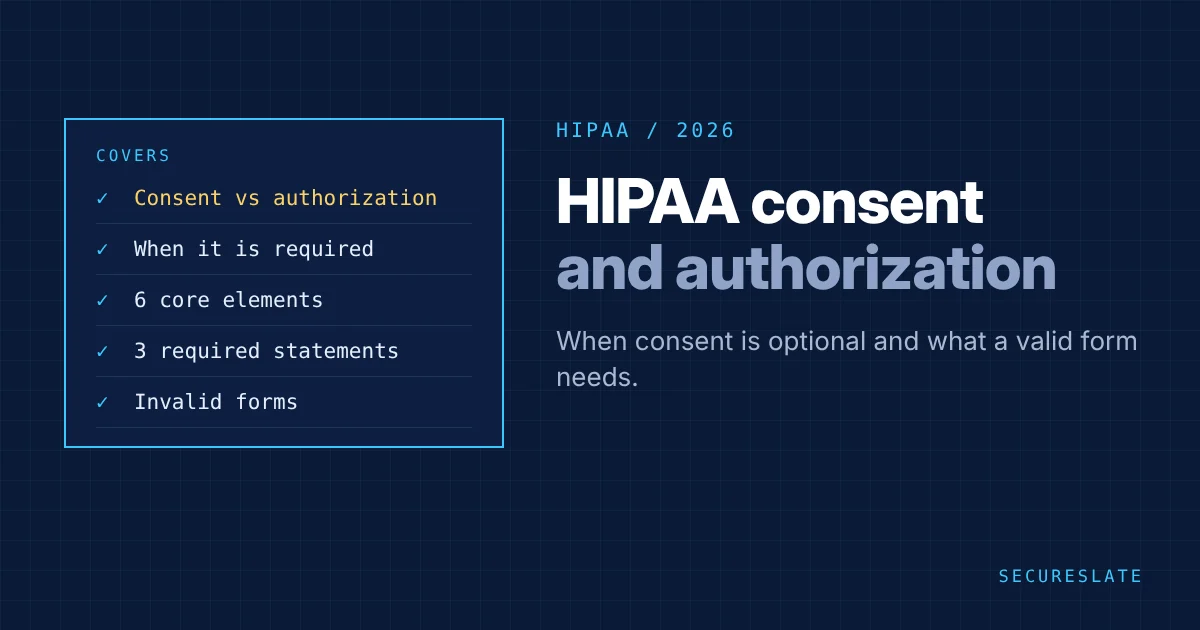
Short answer: HIPAA does not require a consent form for treatment, payment or health care operations. A provider may ask for one, but it is optional. What HIPAA does require is a signed authorization, meeting the elements in 45 CFR 164.508, before you use or disclose PHI for purposes the rules do not otherwise permit, such as most marketing.
Related guides: HIPAA permitted uses and disclosures · HIPAA right of access · 42 CFR Part 2
Key takeaways
- "HIPAA consent form" is often used loosely. Under the Privacy Rule, consent and authorization are different things.
- Consent for treatment, payment and health care operations is optional under 45 CFR 164.506(b).
- An authorization is required for psychotherapy notes, marketing, sale of PHI and any other use not otherwise permitted.
- A valid authorization needs six core elements and three required statements, in plain language, with a copy given to the individual.
- Signed authorizations must be retained for six years under the HIPAA documentation rules.
Is a HIPAA consent form the same as an authorization?
No. A consent is a general permission a provider may choose to collect for routine uses. An authorization is a detailed, specific permission that the Privacy Rule requires for uses outside the permitted categories.
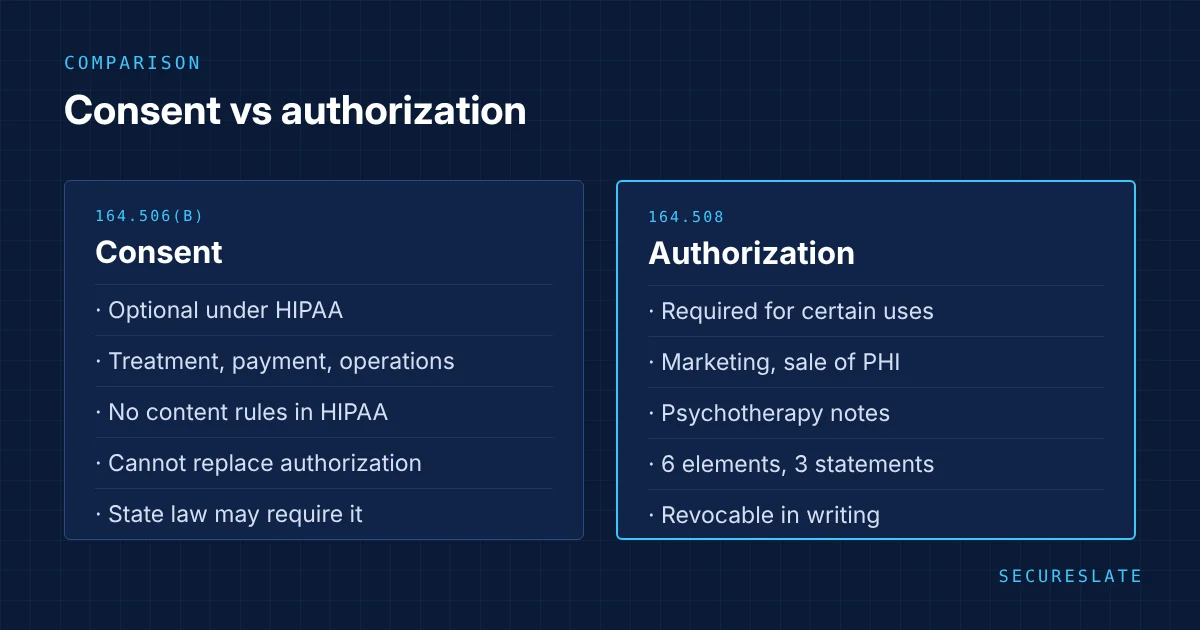
| Consent | Authorization | |
|---|---|---|
| Legal basis | 45 CFR 164.506(b) | 45 CFR 164.508 |
| Required? | No, optional | Yes, for uses that need it |
| Typical use | Treatment, payment and health care operations | Marketing, psychotherapy notes, sale of PHI, disclosures to employers or other third parties |
| Content rules | None set by HIPAA | Six core elements and three required statements |
| Can treatment be conditioned on it? | Not addressed by HIPAA | Generally no, with narrow exceptions |
| Overrides other rules? | No. Consent cannot replace a required authorization | Use must match what the authorization says |
Many practices hand patients an intake packet that includes a "consent to treat" form, an acknowledgment of the notice of privacy practices and sometimes an authorization to release records. These are three separate documents with three different purposes. Treating them as one is a common source of confusion and invalid forms.
Note that state laws and other federal rules can be stricter. Substance use disorder records covered by 42 CFR Part 2 have their own consent requirements, and many states require specific consent for categories such as mental health, HIV or genetic information.
When do you need a signed HIPAA authorization?
You need an authorization whenever the use or disclosure is not permitted or required elsewhere in the Privacy Rule. The rule singles out three cases that always need one:
- Psychotherapy notes. Most uses and disclosures need an authorization, apart from narrow exceptions such as use by the note's originator for treatment.
- Marketing. Using or disclosing PHI for marketing needs an authorization, except face-to-face communications and promotional gifts of nominal value. If a third party pays for the marketing, the authorization must say so.
- Sale of PHI. Any disclosure that is a sale of PHI needs an authorization that states the covered entity will receive remuneration.
Beyond those, common examples include sending records to a patient's employer, a life insurer or a lawyer at someone else's request, or sharing PHI with a technology partner for its own product development. By contrast, many disclosures, such as those for treatment, payment, operations, public health and some law enforcement purposes, are permitted without authorization. Our guide to HIPAA permitted uses and disclosures lists them.
A patient asking for their own records is not an authorization request. That is the right of access, which has its own rules and timelines; see HIPAA right of access.
What must a HIPAA authorization form include?
A valid authorization must contain six core elements and three required statements, set out in 45 CFR 164.508(c).
| Core element | What to write |
|---|---|
| Description of the information | Specific and meaningful, for example "lab results from January to June 2026" rather than "all records" when that is not intended |
| Who may disclose | Name or specific identification of the person or class of persons authorized to make the disclosure |
| Who may receive | Name or specific identification of the recipient or class of recipients |
| Purpose | A description of each purpose. "At the request of the individual" is enough when the patient initiates the request and chooses not to give a reason |
| Expiration | A date or an event tied to the individual or the purpose. For research, "end of the research study" or "none" can be enough |
| Signature and date | Signed and dated by the individual, or by a personal representative with a description of their authority |
The form must also contain statements that put the individual on notice of:
- The right to revoke the authorization in writing, with the exceptions and how to revoke, or a reference to the notice of privacy practices if it explains this.
- Whether treatment, payment, enrollment or eligibility can be conditioned on signing. Usually the statement is that it cannot be.
- The potential for redisclosure, meaning information disclosed under the authorization may be redisclosed by the recipient and no longer be protected by HIPAA.
Finally, the authorization must be written in plain language, and if you asked for it, you must give the individual a copy of the signed form.
What makes an authorization invalid?
An authorization is defective, and cannot be relied on, if any of the following apply:
- The expiration date has passed or the expiration event is known to have occurred.
- A required element has not been filled out completely.
- The covered entity knows it has been revoked.
- It breaks the rules on compound authorizations or conditioning.
- Material information in it is known to be false.
Compound authorizations are a frequent trap. In general, an authorization cannot be combined with another document, such as a consent to treat. Research authorizations and psychotherapy note authorizations have their own specific combination rules.
How to manage HIPAA consent and authorization forms
Getting the template right is half the job. The other half is running the process so that every disclosure can be traced to a valid form.
- Separate your documents. Keep consent to treat, the notice of privacy practices acknowledgment and authorizations as distinct forms.
- Build a compliant template. Include all six core elements and three statements, and have counsel review it against state law.
- Check before disclosing. Train staff to confirm the form is complete, unexpired, unrevoked and matches the request.
- Disclose only what is described. Release the information listed in the authorization and nothing more.
- Record revocations. Log written revocations and stop future disclosures that relied on the authorization.
- Retain records. Keep signed authorizations for six years, in line with the documentation requirements in 164.530(j). See HIPAA data retention requirements.
- Review e-signature flows. If you collect authorizations online, make sure the signature process is reliable, the form is complete and the patient receives a copy.
How SecureSlate helps
SecureSlate helps healthcare and healthtech teams keep the policies behind consent and authorization in good order. The built-in HIPAA framework maps Privacy and Security Rule controls, so your authorization policy, retention rules and training sit alongside the evidence that supports them. Risk management records gaps such as missing state-law review, and vendor risk management covers e-signature and records-release vendors that handle PHI. Audit management keeps it ready to show auditors or customers. SecureSlate does not provide legal advice or draft legally binding forms for you.
FAQ
Is a HIPAA consent form required?
No. Under 45 CFR 164.506(b), covered entities may obtain consent for treatment, payment and health care operations, but HIPAA does not require it. State law may still require consent for treatment or for certain types of records.
What is the difference between a HIPAA release form and an authorization?
"HIPAA release form" is an informal name. In practice it usually means an authorization to disclose PHI, which must meet the requirements of 45 CFR 164.508.
How long is a HIPAA authorization valid?
Until the expiration date or event written on the form, or until the individual revokes it in writing. HIPAA does not set a fixed maximum, but the form must state an expiration.
Can a patient revoke a HIPAA authorization?
Yes, at any time, in writing. The revocation does not undo disclosures already made in reliance on the authorization.
How long must signed authorizations be kept?
Six years from the date the document was created or last in effect, whichever is later, under the HIPAA documentation requirements.
Disclaimer (legal note)
This article is for general information only and is not legal, regulatory, or professional advice. Requirements vary by framework, industry, and jurisdiction. Consult qualified advisors for your specific obligations.
Need compliance without the complexity?
SecureSlate automates ISO 27001, SOC 2, GDPR, HIPAA, and more. Built for growing teams. See it in action.
Find compliance gaps in 30 seconds