
Short answer: There is no single HIPAA compliance form for employers. HIPAA mostly does not regulate employers acting as employers. The forms that matter depend on your role: an authorization when you need health information from an employee's provider, plan documents and a certification if you sponsor a group health plan, and workforce acknowledgments if you are a covered entity.
Related guides: Who does HIPAA apply to? · HIPAA compliance training requirements · HIPAA business associate agreements
Key takeaways
- HIPAA regulates covered entities and business associates, not employers in general.
- Employment records are not PHI, even when they contain health details, but other laws still require confidentiality.
- A provider needs the employee's signed authorization before sharing PHI with an employer, unless another rule permits it.
- Employers that sponsor a group health plan need plan document amendments and a plan sponsor certification before receiving PHI from the plan.
- Healthcare employers must also give their own workforce HIPAA training, policies and sanctions.
Does HIPAA apply to employers?
In most cases, no. HHS states that "in most cases, the Privacy Rule does not apply to the actions of an employer". HIPAA applies to health plans, health care clearinghouses, health care providers that conduct standard electronic transactions, and their business associates.
HIPAA can still reach an employer in three ways:
- The employer sponsors a group health plan. The plan is a covered entity, and the employer receives plan information as plan sponsor.
- The employer is a covered entity, such as a hospital, clinic or health insurer, with its own workforce.
- The employer is a business associate, such as a software or billing company handling PHI for covered entities.
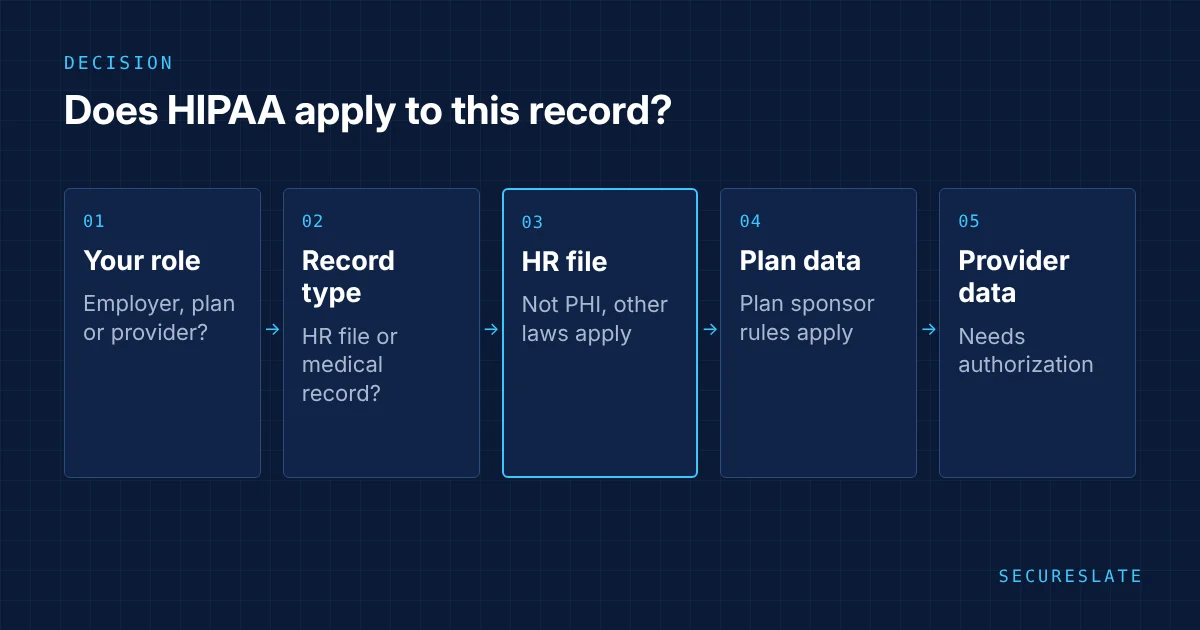
The definition of protected health information in 45 CFR 160.103 excludes employment records held by a covered entity in its role as employer. So a sick note in a personnel file is not PHI, even at a hospital. The same patient's chart in the hospital's records system is PHI. See our guide on what is considered PHI for the full definition.
Which HIPAA forms do employers use?
The forms you need follow from your role, not from being an employer as such.
| Form | Who uses it | Purpose | HIPAA source |
|---|---|---|---|
| Authorization for release of PHI | Employee signs, provider or plan relies on it | Lets a provider or plan share PHI with the employer | 45 CFR 164.508 |
| Plan document amendment | Group health plan sponsor | Sets the limits on how the sponsor uses plan PHI | 45 CFR 164.504(f) |
| Plan sponsor certification | Group health plan sponsor | Confirms the plan documents were amended, before the plan discloses PHI | 45 CFR 164.504(f) |
| Business associate agreement | Group health plan and its vendors (such as a third-party administrator) | Contract terms for vendors handling plan PHI | 45 CFR 164.504(e) |
| Notice of privacy practices | The group health plan | Tells participants how the plan uses PHI | 45 CFR 164.520 |
| Workforce acknowledgment and confidentiality agreement | Covered entities and business associates | Records that staff received policies and training | Supports 45 CFR 164.530 and 164.308 |
There is no HHS-issued "HIPAA employer form." Templates sold under that name are usually an authorization form, an employee confidentiality agreement or a training acknowledgment. Check which of these you actually need before using one.
Can an employer ask employees for medical information?
Yes, HIPAA does not stop an employer from asking. HHS says your employer "can ask you for a doctor's note or other health information," for example for sick leave, workers' compensation, wellness programs or health insurance. What HIPAA controls is the provider: it "cannot give your employer the information without your authorization" unless another law requires or permits the disclosure.
| Scenario | Who needs a HIPAA form? |
|---|---|
| Employee hands HR a doctor's note | No HIPAA form, the employee chose to share it |
| HR calls the employee's doctor to confirm a diagnosis | Provider needs the employee's signed authorization |
| Pre-employment physical paid for by the employer | Provider can require authorization to send results to the employer before providing the exam |
| Workers' compensation claim | Provider may disclose as permitted by workers' compensation law, under 45 CFR 164.512(l) |
| Employee health records at an occupational health clinic run by the employer | Clinic records are PHI if the clinic is a covered provider, and need separation from HR files |
Other laws apply to the information once the employer has it. The Americans with Disabilities Act and the Family and Medical Leave Act, for example, have their own confidentiality rules for medical information, which usually means separate, restricted files. State privacy laws may add more.
What forms does a group health plan sponsor need?
An employer that sponsors a group health plan needs amended plan documents and a written certification before the plan can share PHI with it for plan administration. The rules are in 45 CFR 164.504(f).
The plan documents must, among other things:
- Limit the sponsor's use of PHI to plan administration.
- Prohibit using PHI for employment-related actions or for other benefit plans.
- Require the sponsor to report improper uses, and to make PHI available to participants for access and amendment.
- Identify which employees may access PHI and keep them separated from the rest of the company.
- Require the sponsor to safeguard electronic PHI as the Security Rule requires.
Without the amendment and certification, the plan may still share two limited types of information: summary health information for getting premium bids or changing the plan, and enrollment and disenrollment information. Fully insured plans that only receive this limited information have reduced administrative obligations under 164.530(k). Self-insured plans usually handle more PHI and need the full program, including business associate agreements with third-party administrators.
A plan with fewer than 50 participants that is administered by the employer that established it is excluded from the HIPAA definition of health plan. Even so, other benefits laws may apply.
What if the employer is a healthcare organization?
A covered entity or business associate must manage HIPAA for its own workforce, which brings its own forms and records. Typical documents:
- Signed acknowledgment of HIPAA policies and procedures.
- Training completion records. See our guide to HIPAA training requirements.
- Confidentiality agreements for employees, contractors and volunteers.
- Access request and approval records for systems that hold PHI.
- Sanctions records when policy is broken.
Remote work adds device and home-office controls, covered in our guide to HIPAA compliance for remote employees. Remember that the employee's own medical care at the organization is PHI, and staff should not look it up for HR purposes.
HIPAA checklist for HR teams
Use this to work out which forms and processes apply to you:
- Determine your role. Are you a covered entity, a business associate, a group health plan sponsor, or none of these?
- Separate files. Keep medical information out of general personnel files, in restricted records.
- Use authorizations correctly. When you need information from a provider, ask the employee to sign an authorization that names your organization and the purpose.
- Amend plan documents. If you sponsor a group health plan that shares PHI with you, complete the amendment and certification.
- Sign BAAs with plan vendors. Third-party administrators and benefits platforms handling plan PHI need business associate agreements.
- Limit and train plan staff. Only named employees should handle plan PHI, and they need training.
- Keep records for six years. HIPAA documentation such as policies, authorizations and certifications should be kept for at least six years.
How SecureSlate helps
For employers that are covered entities, business associates or self-insured plan sponsors, SecureSlate includes HIPAA as a built-in framework with mapped controls. Policies and training evidence live with the controls they support, access reviews show who can reach HR and benefits systems, the device agent collects endpoint evidence, and vendor risk management tracks third-party administrators and other business associates. Agentless read-only cloud integrations collect configuration evidence automatically.
Start a free trial to organize your HIPAA program. SecureSlate does not provide legal advice on plan documents.
FAQ
Is there an official HIPAA compliance form for employers?
No. HHS does not issue one. Employers use authorizations, plan sponsor certifications, business associate agreements or workforce acknowledgments, depending on their role.
Is it a HIPAA violation for my boss to ask about my health?
Usually not. HIPAA does not regulate employers acting as employers. Other laws, such as the ADA, may limit what an employer can ask and how it stores the answer.
Can my doctor tell my employer about my condition?
Not without your signed authorization, unless another rule permits it, such as workers' compensation laws or certain workplace medical surveillance situations.
Do small employers need HIPAA forms for their health plan?
It depends on the plan. A self-administered plan with fewer than 50 participants is not a HIPAA health plan. Insured plans that receive only summary and enrollment information have fewer requirements.
Are employee vaccination records protected by HIPAA?
Not when the employer holds them as employment records. They may still be protected by other laws and should be kept confidential.
Disclaimer (legal note)
This article is for general information only and is not legal, regulatory, or professional advice. Requirements vary by framework, industry, and jurisdiction. Consult qualified advisors for your specific obligations.
Need compliance without the complexity?
SecureSlate automates ISO 27001, SOC 2, GDPR, HIPAA, and more. Built for growing teams. See it in action.
Find compliance gaps in 30 seconds