
Short answer: To report a HIPAA violation, file a complaint with the HHS Office for Civil Rights (OCR) through its online portal, by mail or by email, within 180 days of when you knew about the problem. Anyone can file. Organizations also have their own duties: they must accept internal complaints and notify individuals and HHS of breaches.
Related guides: HIPAA Breach Notification Rule · HIPAA incident response plan · Real-life examples of HIPAA violations
Key takeaways
- Anyone can file a HIPAA complaint with OCR: patients, family members, employees, vendors or members of the public.
- Complaints must be filed within 180 days of when you knew about the act or omission, unless OCR extends the deadline for good cause.
- OCR only investigates covered entities and business associates, and does not act on complaints without a name and contact details.
- Covered entities must run their own complaint process, and must report breaches of unsecured PHI to individuals and HHS on fixed timelines.
- HIPAA prohibits retaliation against anyone who files a complaint or takes part in an investigation.
Who can report a HIPAA violation, and to whom?
Anyone who believes a covered entity or business associate broke the HIPAA Privacy, Security or Breach Notification Rules can report it, and the main external channel is OCR. According to HHS's complaint process page, "anyone can file a complaint," so you do not need to be the patient whose records were involved.
The right channel depends on who you are and what happened:
| Reporter | Usual first step | External channel |
|---|---|---|
| Patient or family member | Complaint to the provider's or plan's privacy officer | OCR complaint |
| Employee of a covered entity | Internal report to privacy or security officer | OCR complaint, or a health oversight agency or attorney |
| Business associate or vendor | Report to the covered entity under the BAA | OCR complaint if needed |
| Member of the public | None required | OCR complaint |
| Covered entity (about its own breach) | Internal incident response | Breach report to HHS and notices to individuals |
State attorneys general can also bring civil actions for HIPAA violations affecting their residents, a power added by the HITECH Act. Some conduct, such as knowingly obtaining or disclosing PHI for personal gain, is a federal crime, and OCR can refer those cases to the Department of Justice.
How do you file a HIPAA complaint with OCR?
You file a HIPAA complaint through the OCR Complaint Portal, or by mail or email using HHS's complaint and consent forms.
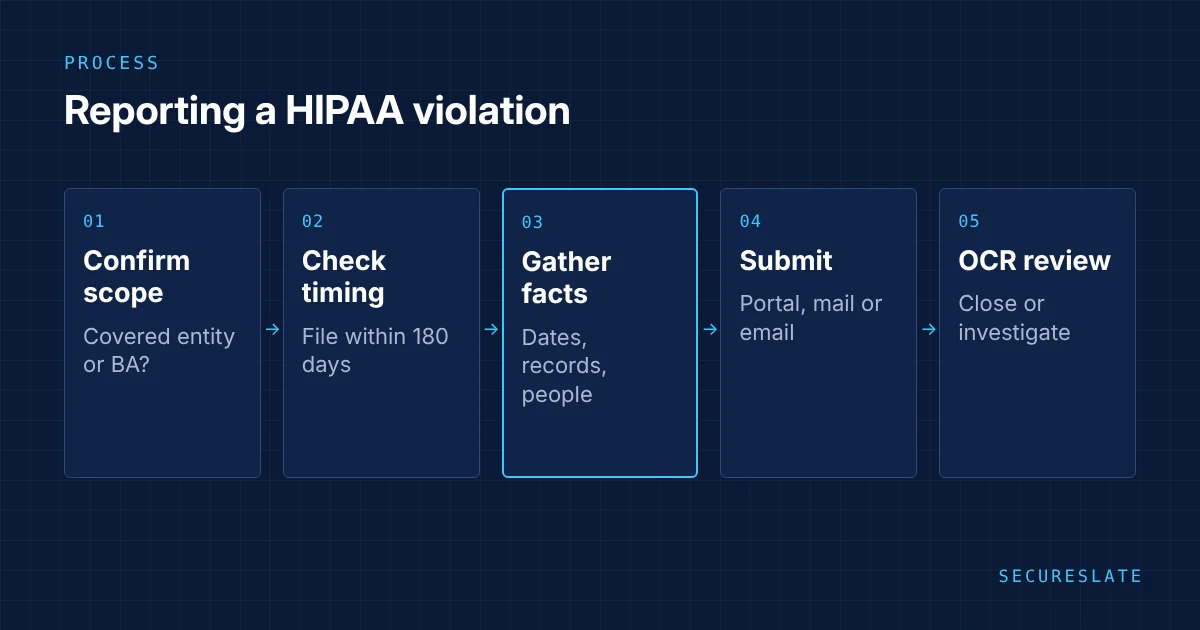
- Confirm HIPAA applies. OCR can only investigate covered entities (health plans, clearinghouses and providers that bill electronically) and their business associates. A gym, a school or an employer acting as an employer is usually outside HIPAA. Our guide on who HIPAA applies to explains the boundaries.
- Check the deadline. The rule in 45 CFR 160.306 requires a complaint to be filed within 180 days of when the complainant knew or should have known the act or omission occurred. OCR may waive this for good cause.
- Gather facts. Write down names, dates, what was disclosed or accessed, and how you learned about it.
- Submit the complaint. Use the online portal, or send the completed forms by mail to HHS in Washington, D.C., or by email to OCRComplaint@hhs.gov. HHS warns that unencrypted email can be intercepted.
- Keep a copy of what you sent and any confirmation number.
What should a HIPAA complaint include?
A useful complaint names the organization, describes the specific act or omission, and explains when it happened. OCR requires complaints in writing, and it does not investigate complaints filed without the complainant's name and contact information, although you can ask for your identity to be kept confidential on the consent form.
Use this checklist before submitting:
- Name and address of the covered entity or business associate
- What happened, in plain terms (for example, "my test results were sent to my employer")
- Date or approximate date of the event, and when you found out
- Which records or information were involved
- Names of staff involved, if known
- Copies of letters, emails or screenshots that support the complaint
- Any steps you already took, such as an internal complaint and the response
- Your name and contact details, plus a request for confidentiality if you want one
What happens after a violation is reported?
OCR reviews each complaint to decide whether it has jurisdiction and whether the facts describe a possible violation, then either closes it or investigates. Many complaints are closed because the organization is not covered, the activity is not a violation, or the deadline has passed.
When OCR investigates, it asks the organization for information and documents. Outcomes generally fall into these groups:
| Outcome | What it means |
|---|---|
| Closed, no jurisdiction or no violation | The entity or conduct is outside HIPAA |
| Technical assistance | OCR explains the requirement and the entity corrects the issue |
| Corrective action | The entity agrees to specific fixes, sometimes through a resolution agreement and monitoring |
| Civil money penalty | OCR imposes penalties, scaled by the level of culpability |
| Referral to DOJ | Possible criminal conduct is passed to the Department of Justice |
Penalty amounts are adjusted for inflation each year, so check current figures at the source rather than relying on older articles. Our breakdown of violations that trigger the highest penalties covers the culpability tiers.
When must an organization report its own violation?
HIPAA does not require an organization to report every policy slip to OCR, but it must report every breach of unsecured PHI. A breach is presumed unless a documented risk assessment shows a low probability that the PHI was compromised. The deadlines come from the Breach Notification Rule, including 45 CFR 164.408:
| Who must be notified | Trigger | Deadline |
|---|---|---|
| Affected individuals | Any breach of unsecured PHI | Without unreasonable delay, no later than 60 calendar days after discovery |
| HHS | Breach affecting 500 or more individuals | At the same time as individual notices, within 60 days of discovery |
| HHS | Breach affecting fewer than 500 individuals | Within 60 days after the end of the calendar year it was discovered |
| Prominent media outlets | Breach affecting more than 500 residents of a state or jurisdiction | Within 60 days of discovery |
| Covered entity (by a business associate) | Breach at the business associate | Without unreasonable delay, no later than 60 days after discovery |
Problems that are not breaches, such as a missing risk analysis, are not self-reported this way, but they still need to be fixed and documented. Our guide to the HIPAA Breach Notification Rule covers the risk assessment and notice content.
How should staff report violations internally?
Staff should report suspected violations to the privacy officer or security officer as soon as they notice them, through a channel the organization has published. Under 45 CFR 164.530, covered entities must designate a contact person for complaints, have a process for individuals to complain, document every complaint and its outcome, and apply sanctions to workforce members who break policy.
In our experience, internal reporting works when it is easy and fast. A good setup includes:
- A single, well-known reporting address or form, plus a phone option for urgent issues.
- A short triage step that decides whether the event is a complaint, a security incident or a possible breach.
- A link from triage to the incident response plan so the 60-day breach clock is tracked from discovery.
- A written record of each report, the investigation, the decision and any sanctions, kept for at least six years.
- Regular reminders in training so people know reporting is expected, not punished.
Early internal reports often turn a possible breach into a contained incident, which is why the internal channel matters as much as the external one.
Are people who report protected from retaliation?
Yes. HIPAA prohibits covered entities and business associates from intimidating, threatening, coercing, discriminating against or retaliating against anyone who files a complaint, testifies, assists in an investigation or opposes an unlawful practice, under 45 CFR 160.316.
The Privacy Rule also has a whistleblower provision. A workforce member or business associate who believes in good faith that the organization is acting unlawfully, or endangering patients or the public, may disclose PHI to a health oversight agency, to an attorney for advice, or in some cases to an accrediting organization, without breaking HIPAA. Disclosures should be limited to what is needed for that purpose.
How SecureSlate helps
SecureSlate helps covered entities and business associates build the program that makes reporting work. It includes HIPAA as a built-in framework with mapped controls, so policies on complaints, sanctions and breach notification sit next to the evidence that proves they operate. Risk management lets you log incidents and decisions, audit management keeps documentation ready for an OCR request, and vendor risk management tracks business associates and their agreements. Access reviews and agentless read-only cloud integrations help you spot inappropriate access early.
Start a free trial to see how it fits your HIPAA program. SecureSlate does not perform audits or provide legal advice.
FAQ
Can I report a HIPAA violation anonymously?
OCR does not investigate complaints filed without a name and contact information. You can ask OCR to keep your identity confidential on the consent form. Internal hotlines at your organization may accept anonymous reports.
What is the deadline to file a HIPAA complaint?
The complaint must be filed within 180 days of when you knew or should have known about the act or omission. OCR can extend this if you show good cause.
Can I sue someone for a HIPAA violation?
HIPAA does not give individuals a private right to sue. Enforcement is through OCR, state attorneys general and, for criminal conduct, the Department of Justice. State laws may offer separate remedies.
Do I have to complain to the provider before going to OCR?
No. You can go straight to OCR. Raising it with the provider's privacy officer first can sometimes resolve the issue faster.
Does a covered entity have to report every violation to HHS?
No. It must report breaches of unsecured PHI to HHS. Other violations must be corrected and documented, but are not reported through the breach portal.
Disclaimer (legal note)
This article is for general information only and is not legal, regulatory, or professional advice. Requirements vary by framework, industry, and jurisdiction. Consult qualified advisors for your specific obligations.
Need compliance without the complexity?
SecureSlate automates ISO 27001, SOC 2, GDPR, HIPAA, and more. Built for growing teams. See it in action.
Find compliance gaps in 30 seconds