
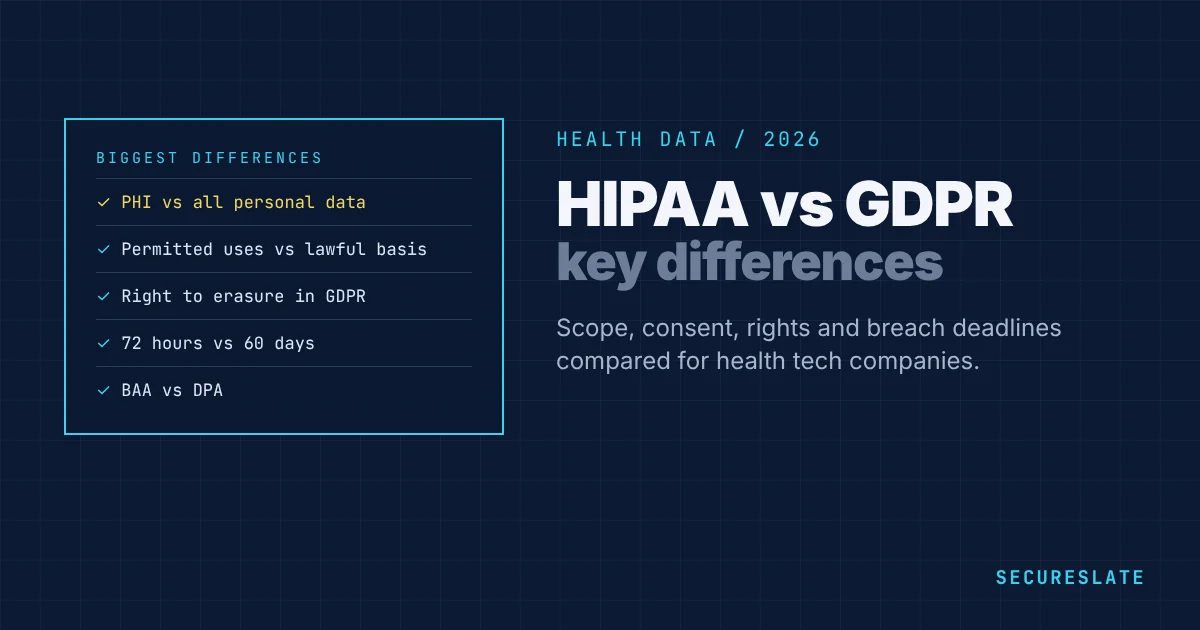
HIPAA vs GDPR is a common question for health tech companies that serve patients or providers in both the United States and Europe. Both laws protect health information, but they differ in who they cover, what data they protect, when consent is needed, what rights people have, and how fast you must report a breach. This guide compares them side by side and explains how to build one program that satisfies both.
Related guides: HIPAA compliance for startups · GDPR compliance for SaaS · HIPAA-compliant email · Common control framework
Key takeaways
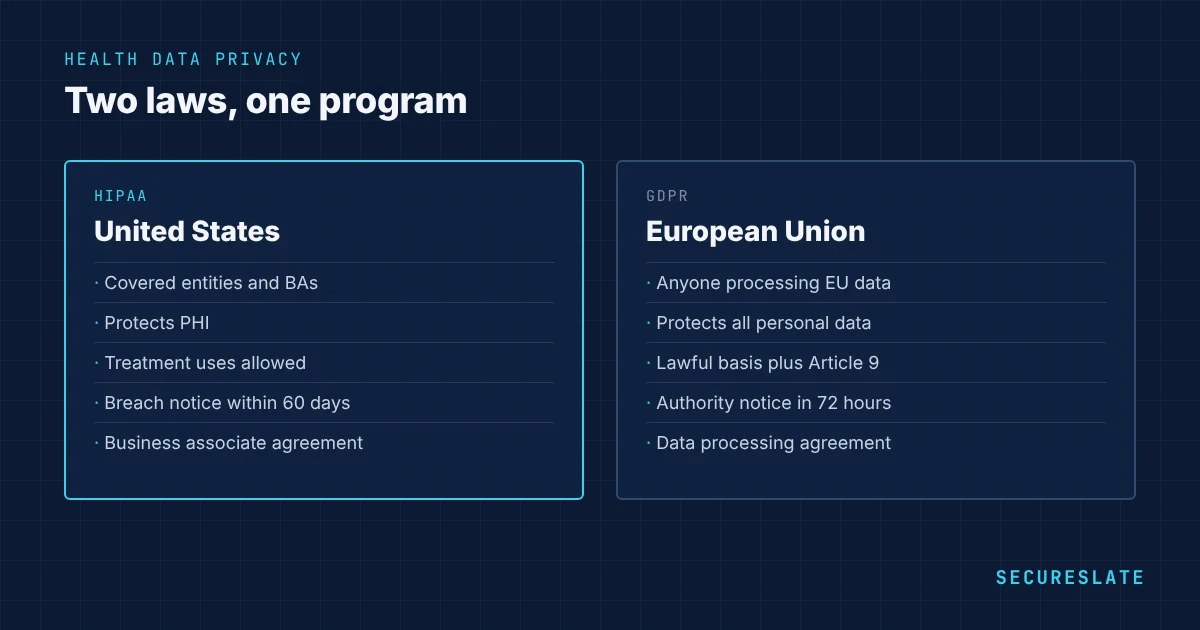
- HIPAA applies to US covered entities and their business associates, and protects protected health information (PHI).
- GDPR applies to anyone processing personal data of people in the EU, and treats health data as a special category with extra protection.
- GDPR requires a lawful basis and, for health data, a specific condition under Article 9. HIPAA allows use for treatment, payment and health care operations without patient authorization.
- Breach notification: GDPR requires notice to the authority within 72 hours. HIPAA requires notice to individuals without unreasonable delay and no later than 60 days.
HIPAA vs GDPR side by side
| HIPAA | GDPR | |
|---|---|---|
| Jurisdiction | United States | EU and EEA, with extraterritorial reach |
| Who it applies to | Covered entities (providers, health plans, clearinghouses) and business associates | Any controller or processor handling personal data of people in the EU |
| Data protected | Protected health information held by covered entities and business associates | All personal data; health data is a special category |
| Legal basis | Uses for treatment, payment and operations allowed; authorization needed for other uses such as marketing | Lawful basis required for all processing, plus an Article 9 condition for health data |
| Individual rights | Access, amendment, accounting of disclosures, restrictions, confidential communications | Access, rectification, erasure, restriction, portability, objection, rights on automated decisions |
| Right to deletion | No general right | Right to erasure in certain cases |
| Security requirements | Security Rule administrative, physical and technical safeguards | Appropriate technical and organizational measures (Article 32) |
| Breach notice to regulator | HHS within 60 days if 500 or more affected; annual log for smaller breaches | Supervisory authority within 72 hours unless unlikely to result in risk |
| Breach notice to individuals | Without unreasonable delay, no later than 60 days | Without undue delay if high risk |
| Vendor contracts | Business associate agreement | Data processing agreement (Article 28) |
| Privacy roles | Privacy officer and security officer | Data protection officer when required |
| Penalties | Tiered civil penalties adjusted for inflation each year, plus possible criminal penalties | Up to 20 million euros or 4% of worldwide annual turnover |
Who must comply with both?
You may need to comply with both if you are a US health tech company with EU patients or users, a European digital health company serving US providers, or a SaaS platform that hosts health data for customers on both sides of the Atlantic. A US company is subject to GDPR when it offers services to people in the EU or monitors their behavior. A European company becomes subject to HIPAA when it acts as a business associate for a US covered entity.
Key differences in practice
Scope of data
HIPAA protects PHI only in the hands of covered entities and business associates. The same health data held by a consumer wellness app that is not a business associate may fall outside HIPAA, though other US laws may apply. GDPR protects personal data wherever it is processed.
Consent and legal basis
Under HIPAA, providers can share PHI for treatment without written authorization. Under GDPR, you need a lawful basis, such as contract or legal obligation, and an Article 9 condition for health data, such as explicit consent or the provision of health care.
Individual rights
GDPR gives broader rights, including erasure and portability. HIPAA focuses on access and amendment. A combined program should follow the stricter rule where they overlap, for example aiming to answer every access request within one month, since GDPR allows one month and HIPAA allows 30 days, each with a possible extension.
Breach notification
GDPR's 72-hour clock to notify the authority is much tighter than HIPAA's 60 days. A single incident response plan should be built around the 72-hour deadline, with HIPAA notices following.
How to comply with HIPAA and GDPR together
- Map your data: where PHI and EU personal data live, who accesses them and which vendors process them.
- Use one security program: the Security Rule safeguards and GDPR Article 32 overlap heavily. A common control framework covers both.
- Combine vendor contracts: sign BAAs and DPAs with the same vendors, or use a combined agreement.
- Build one incident response plan with the 72-hour GDPR deadline and HIPAA notice rules.
- Handle rights requests in one process, applying the stricter rule where they overlap.
- Document lawful bases for EU processing and HIPAA permitted uses for US processing.
- Run one risk analysis that covers HIPAA's required security risk analysis and GDPR's risk-based approach, plus DPIAs where needed.
PHI, PII and personal data
PHI is individually identifiable health information held by a covered entity or business associate. PII is a broad US term for information that identifies a person, used in many state laws. Personal data under GDPR is any information about an identified or identifiable person, which is broader than both. Health data under GDPR is a special category, requiring extra safeguards.
Breach notification timelines compared
| Step | HIPAA | GDPR |
|---|---|---|
| Vendor to customer | Business associate notifies the covered entity without unreasonable delay, no later than 60 days | Processor notifies the controller without undue delay |
| Regulator | HHS within 60 days if 500 or more people affected; smaller breaches reported yearly | Supervisory authority within 72 hours of becoming aware, unless unlikely to result in risk |
| Individuals | Without unreasonable delay, no later than 60 days | Without undue delay if likely to result in high risk |
| Media | Prominent media outlets if more than 500 residents of a state or jurisdiction are affected | No specific media requirement |
| Exceptions | Encrypted PHI meeting HHS guidance is not "unsecured" | Individual notice not needed if data was encrypted or risk is mitigated |
Customer contracts often shorten these deadlines further, so check your BAAs and DPAs too.
A dual compliance roadmap for a small health tech company
| Phase | Focus |
|---|---|
| Month 1 | Data map, HIPAA security risk analysis, GDPR records of processing, appoint privacy and security officers |
| Month 2 | Shared security controls: MFA, encryption, logging, backups, access reviews, device management |
| Month 3 | Policies, incident response plan with the 72-hour clock, rights request process, training |
| Month 4 | Vendor contracts: BAAs and DPAs, sub-processor list, transfer mechanisms for EU data |
| Ongoing | Yearly risk analysis, DPIAs for new high-risk features, evidence collection, customer reviews |
Many health tech companies add SOC 2 or ISO 27001 once this foundation is in place, since most of the controls are already shared.
How SecureSlate helps
SecureSlate maps one control set to HIPAA and GDPR, tracks BAAs and DPAs in your vendor inventory, and keeps risk analyses, policies and evidence in one place for both, which is why HealthTech teams use it for dual compliance.
FAQ
Is GDPR stricter than HIPAA?
In many areas, yes. GDPR covers more data, requires a lawful basis for all processing, gives broader rights and has a shorter breach notification deadline. HIPAA has more specific security safeguards.
Does HIPAA apply to European companies?
Yes, if they act as business associates for US covered entities, for example by hosting or processing PHI for a US provider.
Does GDPR apply to US healthcare providers?
It can, if they offer services to people in the EU or monitor their behavior. Treating an EU tourist in the US does not by itself usually bring a provider under GDPR.
Is HIPAA compliance enough for GDPR?
No. HIPAA controls help with GDPR security requirements, but GDPR adds legal basis, broader rights, data transfer rules and a 72-hour breach deadline.
What is the GDPR equivalent of a BAA?
A data processing agreement under Article 28, which sets out how a processor handles personal data for a controller.
Can one policy set cover both laws?
Yes, with sections for law-specific rules. Most security policies can be shared, while privacy notices, rights procedures and breach procedures need HIPAA and GDPR details.
Do we need a DPO for health data?
Under GDPR, you need a DPO if your core activities involve large-scale processing of special category data, such as health data. Many health tech companies meet that test.
Disclaimer (legal note)
This article is for general information only and is not legal, regulatory, or professional advice. Requirements vary by framework, industry, and jurisdiction. Consult qualified advisors for your specific obligations.
Need compliance without the complexity?
SecureSlate automates ISO 27001, SOC 2, GDPR, HIPAA, and more. Built for growing teams. See it in action.
Find compliance gaps in 30 seconds