
Short answer: ISO/IEC 27004 is the ISO guidance standard for monitoring, measuring, analyzing and evaluating an information security management system. It helps organizations meet clause 9.1 of ISO/IEC 27001 by explaining what to measure, who should measure it, how often, and how to turn the results into decisions. It is guidance, so you cannot be certified against it.
Related guides: Security metrics and KPI tracker template · Top cybersecurity metrics and KPIs · Maintaining ISO 27001 certification
Key takeaways
- The current edition is ISO/IEC 27004:2016, titled "Information security management: Monitoring, measurement, analysis and evaluation".
- It exists to support clause 9.1 of ISO/IEC 27001, which requires you to evaluate information security performance and ISMS effectiveness.
- It separates performance measures (are we doing the work?) from effectiveness measures (is the work achieving its purpose?).
- Good ISMS metrics are few, tied to objectives and risks, owned by a named person and reviewed in management review.
- A new edition is in development as of November 2026, with a draft international standard (DIS) under way.
What is the ISO 27004 standard?
ISO/IEC 27004 is a guidance document that explains how to monitor and measure an ISMS so that management can see whether it is working. According to ISO's page for ISO/IEC 27004:2016, it covers three areas: monitoring and measuring information security performance, monitoring and measuring the effectiveness of the ISMS including its processes and controls, and analyzing and evaluating the results. It applies to organizations of any type or size.
The 2016 edition is the second. The first edition, from 2009, was built around a fairly formal measurement model. The 2016 rewrite aimed to be more practical and aligned it with the 2013 version of ISO/IEC 27001. It explains why measurement matters, the characteristics of a measure (what, when and who), the types of measures, and the processes for developing and using them. Its annexes include a catalogue of example measures and a way to document each measurement construct.
How does ISO 27004 support ISO 27001 clause 9.1?
Clause 9.1 of ISO/IEC 27001 tells you what you must decide about monitoring and measurement; ISO 27004 explains how to make those decisions well.
Under clause 9.1, an organization must determine what needs to be monitored and measured, the methods used, when monitoring and measuring happen, who does it, when results are analyzed and evaluated, and who does that. Documented information must be available as evidence of the results, and the organization must evaluate information security performance and ISMS effectiveness. The ISO 27001 standard page describes the overall requirements.
| Clause 9.1 decision | What ISO 27004 adds |
|---|---|
| What to monitor and measure | Link measures to information needs, objectives, risks and controls |
| Methods | Define how data is collected and calculated so results are comparable and reproducible |
| When to measure | Set a frequency that matches how fast the underlying activity changes |
| Who measures | Assign clear roles for collecting, analyzing and communicating each measure |
| When and who analyzes | Separate data collection from evaluation so results get reviewed by someone with authority to act |
| Evidence | Keep measurement records so trends and decisions can be shown to auditors |
Auditors usually test clause 9.1 by asking to see your list of measures, a few recent results and evidence that management discussed them. Our guide to ISO 27001 audits explains how that testing works.
What is the difference between performance and effectiveness measures?
Performance measures show whether planned activities happen as intended, while effectiveness measures show whether those activities achieve their security objectives.
| Performance (efficiency) measures | Effectiveness measures | |
|---|---|---|
| Question | Are we doing what we planned? | Is it reducing risk or meeting the objective? |
| Typical focus | Completion, timeliness, coverage | Outcomes, incidents, risk levels |
| Example | Share of staff who completed security awareness training this year | Phishing simulation click rate trend after training |
| Example | Access reviews completed on schedule | Inappropriate access found and removed per review |
| Example | Critical patches applied within the target window | Incidents linked to unpatched systems |
| Risk if used alone | Activity looks healthy while risk stays high | Hard to tell which activity caused the result |
You need both. A team that only tracks performance can report full training completion while staff still fall for phishing. A team that only tracks outcomes cannot tell which process to fix when results get worse.
How do you build an ISMS measurement program?
Build a small set of measures from your objectives and top risks, then run them through a repeatable cycle of collection, analysis, reporting and review.
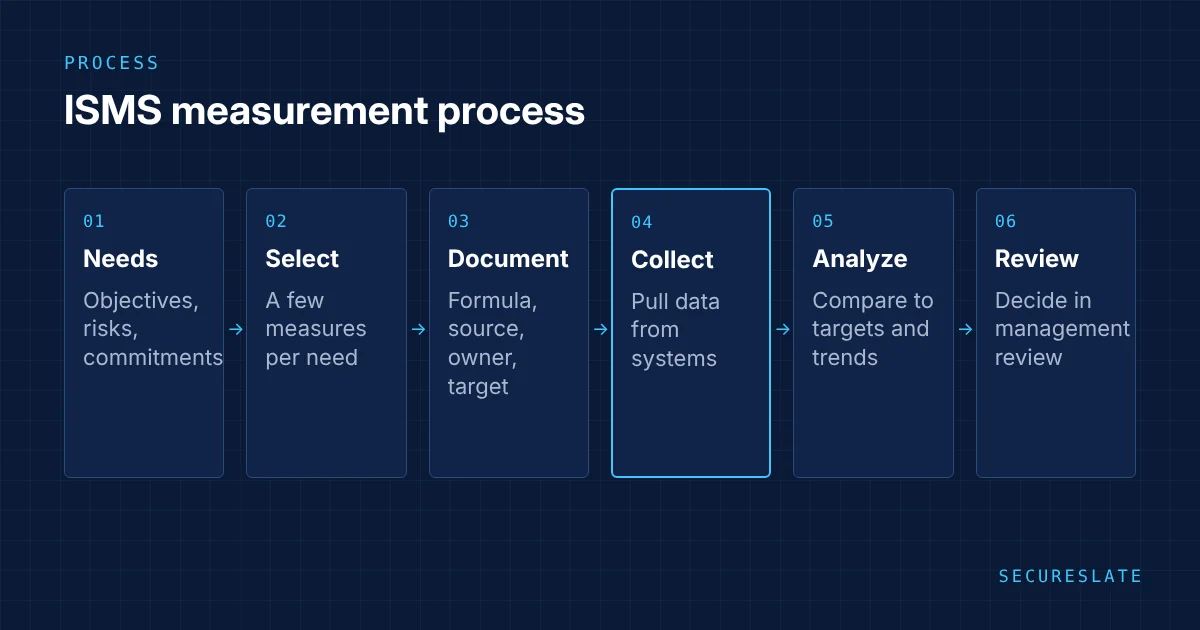
- Start from information needs. List the questions management needs answered, drawn from ISMS objectives (clause 6.2), the risk register and customer commitments.
- Choose a few measures per need. Prefer measures you can collect automatically. In our experience, a short list of well-chosen measures beats a long list that nobody reads.
- Document each measure. Record its purpose, formula, data source, frequency, owner, target and who it is reported to.
- Collect data. Pull from systems where possible, such as the identity provider, ticketing tool, cloud console and device management.
- Analyze and evaluate. Compare against targets and trends. Note the cause of significant changes, not only the number.
- Report and decide. Feed results into management review (clause 9.3) and record decisions and actions.
- Review the measures themselves. Retire measures that do not drive decisions and add new ones when risks or objectives change.
Which ISMS metrics should you track?
Track metrics that map to your highest risks and your stated ISMS objectives. The examples below are common starting points; adapt targets to your own risk appetite.
| Area | Example measure | Type |
|---|---|---|
| Access control | Leavers whose access was removed within the policy deadline | Performance |
| Access control | Access review exceptions not resolved by the due date | Effectiveness |
| Vulnerability management | Critical vulnerabilities open beyond the remediation target | Effectiveness |
| Awareness | Completion of required security training | Performance |
| Incident management | Median time from detection to containment | Effectiveness |
| Supplier risk | Critical vendors with a current security review | Performance |
| ISMS operation | Internal audit findings closed by agreed date | Performance |
| Risk management | High risks with an approved treatment plan | Performance |
If you need a ready-made structure for recording these, the security metrics and KPI tracker template gives you columns for owner, source, frequency and target.
What are common ISMS measurement mistakes?
Most measurement problems come from measuring what is easy rather than what management needs to know.
- Too many metrics. Dashboards with dozens of numbers get ignored. Fewer, sharper measures get discussed.
- No targets. A number without a target or trend cannot show improvement or decline.
- Only activity counts. Counting tickets closed says little about whether risk went down.
- Manual collection. Spreadsheets compiled the week before an audit are error-prone and hard to reproduce, which clause 9.1 expects.
- No link to decisions. If management review minutes never mention the measures, auditors may question whether results are evaluated.
- Never pruning. Measures that no longer matter stay on the list for years.
Is ISO 27004 being updated?
Yes. As of November 2026, ISO lists ISO/IEC 27004:2016 as "to be revised" and shows a draft international standard (ISO/IEC DIS 27004) under development. The 2016 edition still references ISO/IEC 27001:2013, so when you use it today, map its guidance to the clause numbers in ISO/IEC 27001:2022. Clause 9.1 kept the same core intent in the 2022 edition, so the measurement approach still applies.
Until the new edition is published, the 2016 edition remains the current reference. Check the ISO page before purchasing so you buy the edition you need.
How SecureSlate helps
SecureSlate turns many ISMS measures into live data instead of spreadsheets. Agentless, read-only cloud integrations and a device agent check controls continuously, access reviews record completion and exceptions, vendor risk management tracks review status for each supplier, and risk management shows which risks have treatment plans. ISO 27001 is built in and mapped to SOC 2, HIPAA, HITRUST and GDPR, and audit management keeps measurement evidence ready for your certification body. SecureSlate does not perform audits or issue certificates.
FAQ
What is ISO 27004 used for?
It gives guidance on monitoring, measuring, analyzing and evaluating an ISMS, mainly to help organizations meet clause 9.1 of ISO/IEC 27001.
Is ISO 27004 required for ISO 27001 certification?
No. ISO/IEC 27001 requires you to monitor and measure your ISMS, but it does not require you to follow ISO/IEC 27004. The standard is optional guidance.
How many metrics does ISO 27001 require?
ISO/IEC 27001 does not set a number. You decide what to monitor and measure based on your objectives, risks and controls, and keep evidence of the results.
What is the current version of ISO 27004?
As of November 2026, the current edition is ISO/IEC 27004:2016. A revised edition is in development.
What is an effectiveness measure in ISO 27004?
It shows whether a control or process achieves its intended outcome, such as fewer incidents or lower risk, rather than only whether the activity was carried out.
Disclaimer (legal note)
This article is for general information only and is not legal, regulatory, or professional advice. Requirements vary by framework, industry, and jurisdiction. Consult qualified advisors for your specific obligations.
Need compliance without the complexity?
SecureSlate automates ISO 27001, SOC 2, GDPR, HIPAA, and more. Built for growing teams. See it in action.
Find compliance gaps in 30 seconds