
Short answer: ISO/IEC 27005:2022 replaced the 2018 edition. It aligns its wording with ISO/IEC 27001:2022 and ISO 31000, renames "incident scenarios" as "risk scenarios", uses "consequence" instead of "impact", and adds event-based identification next to the familiar asset-based approach. It is still guidance, so you cannot be certified against it.
Related guides: ISO 27001:2022 updates · ISO 27001 risk assessment key concepts · ISO 27001 risk treatment plan template
Key takeaways
- ISO/IEC 27005:2022 is the fourth edition, published in October 2022. The 2018 edition is withdrawn.
- The standard gives guidance on information security risk management. ISO 27001 sets the requirements, and you are audited only against ISO 27001.
- The biggest practical change is the choice between event-based and asset-based risk identification, and the option to combine them.
- Terminology now follows ISO 31000, so registers that still talk about "impact" and "incident scenarios" look dated, but they are not wrong in themselves.
- If your risk method was built on the 2018 edition, you do not have to rewrite it. Review it against ISO 27001:2022 Clauses 6.1.2, 6.1.3, 8.2 and 8.3 and adopt the 2022 ideas where they help.
What is ISO 27005 and how does it relate to ISO 27001?
ISO 27005 is the guidance standard that explains how to run the information security risk process that ISO/IEC 27001 requires.
ISO 27001 tells you what must happen. Clause 6.1.2 requires a defined risk assessment process with risk criteria, risk owners and repeatable results. Clause 6.1.3 requires a risk treatment process, a comparison with Annex A and a Statement of Applicability. Clauses 8.2 and 8.3 require you to actually perform those assessments and treatments at planned intervals and when significant changes occur.
ISO 27005 tells you how you might do it. It describes context setting, risk identification, analysis, evaluation, treatment, acceptance, communication and monitoring in practical detail. The ISO page describes the 2022 edition as adapting the general principles of ISO 31000 to information security.
| ISO/IEC 27001 | ISO/IEC 27005 | |
|---|---|---|
| Type | Requirements ("shall") | Guidance ("should", "can") |
| Certifiable | Yes, by an accredited certification body | No |
| Risk content | Short clauses that set outcomes | Detailed process, techniques and examples |
| Used by auditors | As the audit criteria | As background on good practice |
| Current edition | 2022 | 2022 |
Auditors will not ask whether you "comply with ISO 27005". They will ask whether your method meets Clause 6.1.2 and whether your records show it was followed. Many teams cite ISO 27005 in their risk methodology because it gives the auditor a familiar reference point.
ISO 27005 2018 vs 2022 at a glance
The 2022 edition is a substantial rewrite rather than a minor refresh, but the core risk cycle is the same.
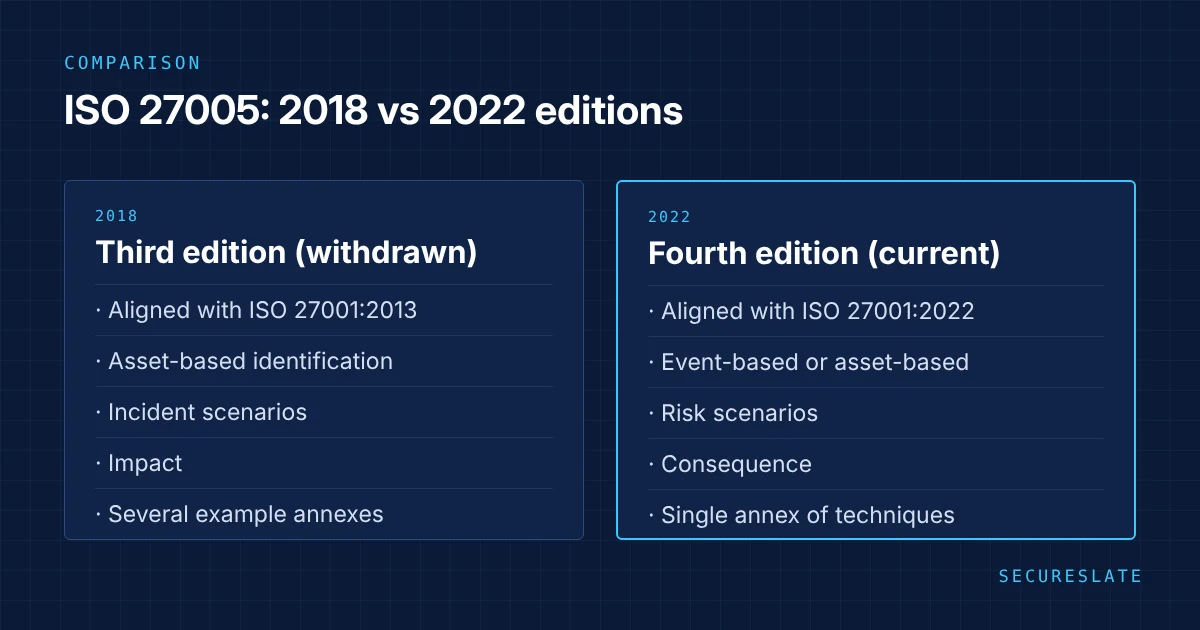
| Topic | ISO 27005:2018 | ISO 27005:2022 |
|---|---|---|
| Full title | Information technology, Security techniques, Information security risk management | Information security, cybersecurity and privacy protection, Guidance on managing information security risks |
| Aligned with | ISO/IEC 27001:2013 | ISO/IEC 27001:2022 and ISO 31000:2018 |
| Risk identification | Asset-based: assets, threats, existing controls, vulnerabilities, consequences | Event-based or asset-based, or both |
| Key term for what could happen | Incident scenario | Risk scenario |
| Effect of a risk | Impact | Consequence |
| Annexes | Several informative annexes with example lists of assets, threats and vulnerabilities | Consolidated into a single annex of practical techniques and examples |
| Link to ISO 27001 processes | Implicit | Explicit guidance on related ISMS processes, including the Statement of Applicability |
The table summarises the changes that matter to someone running an ISMS. It does not list every editorial change, so read the standard itself if you are writing a formal methodology.
What are event-based and asset-based risk identification?
Event-based identification starts from things that could happen to the organization, while asset-based identification starts from the assets you need to protect and works outward to threats and vulnerabilities.
The 2018 edition effectively assumed the asset-based route. You built an asset inventory, listed threats and vulnerabilities for each asset, noted existing controls and recorded consequences. That produces thorough results, but it can also produce hundreds of near-identical rows that nobody reads.
The 2022 edition presents two routes:
- Event-based approach. You look at risk sources and the events they could cause, such as a ransomware attack on production, a cloud provider outage or a disgruntled administrator. It works well at a strategic level and for leadership conversations, because it describes risk in business terms.
- Asset-based approach. You inventory assets, then identify threats and vulnerabilities for each one. It works well at an operational level, where you need to know which systems, data sets and suppliers need which controls.
You can combine them. A common pattern in our experience is an event-based view for the board and management review, backed by asset-based detail for the systems in scope.
| Question | Event-based | Asset-based |
|---|---|---|
| Where you start | Risk sources and events | Asset inventory |
| Typical level | Strategic | Operational |
| Speed to a first register | Faster | Slower |
| Coverage of technical gaps | Can miss detail | Thorough |
| Best for | Leadership reporting, new ISMS, small teams | Mature ISMS, complex estates, control design |
ISO 27001:2022 does not require either approach. Since the 2013 edition, it has not required an asset-based method at all. It only requires that your process identifies risks to the confidentiality, integrity and availability of information within the scope of the ISMS.
Which terms changed in the 2022 edition?
The 2022 edition replaces several 2018 terms with ISO 31000 vocabulary, which makes it easier to plug information security risk into an enterprise risk register.
The changes you are most likely to notice:
- Consequence replaces impact as the term for the outcome of an event affecting objectives.
- Risk scenario replaces incident scenario.
- The risk process is described in ISO 31000 terms: context establishment, risk assessment (identification, analysis, evaluation) and risk treatment, with communication, monitoring and review running alongside.
- Risk acceptance is treated as a decision within treatment rather than as a separate stage, which matches how ISO 27001 Clause 6.1.3 asks risk owners to approve the treatment plan and accept residual risk.
None of this means a register that says "impact" fails an audit. It does mean that a methodology document written for 2018 can confuse new team members who read the 2022 standard, so align the words when you next revise it.
How was the structure reorganized?
The 2022 edition is organized to follow the flow of the ISO 27001 risk requirements and then explains how other ISMS processes support risk management.
Practical consequences of the restructure:
- Clear stages and triggers. The standard describes when each activity should start, finish or be repeated, which helps you define review triggers such as new products, incidents or supplier changes.
- Strategic and operational cycles. Guidance distinguishes high-level risk work from day-to-day operational risk work, matching the event-based and asset-based routes.
- Links to the wider ISMS. It explains how context, leadership, documented information, internal audit and management review feed risk management, so the risk process stops being an isolated spreadsheet.
- Leaner annexes. Long example catalogues gave way to a single annex of techniques and examples. If you relied on the 2018 threat and vulnerability lists, keep using them as prompts, but expect to tailor them.
Do you need to update your risk methodology?
You need to update your methodology only where it no longer meets ISO 27001:2022, but most teams benefit from a light refresh based on the 2022 guidance.
Use this checklist when you next review the method:
- The document references ISO 27001:2022 clauses and Annex A control numbering, not the 2013 edition.
- Risk acceptance criteria and criteria for performing assessments are defined, as Clause 6.1.2 requires.
- Each risk has a named risk owner, and risk owners approve the treatment plan and residual risk.
- The method states whether you use event-based identification, asset-based identification or both, and at which level.
- Review triggers are listed, for example new systems, major changes, significant incidents and new suppliers.
- Likelihood and consequence scales are defined so that two people would score the same risk the same way.
- Risk treatment links to Annex A controls and to your Statement of Applicability.
- The risk register and treatment plan are retained as documented information with dates and versions.
If you are moving from an asset-heavy register, a practical approach is to add a short event-based layer on top: ten to twenty business-level scenarios, each linked to the asset rows that support it. That gives management a readable view without discarding operational detail. For what auditors expect to see in the records, read ISO 27001 risk management processes and auditor expectations.
How SecureSlate helps
SecureSlate is a compliance automation platform that supports your ISO 27001 risk process. It does not perform audits or issue certificates.
- Risk management with a risk register, owners, scoring and treatment tracking, so you can run event-based scenarios, asset-based risks or both.
- Built-in ISO 27001 framework with control mapping to SOC 2, HIPAA, GDPR, NIST CSF and other frameworks, linking risk treatment to the controls that address it.
- Agentless, read-only cloud integrations and a device agent that collect evidence that controls are operating.
- Vendor risk management so supplier risks feed the same register.
- Audit management to organize evidence for internal and certification audits.
Start a free SecureSlate trial to build your ISO 27001 risk register.
FAQ
Is ISO 27005 mandatory for ISO 27001 certification?
No. ISO 27005 is a guidance standard and is not a certification requirement. You can use any risk method that meets ISO 27001 Clauses 6.1.2 and 6.1.3, though many organizations base theirs on ISO 27005.
Is ISO 27005:2018 still valid?
ISO lists the 2018 edition as withdrawn, and the 2022 edition is current as of November 2026. A method based on the 2018 guidance can still meet ISO 27001 if it satisfies the requirements, but you should reference the current edition when you revise it.
What is the main difference between ISO 27005 2018 and 2022?
The 2022 edition aligns with ISO 27001:2022 and ISO 31000, adopts terms like risk scenario and consequence, and allows event-based as well as asset-based risk identification.
Can you be certified to ISO 27005?
No. Organizations are certified to ISO 27001. Individuals can take training courses about ISO 27005 risk management, but that is personal training, not organizational certification.
Does ISO 27005 include a risk matrix?
It describes qualitative and quantitative analysis techniques and gives examples, but it does not impose a single matrix. You define your own scales and acceptance criteria.
Disclaimer (legal note)
This article is for general information only and is not legal, regulatory, or professional advice. Requirements vary by framework, industry, and jurisdiction. Consult qualified advisors for your specific obligations.
Need compliance without the complexity?
SecureSlate automates ISO 27001, SOC 2, GDPR, HIPAA, and more. Built for growing teams. See it in action.
Find compliance gaps in 30 seconds