
Auditor misconceptions make compliance audits harder and more expensive than they need to be. Many teams preparing for SOC 2 or ISO 27001 believe auditors expect perfection, demand specific tools, or will fail them over one mistake. Others assume auditors will tell them how to fix everything or that a certificate means the company is secure. This guide clears up the most common misconceptions, explains what auditors actually look for and offers practical tips for working with them.
Related guides: Internal audit process · Audit risk model · Internal control audit · Declaration of continued audit independence
Key takeaways
- Auditors check whether your controls meet the criteria and work as described, not whether you use particular tools.
- Exceptions happen. A SOC 2 report with a few exceptions is common and still useful to customers.
- Auditors must stay independent, so they cannot design or run your controls.
- A certificate or report is evidence of a working program, not a guarantee against breaches.
- Clear scope, honest communication and good evidence make audits faster and cheaper.
Misconceptions and reality
Misconception 1: Auditors want perfection
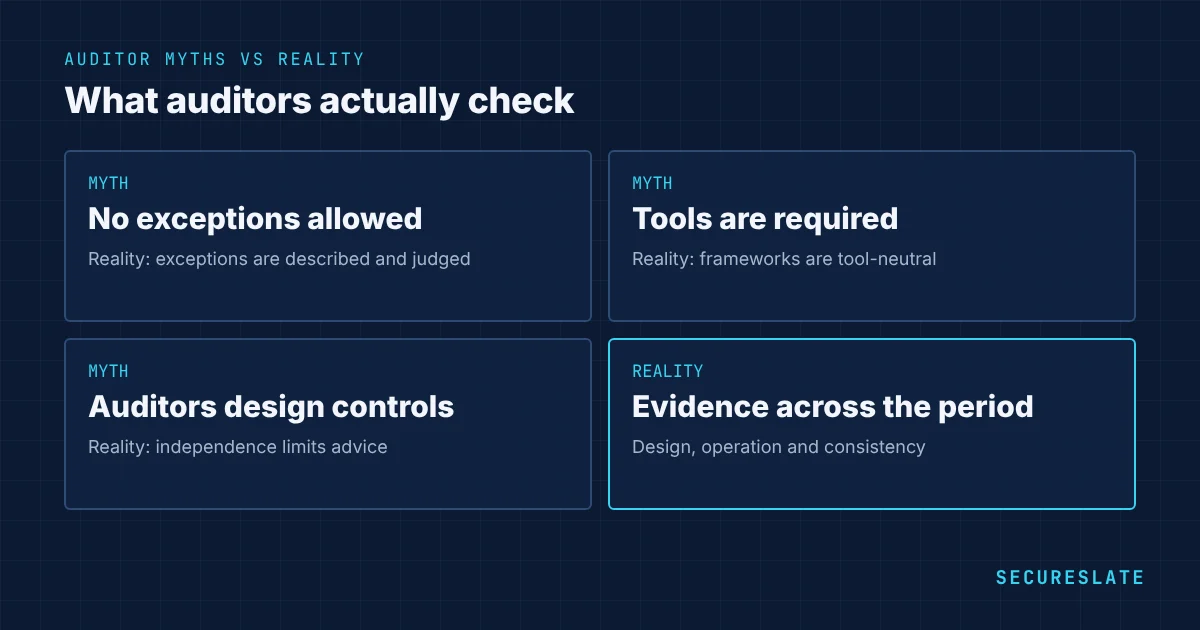
Reality: Auditors look for reasonable assurance that controls are designed and operate effectively. In SOC 2 Type 2 reports, exceptions are described and the auditor decides whether they affect the opinion. In ISO 27001, minor nonconformities can be closed with corrective action plans without preventing certification. What matters is that issues are rare, understood and corrected.
Misconception 2: Auditors require specific tools
Reality: SOC 2 and ISO 27001 are tool-neutral. Auditors care that your controls meet the criteria. Spreadsheets can work; automation simply makes evidence more complete and easier to produce.
Misconception 3: Auditors will tell us how to fix things
Reality: Independence rules limit how much auditors can advise on designing your controls, because they cannot audit their own work. They can explain criteria and findings. For implementation help, use consultants, internal staff or compliance platforms.
Misconception 4: The auditor decides our scope
Reality: In SOC 2, management defines the system and selects the Trust Services Criteria, describing them in the system description. In ISO 27001, you define the ISMS scope. Auditors evaluate whether the scope is appropriate and clearly described.
Misconception 5: More documentation is always better
Reality: Auditors want accurate, current and relevant documents. Long policies nobody follows create findings. Short, specific documents that match practice are better.
Misconception 6: SOC 2 is a certification
Reality: SOC 2 is an attestation report issued by a licensed CPA firm under AICPA standards, not a certificate. ISO 27001, by contrast, results in a certificate from an accredited certification body.
Misconception 7: Passing the audit means we are secure
Reality: Audits test defined controls over a period. They do not guarantee there are no vulnerabilities or that no breach will occur. Security still depends on ongoing monitoring and improvement.
Misconception 8: Auditors are adversaries
Reality: Auditors aim for an accurate opinion. Treating them as partners, with clear communication and organized evidence, reduces surprises.
Misconception 9: Screenshots the week before are enough
Reality: For SOC 2 Type 2 and ISO 27001 surveillance, auditors need evidence across the period, such as access reviews done each quarter and changes approved throughout.
Misconception 10: Any CPA or consultant can do it
Reality: SOC 2 reports must be issued by licensed CPA firms. ISO 27001 certificates should come from certification bodies accredited by a recognized accreditation body for credibility with customers.
What auditors actually look for
| Area | What they check |
|---|---|
| Scope and description | Is it clear, accurate and complete? |
| Control design | Would the control address the risk if performed as described? |
| Operating effectiveness | Did it operate consistently across the period? |
| Evidence quality | Is it complete, accurate and from a reliable source? |
| Consistency | Do policies, interviews and evidence agree? |
| Risk management | Are risks identified and treated? |
| Monitoring and correction | Are issues found and fixed? |
Tips for working with auditors
- Agree scope early and document it.
- Share a control list with owners and evidence sources before fieldwork.
- Organize evidence by control and period.
- Be honest about gaps; explain remediation.
- Respond quickly to requests through one coordinator.
- Prepare control owners for walkthroughs.
- Review drafts carefully and ask questions about findings.
- Hold a lessons learned session after the audit.
Choosing an auditor
| Consideration | Questions to ask |
|---|---|
| Credentials | Licensed CPA firm for SOC 2? Accredited certification body for ISO 27001? |
| Experience | How many audits in our industry and size range? |
| Approach | How do they test automated controls and use platform evidence? |
| Timeline | Availability for our target dates? |
| Communication | Who is our day-to-day contact? |
| Reputation | Do our customers recognize and accept their reports? |
SOC 2 versus ISO 27001 audits at a glance
| Aspect | SOC 2 | ISO 27001 |
|---|---|---|
| Who audits | Licensed CPA firm | Accredited certification body |
| Output | Attestation report with auditor's opinion | Certificate valid for three years with surveillance audits |
| Basis | AICPA Trust Services Criteria | ISO/IEC 27001 clauses and Annex A |
| Period | Point in time (Type 1) or period (Type 2) | Ongoing management system, audited yearly |
| How issues appear | Exceptions described in the report | Nonconformities with corrective actions |
| Distribution | Restricted, shared under NDA | Certificate can be shared publicly |
What to do when you disagree with a finding
- Ask the auditor to explain the criterion and the evidence they relied on.
- Provide any additional evidence promptly, organized by period and sample.
- If the finding stands, write a factual management response describing root cause and corrective action.
- Fix the issue and keep evidence of the fix for the next period.
- Use the experience to improve the control or its evidence.
Most disagreements come from missing or unclear evidence rather than controls that do not exist, which is why continuous evidence collection matters.
Preparing your team for auditor interviews
Auditors interview control owners to confirm processes match documentation. Prepare people by walking through how they perform the control, where the evidence lives and what happens in exceptions. Encourage honest, specific answers and showing the actual system rather than describing it. If someone does not know the answer, they should say so and follow up rather than guess.
Signs of a good auditor relationship
- Clear request lists with due dates
- Regular check-ins during fieldwork
- Early warning of potential exceptions
- Explanations of criteria rather than vague objections
- Consistent team members from year to year
How SecureSlate helps
SecureSlate makes audits smoother by giving auditors organized, system-generated evidence across the whole period. Continuous control tests, policy versions with approvals, access reviews and audit management with auditor access mean fewer requests and fewer surprises, for small and mid-size teams.
FAQ
Do auditors expect a perfect SOC 2 audit?
No. Exceptions are common. Auditors assess whether controls generally operated effectively and describe exceptions in the report.
Can our auditor help us implement controls?
Only to a limited extent. Independence rules prevent auditors from designing or operating controls they will audit.
Is SOC 2 a certification?
No. It is an attestation report by a CPA firm. ISO 27001 is a certification.
Do we need special software for an audit?
No. Auditors do not require specific tools, but automation makes evidence more complete and audits faster.
What happens if the auditor finds an issue?
In SOC 2, exceptions are described in the report. In ISO 27001, nonconformities require corrective action; major ones must be resolved before certification.
Can we change auditors between years?
Yes. Many companies change auditors for cost, service or experience reasons. Plan the switch so there is no gap in report coverage.
How long does an audit take?
SOC 2 fieldwork commonly takes two to six weeks. ISO 27001 stage 2 audits for small companies often take a few days on site or remotely.
Do auditors look at our tools' dashboards?
They may use them, but they also verify that the underlying data is complete and accurate, often by inspecting source systems or exports.
Can auditors use our compliance platform evidence?
Yes, provided they can verify its completeness and accuracy, for example through read-only access or exports from source systems.
Disclaimer (legal note)
This article is for general information only and is not legal, regulatory, or professional advice. Requirements vary by framework, industry, and jurisdiction. Consult qualified advisors for your specific obligations.
Need compliance without the complexity?
SecureSlate automates ISO 27001, SOC 2, GDPR, HIPAA, and more. Built for growing teams. See it in action.
Find compliance gaps in 30 seconds