
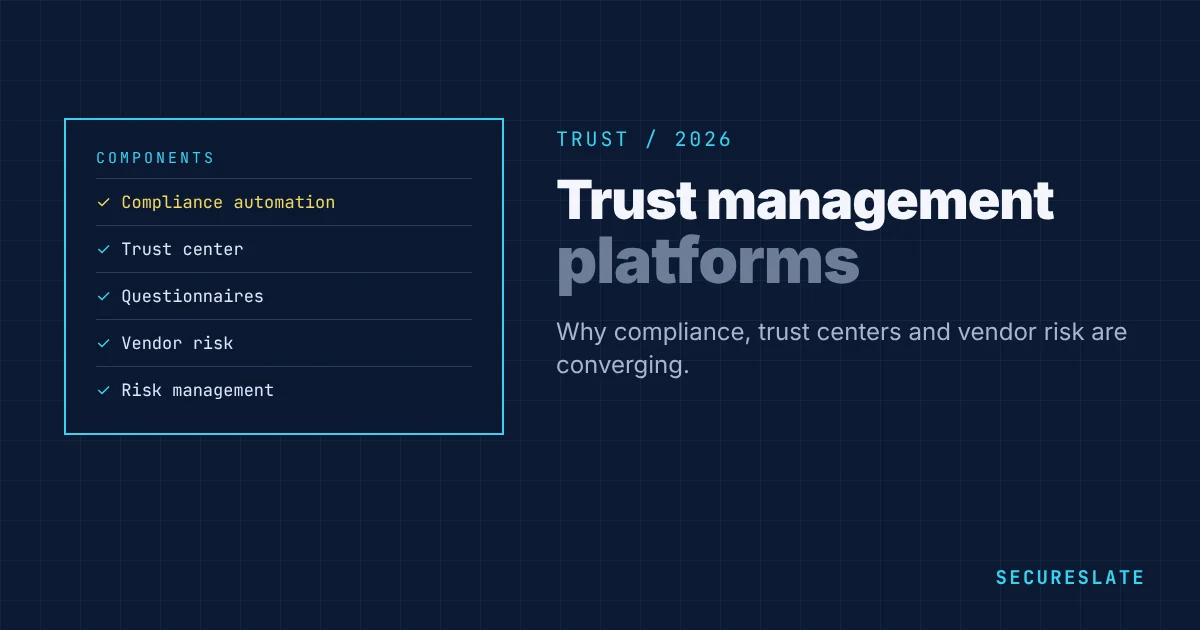
Trust management platforms bring together the tools companies use to earn and prove customer trust: compliance automation, trust centers, security questionnaire responses, vendor risk management and continuous monitoring. A few years ago these lived in separate tools and spreadsheets owned by different teams. Today, buyers expect fast, credible answers about security and privacy, and regulators expect ongoing oversight rather than annual snapshots. This guide explains why trust management platforms have grown, what they include, who uses them and how to evaluate one.
Related guides: Customer security reviews best practices · Trust center design · Best compliance management tools · Common auditor misconceptions
Key takeaways
- A trust management platform combines inbound trust (proving your security to customers) and outbound trust (assessing your vendors).
- Typical components: compliance automation, trust center, questionnaire automation, vendor risk, risk management and monitoring.
- Growth is driven by more security reviews, more frameworks, AI-related questions and stricter regulation.
- Benefits include faster sales, lower audit effort and a single source of truth.
- Evaluate platforms on automation depth, framework coverage, integrations, accuracy of AI features and total cost.
Why trust management is growing
- More security reviews. Buyers of every size now send questionnaires before purchase.
- More frameworks. Companies need SOC 2, ISO 27001, HIPAA, GDPR, ISO 42001 and more, often at once.
- AI questions. Customers ask how vendors use AI and customer data, adding new review areas.
- Regulation. NIS 2, DORA and US state privacy laws require ongoing oversight of security and suppliers.
- Continuous expectations. Annual audits are no longer enough for customers who want current assurance.
- Lean teams. Startups and SMBs must meet enterprise expectations with small security teams.
Components of a trust management platform
| Component | What it does | Who benefits |
|---|---|---|
| Compliance automation | Continuous control monitoring and evidence for frameworks | Security, compliance, auditors |
| Trust center | Public page with certifications, policies, subprocessors and gated documents | Sales, customers |
| Questionnaire automation | Answers security questionnaires from an approved library, often with AI | Sales, security |
| Vendor risk management | Assesses and monitors suppliers | Procurement, security |
| Risk management | Risk register, scoring and treatment | Leadership, compliance |
| Policy management | Templates, approvals and acknowledgments | HR, compliance |
| Security tools | Code scanning, secrets detection, device checks, attack surface monitoring | Engineering, IT |
| Audit management | Auditor access, requests and findings | Compliance, auditors |
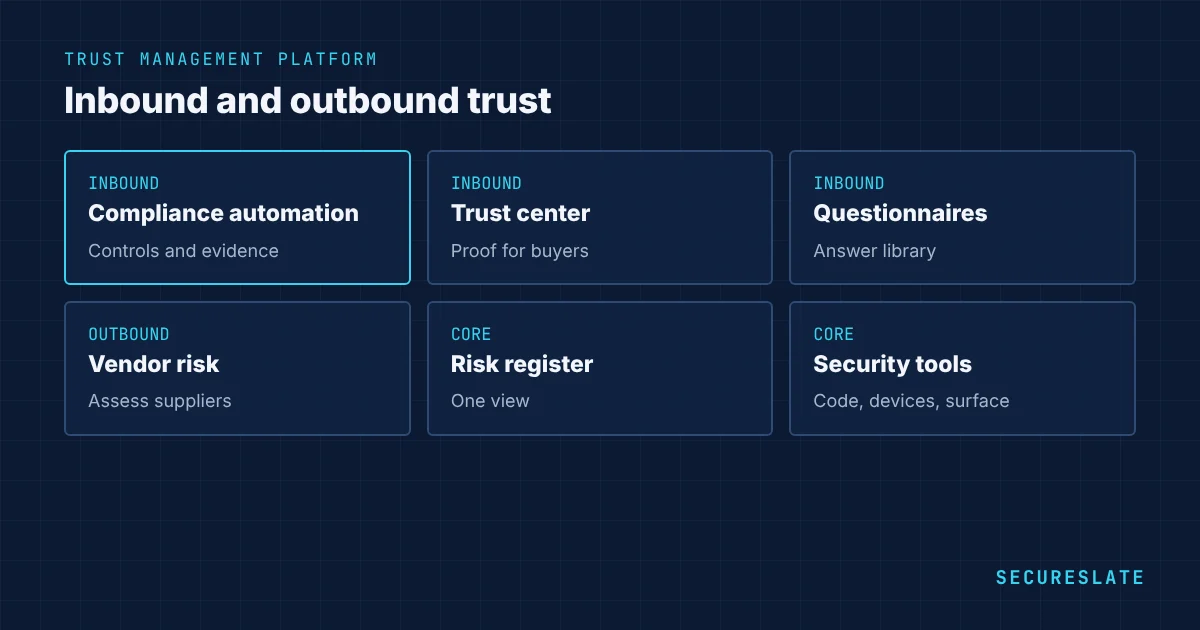
Inbound and outbound trust
| Direction | Question | Tools |
|---|---|---|
| Inbound | Can customers trust us? | Compliance automation, trust center, questionnaires |
| Outbound | Can we trust our vendors? | Vendor risk, monitoring, contracts |
Connecting both directions in one platform means your vendors' risks show up in your own risk register, and your controls power both audit evidence and customer answers.
Benefits
- Shorter sales cycles because security reviews close faster
- Lower audit cost from organized, continuous evidence
- Consistency between what you tell customers and what controls actually do
- Less duplicate work across frameworks and questionnaires
- Visibility for leadership into security posture and risk
How AI is changing trust management
Many platforms now use AI to draft questionnaire answers, extract information from vendor documents, map controls across frameworks and summarize findings. These features save time, but accuracy matters: wrong answers to a customer can become contract issues. Look for features that cite sources, keep humans in review and use only your approved content.
How to evaluate a platform
| Criterion | Questions |
|---|---|
| Automation depth | How many controls are tested automatically for our stack? |
| Framework coverage | Does it support all frameworks we need now and next year? |
| Integrations | Cloud, identity, HR, code, ticketing, endpoint tools? |
| Trust center | Live control status, gated documents, NDAs, analytics? |
| Questionnaires | Answer library, AI with citations, review workflow? |
| Vendor risk | Tiering, questionnaires, document parsing, monitoring? |
| Auditor experience | Read-only access, evidence export, auditor familiarity? |
| Cost | Pricing model by employees, frameworks or modules? |
| Fit | Built for our size, or for large enterprises? |
Trends to watch
- Continuous assurance replacing yearly snapshots
- Machine-readable compliance data such as OSCAL
- AI governance frameworks such as ISO 42001 joining SOC 2 and ISO 27001
- Supply chain transparency through SBOMs and subprocessor monitoring
- Consolidation of security and compliance tools into fewer platforms
Example: before and after a trust management platform
Before: A 70-person SaaS company kept SOC 2 evidence in folders, answered questionnaires by searching old spreadsheets, emailed its SOC 2 report after manual NDA checks and reviewed vendors only when someone remembered. The security lead spent roughly half their time on security reviews and audit preparation.
After: The company connected its cloud, identity, HR and code tools to a trust management platform. Controls are tested continuously, the trust center shows live status and handles NDAs automatically, an answer library drafts questionnaire responses from approved content, and vendor reviews run on a schedule by tier. Audit preparation shrank to a few weeks, and most security reviews close using the trust center and standard documents.
Who uses a trust management platform
| Team | How they use it |
|---|---|
| Security and compliance | Run controls, evidence, audits and vendor reviews |
| Sales and sales engineering | Share the trust center and answer questionnaires |
| Engineering | Fix failing controls and see security findings |
| HR | Track onboarding, training and offboarding tasks |
| Legal and privacy | Manage DPAs, subprocessors and privacy controls |
| Leadership | See risk and compliance status |
Implementation steps
- Choose frameworks and scope.
- Connect integrations for cloud, identity, HR, code and devices.
- Import or adopt policies and assign owners.
- Fix failing controls surfaced by automated tests.
- Build the answer library from existing questionnaires.
- Launch the trust center with reports and policies.
- Add vendors and set review schedules.
- Invite your auditor and schedule the audit.
Pricing models to understand
Platforms price by employee count, number of frameworks, modules or a combination. Ask whether trust center, questionnaire automation, vendor risk and security tools are included or sold separately, and how price changes as you grow. Small teams often get the best value from platforms that include these capabilities in one plan.
How SecureSlate helps
SecureSlate is a trust management platform built for startups and SMBs. It combines compliance automation with multi-framework mapping, a trust center, questionnaire automation, vendor risk, risk management and built-in security tools such as code security and the device agent, at a price smaller teams can afford.
FAQ
What is a trust management platform?
Software that combines compliance automation, trust centers, questionnaire responses, vendor risk and monitoring to help companies prove and manage security trust.
How is trust management different from GRC?
GRC focuses on governance, risk and compliance processes internally. Trust management adds customer-facing proof, such as trust centers and questionnaires, and connects it to controls.
Do small companies need a trust management platform?
Small B2B companies selling to larger customers often benefit, because security reviews and audits can otherwise consume a lot of founder and engineer time.
Can AI answer security questionnaires accurately?
AI can draft answers quickly from approved content, but a person should review them before sending.
What should a trust center include?
Certifications, a controls overview, policies, subprocessors, data hosting details, gated reports and a security contact.
What is the difference between a trust center and a trust management platform?
A trust center is the customer-facing page. A trust management platform includes the trust center plus the compliance, questionnaire, vendor and risk tools behind it.
How long does it take to set up a trust management platform?
Small teams often connect integrations and publish a trust center within a few weeks, with full audit readiness depending on existing controls.
Can a trust management platform replace an auditor?
No. It organizes evidence and monitors controls, but independent auditors still issue SOC 2 reports and ISO certificates.
What frameworks should a platform support?
At minimum the ones you need now, commonly SOC 2 and ISO 27001, plus those on your roadmap such as HIPAA, GDPR, ISO 42001 or CMMC.
Disclaimer (legal note)
This article is for general information only and is not legal, regulatory, or professional advice. Requirements vary by framework, industry, and jurisdiction. Consult qualified advisors for your specific obligations.
Need compliance without the complexity?
SecureSlate automates ISO 27001, SOC 2, GDPR, HIPAA, and more. Built for growing teams. See it in action.
Find compliance gaps in 30 seconds