
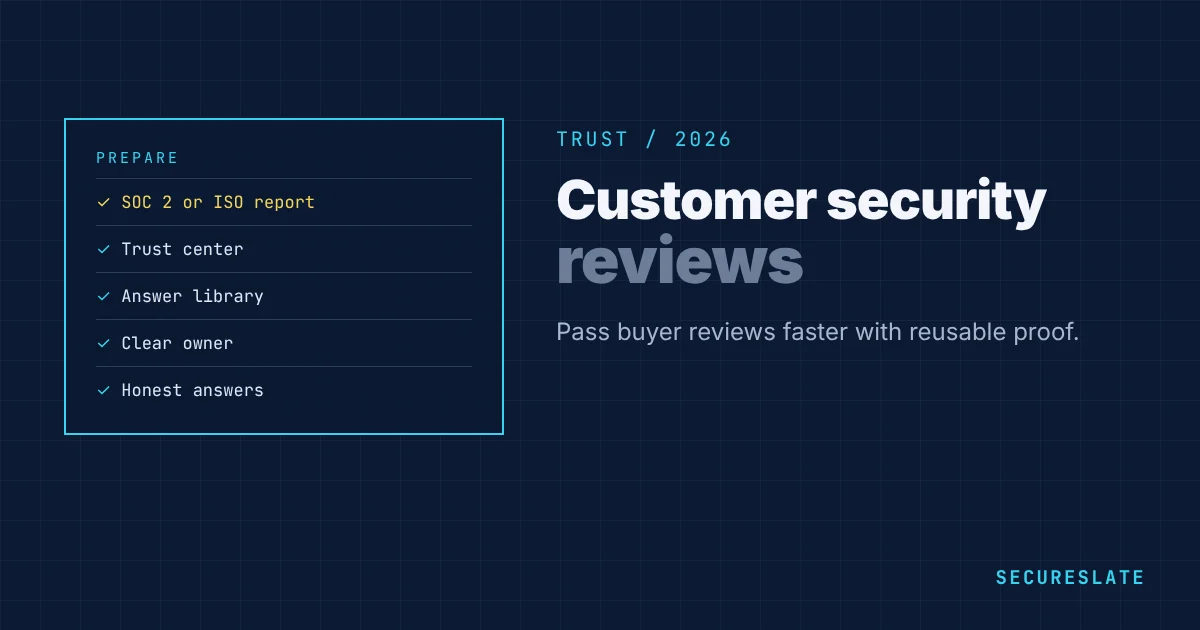
Customer security reviews are how buyers check that a vendor will protect their data before they sign. For B2B software companies, these reviews arrive as questionnaires, document requests, calls with the customer's security team and contract clauses. Done badly, they stall deals for weeks. Done well, they become a sales advantage. This guide covers best practices for handling security reviews efficiently, from preparing reusable materials to answering difficult questions honestly.
Related guides: Trust center design · Trust center updates best practices · The rise of trust management platforms · How to improve security assessments
Key takeaways
- Most security reviews ask the same core questions. Prepare reusable answers and evidence.
- A trust center and an independent report such as SOC 2 or ISO 27001 answer many questions up front.
- Assign a clear owner and response targets so reviews do not stall.
- Answer honestly and specifically, with evidence where possible.
- Track reviews to learn which questions and gaps slow deals, then fix them.
What a typical security review includes
| Component | Examples |
|---|---|
| Questionnaire | SIG, CAIQ, HECVAT for higher education, or the customer's own spreadsheet or portal |
| Document requests | SOC 2 report, ISO 27001 certificate, penetration test summary, policies, insurance certificate |
| Data protection terms | Data processing agreement, subprocessor list, data location |
| Technical questions | Encryption, SSO support, logging, data deletion, architecture |
| Calls | Clarification sessions with the customer's security or privacy team |
| Contract clauses | Breach notification, audit rights, security requirements |
Best practices
1. Get an independent report
A SOC 2 Type 2 report or ISO 27001 certificate answers a large share of questions and is accepted by many customers in place of detailed questionnaires.
2. Publish a trust center
Show certifications, policies, subprocessors, security practices and FAQs on a public page, with gated access to sensitive documents under NDA.
3. Build an answer library
Store approved answers to common questions, tagged by topic and linked to evidence. Review it quarterly and after any control change.
4. Pre-fill standard questionnaires
Complete SIG Lite and CAIQ once and offer them proactively.
5. Assign ownership
Name a security review owner, often in security, compliance or sales engineering, with defined response targets such as five business days for standard questionnaires.
6. Involve sales early
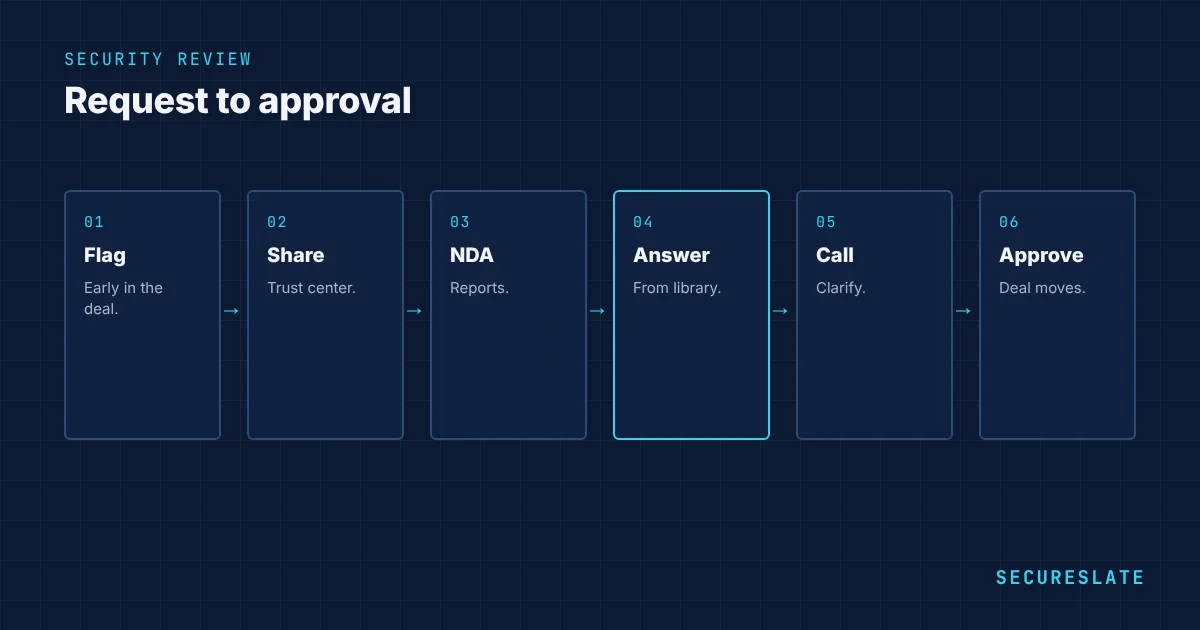
Ask sales to flag security reviews at the start of the deal, not at contract stage.
7. Answer specifically
"All production data is encrypted at rest with AES-256 using cloud provider managed keys" is better than "Yes, we use industry-standard encryption."
8. Provide evidence
Link answers to your trust center, report sections or policies where possible.
9. Handle gaps honestly
If you do not meet a requirement, say so, explain compensating controls and give a timeline if you plan to address it. Misstatements can become contract breaches.
10. Limit custom work
Offer your standard materials first. Agree to custom questionnaires only when necessary, and reuse answers.
11. Track and learn
Record which customers asked what, time to complete and outcomes. Fix the gaps that come up repeatedly.
Common hard questions and how to answer
| Question | Approach |
|---|---|
| "Do you have a SOC 2 Type 2 report?" | If not yet, share status, auditor, expected date and current controls; offer a Type 1 or bridge letter where available |
| "Can we audit you on-site?" | Offer your SOC 2 report, trust center and a call instead; negotiate audit rights limited to cause and reasonable notice |
| "Is customer data used to train AI?" | State your policy clearly and match it to your contract and privacy notice |
| "Where is our data stored?" | List regions and subprocessors; explain options if regional hosting is available |
| "What is your breach notification time?" | Give the contractual commitment, such as within 72 hours of confirmation |
| "Do you support SSO and SCIM?" | Answer accurately, including plan restrictions |
Response time targets
| Request | Target |
|---|---|
| Trust center access | Same day |
| Standard documents under NDA | One business day |
| Standard questionnaire (SIG Lite, CAIQ) | Two to five business days |
| Custom questionnaire | Five to ten business days |
| Security call | Within one week |
Metrics to track
- Number of reviews per quarter
- Average days to complete
- Percentage resolved with trust center and standard documents only
- Deals delayed by security reviews
- Top recurring questions not covered by existing materials
Common mistakes
- Starting reviews at the end of the sales cycle
- Answering "yes" to everything to speed things up
- Outdated answers after controls change
- No single owner, so requests bounce between teams
- Sending SOC 2 reports without an NDA
Building your security review kit
| Item | Purpose | Update frequency |
|---|---|---|
| SOC 2 Type 2 report and bridge letter | Independent assurance | Yearly, bridge letter as needed |
| ISO 27001 certificate and Statement of Applicability summary | International assurance | On issue and surveillance |
| Security overview document | Plain-language summary of your program | Quarterly |
| Completed SIG Lite and CAIQ | Standard questionnaire answers | Quarterly |
| Penetration test summary letter | Testing assurance | Yearly |
| Policy set or summaries | Governance evidence | After each review |
| Data processing agreement and subprocessor list | Privacy terms | When changed |
| Insurance certificate | Financial protection | Yearly |
| Architecture and data flow overview | Technical questions | When architecture changes |
Working with sales
Sales teams should know what is available without a security call: the trust center link, which documents need an NDA and typical turnaround times. Give account executives a one-page guide and a short internal channel for questions. When a review starts, sales should share the customer's deadline, the deal size and any unusual requirements so the security owner can prioritize.
Example timeline for a smooth review
| Day | Activity |
|---|---|
| Day 1 | Sales shares the trust center; customer signs the NDA and downloads the SOC 2 report |
| Day 2 | Customer sends a short follow-up questionnaire |
| Day 4 | Security owner answers from the library and adds evidence links |
| Day 6 | Clarification call on SSO and data retention |
| Day 8 | Customer security team approves |
Compare that with reviews that start late, rely on custom answers and stretch over several weeks.
Handling questionnaire portals
Some customers use third-party risk portals instead of spreadsheets. Keep a record of portals you have completed, reuse your library answers, upload your standard documents and set reminders for annual reassessments. Many portals allow you to share a completed profile with multiple customers, which saves time.
How SecureSlate helps
SecureSlate helps small and mid-size companies pass security reviews faster. Get audit-ready for SOC 2 and ISO 27001, publish a trust center with gated documents and live control status, and answer questionnaires with questionnaire automation drawing on an answer library tied to real controls, at a price built for growing companies.
FAQ
What is a customer security review?
A process in which a prospective customer evaluates a vendor's security and privacy practices before buying.
How can we speed up security reviews?
Get a SOC 2 or ISO 27001 report, publish a trust center, maintain an answer library, pre-fill standard questionnaires and assign a clear owner.
What is SIG?
The Standardized Information Gathering questionnaire from Shared Assessments, widely used for vendor security reviews, with Lite and Core versions.
What is CAIQ?
The Consensus Assessments Initiative Questionnaire from the Cloud Security Alliance, based on the Cloud Controls Matrix.
Should we share our SOC 2 report with prospects?
Yes, under NDA. SOC 2 reports are intended for customers and prospects with a business need, not public release.
Who should own security reviews?
Security or compliance usually owns the content, with sales engineering coordinating the customer relationship. One named owner prevents requests from stalling.
What if we do not have a SOC 2 report yet?
Share your readiness status, auditor and expected report date, your policies and a security overview. A Type 1 report or a letter from your auditor can help in the meantime.
Disclaimer (legal note)
This article is for general information only and is not legal, regulatory, or professional advice. Requirements vary by framework, industry, and jurisdiction. Consult qualified advisors for your specific obligations.
Need compliance without the complexity?
SecureSlate automates ISO 27001, SOC 2, GDPR, HIPAA, and more. Built for growing teams. See it in action.
Find compliance gaps in 30 seconds