
Improving security assessments makes them faster, more accurate and more useful, whether you are assessing your own environment, a vendor or a product before launch. Many assessments fail in predictable ways: scope is vague, questions are generic, answers are accepted without evidence, findings sit in a report nobody acts on, and the same work is repeated every year. This guide covers practical ways to fix each of those problems, with checklists and examples for internal, vendor and customer-facing assessments.
Related guides: Security reviews best practices · Third-party cyber threat assessment · Security posture best practices · Penetration testing best practices
Key takeaways
- Start every assessment with a clear purpose, scope and decision it supports.
- Use risk-based questions tailored to the system or vendor, not one long generic list.
- Prefer evidence and testing over self-reported answers.
- Automate repeatable checks so people focus on judgment.
- Track findings to closure with owners and dates, and reuse results across frameworks and customers.
Types of security assessments
| Type | Purpose | Typical method |
|---|---|---|
| Risk assessment | Identify and prioritize risks to the organization | Workshops, asset and threat analysis, scoring |
| Control assessment or audit | Check whether controls are designed and operating | Evidence review, sampling, testing |
| Vulnerability assessment | Find technical weaknesses | Automated scanning |
| Penetration test | Show how weaknesses can be exploited | Manual and automated attack simulation |
| Vendor security assessment | Evaluate a third party's security | Questionnaires, reports, monitoring |
| Architecture or design review | Find security issues before building | Threat modeling, design review |
| Gap assessment | Compare current state against a framework | Control mapping, interviews |
Common problems with security assessments
- Scope is unclear, so assessors look at the wrong things
- Questionnaires are long and generic, so answers are rushed
- Answers are accepted without evidence
- Findings are vague or not prioritized
- Results are not shared with the people who can fix issues
- The same assessment is repeated from scratch every year
- Assessments happen too late to influence decisions
How to improve security assessments
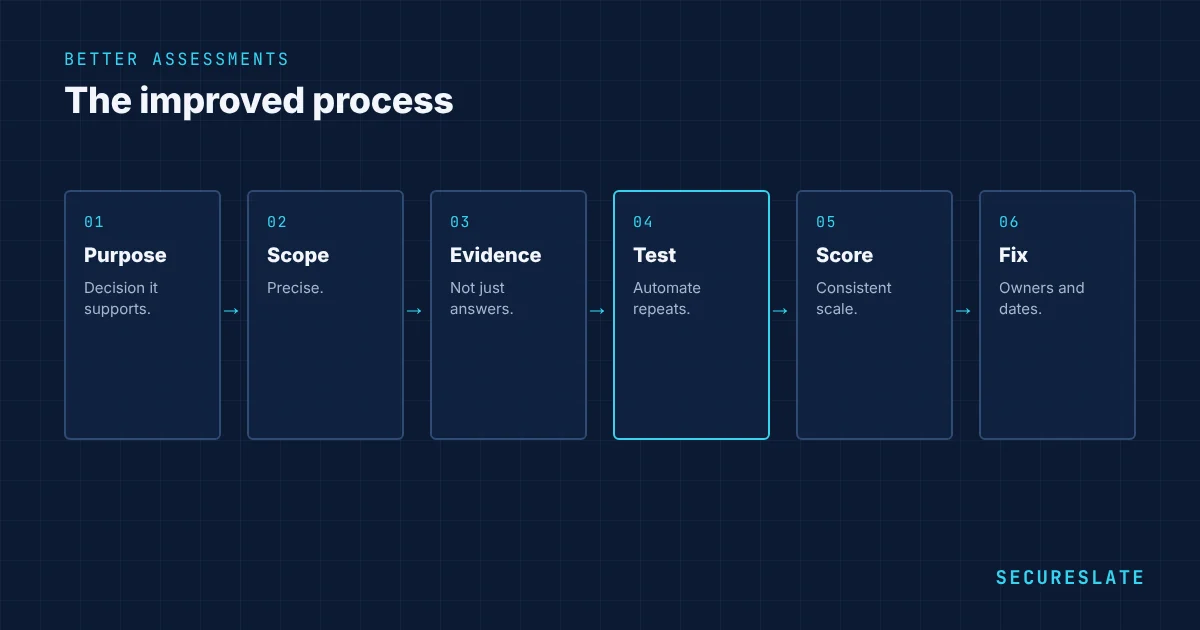
1. Define purpose and decision
Write one sentence: "This assessment decides whether we can launch feature X" or "whether vendor Y can process customer data." The decision shapes scope and depth.
2. Scope precisely
List systems, data, environments, locations, teams and the period covered. Note what is out of scope and why.
3. Use a recognized baseline
Base questions and tests on a framework such as ISO 27001, SOC 2, NIST CSF 2.0 or CIS Controls v8.1 so results are comparable and complete.
4. Tailor by risk
Ask more about what matters for this system or vendor. A vendor with production access gets deep questions about access control and incident response; a vendor with no data gets a short review.
5. Ask for evidence
Replace "Do you enforce MFA?" with "Provide an export of MFA enforcement settings for all users." Accept independent audit reports where they cover the scope.
6. Test where possible
Check configurations directly, run scans, sample tickets and review logs. Testing finds what questionnaires miss.
7. Automate the repeatable parts
Continuous control monitoring, automated scans and evidence collection let assessors focus on judgment rather than gathering screenshots.
8. Score consistently
Use a defined rating scale for findings and an overall rating, so different assessors reach similar conclusions.
9. Write actionable findings
Each finding states what was found, why it matters, the risk rating and a specific recommendation.
10. Track remediation
Assign owners and dates, follow up and verify fixes. Report overdue items to leadership.
11. Reuse results
Map evidence to multiple frameworks and customer questionnaires so one assessment supports many needs.
12. Learn and improve
After each assessment, ask what took too long, what was missed and what should change next time.
Evidence quality ladder
| Strength | Evidence type | Example |
|---|---|---|
| Weakest | Verbal statement | "Yes, we do access reviews." |
| Weak | Written policy | Access review policy document |
| Moderate | Sample artifact | One completed access review |
| Strong | System-generated records across the period | All quarterly review records with decisions and removals |
| Strongest | Independent testing or continuous monitoring | Auditor testing results or continuous automated checks |
Assessment metrics
| Metric | What it shows |
|---|---|
| Time to complete an assessment | Efficiency |
| Percentage of findings backed by evidence | Quality |
| Findings closed on time | Effectiveness |
| Repeat findings | Whether root causes are fixed |
| Assessments reused for other purposes | Leverage |
Improving vendor assessments specifically
- Tier vendors so low-risk vendors get short reviews
- Accept SOC 2 and ISO 27001 reports to replace large parts of questionnaires
- Read SOC 2 exceptions and complementary user entity controls
- Use outside-in monitoring between assessments
- Reassess on triggers such as breaches or scope changes
Improving how others assess you
If customers assess your company, make it easy for them: publish a trust center with certifications and policies, keep an answer library for common questionnaires, share your SOC 2 report under NDA and respond with evidence. Faster, better answers shorten sales cycles.
Example: before and after
Before: A company sends every vendor and internal team a 250-question spreadsheet each year. Answers are mostly "yes," few include evidence, findings are emailed to the security lead and nothing is tracked. The same gaps appear year after year.
After: Vendors are tiered and critical ones provide SOC 2 reports, which the team reads for exceptions. Internal assessments use continuous control monitoring for technical controls and focus interviews on processes that cannot be automated. Each finding is logged with an owner and due date, overdue items are reported monthly, and results are mapped to SOC 2 and ISO 27001 so customers' questionnaires can be answered from the same evidence. Assessment time drops and repeat findings fall.
Writing better assessment questions
| Weak question | Better question |
|---|---|
| Do you have an incident response plan? | When was your incident response plan last tested, and what changed as a result? Provide the test summary. |
| Do you encrypt data? | Which data stores hold our data, and how is each encrypted at rest and in transit? |
| Do you perform access reviews? | How often are access reviews performed for production systems, and can you share the most recent completion record? |
| Do you train employees? | What percentage of employees completed security training in the last 12 months? |
Good questions ask for specifics, time frames and evidence, which makes answers comparable and harder to exaggerate.
Assessment roles
| Role | Responsibility |
|---|---|
| Assessment lead | Plans scope, runs the assessment and signs off conclusions |
| Control or system owners | Provide evidence and explain how controls work |
| Technical testers | Run scans and tests |
| Risk owner | Decides on treatment of findings |
| Leadership | Receives results and funds remediation |
How SecureSlate helps
SecureSlate makes security assessments faster and more reliable. Continuous control tests give assessors system-generated evidence, vendor risk tiers and assesses suppliers, the risk register tracks findings to closure, and questionnaire automation and a trust center help when customers assess you.
FAQ
What is a security assessment?
A structured evaluation of security risks, controls or vulnerabilities in a system, organization or vendor.
How can security assessments be improved?
Define purpose and scope, use risk-based questions, require evidence, test directly, automate repeatable checks, score consistently and track findings to closure.
How often should security assessments be done?
Risk assessments at least yearly, control monitoring continuously, vendor assessments by tier and penetration tests at least yearly or after major changes.
What is the difference between a security assessment and an audit?
An audit is a formal assessment against defined criteria, often by an independent party, resulting in an opinion or certification. Assessments can be internal and broader.
Can security assessments be automated?
Many parts can, especially evidence collection, configuration checks and vulnerability scanning. Judgment about risk and context still needs people.
Should we use a standard questionnaire for assessments?
Standard questionnaires such as SIG or CAIQ save time and improve consistency. Tailor the depth by risk instead of sending the full version to everyone.
Disclaimer (legal note)
This article is for general information only and is not legal, regulatory, or professional advice. Requirements vary by framework, industry, and jurisdiction. Consult qualified advisors for your specific obligations.
Need compliance without the complexity?
SecureSlate automates ISO 27001, SOC 2, GDPR, HIPAA, and more. Built for growing teams. See it in action.
Find compliance gaps in 30 seconds