
Short answer: PCI DSS is a prescriptive security standard that any business storing, processing or transmitting payment card data must meet under its contracts with the card brands and acquirers. SOC 2 is a voluntary attestation report, issued by an independent CPA firm, that shows customers how well your controls protect their data. Many SaaS companies that touch card data need both.
Related guides: PCI DSS compliance checklist · SOC 2 vs other frameworks · PCI DSS self-assessment questionnaires
Key takeaways
- PCI DSS protects cardholder data and is required by contract for anyone in the payment chain. SOC 2 is market driven: customers ask for it, no law or card brand requires it.
- PCI DSS tells you exactly what to do, down to password length and scan frequency. SOC 2 sets criteria and lets you design controls that meet them.
- PCI DSS is validated with a Report on Compliance or a self-assessment questionnaire plus an Attestation of Compliance. SOC 2 ends in an auditor's opinion in a Type 1 or Type 2 report.
- A SOC 2 report does not replace PCI DSS validation, and PCI DSS compliance does not give customers a SOC 2 report.
- The controls overlap heavily, so one mapped control set and one evidence pool can serve both.
What is the main difference between PCI DSS and SOC 2?
The main difference is purpose: PCI DSS is a mandatory rulebook for protecting payment card data, while SOC 2 is an independent report on how you protect customer data in general.
PCI DSS is published by the PCI Security Standards Council, a body formed by the major payment brands. It applies to merchants and service providers that store, process or transmit cardholder data, and to systems that can affect the security of that data. The Council writes the standard, but it does not enforce it. According to the Council's own overview of its role, enforcement and any penalties are handled by the individual payment brands, usually through acquiring banks. PCI DSS v4.0.1 was published in June 2024, and v4.0 was retired on 31 December 2024; check the Council's document library for the version in force when you assess.
SOC 2 is an attestation framework from the AICPA. A licensed CPA firm examines your controls against the Trust Services Criteria: Security, which every SOC 2 report covers, plus optional Availability, Processing Integrity, Confidentiality and Privacy. You choose the scope, write your own control descriptions and receive an opinion on whether those controls are suitably designed (Type 1) or also operated effectively over a period (Type 2).
PCI DSS vs SOC 2 side by side
The table below compares the two on the points that usually decide budget and timeline.
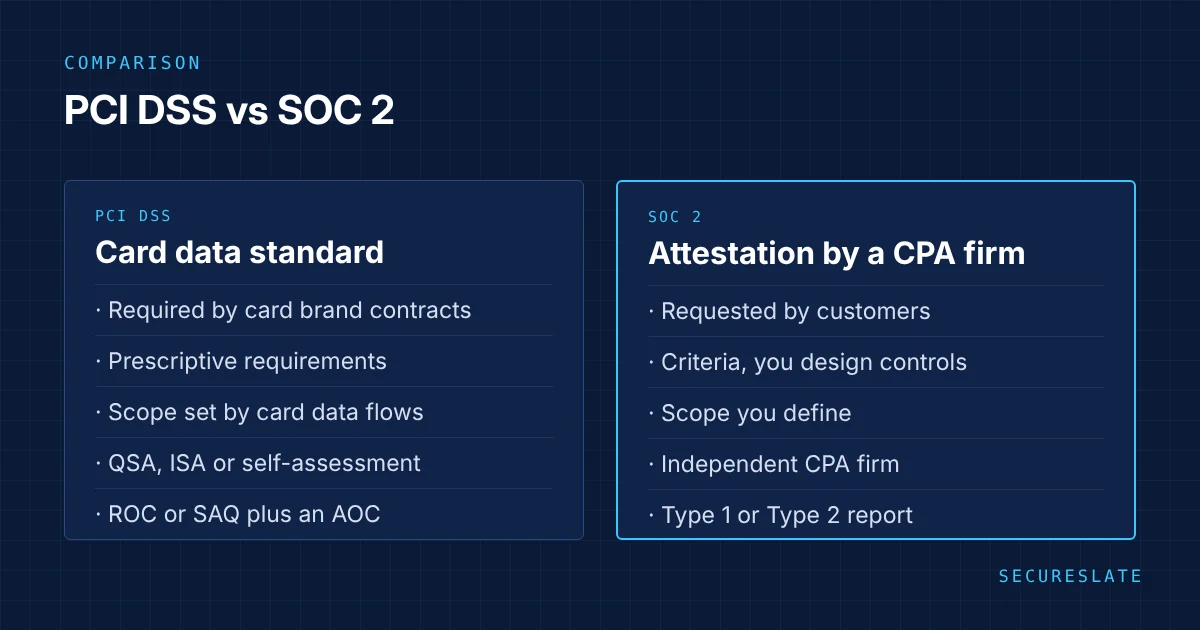
| PCI DSS | SOC 2 | |
|---|---|---|
| Owner | PCI Security Standards Council | AICPA |
| Why you do it | Contract with acquirer, processor or card brands | Customer and sales requirements |
| What it protects | Cardholder data and sensitive authentication data | Systems and data in the scope you define |
| Style | Prescriptive requirements and testing procedures | Criteria; you design the controls |
| Structure | 12 principal requirements | Common criteria plus up to four optional categories |
| Who assesses | QSA, ISA or self-assessment, depending on level | Independent CPA firm |
| Output | ROC or SAQ, plus an Attestation of Compliance | Type 1 or Type 2 report with auditor opinion |
| Frequency | Annual validation, plus recurring activities such as quarterly scans | Usually yearly, Type 2 covers an observation period |
| Who sees it | Acquirer, payment brands, business partners | Customers and prospects, usually under NDA |
| Outcome | Compliant or non-compliant per requirement | Unmodified, qualified, adverse or disclaimer opinion |
Two rows matter most. First, the scope of PCI DSS is fixed by where card data flows, so you reduce effort by shrinking the cardholder data environment, not by choosing fewer criteria. Second, a PCI DSS assessment is pass or fail requirement by requirement, while SOC 2 reports exceptions and lets the reader judge them.
Do you need PCI DSS, SOC 2 or both?
You need PCI DSS if card data touches your systems, and you need SOC 2 if your customers ask for it; plenty of companies fall into both groups.
| Your situation | PCI DSS | SOC 2 |
|---|---|---|
| Online store using a fully hosted payment page | Yes, usually a short SAQ | Rarely asked for |
| B2B SaaS that never touches card data | No | Usually yes, for enterprise deals |
| SaaS that takes card payments through its own app | Yes | Often yes |
| Payment processor or gateway | Yes, as a service provider | Often expected by customers |
| HealthTech platform billing patients by card | Yes, for the payment flow | Often requested alongside HIPAA work |
PCI DSS applies even to small merchants. What changes with size is how you validate: your merchant level, set by the card brands and your acquirer, decides whether a self-assessment questionnaire is enough or an onsite assessment is needed. See PCI DSS merchant and service provider levels for the detail. Using a payment provider that keeps card data off your servers can reduce your PCI DSS scope a lot, but it does not remove your obligations entirely.
SOC 2 has no legal trigger. In our experience it becomes necessary when enterprise buyers, hospitals or financial customers put it in their security questionnaires or contracts.
Where do the controls overlap?
Most of the technical and operational controls overlap, because both frameworks expect the same security basics.
| Control area | PCI DSS v4.0.1 | SOC 2 Trust Services Criteria |
|---|---|---|
| Network security | Requirement 1 | CC6.1, CC6.6 |
| Secure configuration | Requirement 2 | CC7.1, CC8.1 |
| Encryption of stored and transmitted data | Requirements 3 and 4 | CC6.1, CC6.7 |
| Malware protection | Requirement 5 | CC6.8 |
| Secure development and change management | Requirement 6 | CC8.1 |
| Access control and authentication | Requirements 7 and 8 | CC6.1 to CC6.3 |
| Logging and monitoring | Requirement 10 | CC7.2, CC7.3 |
| Vulnerability scanning and testing | Requirement 11 | CC7.1, CC4.1 |
| Policies, risk assessment, training, vendors | Requirement 12 | CC1, CC2, CC3, CC9.2 |
The differences sit in the detail. PCI DSS sets specific values, such as quarterly vulnerability scans, minimum password lengths and session timeouts. SOC 2 lets you set your own values, as long as they are reasonable and you follow them. If you configure controls to the PCI DSS value, you will normally meet the SOC 2 expectation for the same area. Physical security of card data (Requirement 9) has a SOC 2 counterpart in CC6.4, which many cloud-first companies cover through their hosting provider's reports.
How to run both from one program
The cleanest approach is to build one control set at PCI DSS strictness and map it to SOC 2.
- Map your card data flows. Find every system that stores, processes or transmits card data, and every system connected to them. This defines PCI DSS scope.
- Reduce PCI DSS scope first. Tokenization, hosted payment pages and network segmentation can take most systems out of scope.
- Define SOC 2 scope. Pick the system and Trust Services Criteria your customers care about. Security is always included.
- Write one control library. Each control lists the PCI DSS requirement and the SOC 2 criteria it supports, with one owner.
- Collect evidence once. Access reviews, scan reports, change tickets and training records serve both assessments.
- Align the calendars. Schedule the PCI DSS assessment and the SOC 2 observation period so the same evidence covers both.
- Track framework-specific items separately. ASV scans, the Attestation of Compliance and SOC 2 system description work only apply to one side.
Common mistakes when comparing them
- Treating a SOC 2 report as PCI DSS proof. Acquirers and payment brands expect PCI DSS validation documents, not a SOC 2 opinion.
- Assuming a payment provider makes you exempt. Outsourcing payments reduces scope, but you still validate your remaining responsibilities.
- Scoping SOC 2 to match PCI DSS. SOC 2 customers usually care about your whole product, not only the payment flow.
- Running two evidence processes. Duplicate screenshots and reviews waste time and create inconsistencies auditors notice.
- Ignoring the vendor side. Both frameworks expect you to manage service providers that can affect your security.
How SecureSlate helps
SecureSlate has built-in PCI DSS and SOC 2 frameworks with multi-framework control mapping, so one control and one piece of evidence can count toward both. Agentless, read-only cloud integrations and a device agent collect configuration evidence continuously, while access reviews, vendor risk management and risk management keep the shared operational controls current. Audit management helps you organize requests from your QSA and CPA firm, and a trust center and security questionnaire automation help you share your posture with customers. SecureSlate does not perform assessments or issue reports; your assessors do.
FAQ
Is SOC 2 harder than PCI DSS?
Neither is simply harder. PCI DSS has more fixed, detailed requirements within a narrower scope, while SOC 2 gives more freedom but often covers a wider system and, for Type 2, requires evidence over a whole period.
Can a SOC 2 report replace PCI DSS compliance?
No. If you store, process or transmit card data, your acquirer or the payment brands expect PCI DSS validation, such as a ROC or SAQ with an Attestation of Compliance.
Does PCI DSS compliance count toward SOC 2?
Not directly, but the controls and evidence you build for PCI DSS cover a large part of the SOC 2 Security criteria. Your CPA firm still has to test them under SOC 2.
Which should a startup do first?
If you handle card data, start with PCI DSS because it is a contractual obligation. If you do not, and customers ask for assurance, start with SOC 2.
Do I need PCI DSS if I use a payment processor?
Usually yes, but with a much smaller scope. Your acquirer decides how you validate, often with a short self-assessment questionnaire.
Disclaimer (legal note)
This article is for general information only and is not legal, regulatory, or professional advice. Requirements vary by framework, industry, and jurisdiction. Consult qualified advisors for your specific obligations.
Need compliance without the complexity?
SecureSlate automates ISO 27001, SOC 2, GDPR, HIPAA, and more. Built for growing teams. See it in action.
Find compliance gaps in 30 seconds