
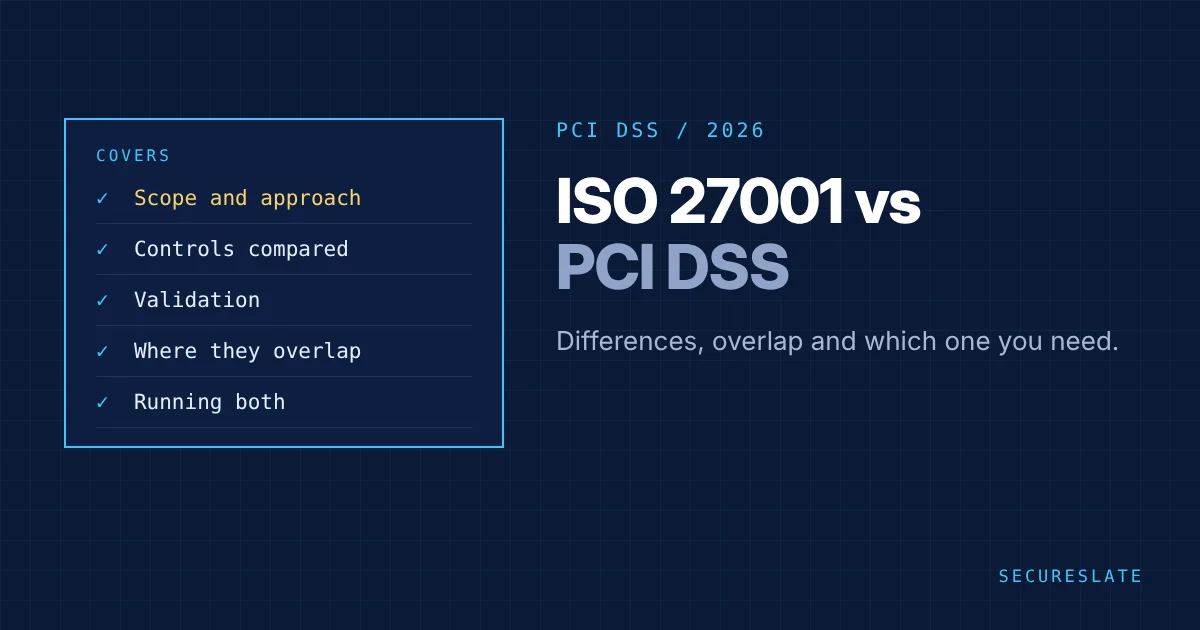
Short answer: ISO 27001 is a voluntary, risk-based standard for running an information security management system across whatever scope you choose, and it leads to a certificate. PCI DSS is a prescriptive set of payment card requirements that any entity storing, processing or transmitting cardholder data must meet, enforced through card brand and acquirer contracts.
Related guides: PCI DSS compliance checklist · ISO 27001 certification guide · SOC 2 vs other frameworks
Key takeaways
- ISO 27001 asks you to build a management system and pick controls based on your own risk assessment. PCI DSS tells you which controls to implement for the cardholder data environment.
- ISO 27001 scope is chosen by you. PCI DSS scope is defined by where card data flows and what connects to it.
- ISO 27001 is validated by an accredited certification body. PCI DSS is validated by a Report on Compliance or a Self-Assessment Questionnaire, depending on your level.
- The two overlap heavily in access control, logging, vulnerability management, incident response and vendor management, so one control set can serve both.
- An ISO 27001 certificate does not replace PCI DSS validation.
What is the core difference between ISO 27001 and PCI DSS?
The core difference is that ISO 27001 tells you how to manage security risk, while PCI DSS tells you exactly what to do to protect payment card data.
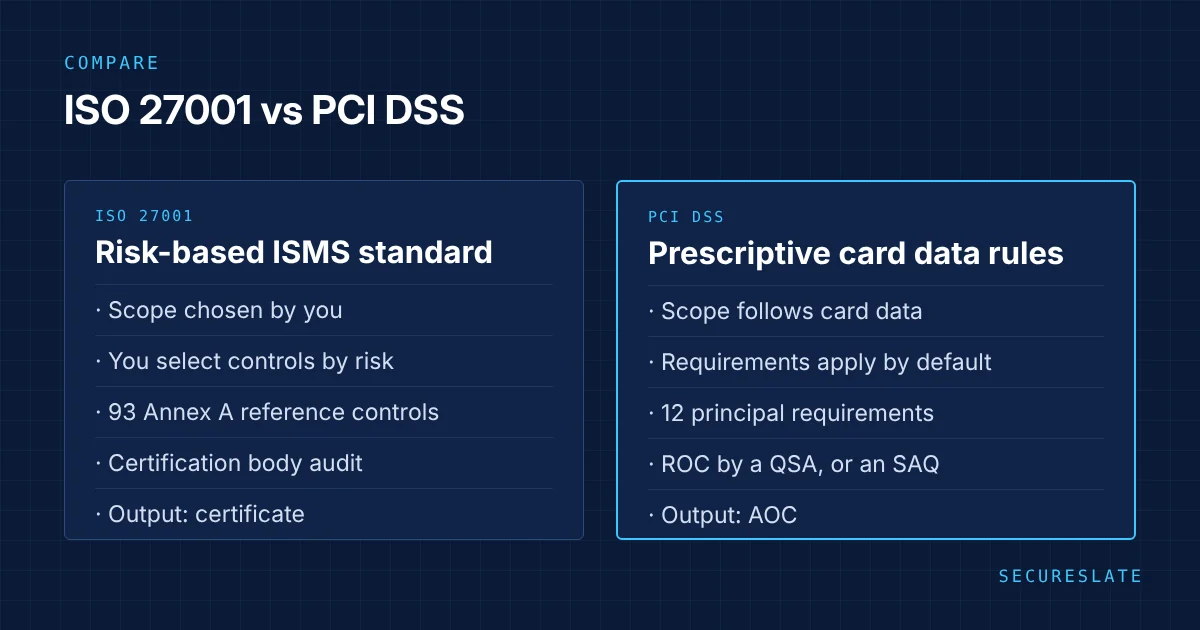
ISO/IEC 27001:2022 sets requirements for an information security management system (ISMS) in clauses 4 to 10: context, leadership, planning, support, operation, performance evaluation and improvement. Annex A lists 93 reference controls in four themes (organizational, people, physical and technological). You decide which controls apply, and why, in a Statement of Applicability.
PCI DSS, currently version 4.0.1, is maintained by the PCI Security Standards Council. It has 12 principal requirements grouped under six goals, each broken down into detailed sub-requirements with testing procedures. Version 4.0 was retired at the end of 2024, and the requirements that were future-dated became mandatory on 31 March 2025.
Put simply: ISO 27001 is a management framework with flexibility. PCI DSS is a technical rulebook with very little.
ISO 27001 vs PCI DSS side by side
The table compares the two on the points buyers and auditors ask about most.
| Factor | ISO 27001 | PCI DSS |
|---|---|---|
| Owner | ISO and IEC | PCI Security Standards Council, enforced by card brands and acquirers |
| Why you do it | Customer demand, market access, better security management | Contractual requirement if you handle cardholder data |
| Scope | Defined by you (whole company, one product, one site) | Systems that store, process or transmit card data, plus connected and security-impacting systems |
| Approach | Risk-based; you select controls | Prescriptive; requirements apply unless not applicable or met by compensating controls or the customized approach |
| Controls | 93 Annex A reference controls plus ISMS clauses | 12 principal requirements with detailed sub-requirements |
| Validation | Certification audit by an accredited certification body | Report on Compliance by a QSA, or a Self-Assessment Questionnaire, depending on level and acquirer |
| Cycle | Three-year certificate with surveillance audits | Annual validation, plus recurring activities such as quarterly external vulnerability scans by an ASV |
| Output | Certificate | Attestation of Compliance (AOC), with a ROC or SAQ |
| Geography | International | Global, wherever the card brands operate |
Where do ISO 27001 and PCI DSS overlap?
They overlap in most of the day-to-day security controls, which is why companies that hold an ISO 27001 certificate usually find PCI DSS faster to implement.
| Control area | ISO 27001 (Annex A theme) | PCI DSS requirement |
|---|---|---|
| Security policies and roles | Organizational controls | Requirement 12 |
| Network security | Technological controls | Requirement 1 |
| Secure configuration | Technological controls | Requirement 2 |
| Cryptography and data protection | Technological controls | Requirements 3 and 4 |
| Malware protection | Technological controls | Requirement 5 |
| Secure development and change | Technological controls | Requirement 6 |
| Access control and authentication | Organizational and technological controls | Requirements 7 and 8 |
| Physical security | Physical controls | Requirement 9 |
| Logging and monitoring | Technological controls | Requirement 10 |
| Vulnerability management and testing | Technological controls | Requirement 11 |
| Supplier management | Organizational controls | Requirement 12 |
| Incident response | Organizational controls | Requirement 12 |
| Security awareness | People controls | Requirement 12 |
The difference is depth. Where ISO 27001 asks you to manage technical vulnerabilities in line with your risk assessment, PCI DSS sets specific expectations, such as quarterly internal and external vulnerability scans, external scans performed by an Approved Scanning Vendor, and penetration testing at least once every 12 months. Where ISO 27001 lets you define your own password and authentication rules, PCI DSS specifies requirements such as multi-factor authentication for access into the cardholder data environment.
Does ISO 27001 certification make you PCI DSS compliant?
No. An ISO 27001 certificate does not satisfy PCI DSS, and card brands and acquirers expect PCI DSS validation in its own form.
There are three reasons. First, the ISO 27001 scope you chose may not include the cardholder data environment. Second, even when it does, your risk assessment might have led you to controls that are weaker or different from the specific PCI DSS requirements. Third, PCI DSS validation must be documented in the Council's own formats, a Report on Compliance or a Self-Assessment Questionnaire, each with an Attestation of Compliance.
What ISO 27001 does give you is a working ISMS: risk assessment, policies, internal audit, management review and continual improvement. Those make PCI DSS easier to sustain year after year, which is where many PCI programs struggle.
Which do you need, and which comes first?
If you handle cardholder data, PCI DSS is not optional; ISO 27001 is a business choice driven by customers and markets.
Use this decision guide:
- Do you store, process or transmit card data, or can you affect its security? If yes, PCI DSS applies. Check your merchant or service provider level to see how you must validate.
- Can you reduce PCI scope? Many SaaS and HealthTech companies use a payment provider's hosted fields or redirect so card data never touches their servers. That often means a short Self-Assessment Questionnaire instead of a full assessment.
- Do customers ask for ISO 27001? In our experience, enterprise buyers outside the US, and many health systems, often ask for it. If they do, plan ISO 27001 as the umbrella program.
- Sequence by deadline. If an acquirer or partner needs PCI DSS validation by a date, do that first. If not, building the ISMS first gives you the governance layer that PCI DSS then sits inside.
For most small SaaS companies with outsourced payments, the practical answer is: minimize PCI scope, complete the right SAQ, and pursue ISO 27001 if your customers want it.
How do you run both programs together?
Run one control library, mapped to both frameworks, with the PCI DSS scope treated as a stricter zone inside your ISMS.
- Define scope once, in layers. Make the cardholder data environment a clearly bounded part of the ISMS scope.
- Use the stricter rule. Where PCI DSS is more specific, adopt its requirement for the cardholder data environment and decide by risk whether to extend it elsewhere.
- Share evidence. Access reviews, vulnerability scans, training records and incident tests can satisfy both auditors if they cover the right systems and dates.
- Align calendars. Plan the ISO 27001 surveillance audit and the PCI DSS assessment so evidence periods line up.
- Keep PCI-specific records separate. ASV scan reports, scope confirmation and targeted risk analyses are PCI DSS artifacts that ISO auditors will not ask for.
How SecureSlate helps
SecureSlate supports companies running ISO 27001 and PCI DSS at the same time:
- Built-in ISO 27001 and PCI DSS frameworks with multi-framework control mapping, so a shared control is implemented and evidenced once.
- Agentless, read-only cloud integrations and a device agent for continuous evidence on configurations, encryption and endpoints.
- Access reviews, vendor risk management and risk management for the processes both frameworks require.
- Audit management to share evidence with your certification body and your QSA.
- Code security and secrets detection to support secure development requirements.
SecureSlate does not perform audits or issue certifications. Start a free trial to map both frameworks in one place.
FAQ
Is PCI DSS a law?
No. PCI DSS is an industry standard. It is enforced through contracts between card brands, acquirers, merchants and service providers, although some laws refer to it.
Is ISO 27001 harder than PCI DSS?
They are hard in different ways. ISO 27001 requires building and running a management system. PCI DSS requires meeting many specific technical requirements in the cardholder data environment.
Can one audit cover both ISO 27001 and PCI DSS?
They are separate assessments with different assessors and reports. You can coordinate timing and reuse evidence, but each produces its own result.
Does PCI DSS apply if I use a payment provider?
Usually yes, but your scope may be much smaller. Even with outsourced payment pages you typically still validate, often with a shorter SAQ.
How many controls does ISO 27001 have compared with PCI DSS?
ISO 27001:2022 Annex A lists 93 reference controls. PCI DSS has 12 principal requirements, each containing many detailed sub-requirements.
Disclaimer (legal note)
This article is for general information only and is not legal, regulatory, or professional advice. Requirements vary by framework, industry, and jurisdiction. Consult qualified advisors for your specific obligations.
Need compliance without the complexity?
SecureSlate automates ISO 27001, SOC 2, GDPR, HIPAA, and more. Built for growing teams. See it in action.
Find compliance gaps in 30 seconds