
The SOC 2 Type 2 timeline usually runs from about six months to a year from starting work to receiving your first report. It has four main phases: readiness and implementation, an observation period in which controls must operate (commonly three to twelve months), fieldwork by the auditor, and report issuance. A SOC 2 Type 2 report is an attestation issued by a licensed CPA firm under AICPA standards, covering whether your controls were suitably designed and operated effectively over the period. This guide walks through each phase, typical durations, what determines your timeline and how to move faster without cutting corners.
Related guides: SOC 2 Type 2 guide · Best SOC 2 compliance software · Common auditor misconceptions · Internal control audit
Key takeaways
- A first SOC 2 Type 2 typically takes 6 to 12 months end to end.
- The observation period cannot be shortened after it starts; first reports often use 3 to 6 months.
- Readiness time depends on how many controls you need to build.
- Some companies get a Type 1 report first to show progress while the Type 2 period runs.
- After the first report, SOC 2 becomes a yearly cycle with continuous evidence.
SOC 2 Type 1 vs Type 2
| Aspect | Type 1 | Type 2 |
|---|---|---|
| What it covers | Design of controls at a point in time | Design and operating effectiveness over a period |
| Period | A single date | Usually 3 to 12 months |
| Effort | Lower | Higher, with evidence across the period |
| Customer value | Shows controls exist | Shows controls work consistently; preferred by most buyers |
The SOC 2 Type 2 timeline
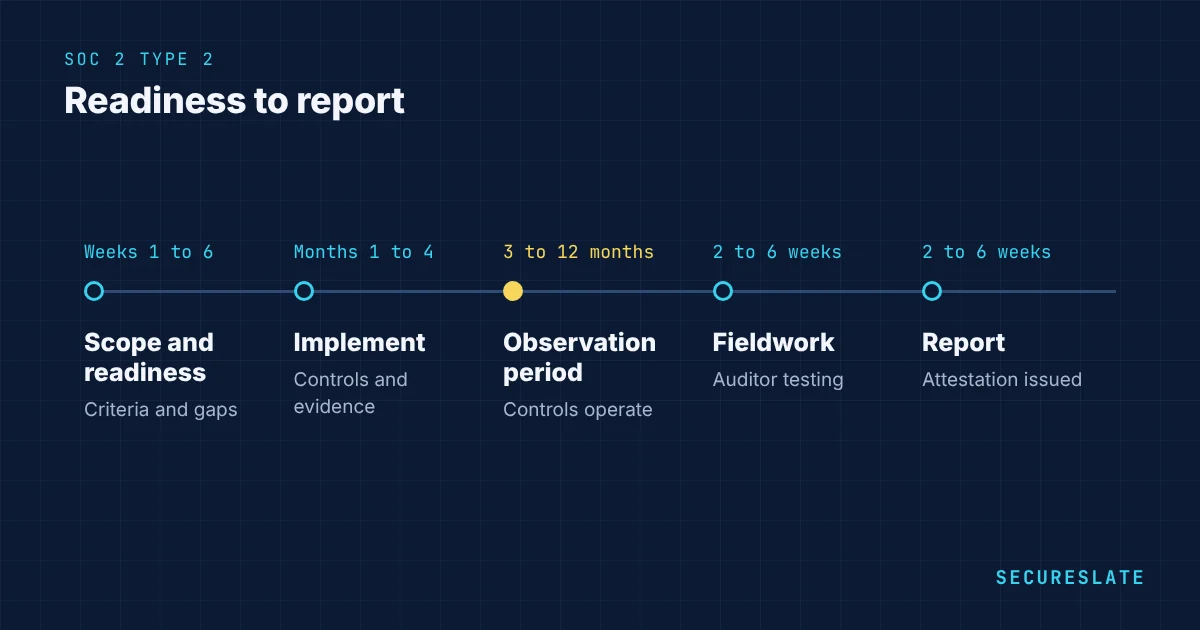
| Phase | Typical duration | Main activities |
|---|---|---|
| 1. Scoping | 1 to 2 weeks | Choose Trust Services Criteria, define system boundaries, pick an auditor |
| 2. Readiness assessment | 2 to 4 weeks | Gap analysis against chosen criteria |
| 3. Implementation | 1 to 4 months | Policies, access controls, logging, vendor management, training, risk assessment, tooling |
| 4. Observation period | 3 to 12 months | Controls operate; evidence collected continuously |
| 5. Fieldwork | 2 to 6 weeks | Auditor tests samples and evidence across the period |
| 6. Report issuance | 2 to 6 weeks | Draft review, management response, final report |
Implementation and the start of the observation period can overlap once key controls are in place.
Phase details
Scoping
Most companies start with the Security criteria (the Common Criteria), adding Availability, Confidentiality, Processing Integrity or Privacy based on customer needs. Define which products, infrastructure, people and vendors are in scope.
Readiness
Compare current practices with the criteria. Typical gaps for startups include missing policies, no formal risk assessment, inconsistent access reviews, limited logging and no vendor management.
Implementation
Build and document controls. Many companies use a compliance automation platform to connect systems, provide policy templates and track evidence.
Observation period
Controls must operate consistently. Examples: quarterly access reviews completed, changes approved, new hires trained, leavers removed promptly, incidents handled. Exceptions during this period may appear in the report.
Fieldwork
The auditor selects samples from across the period and tests them. Respond quickly to requests and have control owners available.
Report issuance
You review the draft for factual accuracy and provide management responses to any exceptions. The final report includes the auditor's opinion, management's assertion, the system description and test results.
Example timelines
| Company situation | Readiness and implementation | Observation | Fieldwork and report | Total |
|---|---|---|---|---|
| Startup with good cloud practices and automation | 6 to 8 weeks | 3 months | 4 to 6 weeks | About 6 months |
| SMB with some policies, manual processes | 3 to 4 months | 6 months | 6 to 8 weeks | 10 to 12 months |
| Company with Type 1 already | Minimal | 3 to 6 months | 4 to 8 weeks | 5 to 8 months |
What slows SOC 2 down
- Unclear scope or changing scope mid-project
- No dedicated owner
- Manual evidence collection
- Late auditor selection, with limited availability
- Control gaps discovered during fieldwork
- Slow responses to auditor requests
How to move faster
- Choose an owner with time allocated.
- Use automation to connect systems and collect evidence continuously.
- Book your auditor early and agree the period.
- Fix high-impact gaps first, such as MFA, access reviews, logging and change management.
- Consider a Type 1 if customers need something sooner.
- Start with a 3-month observation period for the first Type 2, if your customers accept it.
- Prepare people for walkthroughs.
Attestation basics
SOC 2 reports are examination engagements performed under AICPA attestation standards (AT-C section 205) using the Trust Services Criteria (2017, with revised points of focus in 2022) and the description criteria (DC 200). Only licensed CPA firms can issue them. The report is intended for customers and other parties with sufficient knowledge, so it is shared under NDA, often through a trust center. When customers ask about the gap between the report period and today, provide a bridge letter.
After the first report
SOC 2 Type 2 is usually renewed every year with a 12-month period that starts where the last one ended, so there are no gaps in coverage. Continuous control monitoring keeps evidence ready and reduces the work for each cycle.
Month-by-month plan for a first report
| Month | Focus |
|---|---|
| 1 | Choose auditor and platform, define scope, run readiness assessment |
| 2 | Write policies, enforce MFA and SSO, set up logging, start vendor inventory, run risk assessment |
| 3 | Complete training, first access review, change management workflow, incident response plan; start observation period |
| 4 to 5 | Operate controls; second access review; fix any failing automated tests |
| 6 | Observation period ends; auditor fieldwork begins |
| 7 | Respond to requests; review draft report; management responses |
| 8 | Final report issued; publish to trust center under NDA |
This assumes a three-month observation period and a team with good cloud practices.
Evidence auditors request most
- Population of new hires and terminations, with onboarding and offboarding evidence
- Access review records for in-scope systems
- Change tickets with approvals and testing
- MFA and password settings from the identity provider
- Logging and monitoring configuration with alert samples
- Vulnerability scan results and remediation
- Vendor list with reviews of critical vendors
- Risk assessment and risk register
- Incident records and the incident response plan
- Policy acknowledgments and training completion
- Backup configuration and restore test results
Budgeting for the timeline
Plan for the auditor's fee, a compliance platform, any penetration test, possible tooling such as device management or logging, and internal time. Starting earlier with readiness work reduces rush fees and avoids paying for a longer observation period than customers require.
How SecureSlate helps
SecureSlate shortens the SOC 2 Type 2 timeline for startups and SMBs. It connects to cloud, identity, HR and code systems for continuous control tests and evidence, provides policy templates, runs access reviews, manages vendor risk, gives auditors organized access through audit management and publishes your report in a trust center, at a price smaller teams can afford.
FAQ
How long does a SOC 2 Type 2 take?
Typically six to twelve months for a first report, including readiness, a three to twelve month observation period, fieldwork and report issuance.
What is the minimum SOC 2 Type 2 observation period?
There is no strict minimum in the standards, but three months is commonly the shortest period auditors and customers accept for a first report.
Can we get SOC 2 Type 1 first?
Yes. Many companies get a Type 1 to show progress, then a Type 2.
Who issues a SOC 2 report?
A licensed CPA firm performing an attestation engagement under AICPA standards.
How often is SOC 2 Type 2 renewed?
Usually every year, with consecutive periods so there are no gaps.
Can the observation period start before all controls are in place?
It can start once controls are operating. Controls added partway through may only be tested for part of the period, so implement key controls first.
Disclaimer (legal note)
This article is for general information only and is not legal, regulatory, or professional advice. Requirements vary by framework, industry, and jurisdiction. Consult qualified advisors for your specific obligations.
Need compliance without the complexity?
SecureSlate automates ISO 27001, SOC 2, GDPR, HIPAA, and more. Built for growing teams. See it in action.
Find compliance gaps in 30 seconds