
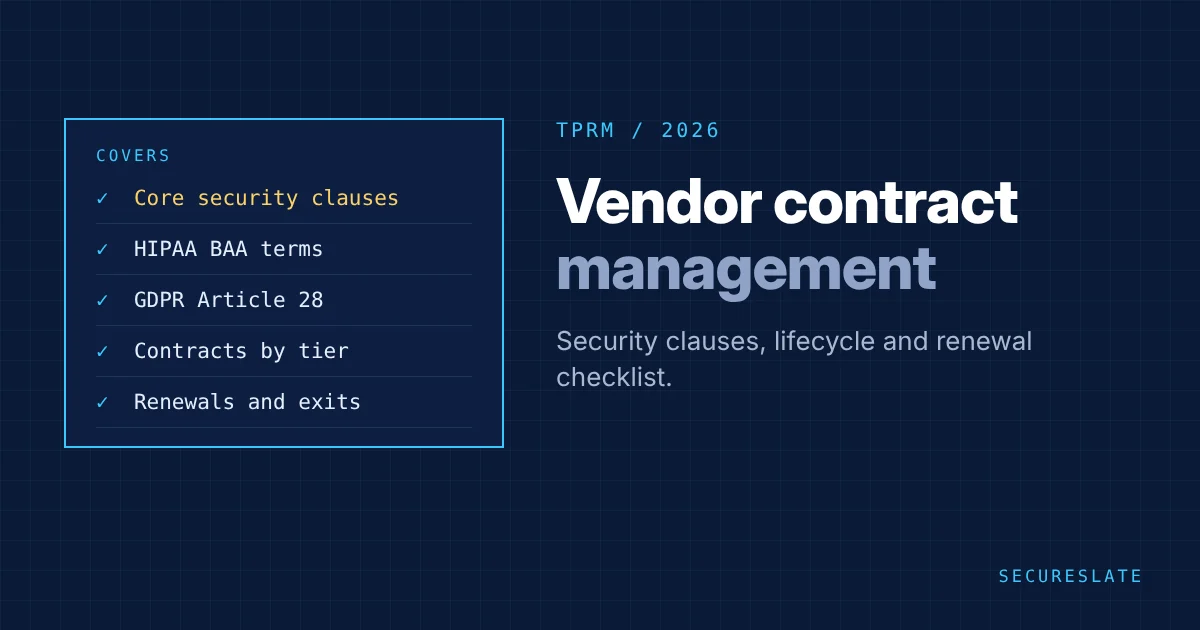
Short answer: Vendor contract management is the process of drafting, approving, tracking and renewing supplier agreements so that security, privacy and continuity obligations are written down and enforced. For compliance teams it means every vendor that touches sensitive data has the right clauses, such as a HIPAA business associate agreement or a GDPR data processing agreement, and that obligations are reviewed before renewal.
Related guides: AI clauses in customer contracts · Vendor due diligence · Vendor offboarding
Key takeaways
- A vendor contract is a security control. It is where you set breach notice, audit rights, subcontractor rules and data return.
- Some clauses are legally required: HIPAA business associate agreements and GDPR Article 28 processor terms have defined contents.
- Scale the contract to the vendor's risk tier. Low-risk tools rarely justify custom negotiation.
- Track renewal dates, notice periods and obligations in one register so nothing auto-renews unreviewed.
- Plan the exit at signing: data return or deletion, transition help and access removal.
What is vendor contract management?
Vendor contract management is the set of steps that turns a vendor decision into an enforceable agreement and keeps that agreement current for as long as the relationship lasts. Procurement and legal usually own the commercial side. Security and compliance teams own the parts that protect data: what the vendor must do, what it must tell you and what happens when the relationship ends.
Auditors look at this directly. In a SOC 2 examination, criterion CC9.2 in the Trust Services Criteria covers assessing and managing risks associated with vendors and business partners, and contracts are a common source of evidence. In ISO/IEC 27001:2022, Annex A control 5.20 requires relevant information security requirements to be established and agreed with each supplier.
What are the stages of the vendor contract lifecycle?
A vendor contract moves through six stages, from intake to exit, and security has a job at each one.
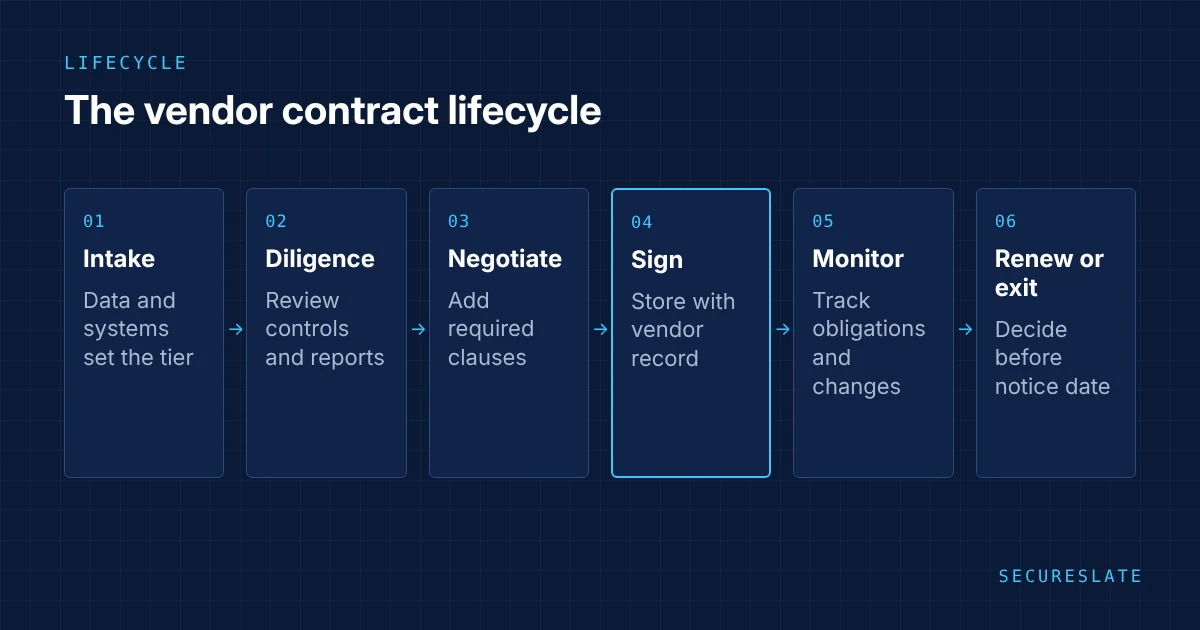
- Intake. The business requests a vendor and describes the data and systems involved. This decides the risk tier.
- Due diligence. Security reviews the vendor's controls, for example by reviewing its SOC 2 report or questionnaire answers. Findings feed the contract.
- Negotiation. Required clauses are added, and gaps found in due diligence become specific commitments or compensating controls.
- Signing and recording. The signed agreement, data processing terms and any business associate agreement are stored with the vendor record, together with key dates.
- Monitoring. Obligations are checked during the relationship: updated reports, subprocessor changes, incidents and service levels.
- Renewal or exit. Before the notice deadline, the owner decides to renew, renegotiate or exit, and exit steps such as data return are carried out.
Which security clauses belong in vendor contracts?
Most vendor contracts that involve sensitive data should cover the same core set of security clauses. The wording varies, but the intent is consistent.
| Clause | What it should say | Why it matters |
|---|---|---|
| Security obligations | Vendor maintains appropriate administrative, technical and physical safeguards, ideally tied to a named standard or report | Gives you a baseline to hold the vendor to |
| Breach notification | Vendor notifies you of security incidents affecting your data within a defined time, with details and cooperation | Your own notice clocks may depend on it |
| Subcontractors | Vendor discloses subprocessors, flows down equivalent obligations and gives notice of changes | Controls fourth-party exposure |
| Audit and assurance | Vendor provides current independent reports (such as SOC 2 or ISO 27001 certificates) and answers reasonable questionnaires | Lets you verify controls over time |
| Data location and use | Where data is stored and processed, and limits on use beyond providing the service | Supports privacy and customer commitments |
| Confidentiality | Vendor staff are bound by confidentiality | Basic protection for your information |
| Data return and deletion | Data returned in a usable format and deleted at the end, with confirmation | Prevents data being left behind |
| Business continuity | Recovery commitments and service levels that match your own commitments | Protects your availability promises |
| Liability and insurance | Liability caps and insurance that reflect the data at stake | Determines who bears the cost of an incident |
For AI vendors, add terms on whether your data is used to train models and how outputs are handled. Our guide to AI contract clauses covers the customer side of the same topic.
What do HIPAA and GDPR require in vendor contracts?
HIPAA and GDPR both prescribe minimum contract contents for vendors that handle regulated data, so these clauses are not optional when the law applies.
| Requirement | HIPAA business associate agreement | GDPR Article 28 processor terms |
|---|---|---|
| Legal source | 45 CFR 164.504(e) and 45 CFR 164.314(a) | GDPR Article 28(3) |
| Permitted use | Only uses and disclosures permitted by the agreement or required by law | Process only on the controller's documented instructions |
| Safeguards | Comply with the Security Rule for electronic PHI | Take the security measures required by Article 32 |
| Subcontractors | Ensure subcontractors agree to the same restrictions and conditions | Engage another processor only with the controller's authorization and the same obligations |
| Incident reporting | Report security incidents and breaches of unsecured PHI to the covered entity | Notify the controller without undue delay after becoming aware of a personal data breach (Article 33(2)) |
| Individual rights | Make PHI available for access and amendment as required | Assist the controller in responding to data subject requests |
| End of relationship | Return or destroy PHI at termination where feasible | Delete or return personal data at the end of services, at the controller's choice |
| Oversight | Make records available to HHS to determine compliance | Make information available and allow audits by the controller |
Under the HIPAA breach notification rule, a business associate must notify the covered entity without unreasonable delay and no later than 60 calendar days after discovering a breach of unsecured PHI (45 CFR 164.410). Many covered entities negotiate a shorter period. For more on vendor obligations in healthcare, see HIPAA third-party risk requirements.
How much contract does each vendor need?
The right amount of contract work depends on the vendor's risk tier. Negotiating every tool the same way wastes legal time and slows the business without reducing much risk.
| Vendor tier | Typical examples | Contract approach |
|---|---|---|
| Critical | Cloud hosting, EHR integration, payment processing, identity provider | Full security and privacy terms, BAA or DPA where required, exit assistance, recovery commitments |
| High | Tools that store customer data or PHI, such as support desks and analytics | Vendor DPA or BAA reviewed against your checklist, breach notice, subprocessor terms |
| Moderate | Internal tools with limited sensitive data | Standard terms reviewed for data use, deletion and breach notice |
| Low | Tools with no sensitive data | Click-through terms accepted, recorded in the inventory |
Large vendors often refuse custom terms. In that case, review their standard data processing terms against your checklist, record any gaps and decide whether to accept them, add compensating controls or choose another vendor.
How do you manage renewals, changes and exits?
Manage renewals and exits by tracking every contract date and obligation in one register and reviewing high-risk vendors well before notice periods close.
Renewal and change checklist
- Renewal date and notice period recorded for every contract
- Owner reminded far enough ahead to review before the notice deadline
- Latest independent report or certificate collected and reviewed
- Subprocessor changes since last review checked
- Incidents and service level misses during the term reviewed
- Changes in the data shared with the vendor reflected in its tier
- Contract updated if regulations or your customer commitments changed
How often to repeat the review depends on tier. Our guide on vendor reassessment frequency suggests schedules by risk level.
Exit checklist
- Data exported in a usable format and verified
- Deletion or return of data confirmed in writing
- Accounts, API keys and integrations removed
- Vendor record closed with exit evidence attached
Common vendor contract mistakes
- Signing before security review. Leverage is highest before signature. Afterwards, gaps are hard to close.
- Missing BAAs. Sharing PHI with a vendor that has not signed a business associate agreement is a common HIPAA problem.
- Auto-renewals nobody reviewed. Contracts roll over with outdated terms and unrecorded changes.
- Contracts stored outside the vendor record. Auditors ask for evidence by vendor, and scattered files slow every request.
- No exit plan. Without data return terms, leaving a vendor can mean losing data or leaving copies behind.
How SecureSlate helps
SecureSlate's vendor risk management module keeps each vendor's tier, due diligence, documents and review dates in one record, so contracts, BAAs and DPAs sit next to the assessments that justified them. Its security questionnaire automation and audit management features help you collect and present evidence, and built-in mappings for SOC 2, ISO 27001, HIPAA and GDPR link your vendor controls to the criteria auditors test. SecureSlate is not a contract drafting or legal service, so keep your counsel involved in contract terms.
FAQ
What is vendor contract management?
It is the process of creating, approving, storing, monitoring and renewing supplier agreements, including the security and privacy obligations those agreements contain.
Which clauses are most important in a vendor contract for security?
Security obligations, breach notification, subcontractor rules, audit and assurance rights, data use limits, and data return or deletion at the end of the relationship.
Is a business associate agreement required for every vendor?
No. Under HIPAA, a BAA is required when a vendor creates, receives, maintains or transmits PHI on behalf of a covered entity or another business associate. Vendors without access to PHI do not need one.
What must a GDPR data processing agreement include?
Article 28(3) lists the contents, including processing only on documented instructions, confidentiality, security measures, rules for sub-processors, assistance with data subject rights, deletion or return of data, and audit rights.
Who should own vendor contract management?
Procurement or legal usually owns the contract itself, while security and compliance own the security requirements, risk tiering and evidence. A named business owner for each vendor keeps renewals on track.
Disclaimer (legal note)
This article is for general information only and is not legal, regulatory, or professional advice. Requirements vary by framework, industry, and jurisdiction. Consult qualified advisors for your specific obligations.
Need compliance without the complexity?
SecureSlate automates ISO 27001, SOC 2, GDPR, HIPAA, and more. Built for growing teams. See it in action.
Find compliance gaps in 30 seconds